
Content
- India’s Resilient Production Systems in Agriculture
- One Station One Product: Bringing India’s Local Heritage to Railway Platforms
India’s Resilient Production Systems in Agriculture
Introduction
- India’s agriculture contributes ~18–20% of GVA, employs 46.1% workforce, and supports ~55% population, making it central to food security, livelihoods, and macroeconomic stability.
- Record production of 357.73 MMT foodgrains and 362.08 MT horticulture (2024–25) reflects structural transition towards diversified, high-value, and resilient agricultural systems.
- Agricultural growth averaged ~4.4% (last 5 years), driven by improved seeds, irrigation expansion, mechanisation, and policy-led resilience strategies integrating production with markets.
Relevance
GS Paper III (Economy / Agriculture / Environment)
- Agricultural productivity, diversification, and value addition
- Food security and nutritional security
- Climate-resilient agriculture and sustainability
- Agricultural marketing reforms, exports, and value chains
- Digital agriculture (AgriStack, e-NAM)
Practice Questions
Q1.“India’s agricultural resilience is increasingly shaped by diversification, technology, and institutional support rather than mere production expansion.”Critically examine.(250 Words)
Static Background
- Post-Green Revolution, India ensured cereal self-sufficiency, but current policy focus has shifted towards diversification, income enhancement, climate resilience, and global value chain integration.
- Structural features include 86% small and marginal farmers, ~45% rainfed area, and regional specialisation, influencing productivity, vulnerability, and targeted policy design.
Constitutional Dimensions
- Agriculture is a State subject (Entry 14), while Centre intervenes via Entry 33 (Concurrent List), MSP, trade regulation, and centrally sponsored schemes under cooperative federalism.
- National Food Security Act, 2013 ensures subsidised foodgrain to 81.35 crore beneficiaries, linking agricultural production systems with rights-based food security framework.
- Absence of statutory MSP creates policy uncertainty, while reform attempts highlight tensions between market liberalisation and federal autonomy in agricultural governance.
Governance Dimension
- Mission-mode interventions like NFSNM, NMEO, and Aatmanirbharta in Pulses (2025–31) aim at productivity enhancement, import substitution, and crop diversification.
- 25.55 crore Soil Health Cards issued covering 12 parameters, enabling scientific nutrient management, improved soil fertility, and balanced fertiliser usage.
- Irrigation coverage increased to 55.8% gross cropped area under PMKSY, promoting micro-irrigation, water-use efficiency, and climate resilience.
- Institutional credit reached ₹28.67 lakh crore (2024–25) with 7.72 crore KCC accounts, enhancing formal credit penetration and reducing dependence on moneylenders.
Economic Dimension
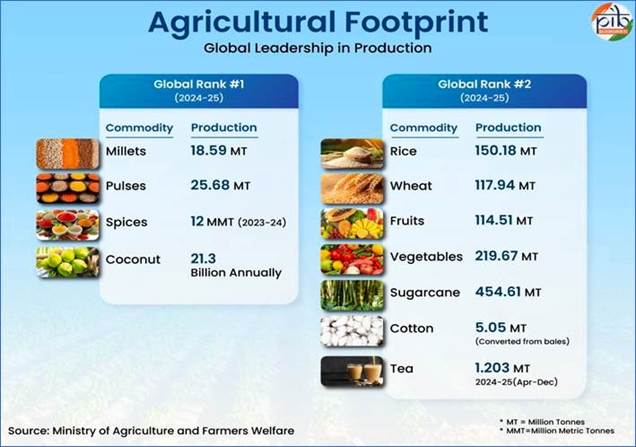
- India produced 150.18 MT rice and 117.94 MT wheat (2024–25), maintaining its position as second-largest global producer, ensuring food security and export strength.
- Pulses production reached 25.68 MT and millets 18.59 MT, reflecting emphasis on protein security, climate-resilient crops, and import substitution strategies.
- Horticulture output rose to 362 MT, surpassing foodgrain production, indicating structural shift towards high-value crops, diversification, and income-enhancing agriculture.
- Agricultural exports increased from $34.5 billion (FY20) to $51.1 billion (FY25) with 8.2% CAGR, reflecting improved global competitiveness and export diversification.
- Processed food share rose from 14.9% (FY18) to 20.4% (FY25), indicating gradual transition from raw commodity exports to value-added agri-products.
Social Dimension
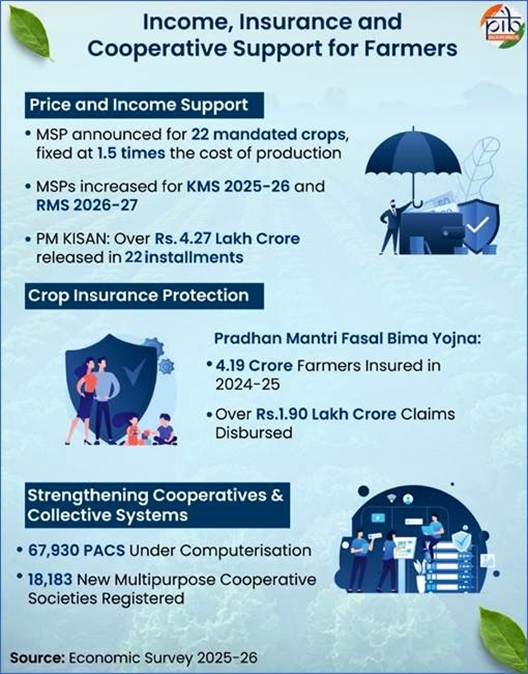
- PM-KISAN disbursed ₹4.27 lakh crore in 22 instalments, providing ₹6,000 annual income support, stabilising rural consumption and reducing distress.
- MSP (≥1.5× cost) ensures price assurance for 22 crops, but cereal bias raises concerns about crop diversification and long-term sustainability.
- PMFBY insured 4.19 crore farmers covering 6.2 crore hectares, with claims exceeding ₹1.90 lakh crore, strengthening climate risk mitigation.
- ONORC achieved 99.8% Aadhaar seeding, covering 81.35 crore beneficiaries, enhancing portability, inclusion, and leak-proof food distribution.
Environmental Dimensions
- Natural farming expanded to 6.39 lakh hectares with 15.79 lakh farmers, reducing chemical inputs and promoting sustainable, low-cost agriculture practices.
- Millets (Shree Anna) promoted as climate-resilient crops due to low water requirement, supporting nutrition security and climate adaptation goals.
- Ethanol blending programme saved ₹1.44 lakh crore forex, linking agriculture with energy security and diversified farmer income streams.
- e-NAM platform integrates 1.8 crore farmers and 1,656 mandis, enabling transparent price discovery, inter-state trade, and digital agriculture ecosystem.
Market And Value Chain Dimension
- 49,796 storage projects and 25,009 marketing infrastructure projects received subsidies exceeding ₹7,000 crore, strengthening post-harvest management and reducing wastage.
- 10,000 FPOs registered (2026) improve collective bargaining, scale economies, and market access, especially for small and marginal farmers.
- Food processing contributes 12.91% of organised manufacturing employment, with PMKSY and PLISFI boosting infrastructure, investments, and export competitiveness.
- PMFME scheme supported 4.04 lakh applications, promoting micro-enterprises, women SHGs, and decentralised value addition in rural areas.
Global And Strategic Dimension
- India ranks 1st in pulses, millets, spices and 2nd in rice, wheat, fruits, vegetables, strengthening its role as a global food security anchor.
- Rice exports reached $12.95 billion, highlighting dominance in global cereal markets, while diversification into processed food enhances export resilience and stability.
- India’s agricultural system supports South-South cooperation, contributing to global food supply stability and climate-resilient crop promotion (millets).
Challenges And Gaps
- 86% small landholdings limit mechanisation, productivity gains, and economies of scale, constraining income growth despite policy support and technological interventions.
- Regional imbalance persists with Green Revolution states dominating cereals, while rainfed regions lag in productivity, infrastructure, and income levels.
- Environmental stress includes groundwater depletion, soil degradation, and N:P:K imbalance, threatening long-term sustainability of intensive agriculture.
- Market inefficiencies in APMC system, price volatility in perishables, and low processing share (~20%) limit farmer income realisation and export potential.
- Governance issues include scheme fragmentation, weak extension services, and last-mile delivery gaps, particularly affecting small and marginal farmers.
Way Forward
- Reorient MSP towards pulses, oilseeds, millets to promote diversification, reduce import dependence, and ensure sustainable cropping aligned with agro-climatic conditions.
- Scale climate-smart agriculture through micro-irrigation, agroforestry, and weather-based advisories integrating traditional knowledge with modern technology.
- Strengthen FPOs with credit, capacity building, and market linkages to transform smallholders into competitive market participants.
- Expand cold chains, logistics, and agro-processing clusters to reduce post-harvest losses and increase farmer share in consumer prices.
- Promote digital agriculture (AgriStack, AI advisories, precision farming) to enhance productivity, reduce input costs, and improve decision-making efficiency.
Prelims Pointers
- Foodgrain production (2024–25): 357.73 MMT; Horticulture: 362 MT
- PMFBY launched: 2016; MSP covers 22 crops
- NFSA beneficiaries: 81.35 crore
- e-NAM mandis: 1,656
- India largest producer: pulses, millets, spices
One Station One Product: Bringing India’s Local Heritage to Railway Platforms
Introduction
- One Station One Product (OSOP) launched in Union Budget 2022–23 aims to promote indigenous products, local artisans, and regional identity through dedicated retail outlets at railway stations.
- As of January 2026, OSOP covers 2,000+ railway stations with 2,326 outlets, benefiting over 1.32 lakh individuals, demonstrating integration of public infrastructure with livelihood generation.
- Concept aligns with “Vocal for Local”, transforming railway stations into marketplaces for local goods, bridging gaps between production centres and consumer markets.
Relevance
GS II (Governance / Polity)
- Innovative governance using public infrastructure
- Cooperative federalism (Railways–States–SHGs coordination)
- Directive Principles (Article 43 – promotion of cottage industries)
GS Paper III (Economy / MSME / Inclusive Growth)
- MSME development and rural non-farm employment
- Market access, value chains, and local product promotion
- Infrastructure-led economic development
- Local-to-global economic strategy
Practice Question
Q1.“One Station One Product (OSOP) reflects a paradigm shift in using infrastructure for inclusive economic development.” Discuss.(250 Words)
Static Background
- Inspired by “One Village One Product (OVOP)” (Japan), focusing on local specialisation, branding, and decentralised economic development models.
- India adapted the model to the railway ecosystem, leveraging Indian Railways’ ~8 billion annual passengers (pre-COVID) to ensure mass-scale market access for local products.
Constitutional And Legal Dimension
- Linked to Directive Principles (Article 43) promoting cottage industries and rural livelihoods through decentralised and community-based production systems.
- Supports Article 19(1)(g) by enabling artisans, SHGs, and MSMEs to access formal markets, economic opportunities, and entrepreneurial activities.
- Operates under an executive policy framework, implemented by Indian Railways in coordination with states, MSMEs, and SHGs, reflecting cooperative federalism.
Governance And Administrative Dimension
- Launched on 25 March 2022, initially piloted across 19 stations for 15 days, and later scaled nationwide through structured and phased implementation.
- OSOP stalls are allotted on a rotational basis at nominal fees, ensuring inclusive participation and equitable access for artisans, SHGs, and MSMEs.
- Implementation involves Railway divisions, State agencies, SHGs, and MSMEs, ensuring institutional convergence, coordination, and operational efficiency.
Economic Dimension
- Provides direct market access to local producers, reducing middlemen dependence, improving price realisation, income stability, and profitability.
- Enhances rural non-farm employment by promoting handicrafts, handlooms, agro-products, and processed goods at high-footfall railway stations.
- Supports MSME sector, contributing ~30% of GDP and ~45% of exports, strengthening grassroots entrepreneurship and economic diversification.
- Converts railway stations into commercial hubs, improving economic utilisation of public infrastructure and stimulating local economic ecosystems.
Social And Ethical Dimension
- Prioritises women-led SHGs, artisans, weavers, and farmers, promoting inclusive growth, gender empowerment, and social equity in rural and semi-urban regions.
- Benefits over 1.32 lakh individuals, enhancing income security, dignity of labour, and community-level socio-economic empowerment.
- Encourages preservation of traditional crafts (Madhubani, Sanganeri prints, cane work), safeguarding intangible cultural heritage and local knowledge systems.
- Enhances consumer awareness, enabling travellers to engage with authentic local products, traditions, and cultural narratives.
Environmental And Sustainability Dimension
- Promotes local production and consumption, reducing carbon footprint associated with long-distance logistics and supply chains.
- Encourages eco-friendly products such as handlooms, natural dyes, and handicrafts, which have lower environmental impact compared to industrial goods.
- Supports sustainable livelihoods, reducing pressure on agriculture and enabling diversification into non-farm and low-carbon economic activities.
Market And Value Chain Dimension
- Integrates local producers into national market networks, improving visibility, branding, demand generation, and price discovery for regional products.
- Acts as a last-mile market linkage, complementing initiatives like e-NAM, ODOP, and PMFME in strengthening agricultural and rural value chains.
- Rotational stall allocation ensures product diversity, inclusivity, and wider participation, preventing monopolisation and ensuring equitable access.
- Enhances tourism-linked consumption, where passengers act as buyers of regional crafts and souvenirs, boosting local economies.
Cultural And Heritage Dimension
- Showcases region-specific products such as Madhubani paintings (Bihar), Sanganeri textiles (Rajasthan), cane products (Tamil Nadu), reflecting India’s diversity.
- Transforms railway stations into cultural spaces, where commerce intersects with heritage, identity, and storytelling traditions.
- Strengthens domestic cultural diplomacy, promoting awareness of India’s diverse traditions, crafts, and regional identities among citizens and tourists.
Challenges And Gaps
- Limited branding, packaging, and standardisation affects competitiveness against organised retail and e-commerce platforms.
- Inconsistent quality control across stations can reduce consumer trust, repeat demand, and brand reliability.
- Dependence on footfall-based physical sales limits scalability compared to digital and online marketplaces.
- Institutional coordination challenges between Railways, states, and SHGs may affect implementation efficiency and uniformity.
- Lack of digital integration and online sales channels restricts long-term market expansion and sustained income growth.
Way Forward
- Integrate OSOP with digital platforms (e-commerce, ONDC) to expand market access, scalability, and national/global outreach.
- Develop standardised branding, packaging, and GI tagging to enhance product quality, recognition, and export competitiveness.
- Provide capacity building and skill development for artisans in design, marketing, and quality assurance systems.
- Converge with schemes like ODOP, PMFME, and National Handicrafts Mission for holistic value chain development and synergy.
- Introduce QR-based traceability and digital payments, improving transparency, consumer confidence, and digital inclusion.
Prelims Pointers
- OSOP launched: 2022 (Union Budget)
- Coverage: 2,000+ stations; 2,326 outlets
- Beneficiaries: 1.32 lakh individuals
- Inspired by: OVOP (Japan)
- Focus: local products, SHGs, MSMEs


