
Contents
The Defence Decade: India’s Enhanced Capability, Capacity and Credibility (2014–2026)
- A government review documents 12 years (2014–2026) of India’s defence transformation across four pillars: Capability (R&D, innovation), Capacity (production, exports, corridors), Operational Excellence (indigenous platforms and milestones), and Credibility (defence diplomacy and multilateral engagement).
- The central shift is from historical import dependence (65–70% of equipment procured abroad) to strategic self-reliance anchored in Atmanirbhar Bharat and Make in India, with a target of ₹50,000 crore in defence exports by 2029.
- Key policy instruments — Defence Acquisition Procedure (DAP) 2020, Positive Indigenisation Lists (2020), iDEX, and the DcPP model — form the structural backbone of this transformation.
- Historical import dependence: India was among the world’s largest arms importers, with 65–70% of equipment procured from Russia, France, USA and Israel — creating strategic vulnerabilities, technology gaps and high lifecycle costs.
- Constitutional basis: Defence is a Union subject (Schedule VII, List I, Entry 1); all procurement is controlled by MoD through the Defence Acquisition Council (DAC) — the apex body chaired by the Raksha Mantri.
- Policy evolution: Defence Procurement Procedure (DPP) evolved from 2002 → 2006 → 2013 → 2016 before DAP 2020 replaced it — introducing Buy Indian-IDDM (Indigenously Designed, Developed and Manufactured) as the highest procurement preference for the first time.
- Positive Indigenisation Lists (PIL): Issued by MoD since 2020 to progressively ban imports of listed defence items, directing procurement to domestic sources. Over 500 items placed under successive lists.
- Key institutions: DRDO (Defence Research and Development Organisation, est. 1958) is the apex R&D body, rationalised to 36 active labs. The ecosystem comprises 16 DPSUs (HAL, BEL, MDL, BDL, BEML, GRSE etc.), ~500 licensed private companies and ~17,000 MSMEs.
- Defence budget grew from ₹2.53 lakh crore (FY14) to ₹7.85 lakh crore (FY27). Capital expenditure — the long-term investment portion for weapons and platforms — rose from ₹94,587 crore (FY15) to ₹2.19 lakh crore (FY27).
- R&D allocation rose 112% from ₹13,716 crore (FY15) to ₹29,100 crore (FY27). In FY 2022–23, 25% of the defence R&D budget was opened to industry, startups and academia, ending the near-monopoly of government labs.
- iDEX (Innovations for Defence Excellence): Connects startups, MSMEs, individual innovators and academia to defence procurement needs. Budget: ₹498.78 crore (2021–26). By March 2026: 676 innovators engaged; 551 D&D contracts signed. Implemented through DIO (Defence Innovation Organisation). Sub-scheme ADITI (Acing Development of Innovative Technologies with iDEX) carries ₹750 crore (2023–26) for critical and emerging technologies.
- DcPP (Development-cum-Production Partner) Model: DRDO identifies and transfers technology to capable industry partners through a competitive process. By March 2026: 134 companies enrolled; 2,180 technology transfers; 2,780+ IPRs licensed to Indian industry. Supported by a network of 2,200+ capable companies.
- TDF (Technology Development Fund): MoD initiative executed by DRDO; provides grants up to ₹50 crore per project to support critical defence innovation. As of June 2026: 80 projects worth ₹334 crore under implementation; additional corpus of ₹500 crore sanctioned for deep-tech focus.
- DIA-CoEs (DRDO Industry-Academia Centres of Excellence): 15 centres, 82 research verticals, 281 projects worth ₹967 crore across 52 institutions, enabling translational defence research.
- Human capital: Five Young Scientists Laboratories (DYSLs) established January 2020; 6th scheduled 2026. New scientists undergo a two-year M.Tech in defence technology at DIAT (Defence Institute of Advanced Technology, Pune). Over 3,500 engineers and technicians join DRDO as paid apprentices annually.
- Indigenous production: ₹43,746 crore (FY14) → ₹1.78 lakh crore (FY26) — a 110% increase since FY21 alone (when it stood at ₹84,643 crore). Production structure: DPSUs 76%; private sector 24% (~₹42,000 crore — private sector’s all-time high, up from 22% in FY25).
- Defence exports: ₹686 crore (FY14) → ₹38,424 crore (FY26) — a 5,500%+ surge over 12 years; 145 exporter firms now reach 80+ countries. Export target: ₹50,000 crore by 2029.
- Export portfolio: Includes BrahMos supersonic cruise missiles, Pinaka MBRLS, Akash SAM systems, ALH Dhruv, patrol vessels, bulletproof equipment, electronics, aero-components and sub-systems. Key buyers: Armenia (Akash, Pinaka, ATAGS howitzers), Philippines (BrahMos), USA (components and sub-systems).
- Industrial licences more than tripled: 258 (2015) → 834 (March 2026), reflecting widened private sector entry and improved ease of doing business.
- Defence procurement contracts: 193 contracts worth ₹2,09,050 crore signed in FY 2024–25; ₹1.82 lakh crore in FY 2025–26 (concluded so far). DAC accorded AoN worth over ₹6 lakh crore for DRDO-designed, Indian industry-manufactured systems including 97 Tejas Mk-1A and 156 LCH Prachand.
- UP Defence Industrial Corridor: Commitments — ₹42,057 crore; grounded (actual) investment — ₹4,409 crore; includes DTTC (Defence Technology & Test Centre) for testing and innovation.
- Tamil Nadu Defence Industrial Corridor: Investments committed — ₹32,699 crore; actual investment — ₹6,446 crore. Both corridors are building regional defence supply chains and generating employment.
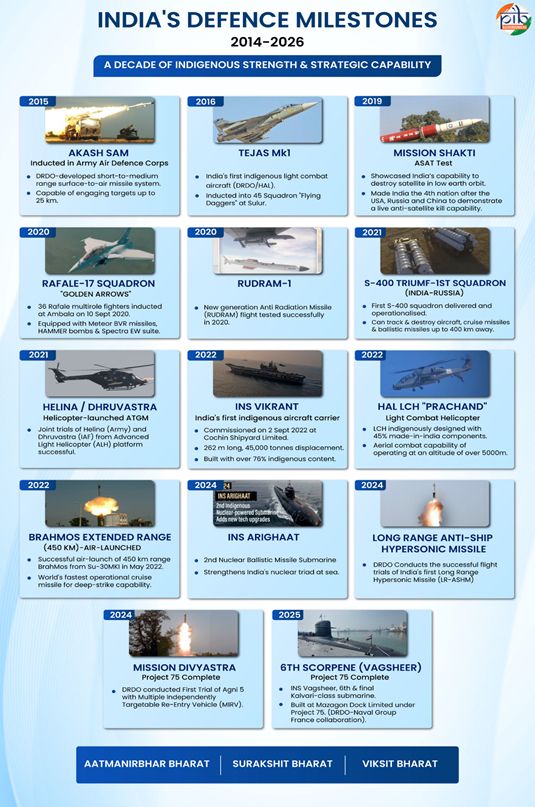
- Air power: Tejas Mk-1 received Final Operational Clearance (FOC) in February 2019; DAC accorded AoN for 97 Tejas Mk-1A worth ₹62,000 crore; 83 Mk-1A approved for IAF induction. 156 LCH Prachand light combat helicopters (~₹62,700 crore) approved.
- Army: Arjun Mk-IA battle tank inducted February 2021. 26 Rafale-Marine aircraft for the Navy approved by DAC in 2023.
- Navy: All 6 Kalvari-class Scorpène submarines delivered under Project 75; built by Mazagon Dock Shipbuilders Ltd (MDL), Mumbai with French collaboration; 6th commissioned January 2025.
- Space and strategic missiles: Mission Shakti (27 March 2019) — India demonstrated ASAT (Anti-Satellite) capability, joining a select group of nations. Mission Divyastra (11 March 2024) — first successful test of Agni-5 with MIRV (Multiple Independently Targetable Re-entry Vehicle) capability — a major deterrence milestone.
- Hypersonics: Ground test of actively cooled scramjet full-scale combustor for 12 minutes (9 January 2026, SCPT facility) — milestone in hypersonic missile development. A Hypersonic Wind Tunnel established at Hyderabad.
- AI integration (2022): 75 AI-based technologies introduced for surveillance, cybersecurity, logistics, autonomous systems and battlefield support.
- Operation Sindoor: Indigenous Akash air defence missiles, BrahMos, anti-drone systems and airborne surveillance deployed — providing real battlefield validation of Atmanirbhar Bharat systems. Advanced combined air defence system (missile interceptors + SHORAD + laser) tested 23 August 2025.
- Agnipath Scheme (launched 15 June 2022): 4-year short-service recruitment of Agniveers across all three services; aims at a younger, technology-oriented force. Provides M.Tech pathways (IGNOU/NIOS), skill certificates and post-service career pathways.
- India–USA: Three foundational agreements — LEMOA (logistics, 2016) → COMCASA (communications security, 2018) → BECA (geospatial intelligence, 2020); Major Defence Partner and STA-1 status. iCET (2023) → TRUST (2025) for AI, semiconductors, space. 10-year defence framework signed October 2025 at Kuala Lumpur.
- India–Russia: Anchored in IRIGC-M&MTC (21st session: Dec 2024; 22nd: Dec 2025); S-400 cooperation, Su-30MKI upgrades; Exercise Indra (flagship tri-services). Focus shifting to co-production under Atmanirbhar Bharat while maintaining strategic autonomy.
- India–EU: Security and Defence Partnership signed 27 January 2026 (HR/VP Kallas and EAM Jaishankar) — covers maritime security, cyber-defence, counter-terrorism and space; establishes the India–EU Defence Industry Forum.
- India–France: Rafale deal (2016); Horizon 2047 Defence Industrial Roadmap; Dassault–TATA fuselage JV; Safran–HAL engine partnership. India–Japan: ACSA (2020); Exercise JIMEX (latest: Yokosuka 2025). India–UAE: Letter of Intent for Strategic Defence Partnership (January 2026). India–Australia: Comprehensive Strategic Partnership (2020); inaugural Defence Ministers’ Dialogue (Canberra, October 2025).
- SCO (India joined 2017): Champions counter-terrorism and WMD prevention with a strategically autonomous posture; asserts positions at variance with Pakistan. QUAD (revived 2017; Leaders’ Summit 2021): Australia rejoined Exercise Malabar (2020); 2025 Quad-at-Sea Mission — first combined Coast Guard exercise of all four partners.
- ADMM-Plus (Kuala Lumpur, November 2025): India reaffirmed freedom of navigation in the Indo-Pacific; deepened ties with Vietnam, Philippines and Indonesia through vessel gifting and BrahMos cooperation under Act East Policy.
- SAGAR (Security and Growth for All in the Region, 2015) and MAHASAGAR doctrine (March 2025): India as net security provider in the Indian Ocean Region (IOR), anchoring its Indo-Pacific credibility.
- The 5,500%+ export growth in 12 years is quantitatively unprecedented; equally significant is the widening of the exporter base to 145 companies, reducing concentration risk and deepening ecosystem resilience.
- The multi-tier manufacturing ecosystem — 16 DPSUs + 500 licensed companies + 17,000 MSMEs — creates supply-chain depth and resilience absent a decade ago.
- iDEX and TDF operationalise the innovation-to-procurement pipeline, addressing the “valley of death” between R&D output and defence induction. The 551 contracts signed signal genuine early-stage technology absorption from startups.
- Foundational agreements (LEMOA, COMCASA, BECA, iCET/TRUST, EU Defence Partnership) provide the diplomatic-legal infrastructure for technology access in AI, semiconductors, geospatial intelligence — previously unavailable.
- Operation Sindoor delivered real battlefield validation of indigenous systems (Akash, BrahMos, anti-drone), transitioning self-reliance from policy aspiration to operational proof-of-concept.
- India’s strategic autonomy — maintained while simultaneously deepening partnerships with USA, Russia, France, EU and Japan — represents sophisticated multi-directional diplomatic balancing.
- Private sector share at 24% remains low compared to defence manufacturing leaders such as the USA, Israel and France where private innovation drives the frontier. The 76% DPSU dominance raises concerns about agility, cost efficiency and technology leadership.
- The importer–exporter paradox: India remains one of the world’s 2nd largest arms importers even as exports cross ₹38,000 crore. The bulk of exports are components, sub-systems and mid-tech platforms — not high-end strategic systems. True self-reliance remains incomplete.
- Export scale in global context: At ~$4.6 billion, India’s exports are a fraction of the USA (~$240 billion), Russia or France. The ₹50,000 crore (~$6 billion) target by 2029 will still leave India in the global second tier of exporters.
- Corridor commitment gap: UP Corridor — ₹42,057 crore committed but only ₹4,409 crore grounded (actual investment). The gap between investment announcements and operational production capacity is a structural weakness.
- Technology depth remains limited: India’s export basket does not yet include advanced jet engines, nuclear submarine propulsion, 5th-generation aircraft or advanced satellite systems — domains that remain import-dependent or under protracted domestic development.
- Agnipath Scheme faces political and societal concerns; the 4-year tenure with limited retention raises structural questions about institutional military memory, regimental cohesion, and long-term operational readiness.
- Raise private sector share beyond 24% through dedicated procurement quotas in frontier technology segments, clearer IP ownership norms and faster testing access via the Defence Testing Portal.
- Close the corridor investment gap — convert committed capital into actual production through time-bound performance milestones, single-window clearances and enforceable investment pledges.
- Upgrade the export profile from components and mid-tech to complete strategic platform exports; leverage Act East and QUAD partnerships as primary markets for Akash, Pralay and next-generation systems.
- Deepen iCET/TRUST and the EU Defence Partnership to secure genuine technology transfers in advanced propulsion, hypersonics and quantum — not merely co-production of existing platforms.
- Invest in strategic technology gaps — own jet engine, AESA radar, submarine propulsion and space-based ISR — where import dependence persists and makes self-reliance structurally incomplete.
- Publish outcome-based metrics beyond production figures: DRDO schedule performance, export destination sustainability, lifecycle costs of inducted platforms and combat readiness rates.
Q1. Consider the following statements about India’s defence innovation ecosystem: (1) The ADITI scheme under iDEX carries an outlay of ₹750 crore for critical technology development. (2) The Technology Development Fund (TDF) provides grants of up to ₹100 crore per project. (3) 25% of India’s defence R&D budget was opened to industry, startups and academia in FY 2022–23. Which of the above are correct?
A) 1 and 3 only B) 2 and 3 only C) 1 and 2 only D) 1, 2 and 3Q2. Match List I (India-USA Defence Frameworks) with List II (Year of conclusion): A. LEMOA · B. BECA · C. COMCASA · D. iCET // 1. 2023 · 2. 2018 · 3. 2016 · 4. 2020. Choose the correct match:
A) A-3, B-4, C-2, D-1 B) A-4, B-3, C-2, D-1 C) A-3, B-2, C-4, D-1 D) A-2, B-4, C-3, D-1Q3. (Assertion–Reasoning) Assertion (A): India continues to import significant quantities of defence equipment even as its defence exports have crossed ₹38,000 crore. Reason (R): India’s domestic production still relies on foreign platforms for high-end technologies such as advanced jet engines, nuclear submarine propulsion and 5th-generation aircraft systems.
A) Both A and R are true, and R is the correct explanation of A B) Both A and R are true, but R is NOT the correct explanation of A C) A is true, R is false D) A is false, R is true

