The Hindu — UPSC Analysis
Thursday, 19 November 2026
International Edition · Vol. 4, No. 273 · Curated for Prelims & Mains | GS I · II · III · IV
📋 Today's Topics
- COVID-19 lessons for tackling air pollutionGS3 · GS2
- U.S.-China-Russia summit at APEC, ShenzhenGS2
- India-Canada: defence pact and CEPA on the cardsGS2
- EPFO: higher pensions and the Reliance Capital defaultGS3 · GS2
- The need to expand Jan AushadhiGS2
- Food inflation, the thali index and the crude import billGS3
- Climate finance: from promises to praxisGS3
- Turning police reform into practiceGS2 · GS3
- Environmental clearance gap for educational campusesGS3 · GS2
- Cyclone Akvan: forecasting an erratic stormGS1 · GS3
- Asian elephants' social fabric at a 'tipping point'GS3
- Rosalind Franklin and the story of Photograph 51GS3 · GS4
- Quick Prelims Revision (MCQ Bank)Prelims
- FAQsRevision
COVID-19 lessons for tackling air pollution
Context
In an op-ed, Dr. Soumya Swaminathan and Dr. Chandrakant Lahariya argue that air pollution, like COVID-19, enters through the air and harms many organs. They say it should get the same coordinated national response the pandemic did, instead of being treated as a seasonal problem.
Background & Key Facts
- Burden: The State of Global Air 2025 report attributed more than two million deaths in India in 2023 to air pollution.
- Funding mismatch: CREA found ₹13,415 crore released under NCAP and related Finance Commission grants, about 74% of it used. Of the spending, 68% went to road dust, while industry and household fuel each got less than 1%.
- Standards: India's annual PM2.5 standard of 40 µg/m³ is eight times the WHO guideline of 5 µg/m³.
- Economic cost: A Lancet Planetary Health study estimated losses of 1.36% of GDP in 2019.
- Equity: Exposure is involuntary and falls hardest on poorer households, outdoor workers and children.
Critical Analysis
Wrong pollutant targeted: Road-dust control mainly reduces PM10, while PM2.5 from burning fuel and from industry does more damage to health.
Emergency vs prevention: Like COVID-19 lockdowns, GRAP only buys time. It cannot replace cutting emissions all year round.
Burden on citizens: The authors warn that a focus on masks, air purifiers and hybrid schooling shifts responsibility from governments to individuals.
Way Forward
- Run NCAP in mission mode, with outcome indicators and funding tied to health risk.
- Build a national surveillance platform that links AQI with hospital and death data.
- Set a phased roadmap towards tighter PM2.5 standards.
Exam Relevance
"Air pollution continues to be treated as a seasonal inconvenience rather than a year-round public health crisis." What lessons can India draw from its COVID-19 response? (GS3, 15 marks, 250 words)
The WHO's guideline value for annual average PM2.5 concentration is:
(a) 40 µg/m³ (b) 5 µg/m³ (c) 15 µg/m³ (d) 60 µg/m³
U.S.-China-Russia summit at APEC, Shenzhen
Context
Chinese President Xi Jinping welcomed U.S. President Donald Trump at Shenzhen airport ahead of a rare three-way summit with Russian President Vladimir Putin, held alongside the APEC gathering. The editorial "Many imperatives" says New Delhi must watch the outcomes closely.
Background & Key Facts
- Agenda: U.S. officials said likely topics were the war in Ukraine, Iran, global energy stability and nuclear arms control.
- Expectations: Officials called the meeting exploratory and symbolic, and played down chances of substantive outcomes.
- Xi's pitch: At the APEC CEO Summit, Xi argued for openness and stable supply chains, and proposed a World Bay Area Economic Cooperation Alliance.
- China-Russia: Xi called the relationship a "source of stability" in a turbulent world.
- U.S.-China trade: The two sides have only extended their trade truce until January. Disputes over semiconductors and rare earths are unresolved.
Critical Analysis
Symbolism for Beijing: Hosting the summit lets China present itself as the centre of "major country diplomacy".
Implications for India: A U.S.-China-Russia understanding could change the strategic context of the Quad and of India's own ties with Russia.
Limited deliverables: Deep differences over Ukraine, West Asia and nuclear disarmament make a breakthrough unlikely.
Way Forward (for India)
- Keep strategic autonomy through multi-alignment.
- Deepen Indo-Pacific partnerships regardless of how great-power ties shift.
- Watch closely for any trade or technology deals that affect India.
Exam Relevance
How might closer engagement among the U.S., China and Russia affect India's strategic autonomy? (GS2, 10 marks, 150 words)
Consider the following statements about APEC: 1. India is a member. 2. Russia and China are members. Which is/are correct?
(a) 1 only (b) Both 1 and 2 (c) 2 only (d) Neither
India-Canada: defence pact and CEPA on the cards
Context
India's High Commissioner to Ottawa, Dinesh K. Patnaik, said India and Canada could announce a defence agreement during PM Modi's visit on December 11-12. He also said they are "on the cusp" of finalising a Comprehensive Economic Partnership Agreement (CEPA).
Background & Key Facts
- Breakdown: Ties collapsed after the June 2023 killing of Hardeep Singh Nijjar and then PM Justin Trudeau's allegations against India. Both countries expelled each other's High Commissioners.
- Reset: Normalisation began with both sides reinstating High Commissioners. Mr. Patnaik took charge in September 2025.
- Areas of cooperation: Defence, space, nuclear energy, deep tech, trade and the movement of people.
- His view: The two countries' core strategic interests do not conflict, and the rupture came from a "fringe diaspora issue" and a lack of trust.
Critical Analysis
Rebuilding trust: Repeated meetings between ministers, NSAs and agencies helped repair the relationship.
Economic complementarity: Canada's critical minerals, uranium and pension funds suit India's growth needs.
Residual risk: Separatist activity in the diaspora and Canadian domestic politics could still strain ties.
Way Forward
- Conclude CEPA and the defence pact.
- Set up law-enforcement dialogue mechanisms on extremism.
- Expand student and professional mobility frameworks.
Exam Relevance
"Diaspora politics can both strengthen and strain bilateral relations." Examine with reference to India-Canada ties. (GS2, 10 marks, 150 words)
The India-Canada trade agreement under negotiation is called a:
(a) Comprehensive Economic Partnership Agreement (b) Bilateral Investment Treaty (c) Preferential Trade Agreement (d) Customs Union
EPFO: higher pensions and the Reliance Capital default
Context
Ahead of its Central Board of Trustees (CBT) meeting, the EPFO told trustees two things. Paying higher pensions under the Supreme Court's ruling may cost about ₹1.1 lakh crore. And it has no remaining legal way to recover about ₹1,800 crore from Reliance Capital Ltd. (RCL).
Background & Key Facts
- Higher pension: The EPFO received 17.49 lakh applications and considered 15.24 lakh. It issued 4,45,471 demand letters, and pension payment orders have gone to about 1.52 lakh people.
- Liability: The estimated average is about ₹24.9 lakh per person.
- RCL: The EPFO invested ₹2,500 crore of workers' money in RCL in 2013-14, and only about 59.7% of the principal has been received.
- Legal opinion: Supreme Court rulings and the NCLT-approved resolution plan rule out further recovery.
- Probes: The CBI has registered a case, and the EPFO has asked the Ministry of Corporate Affairs to refer the matter to the SFIO. Anil Ambani's spokesperson has denied any wrongdoing.
Critical Analysis
Fiscal sustainability: The extra pension liability tests the health of the Employees' Pension Scheme.
Investment governance: The RCL loss raises questions about how the EPFO assesses credit risk on workers' savings.
Limits of IBC: Once a resolution plan is approved, creditors are bound by it, even public funds.
Way Forward
- Tighten investment guidelines and independent risk audits.
- Speed up pension orders and the payment of arrears.
- Make portfolio managers' performance reviews public.
Exam Relevance
Discuss the governance challenges in managing India's retirement funds, with reference to the EPFO. (GS3, 10 marks, 150 words)
The Serious Fraud Investigation Office (SFIO) works under which Ministry?
(a) Finance (b) Home Affairs (c) Labour and Employment (d) Corporate Affairs
The need to expand Jan Aushadhi
Context
A Text & Context piece argues that the Pradhan Mantri Bhartiya Janaushadhi Pariyojana (PMBJP) cuts medicine bills sharply, but has not reached as many people as a country of India's size needs.
Background & Key Facts
- Scheme: It was launched in 2008, revamped in 2015, and is run by the Pharmaceuticals and Medical Devices Bureau of India.
- Basket: 2,110 medicines and 315 surgical items.
- Outlets: 20,547 by July 2026, against a target of 25,000 by March 2027. This is small next to the roughly 12 lakh chemists in India.
- Savings: The government estimates savings of about ₹9,000 crore in 2025-26, implying an average discount of about 80%.
- Quality: The government reports a substandard rate of 0.34%, against 3.70% in the open market.
Critical Analysis
Awareness gap: In a small Port Blair study, only a third of outpatients had heard of the scheme.
Prescriptions: The NMC's generic-prescription order was put on hold after doctors' bodies objected, citing autonomy and quality.
Stock-outs: Irregular availability erodes trust in the outlets.
Way Forward
- Promote Kendras as shops for everyone, not only for the poor.
- Publish testing methods and results transparently.
- Run a national survey on awareness and availability.
Exam Relevance
What are the constraints limiting the reach of Jan Aushadhi Kendras? Suggest measures to scale up the scheme. (GS2, 10 marks, 150 words)
The Pradhan Mantri Bhartiya Janaushadhi Pariyojana is implemented by:
(a) National Health Authority (b) CDSCO (c) Pharmaceuticals and Medical Devices Bureau of India (d) NPPA
Food inflation, the thali index and the crude import bill
Context
A Data Point finds that a home-cooked vegetarian thali costs 16% more than in March 2026, with food inflation at its highest in the new series. Separately, India's October crude import bill rose 87.5% to $19.5 billion.
Background & Key Facts
- Food prices: Food inflation reached 8.9% in October. Onion prices more than doubled since March.
- Household cost: Two thalis a day for a month now cost more than ₹2,500, up 14% from a year ago and 35% from five years ago.
- Wages: CMIE puts average wages at ₹26,310 in September 2026, up about 12.7% this year, against a 13.4% rise in thali costs over the same period.
- Cause: The U.S.-Iran war and disruption in the Strait of Hormuz have hit supplies of crude oil and fertiliser.
- Crude: India imports 88.7% of its crude needs. The Indian basket averaged $119.91 per barrel in October.
Critical Analysis
Uneven burden: Salaried households may cut non-essential spending, while daily-wage earners may struggle to afford food.
Imported inflation: Higher oil and fertiliser costs feed into food prices and the current account deficit.
Partial hedge: Petroleum product exports offset part of the higher import bill.
Way Forward
- Build buffer stocks and use targeted market interventions for vegetables and pulses.
- Diversify crude suppliers and expand strategic reserves.
- Protect vulnerable households through PDS and income support.
Exam Relevance
How do geopolitical supply shocks transmit into domestic food inflation in India? Suggest policy responses. (GS3, 15 marks, 250 words)
The Strait of Hormuz connects the Persian Gulf with the:
(a) Red Sea (b) Gulf of Oman (c) Gulf of Aden (d) Caspian Sea
Climate finance: from promises to praxis
Context
Vipin Benny argues that climate commitments must become usable finance and bankable projects. A separate opinion piece by Soumya Sarkar says Nepal's appeal at the climate summit in Antalya, Türkiye, shows how little money the loss and damage fund has.
Background & Key Facts
- COP29 (Baku, 2024): Countries agreed to provide up to $300 billion a year to developing countries by 2035, and called for mobilising $1.3 trillion a year.
- India's capacity: India had 300.5 GW of non-fossil capacity by July 2026, over 60% of its 500 GW target for 2030.
- Renewable obligation: Certain consumers must reach 43.33% renewable consumption by 2029-30.
- COP31 goal: Raise electricity's share of final energy consumption to 35% by 2035.
- Loss and damage: Nepal needs $4.78 billion to recover, but only $21.6 million has been provisionally set aside, less than half of 1%. The fund was agreed in Egypt in 2022 and is hosted by the World Bank for an interim period.
Critical Analysis
Capacity vs generation: Installed renewable capacity does not equal reliable supply without investment in grids and storage.
Debt risk: Loans must not saddle vulnerable countries with unsustainable debt. Grants matter more for adaptation.
Just transition: Coal-dependent workers and regions need retraining and a planned shift.
Way Forward
- Simplify access to climate funds and track how much is actually delivered.
- Invest in transmission, storage and distribution, not only new capacity.
- Get predictable contributions to the loss and damage fund.
Exam Relevance
"The measure of climate finance is not the size of the promise but the support that reaches the ground." Discuss. (GS3, 15 marks, 250 words)
Countries agreed to set up the loss and damage fund at which COP?
(a) COP26, Glasgow (b) COP28, Dubai (c) COP27, Sharm el-Sheikh (d) COP29, Baku
Turning police reform into practice
Context
Former IPS officer R.K. Vij describes an Indian Police Foundation (IPF) project on "internal police reforms", supported by the Azim Premji Foundation. It surveyed 15 police stations across Punjab, Telangana and Tamil Nadu.
Background & Key Facts
- Findings: Citizens are reluctant to visit police stations and often need multiple visits. Police staff report heavy workloads and too few weekly offs.
- Complaints and FIRs: Recommendations include visitor management systems, help desks and QR codes at stations. The piece notes that turning e-complaints into FIRs is still hard.
- Citizen services: Night escorts for working women, panic buttons in taxis, and body-worn cameras.
- Preventing misconduct: Review of arrest reasons at DySP level, a phone call for the accused after arrest, and remote monitoring of lock-ups.
- Rollout: A "change manual" will be implemented first in Punjab.
Critical Analysis
Bottom-up approach: Station-level changes can be made without waiting for structural legislation.
Working conditions: Rest rooms, weekly offs and devices for the e-Sakshya app are basic requirements.
Limits: Internal fixes cannot replace the structural reforms the Supreme Court directed in Prakash Singh (2006).
Way Forward
- Evaluate the Punjab pilot independently before scaling it up.
- Link training to career progression.
- Involve constables in investigation work.
Exam Relevance
"Police reform in India has been more about directives than practice." Discuss, suggesting station-level reforms. (GS2, 15 marks, 250 words)
"Police" and "public order" are listed in which list of the Seventh Schedule?
(a) State List (b) Union List (c) Concurrent List (d) Residuary
Environmental clearance gap for educational campuses
Context
Kalaiselvan Periyasamy argues that recent Supreme Court rulings have left educational institutions with no way to get Environmental Clearance (EC) for large buildings built without it. He urges the Ministry of Environment to issue a statutory remedy.
Background & Key Facts
- Rule: Under the EIA Notification, 2006, buildings over 20,000 sq m need prior EC.
- Exemptions: The 2014 exemption for educational buildings was quashed by the Kerala HC in 2024. A fresh exemption from January 2025 was cancelled by the SC in August 2025, after a challenge by Vanashakti.
- Post-facto EC: The 2017 and 2021 mechanisms were struck down. On July 29, 2026, the court allowed only a tailored, time-bound statutory scheme where there is overriding public interest.
- Gap: A MoEF&CC Office Memorandum of September 30, 2026 allows only pending applications to proceed.
Critical Analysis
Rule of law: Prior EC protects the environment, and blanket exemptions could weaken it.
Development impact: Universities cannot expand classrooms, laboratories or hostels.
Proportionality: The author argues that deliberate violations should be treated differently from unintended ones.
Way Forward
- Issue a statutory notification for eligible campuses, in line with the SC judgment.
- Require damage assessment, proportionate compensation and restoration of green cover.
- Keep the scheme time-bound to prevent misuse.
Exam Relevance
Critically examine the debate on ex post facto environmental clearances in India. (GS3, 10 marks, 150 words)
The EIA Notification, 2006, was issued under which Act?
(a) Forest (Conservation) Act, 1980 (b) Environment (Protection) Act, 1986 (c) Air Act, 1981 (d) Wildlife (Protection) Act, 1972
Cyclone Akvan: forecasting an erratic storm
Context
Severe cyclonic storm Akvan changed course several times. The IMD's latest bulletin expects landfall between Narsapur in Andhra Pradesh and Puri in Odisha on November 20.
Background & Key Facts
- Shifting track: The forecast landfall moved from the Narsapur-Kakinada area northwards towards north Andhra and south Odisha.
- Intensity: The revised forecast said it may not become a very severe cyclonic storm (VSCS) and could weaken before landfall.
- Uncertainty: Experts point to El Niño, mid-level moisture and other factors.
- Alerts: Northern Andhra Pradesh and southern Odisha are on alert.
Critical Analysis
Forecast limits: Erratic tracks make it hard to target evacuations precisely.
Odisha model: Early warning and community shelters have greatly reduced deaths in recent decades.
Livelihoods: Fisherfolk and farmers face losses even from weaker storms.
Way Forward
- Give probabilistic, impact-based forecasts.
- Pre-position NDRF teams across the whole uncertainty zone.
- Strengthen coastal shelters and the last-mile spread of warnings.
Exam Relevance
Why does the Bay of Bengal experience more frequent and intense cyclones than the Arabian Sea? Discuss India's preparedness. (GS1, 10 marks, 150 words)
Names for tropical cyclones in the North Indian Ocean are assigned by:
(a) NASA (b) UNDRR (c) IMD alone (d) WMO/ESCAP Panel on Tropical Cyclones member countries
Asian elephants' social fabric at a 'tipping point'
Context
A study in Science from Sri Lanka found that Asian elephants respond to stress by splintering into smaller groups, unlike African elephants, which form larger ones.
Background & Key Facts
- Study: It tracked 443 female elephants in Udawalawe National Park for over a decade.
- Fragmentation: There were 20 groups in 2007 and 37 groups in 2018, with average group size falling to about three.
- Decline: The number of females observed since the start of the study fell by 69%.
- Threats: Poaching, conflict with people, and invasive shrubs replacing native grasses.
- Knowledge loss: Prof. Raman Sukumar (IISc) notes that calves learn from older females where to find water and food and how to avoid danger.
Critical Analysis
Beyond numbers: Conservation must protect social structure, not just head counts.
Captivity concerns: Isolated captive elephants show stereotypies, such as repetitive rocking and head-nodding.
Transfers: The study came out soon after an investigative report on a hasty transfer of young elephants from Assam to Tamil Nadu.
Way Forward
- Secure corridors and restore native grasslands.
- Avoid separating family groups during translocations.
- Regulate how captive elephants are kept and transferred.
Exam Relevance
"Conserving elephants requires conserving their social fabric." Discuss with reference to habitat fragmentation and human-elephant conflict. (GS3, 10 marks, 150 words)
The IUCN Red List status of the Asian elephant is:
(a) Vulnerable (b) Endangered (c) Critically Endangered (d) Near Threatened
Rosalind Franklin and the story of Photograph 51
Context
A new paper in the Journal of the History of Biology uses Rosalind Franklin's notebooks to argue that she understood DNA's helical structure, and took Photograph 51 deliberately to capture it.
Background & Key Facts
- Photograph 49: Franklin analysed it, read it as a helix, and calculated a repeat of 34 Å with bases spaced 3.4 Å apart. Its film holder was misaligned.
- Photograph 51: She and her student Raymond Gosling took it in 1952 with the holder centred, to capture the complete pattern.
- A and B forms: Franklin first showed that changing humidity converts DNA between its 'A' and 'B' forms. The wetter 'B' form is the one found in cells.
- Credit: Watson and Crick saw the photo without her knowledge and worked out base pairing and antiparallel strands independently.
- Chargaff's rules: In DNA, adenine equals thymine and cytosine equals guanine.
Critical Analysis
Scientific credit: The case remains a reference point in debates on credit, consent and data sharing.
Gender bias: Watson's portrayal of Franklin in The Double Helix has been criticised as sexist.
Revising history: Archival evidence challenges the claim that Franklin missed her own result.
Way Forward
- Build fair credit norms and safeguards against misuse of others' data.
- Support women in science through mentoring and recognition.
- Preserve laboratory notebooks and archives.
Exam Relevance
Using the example of Photograph 51, discuss the ethical issues around credit and consent in scientific research. (GS4, 10 marks, 150 words)
According to Chargaff's rules, in double-stranded DNA:
(a) Adenine equals guanine (b) Cytosine equals thymine (c) Adenine equals uracil (d) Adenine equals thymine, and cytosine equals guanine
Quick Prelims Revision (MCQ Bank)
Q1. The Defence Ministry signed a contract to upgrade the Barak point defence missile system on Navy warships with:
(a) Rafael (b) Israel Aerospace Industries
(c) Elbit Systems (d) BrahMos Aerospace
Answer: (b) — The ₹1,976.40 crore contract with IAI was signed under the Other Capital Procurement Procedure.
Q2. The first section of the Mumbai-Ahmedabad bullet train corridor to be energised lies between:
(a) Surat and Bilimora (b) Vadodara and Anand
(c) Thane and Virar (d) Bharuch and Vapi
Answer: (a) — The 50-km Surat-Bilimora section was to be energised on November 20, 2026. The system uses 2×25 kV overhead traction.
Q3. ACME Group's $3.6-billion green ammonia project is located at:
(a) Kandla, Gujarat (b) Kakinada, Andhra Pradesh
(c) Paradip, Odisha (d) Tuticorin, Tamil Nadu
Answer: (c) — The Paradip plant will produce 7,60,000 tonnes a year, run entirely on renewable energy, and is expected to be commissioned by 2029.
Q4. A Bombay HC ruling held that sanction to prosecute a bank's former chief should come from the RBI, under which provision?
(a) Section 35A, RBI Act (b) Section 45, RBI Act
(c) Section 17, PC Act (d) Section 36-AA(1), Banking Regulation Act, 1949
Answer: (d) — Since the RBI has the power to remove bank officers under Section 36-AA(1), the court held that the bank's board could not grant sanction.
Q5. According to the UN intellectual property agency, patent applications filed worldwide in 2025 were about:
(a) 1.2 million (b) 2.4 million
(c) 3.9 million (d) 6.5 million
Answer: (c) — More than 3.9 million applications were filed, up 6% from 2024, with China accounting for more than half of the increase. The agency is WIPO.
Q6. Which two countries have amassed troops along their shared border, raising fears of war near Tigray?
(a) Sudan and South Sudan (b) Ethiopia and Eritrea
(c) Somalia and Kenya (d) Djibouti and Eritrea
Answer: (b) — Conflict monitors report that the two armies' build-up has brought them within striking distance of each other.
Q7. The aggregate net profit of public sector banks in H1 FY27 rose by about:
(a) 5.2% (b) 9.8%
(c) 25% (d) 16.9%
Answer: (d) — Net profit rose 16.9% to ₹1.10 lakh crore, and total business crossed ₹300 lakh crore for the first time.
Q8. The Japanese warship toured by Defence Minister Rajnath Singh at Yokosuka, JS Natori, is a:
(a) Mogami-class frigate (b) Izumo-class helicopter carrier
(c) Soryu-class submarine (d) Kongo-class destroyer
Answer: (a) — JS Natori is a Mogami-class multi-mission frigate of the Japan Maritime Self-Defense Force.
Frequently Asked Questions
Why do the authors say NCAP spending is misdirected?
About 68% of reported spending went to road-dust management, which mainly reduces PM10. Sources of the more harmful PM2.5, such as industry and household fuels, each got less than 1%.
Why is the EPFO unable to recover the Reliance Capital dues?
According to its legal opinion, binding Supreme Court judgments and the NCLT-approved resolution plan make the distributions a full and final settlement. This leaves no legal route to claim more principal or interest.
What limits the reach of Jan Aushadhi Kendras?
Low awareness, the perception that they are only for the poor, doctors' reluctance to prescribe generics, and irregular stocks. They also number only about 1.7% of the count of chemists in India.
What is the loss and damage fund?
It was agreed at COP27 in Egypt in 2022 to help vulnerable countries cope with climate harms that adaptation cannot prevent. The World Bank hosts it for an interim period, but contributions remain small compared with needs.
Why are educational campuses stuck on environmental clearance?
Exemptions for educational buildings and post-facto clearance mechanisms have been struck down. A September 2026 Ministry memorandum lets only pending applications proceed, so large buildings built without prior EC have no route to compliance.
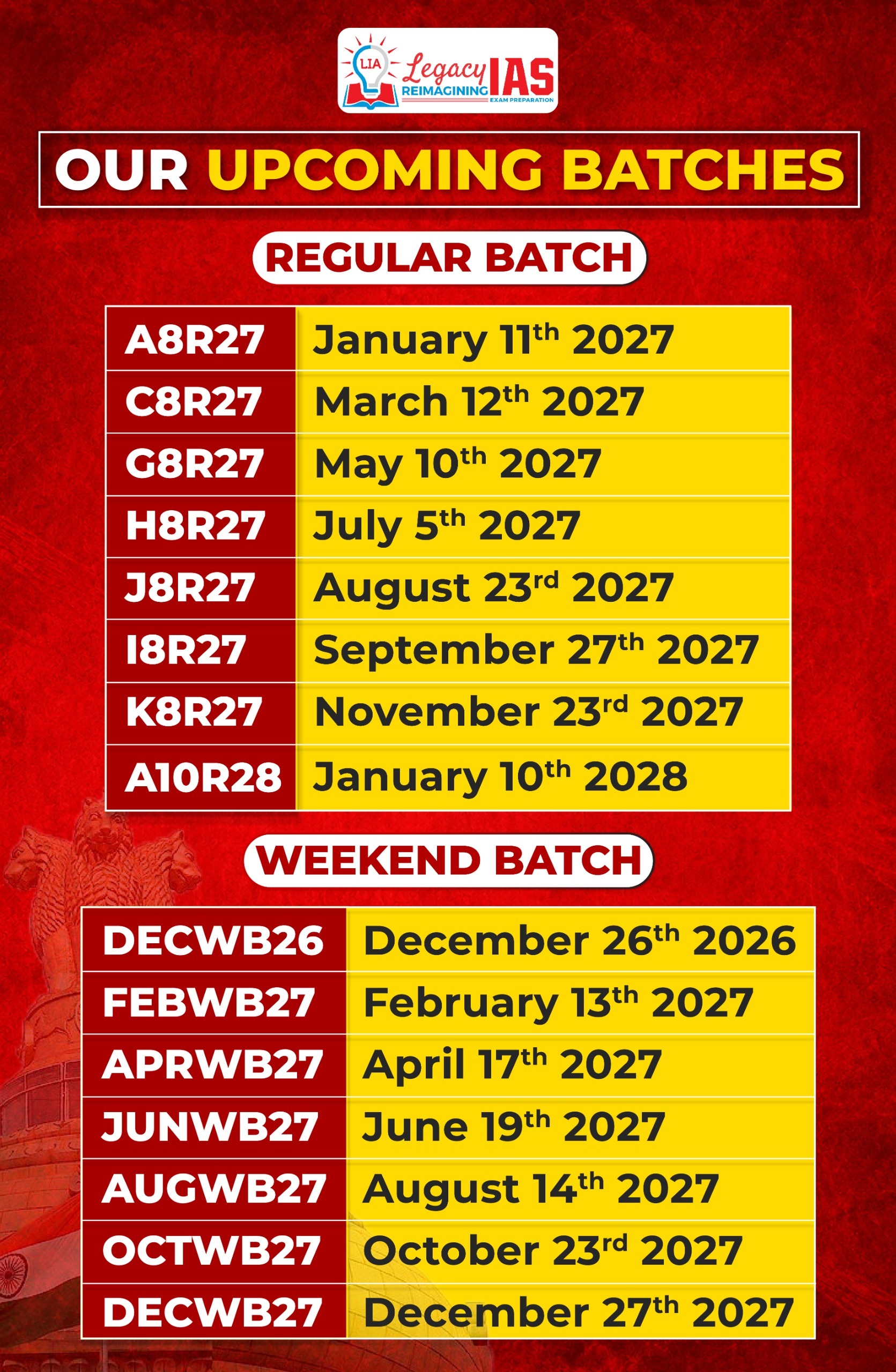
Serious about cracking UPSC CSE?
Join Legacy IAS Academy's structured Prelims + Mains programs, or get personalised mentorship from experienced faculty and toppers.
Legacy IAS Academy — Bengaluru
#1, 2nd Floor, KHB Colony, 5th Block, Koramangala, Bengaluru, Karnataka
Source: The Hindu, International Edition, 19 November 2026. Static background and frameworks have been added for exam preparation. Original article text has been paraphrased, not reproduced; this analysis is prepared independently for UPSC Civil Services exam preparation.