The Hindu — UPSC Analysis
Friday, 20 November 2026
Delhi City Edition · Vol. 16, No. 274 · Curated for Prelims & Mains | GS I · II · III · IV
📋 Today's Topics
- Shenzhen summit: U.S.-China-Russia 'Declaration toward Peace'GS2
- ICJ rules Myanmar committed genocide against the RohingyaGS2
- Talks without peace: Europe and the Ukraine settlementGS2
- India-Japan 2+2: Japanese forces to train in Indian rangesGS2 · GS3
- Incomplete remedies: ECI relief for deleted electorsGS2
- PM to industry: raise wages, jobs and qualityGS3
- From mineral auctions to material securityGS3
- What protects workers in case of layoffs?GS3 · GS2
- EPFO approves systematic withdrawal plan for retireesGS2 · GS3
- Antimicrobials to be regulated as 'new drugs'GS2 · GS3
- OPEC's share in India's crude imports fallsGS3
- Quick Prelims Revision (MCQ Bank)Prelims
- FAQsRevision
Shenzhen summit: U.S.-China-Russia 'Declaration toward Peace'
Context
The leaders of the U.S., China and Russia held their first-ever trilateral summit in Shenzhen, on the sidelines of APEC. The meeting offered striking optics but few substantive outcomes on Ukraine or Iran.
Background & Key Facts
- Declaration: The "China-Russia-U.S. Heads of State Declaration toward Peace" was released after 90 minutes of talks.
- Nuclear risk: The three agreed to launch a dialogue on reducing nuclear risks, reaffirming that "a nuclear war cannot be won and must never be fought".
- Energy: They pledged to increase the production and supply of refined petroleum products.
- ICC: They agreed the International Criminal Court and similar bodies must not "abuse their jurisdiction", citing state consent and immunities of State officials.
- Xi's position: Major countries should respect each other's sovereignty and not challenge each other's "red lines".
Critical Analysis
Different aims: Trump is seeking a legacy after the midterms, Xi gains prestige for "major country diplomacy", and Putin escapes isolation in his first in-person APEC attendance in nine years.
Arms control opening: A trilateral nuclear dialogue could matter, since the three are the largest nuclear powers.
Concern for the rest: A great-power understanding on "red lines" could sideline smaller states. The stance on the ICC may weaken international accountability.
Way Forward (for India)
- Make sure decisions on Ukraine, energy and the Indo-Pacific do not sideline India.
- Push for wider, multilateral arms-control talks.
- Keep balanced ties with all three powers.
Exam Relevance
"A concert of great powers may reduce conflict between them but marginalise others." Examine with reference to the Shenzhen summit. (GS2, 15 marks, 250 words)
The International Criminal Court was established under which treaty?
(a) Rome Statute (b) UN Charter (c) Geneva Conventions (d) Hague Convention
ICJ rules Myanmar committed genocide against the Rohingya
Context
In a 9-6 decision, the International Court of Justice held that Myanmar committed genocide against the Rohingya in northern Rakhine State during the 2017 military operation, in violation of the Genocide Convention.
Background & Key Facts
- First: It is the first time the ICJ has ruled that a state committed genocide.
- Defence rejected: The court did not accept Myanmar's claim that the 2017 campaign was a legitimate counter-insurgency operation.
- Remedies: Myanmar must allow the "safe, voluntary and dignified return" of the Rohingya, prosecute those responsible and pay compensation. The amount will be decided later.
- Other cases: The ICJ is also hearing genocide allegations linked to Gaza and the Ukraine war.
Critical Analysis
Precedent: The ruling strengthens state responsibility under the Genocide Convention.
Enforcement gap: The ICJ has no enforcement power of its own. Under the UN Charter, enforcement relies on the Security Council.
Implications for India: The ruling could affect debates on Rohingya refugees in India and Bangladesh, and India's engagement with Myanmar.
Way Forward
- Support the conditions for voluntary, safe return.
- Back humanitarian aid for refugees in Cox's Bazar.
- Balance India's strategic interests in Myanmar with humanitarian concerns.
Exam Relevance
Distinguish between the ICJ and the ICC. Discuss the significance of the ICJ's ruling on Myanmar for international law. (GS2, 10 marks, 150 words)
The International Court of Justice is located at:
(a) Geneva (b) The Hague (c) New York (d) Vienna
Talks without peace: Europe and the Ukraine settlement
Context
The editorial "Talks without peace" says the U.S.-hosted trilateral talks in Abu Dhabi between Russia, Ukraine and the U.S. made no breakthrough. It calls them a good beginning, but argues Europe must be brought to the table.
Background & Key Facts
- Outcome: The talks agreed on humanitarian measures, including prisoner exchanges. U.S., Ukrainian and European officials are due to meet next in Berlin.
- Russia's demands: Ukrainian withdrawal from Donbas, limits on Ukraine's military, and neutrality, meaning no NATO membership.
- Ukraine's position: No territorial concessions, and security guarantees from the West.
- Cost: Ukraine has lost more than 20% of its territory, and its economy depends on European support.
- Western unity fraying: The U.S. lifted sanctions on Russian diesel, and some European leaders have resumed contact with Moscow.
Critical Analysis
Stalemate: The editorial argues neither side has a credible path to victory, so diplomacy is the only way forward.
European stake: Any settlement affects European security, so Europe must help shape it.
Other view: Critics warn that pressing Ukraine to give up territory would reward aggression.
Way Forward
- Build on humanitarian steps to create confidence.
- Include Europe and Ukraine fully in the negotiations.
- India can support dialogue in line with its "this is not an era of war" stance.
Exam Relevance
Examine the obstacles to a negotiated settlement of the Russia-Ukraine war. What role can India play? (GS2, 15 marks, 250 words)
The Kerch Bridge connects Russia with:
(a) Kaliningrad (b) Belarus (c) Crimea (d) Moldova
India-Japan 2+2: Japanese forces to train in Indian ranges
Context
At their 2+2 Foreign and Defence Ministers' dialogue in Tokyo, India and Japan welcomed a Letter of Intent allowing Japan's Self-Defense Forces to use Indian test ranges for live-fire training for the first time.
Background & Key Facts
- Participants: Rajnath Singh and S. Jaishankar met Shinjiro Koizumi and Toshimitsu Motegi.
- Training: The Letter of Intent includes live-fire training with surface-to-ship missiles.
- UNICORN: Both sides signalled progress on India receiving Japan's Unified Complex Radio Antenna naval radar system.
- Japan's policies: Japan briefed India on revisions to its National Security Strategy and National Defence Strategy.
- Earlier engagements: Rajnath Singh toured the Mogami-class frigate JS Natori at Yokosuka, after the JAIMEX exercise.
Critical Analysis
Deeper military ties: Hosting Japanese live-fire training shows trust beyond regular exercises.
Technology: Getting UNICORN would be a rare transfer of Japanese defence technology.
Indo-Pacific: The partnership supports a free and open Indo-Pacific amid Chinese assertiveness.
Way Forward
- Finalise the UNICORN deal and expand co-development.
- Build cooperation on evacuations and humanitarian assistance.
- Link defence ties to economic and supply-chain cooperation.
Exam Relevance
Discuss how India-Japan defence cooperation has evolved and its significance for the Indo-Pacific. (GS2, 10 marks, 150 words)
UNICORN, a system India may receive from Japan, is a:
(a) Submarine (b) Fighter engine (c) Missile defence interceptor (d) Naval radar antenna system
Incomplete remedies: ECI relief for deleted electors
Context
The ECI has offered electors deleted during the Special Intensive Revision (SIR) a way back onto the rolls in seven States and UTs. The editorial "Incomplete remedies" welcomes this but says the SIR's flaws remain.
Background & Key Facts
- SSR: About 74 lakh names were added in 13 States, raising their electorate from 45.22 crore to 45.96 crore.
- Safeguards: No proof of citizenship is needed, personal notice is required before deletions, and EROs must verify deletions where they exceed 2% of a polling station's electors.
- Restoration: Deleted electors can return under Rule 21(1) of the Registration of Electors Rules, 1960, and keep their old EPIC numbers.
- Trigger: On October 28, the Supreme Court said forcing deleted electors to re-enrol through Form 6 was an "error".
- Reach: The editorial says the measures cover about 4.5 crore of the 13.37 crore deleted. Phase 3 draft deletions averaged 17%, and reached 32.8% in Delhi.
Critical Analysis
Exclusions remain: Electors in States where the SIR has ended, such as Bihar and West Bengal, can only re-enrol as new voters.
Documentation burden: The editorial argues that "logical discrepancy" checks amount to a citizenship test.
ECI's view: The Commission says intensive revision is needed to remove duplicate, dead and shifted electors and keep the rolls accurate.
Way Forward
- Extend restoration to all States and to electors who moved between States.
- Enumerate shifted electors door to door, as in the 2002-03 revision.
- Publish deletion reasons at booth level.
Exam Relevance
"Cleaning electoral rolls should not come at the cost of disenfranchisement." Discuss in the context of the SIR. (GS2, 15 marks, 250 words)
Form 6 under the Registration of Electors Rules, 1960, is used for:
(a) Deletion of names (b) Correction of entries (c) New voter registration (d) Shifting of residence within a constituency
PM to industry: raise wages, jobs and quality
Context
At FICCI's annual general meeting, PM Narendra Modi criticised industry for slow progress in manufacturing, not raising wages or employment, and not preparing to use India's FTAs.
Background & Key Facts
- Tax cuts: The PM noted corporate tax was cut to 22% and income up to ₹12 lakh is tax-free, and said industry had not passed on the benefits.
- Quality: He criticised the "export quality" mindset and said Indian consumers deserve the best products.
- FTAs: He called the trade agreements a "historic opportunity" that industry had not planned for.
- Self-reliance: He invoked Gandhi's call for Swadeshi.
- Reaction: The Congress said the PM had echoed its critique on wages, investment and jobs.
Critical Analysis
Wage-led demand: Stagnant wages limit consumption and the domestic market.
Weak private investment: Tax cuts have not produced the expected investment boom.
Industry's view: Businesses often point to regulation, the cost of capital and uncertain demand as reasons for caution.
Way Forward
- Tie incentives such as PLI to employment and wage outcomes.
- Help MSMEs meet the quality standards needed under FTAs.
- Improve ease of doing business and labour skills.
Exam Relevance
"Corporate tax cuts have not translated into higher private investment and wages." Examine the reasons and suggest remedies. (GS3, 15 marks, 250 words)
The concessional corporate tax rate of 22% (without exemptions) for existing domestic companies was introduced in:
(a) 2016 (b) 2019 (c) 2014 (d) 2023
From mineral auctions to material security
Context
Rohan Gupta of Attero argues that auctioning critical-mineral blocks is only the start. He says India's real challenge is processing, refining and recycling to secure usable materials.
Background & Key Facts
- NCMM: The National Critical Mineral Mission has ₹34,300 crore for a seven-year programme.
- Auctions: The amended mining law lets the Centre auction blocks of 24 critical minerals.
- Recycling: A ₹1,500 crore scheme targets recovering 400 kilotonnes of critical minerals by 2031 from tailings, fly ash, red mud and end-of-life products.
- E-waste: India produced 3.8 million tonnes in 2024, according to Redseer.
- China: Its dominance comes from processing at scale, not only from mining.
Critical Analysis
Mines are not materials: Without beneficiation and refining, India will still import processed materials.
Recycling is faster: It can supply materials sooner than new mines, but collection and traceability are weak.
Stockpiles: They cushion short-term shocks but are not a long-term strategy.
Way Forward
- Build mining and processing capacity together.
- Formalise the scrap economy and certify recovered materials.
- Set clear stockpile priorities and update them as technology changes.
Exam Relevance
"Having mines does not mean having materials." Discuss the challenges to India's critical minerals security. (GS3, 15 marks, 250 words)
KABIL, a joint venture for acquiring critical mineral assets overseas, includes which of the following?
(a) NALCO, HCL and MECL (b) ONGC, OIL and GAIL (c) SAIL, NMDC and BHEL (d) Coal India and NTPC only
What protects workers in case of layoffs?
Context
As the four Labour Codes mark their first anniversary on November 21, K.R. Shyam Sundar and Rahul Charkha discuss severance pay and the safety net for workers who lose their jobs.
Background & Key Facts
- Limited coverage: Mandatory retrenchment rules apply mainly to coal mining, plantations and manufacturing. They leave out services, IT and informal workers.
- Tax: Severance pay is taxed as "profit in lieu of salary", which the speakers debate.
- Adjudication: The Industrial Relations Code replaced labour courts with Industrial Tribunals, and Shyam Sundar doubts this will improve efficiency.
- Global models: Germany has earnings-linked unemployment insurance, and the U.S. funds payouts through a payroll tax.
- Gig workers: They are recognised in the Codes, and e-Shram is building the database.
Critical Analysis
No unemployment insurance: India relies on one-time severance and family support.
Weak ESI reach: The ESI hospital network is thin relative to the number of beneficiaries.
Differing views: Shyam Sundar calls much of the labour reform "hogwash". The government argues the Codes simplify compliance and extend social security to gig workers.
Way Forward
- Pilot unemployment insurance for formal workers.
- Explore co-funded income protection for gig workers, with aggregators contributing.
- Link retraining and skilling to job loss.
Exam Relevance
Should India introduce an unemployment insurance scheme? Discuss in the light of AI-driven layoffs and the Labour Codes. (GS3, 10 marks, 150 words)
Which of the following is NOT one of the four Labour Codes?
(a) Code on Wages (b) Code on Social Security (c) Industrial Relations Code (d) Code on Minimum Employment Guarantee
EPFO approves systematic withdrawal plan for retirees
Context
The EPFO's Central Board of Trustees approved a voluntary plan that lets retiring members withdraw their provident fund in instalments while the rest continues to earn returns.
Background & Key Facts
- Payout options: Monthly, quarterly or half-yearly withdrawals, which can also be extended to eligible family members.
- Relaxed norms: The minimum PF balance was cut from 25% to 10% of the corpus, and the waiting period for final withdrawal from 12 months to two months.
- Voluntary: Members are not required to opt in.
- Reliance Capital: The CBT was told there is no remaining legal route to recover the outstanding ₹1,800 crore.
Critical Analysis
Income stream: The plan gives retirees a regular income and protects them against spending the corpus too quickly.
Liquidity vs saving: A lower minimum balance improves access but may weaken savings for old age.
Trust: Investment losses, such as the RCL default, affect members' confidence.
Way Forward
- Help members choose suitable withdrawal plans through financial literacy.
- Strengthen investment governance.
- Integrate the plan with EPS pensions.
Exam Relevance
Examine the challenges of ensuring old-age income security in India. How do recent EPFO reforms address them? (GS2, 10 marks, 150 words)
The Central Board of Trustees of the EPFO is chaired by:
(a) The Union Minister for Labour and Employment (b) The Finance Secretary (c) The RBI Governor (d) The Central PF Commissioner
Antimicrobials to be regulated as 'new drugs'
Context
The Union Health Ministry has proposed amending the New Drugs and Clinical Trials Rules, 2019, to include antimicrobials in the definition of "new drug". The aim is to tighten scrutiny of manufacturing licences.
Background & Key Facts
- Concern: Licences for antimicrobial products have been granted without adequate regulatory scrutiny.
- Bulk drugs: Changes to the Drugs Rules, 1945, would add a separate licence form for selling bulk drugs.
- AMR: Antimicrobial resistance is a major global public health threat.
Critical Analysis
Central scrutiny: "New drug" status brings approvals under the CDSCO.
Irrational combinations: The change could curb unapproved fixed-dose combinations of antibiotics.
Access: The rules must avoid shortages of essential antibiotics.
Way Forward
- Enforce prescription-only sale of antibiotics.
- Strengthen AMR surveillance across humans, animals and the environment (One Health).
- Update and implement the National Action Plan on AMR.
Exam Relevance
Why is antimicrobial resistance called a "silent pandemic"? Evaluate India's regulatory response. (GS2, 10 marks, 150 words)
The "Red Line" campaign in India is associated with:
(a) Road safety (b) Prescription-only antibiotics (c) Tobacco warnings (d) Food adulteration
OPEC's share in India's crude imports falls
Context
PPAC data show OPEC's share of India's crude imports fell to 27.4% in April-October, from 38.5% a year ago. This points to diversification amid West Asian shipping disruptions.
Background & Key Facts
- Other sources: Supplies from outside the traditional West Asian market are taking a larger share. Africa accounted for 6.6% and North America for 3%.
- Cause: The Strait of Hormuz disruption after the U.S.-Iran conflict.
- Dependence: India imports about 88.7% of its crude needs.
Critical Analysis
Resilience: More suppliers reduce exposure to a single chokepoint.
Cost: Longer routes and new grades can raise freight and refining costs.
Strategic choices: Sourcing must balance price, security and diplomatic relationships.
Way Forward
- Expand strategic petroleum reserves.
- Sign long-term contracts with varied suppliers.
- Accelerate the energy transition to cut dependence on imports.
Exam Relevance
Discuss the measures India should take to strengthen its energy security amid disruptions in West Asia. (GS3, 10 marks, 150 words)
Which of the following is NOT a site of India's strategic petroleum reserves (Phase I)?
(a) Visakhapatnam (b) Mangaluru (c) Kandla (d) Padur
Quick Prelims Revision (MCQ Bank)
Q1. The 2025 Indira Gandhi Prize for Peace, Disarmament and Development was conferred on:
(a) Malala Yousafzai (b) Graça Machel
(c) Navi Pillay (d) Ellen Johnson Sirleaf
Answer: (b) — Graça Machel, the Mozambican politician and women's rights advocate, received the award, which carries ₹1 crore.
Q2. Under 'Mission 500', India and the U.S. aim to raise bilateral trade to $500 billion by:
(a) 2027 (b) 2035
(c) 2030 (d) 2047
Answer: (c) — Indian firms also announced a record $20.5 billion of investment in the U.S. this year.
Q3. 'Ehsaas 2026', launched by the Delhi government, is a policy on:
(a) Mental health and well-being in educational institutions (b) Clean air
(c) Women's safety on transport (d) Electric vehicle adoption
Answer: (a) — It addresses academic stress, anxiety, depression and digital behaviour among students.
Q4. Cyclone Akvan was expected to make landfall along the coast between:
(a) Chennai and Nellore (b) Digha and Sagar Island
(c) Mangaluru and Karwar (d) Narsapur (A.P.) and Puri (Odisha)
Answer: (d) — Odisha shifted about three lakh people ahead of landfall.
Q5. The Bar Council of India's advisory to law aspirants was issued following a direction of:
(a) The Ministry of Education (b) The Supreme Court
(c) UGC (d) The Law Commission
Answer: (b) — Following an October 9, 2026 direction of the Supreme Court, it asks students to verify a college's affiliation and approval before admission.
Q6. Under China's revised regulations on local Party committees, the previous version was issued in:
(a) 2015 (b) 2012
(c) 2020 (d) 2008
Answer: (a) — The 2015 version was issued three years into Xi Jinping's tenure. The new rules centralise control and emphasise Xi Jinping Thought.
Q7. The two economists whose century-old debate on consumption and accumulation is being revisited in the context of AI are:
(a) Keynes and Hayek (b) Solow and Romer
(c) Marx and Ricardo (d) Tugan-Baranovsky and Rosa Luxemburg
Answer: (d) — Tugan-Baranovsky argued that investment can replace lost consumption demand. Luxemburg argued machines are not an end in themselves.
Q8. The Delhi Transport Corporation's bus fleet crossed which mark with the launch of 100 new electric buses?
(a) 3,000 (b) 5,000
(c) 7,000 (d) 10,000
Answer: (c) — The new zero-emission buses take the DTC fleet to over 7,000.
Frequently Asked Questions
What did the Shenzhen summit achieve?
It produced a broad "Declaration toward Peace", launched a dialogue on reducing nuclear risks, pledged more petroleum product supply and criticised "abuse" of jurisdiction by the ICC. It made no breakthroughs on Ukraine or Iran.
Why is the ICJ's Myanmar ruling significant?
It is the first time the court has held that a state committed genocide. It orders Myanmar to allow the Rohingya to return safely, prosecute those responsible and pay compensation. Enforcement still depends on the Security Council.
What are the limits of the ECI's relief for deleted electors?
According to the editorial, it reaches about 4.5 crore of the 13.37 crore deleted and leaves out electors who moved between States. Voters in States where the SIR has ended can return only as new voters through Form 6.
Why is processing more important than mining for critical minerals?
Raw ore must be beneficiated and refined before industry can use it. China's dominance rests on processing at scale, so mines alone will not end India's dependence on imports.
What did the EPFO change for retirees?
It allows voluntary monthly, quarterly or half-yearly withdrawals, cuts the minimum PF balance from 25% to 10%, and reduces the waiting period for final settlement from 12 months to two.
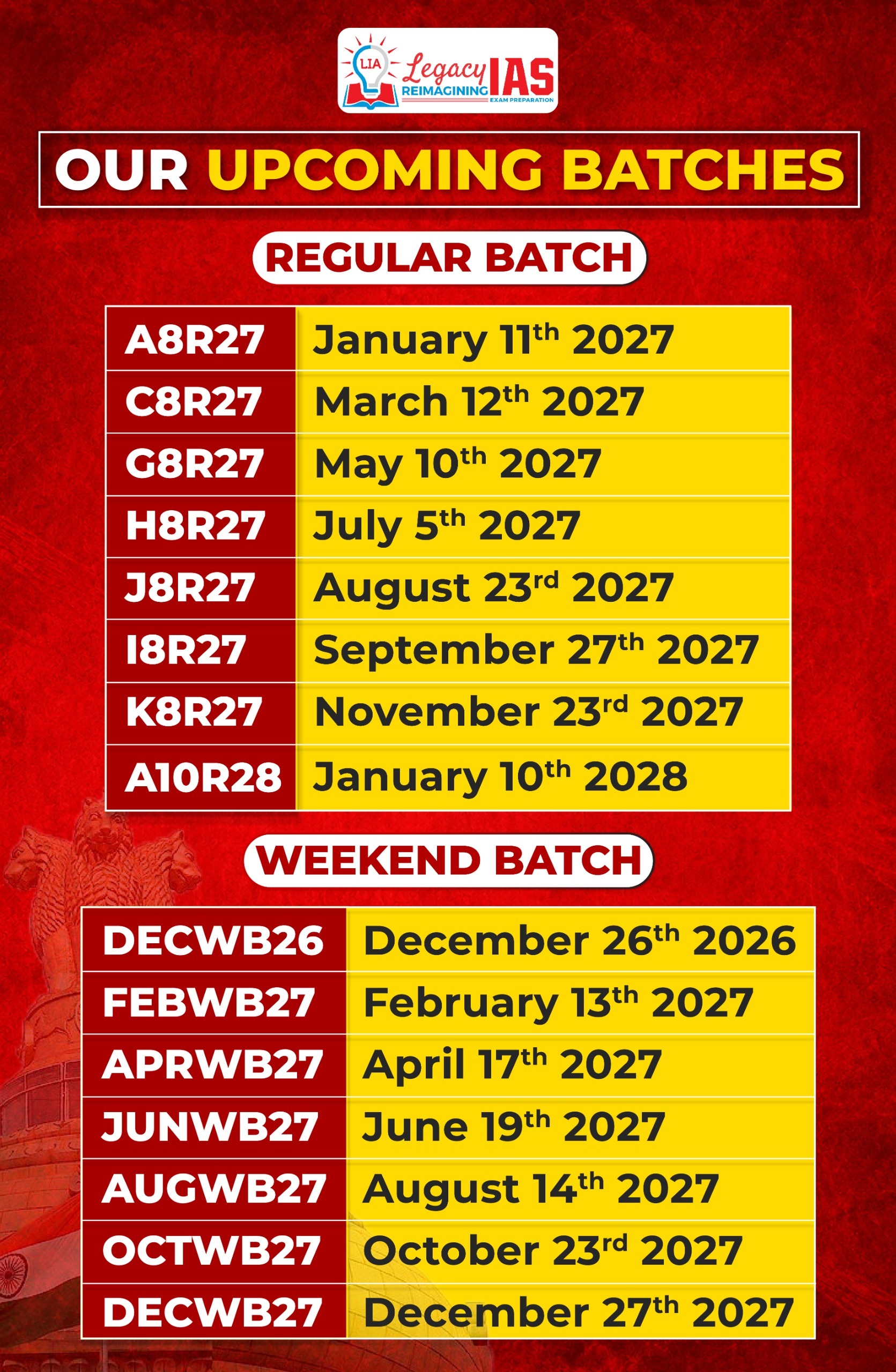
Serious about cracking UPSC CSE?
Join Legacy IAS Academy's structured Prelims + Mains programs, or get personalised mentorship from experienced faculty and toppers.
Legacy IAS Academy — Bengaluru
#1, 2nd Floor, KHB Colony, 5th Block, Koramangala, Bengaluru, Karnataka
Source: The Hindu, Delhi City Edition, 20 November 2026. Static background and frameworks have been added for exam preparation. Original article text has been paraphrased, not reproduced; this analysis is prepared independently for UPSC Civil Services exam preparation.