The Hindu — UPSC Analysis
Tuesday, 24 November 2026
Delhi City Edition · Vol. 16, No. 277 · Curated for Prelims & Mains | GS I · II · III · IV
📋 Today's Topics
- India announces ₹15,000-crore package for flood-hit NepalGS2
- A framework for nuclear risk reduction cannot waitGS2 · GS3
- After COP31: developed nations and the cost of emissionsGS3
- Just verdict: the ICJ ruling and the Rohingya's returnGS2
- SC directs SIR tribunals to hear inclusion appeals firstGS2
- Voters' Form 6 data exposed on ECI portal, claims reportGS2 · GS3
- Pakistani operatives infiltrate defence-linked WhatsApp groupsGS3
- Oil and gas production to pick up in 4-5 years, says MinistryGS3
- Merit and autonomy in IITs and IIMsGS2
- Maharashtra FDA vs FSSAI: food safety federalismGS2
- Quick Prelims Revision (MCQ Bank)Prelims
- FAQsRevision
India announces ₹15,000-crore package for flood-hit Nepal
Context
After talks with Nepal PM Balendra Shah, PM Modi announced a ₹15,000-crore package to help Nepal recover from the August floods in the Bhotekoshi river and build disaster resilience.
Background & Key Facts
- Structure: ₹11,500 crore is a rupee-denominated concessional line of credit for energy projects, and ₹3,500 crore is in grants for reconstruction.
- Boundary: The two PMs asked their Foreign Secretaries to "work on the outstanding boundary issues", including the Kalapani-Limpiyadhura-Lipulekh trijunction.
- EPG: An Eminent Persons Group was set up in 2016 to review bilateral ties. Its report has not been made public.
- Approach: Foreign Secretary Vikram Misri reiterated India's "forward-looking" approach.
Critical Analysis
Disaster diplomacy: Timely help strengthens India's image as a first responder in the region.
Energy focus: Credit for hydropower links Nepal's development with India's power market.
Lingering issue: Boundary disputes, sharpened by Nepal's 2020 map, need patient dialogue.
Way Forward
- Disburse the money quickly and monitor projects transparently.
- Resume boundary talks at Foreign Secretary level.
- Consider releasing the EPG report as a basis for reform.
Exam Relevance
Examine the role of development assistance in India's Neighbourhood First policy, with reference to Nepal. (GS2, 10 marks, 150 words)
The Lipulekh Pass, part of the India-Nepal boundary dispute, connects Uttarakhand with:
(a) Sikkim (b) Bhutan (c) Tibet (China) (d) Himachal Pradesh
A framework for nuclear risk reduction cannot wait
Context
With New START expired and no successor treaty, Adya Madhavan of the Takshashila Institution argues that the U.S., Russia and China should build a step-by-step risk-reduction framework instead of waiting for a full trilateral treaty.
Background & Key Facts
- No limits: For the first time since 1972, no treaty restricts the largest nuclear arsenals.
- U.S. view: The U.S. wants China included and worries about how fast and opaquely China's arsenal is growing. Trump has ordered nuclear testing to resume.
- Russia's view: Russia wants Britain and France included. It suspended New START inspections in 2023 and withdrew its ratification of the test-ban treaty (CTBT).
- China's view: It has about 620 warheads against more than 5,000 each for the U.S. and Russia, so it fears that transparency would make it vulnerable.
- Shenzhen: The declaration has no verification provisions and no date for follow-up talks.
Critical Analysis
Perfect vs workable: A binding three-way treaty is unrealistic for now, but steps where interests overlap are possible.
Suggested steps: Human control of launch decisions, crisis hotlines, launch notifications and a moratorium on explosive testing.
New risks: Putting AI into command and control systems raises the danger of inadvertent escalation.
Way Forward
- The U.S. and Russia should restore limits on their own arsenals now.
- China should join confidence-building measures gradually.
- India can champion norms on keeping humans in control of nuclear weapons.
Exam Relevance
"A functional framework is worth more than waiting for a perfect treaty." Discuss in the context of nuclear arms control after New START. (GS2, 15 marks, 250 words)
The Comprehensive Nuclear-Test-Ban Treaty (CTBT):
(a) Is in force and India is a party (b) Bans only atmospheric tests (c) Was signed in 1968 (d) Has not yet entered into force
After COP31: developed nations and the cost of emissions
Context
The editorial "Fatal disagreement" says COP31 in Antalya ended "with a whimper" without a cover text. It argues that developed countries must honour their climate finance promises.
Background & Key Facts
- Leadership: Türkiye and Australia led the summit and pushed a cover text early.
- Headline target: Electricity was to supply 35% of global final energy consumption by 2035.
- Objection: The EU and about 130 countries wanted explicit language on fossil fuels.
- Progress: There was some movement on just transition, but none on climate finance.
- India and China: Both are large emitters but also leaders in total clean energy installations.
Critical Analysis
Hidden costs: Renewables need land, storage and grid upgrades, which all require capital.
Historical responsibility: The editorial says developed countries must bear much of the cost.
Other view: The EU and vulnerable states argue that leaving fossil fuels out of the text undermines the 1.5°C goal.
Way Forward
- Pair fossil-fuel transition language with commitments to deliver finance.
- Reform multilateral development banks to lower the cost of capital.
- Hold COP32 talks on a clear finance roadmap.
Exam Relevance
"Without climate finance, climate ambition remains hollow." Discuss in the light of the outcome of COP31. (GS3, 10 marks, 150 words)
The COP31 presidency's proposed headline target aimed for electricity to account for what share of global final energy consumption by 2035?
(a) 35% (b) 50% (c) 25% (d) 60%
Just verdict: the ICJ ruling and the Rohingya's return
Context
The editorial "Just verdict" says the ICJ's genocide finding against Myanmar met a very high standard of proof. It argues the Rohingya can return safely only to a truly democratic, federal Myanmar.
Background & Key Facts
- Standard of proof: Without direct evidence of a plan, the court could infer intent to destroy only if it was "the only reasonable inference" from the facts.
- Findings: The court found that the army drew no distinction between fighters and civilians during the 2017 "clearance operations". Over 7,00,000 people fled to Bangladesh.
- History: The editorial notes earlier displacements in 1978 and 1991-92, loss of citizenship under the 1982 law, and disenfranchisement in 2015.
- Refugees: More than 1.2 million Rohingya are in Bangladesh, and international aid has fallen.
- Enforcement: Enforcement depends on the UN Security Council, where China and Russia can use their veto.
Critical Analysis
Accountability without enforcement: The ruling's moral weight may not change the situation on the ground.
Changed ground: Most of Rakhine is now held by the Arakan Army, which also faces allegations of abuses against the Rohingya.
India's position: The editorial criticises India's engagement with Myanmar's regime. The government's case is that engagement is needed for border security and connectivity projects such as Kaladan.
Way Forward
- Support humanitarian aid for refugees in Cox's Bazar.
- Encourage an inclusive political transition in Myanmar.
- Balance India's strategic interests with its humanitarian obligations.
Exam Relevance
How should India balance its strategic interests in Myanmar with humanitarian concerns over the Rohingya? (GS2, 10 marks, 150 words)
The Kaladan Multi-Modal Transit Transport Project connects Kolkata with which port in Myanmar?
(a) Yangon (b) Sittwe (c) Kyaukphyu (d) Dawei
SC directs SIR tribunals to hear inclusion appeals first
Context
A three-judge Bench headed by CJI Surya Kant ordered tribunals hearing West Bengal SIR appeals to separate out and first decide appeals from voters whose names were excluded.
Background & Key Facts
- Backlog: 38.31 lakh appeals have been filed in 19 tribunals, about 22 lakh of them by excluded voters, according to an ECI affidavit.
- Directions: The ECI must add tribunals in consultation with the Calcutta HC Chief Justice and move them to central Kolkata. Appeals from the Kolkata Municipal Corporation area must be prioritised within a week.
- Welfare link: Petitioners cited State orders linking SIR deletions to Annapurna Yojana, the PDS and caste certificates.
- Disagreement: The Solicitor General called these "bald assertions". Justice Joymalya Bagchi noted that a notification was on record, and that exclusion was meant only for the electoral roll.
Critical Analysis
Franchise first: Prioritising re-inclusion protects the right to vote before upcoming civic polls.
Spillover: Linking voter-roll deletions to welfare benefits could cause serious civil harm.
Capacity: Tribunal capacity limits how quickly appeals can be decided.
Way Forward
- Separate electoral-roll status from eligibility for welfare.
- Set time-bound disposal and publish data on outcomes.
- Provide legal aid for marginalised appellants.
Exam Relevance
Discuss the role of the judiciary in safeguarding the right to vote during revisions of electoral rolls. (GS2, 10 marks, 150 words)
Superintendence, direction and control of the preparation of electoral rolls is vested in the Election Commission by:
(a) Article 324 (b) Article 326 (c) Article 329 (d) Article 243K
Voters' Form 6 data exposed on ECI portal, claims report
Context
Civic-tech initiative Charchagram claims that personal data voters submitted through Form 6 was exposed on the ECI's citizen service portal for at least three years.
Background & Key Facts
- Scale: At least seven crore enrolments took place in that period.
- Data: Form 6 contains name, gender, contact details, Aadhaar information and proof of age.
- Flaw: A URL in the publicly available front-end code allegedly allowed anyone to access other voters' Form 6 data.
- Response: CERT-In acknowledged the report, and changes on November 20 blocked access.
- Note: These are the report's claims. The paper does not report an ECI response.
Critical Analysis
Privacy risk: Exposed identity data enables fraud and profiling.
DPDP Act: Government data fiduciaries also have duties to keep data secure.
Trust: Data security is central to public confidence in electoral systems.
Way Forward
- Commission an independent security audit of ECI portals.
- Notify affected users as the DPDP rules require.
- Set up a responsible disclosure programme with timelines.
Exam Relevance
"Digital public infrastructure must be secure by design." Discuss with reference to data breaches in government portals. (GS3, 10 marks, 150 words)
CERT-In, India's nodal agency for responding to cyber incidents, functions under:
(a) Ministry of Home Affairs (b) NSCS (c) Ministry of Electronics and IT (d) Ministry of Defence
Pakistani operatives infiltrate defence-linked WhatsApp groups
Context
The Border Roads Organisation (BRO) warned that Pakistan-based intelligence operatives had infiltrated 11 unofficial WhatsApp groups used by defence, paramilitary and civil defence personnel.
Background & Key Facts
- Method: They used spoofed or compromised Indian numbers and stayed as "silent members" monitoring chats.
- Target groups: Groups about transfers and postings.
- Incident: A civilian employee allegedly passed on information to an operative posing as a DRDO scientist, in exchange for money.
- Related alert: The Indian Cyber Crime Coordination Centre (I4C) warned about misuse of authenticated WhatsApp Web sessions.
Critical Analysis
Human weakness: Social engineering exploits trust and informal communication.
Shadow IT: Unofficial groups sit outside institutional security controls.
Espionage trend: Honey traps and impersonation are recurring tactics.
Way Forward
- Move official communication to secure government platforms such as Sandes.
- Run regular cyber-hygiene training and counter-intelligence awareness.
- Audit and verify group memberships.
Exam Relevance
Examine the threat posed by cyber espionage to India's national security, and suggest institutional safeguards. (GS3, 10 marks, 150 words)
The Indian Cyber Crime Coordination Centre (I4C) functions under:
(a) MeitY (b) Ministry of Home Affairs (c) NIA (d) RBI
Oil and gas production to pick up in 4-5 years, says Ministry
Context
Responding to criticism of falling output, a Petroleum Ministry note says domestic oil and gas production is down because of decisions taken more than a decade ago, and should rise in the next 4-5 years.
Background & Key Facts
- Long gestation: In this industry, the decisions of one decade decide the next decade's output.
- Recent steps: New acreage, record drilling, deepwater wells and the revival of Mumbai High.
- Funding: Profits of upstream companies such as ONGC and Oil India now go into exploration rather than subsidies.
- Data: Crude has contracted for 22 consecutive months and natural gas for 28.
Critical Analysis
Plausible defence: Exploration does take a long time to turn into production.
Accountability: Critics, including Monday's editorial, want clear timelines and targets.
Import dependence: A recovery in output would reduce inflation and current account risks.
Way Forward
- Publish targets for each field and report progress on them.
- Attract global partners for deepwater exploration.
- Use technology to improve recovery from mature fields.
Exam Relevance
Critically evaluate recent upstream oil and gas reforms in India in the context of declining domestic production. (GS3, 10 marks, 150 words)
Mumbai High, India's largest offshore oil field, lies in the:
(a) Bay of Bengal (b) Gulf of Mannar (c) Gulf of Kutch (d) Arabian Sea
Merit and autonomy in IITs and IIMs
Context
Former Secretary Raghav Chandra argues that IITs and IIMs must put merit first in appointing boards, directors and faculty, now that the government has greater powers over the IIMs.
Background & Key Facts
- IIM Act, 2017: It made IIMs institutes of national importance, with boards appointing directors.
- 2023 Amendment: It made the President the Visitor of every IIM and gave the Centre more say over boards and directors.
- The author's concern: Directors chosen only as administrators may lack teaching and research experience.
- Safeguards proposed: Boards chosen for merit, heeding their recommendations, selection-based faculty recruitment, and vigilance officers answerable to the board.
Critical Analysis
Autonomy and excellence: Global top universities rely on merit-based selection at every level.
Government's view: The amendment was justified as improving accountability after governance disputes at some IIMs.
Balance: Oversight should not erode academic freedom.
Way Forward
- Use transparent search committees for directors.
- Let the academic council control curricula.
- Have independent audits that report to boards.
Exam Relevance
"Institutional autonomy is a precondition for academic excellence." Discuss with reference to recent changes in the governance of IIMs. (GS2, 10 marks, 150 words)
Under the IIM (Amendment) Act, 2023, the Visitor of every IIM is:
(a) The Union Education Minister (b) The Prime Minister (c) The President of India (d) The UGC Chairman
Maharashtra FDA vs FSSAI: food safety federalism
Context
Maharashtra's Food and Drug Administration (FDA) has withdrawn its petition in the Bombay High Court. The petition accused the Centre, through the FSSAI, of usurping the State's powers on food safety.
Background & Key Facts
- Petition: It was filed in September by FDA Commissioner Tukaram Mundhe, alleging that a parallel central system hindered State enforcement.
- Law: The FSS Act, 2006 created the FSSAI, while States enforce it through Commissioners of Food Safety.
- Industry view: Businesses want uniform interpretation of rules across States.
Critical Analysis
Uniformity vs local enforcement: National standards help trade, but enforcement capacity lies with States.
Concurrent subject: Adulteration of food is in the Concurrent List, which creates overlapping jurisdiction.
Consumers: What matters most to them is safe food, whichever authority enforces it.
Way Forward
- Clarify the roles of the Centre and States in the regulations.
- Strengthen State laboratories and the number of food inspectors.
- Set up joint enforcement platforms that share data.
Exam Relevance
Discuss the challenges of cooperative federalism in regulating food safety in India. (GS2, 10 marks, 150 words)
The FSSAI functions under which Ministry?
(a) Health and Family Welfare (b) Consumer Affairs (c) Food Processing Industries (d) Agriculture
Quick Prelims Revision (MCQ Bank)
Q1. Which banks are in the RBI's 2026 list of Domestic Systemically Important Banks (D-SIBs)?
(a) SBI, HDFC Bank and ICICI Bank (b) SBI and PNB
(c) SBI, Axis Bank and Kotak (d) HDFC Bank and Bank of Baroda
Answer: (a) — The three were retained in the same buckets as in 2025. Higher buckets require more additional capital.
Q2. The Supreme Court mooted allowing only vehicles meeting which emission norm into Delhi?
(a) BS-IV (b) BS-VI
(c) Euro 7 (d) BS-V
Answer: (b) — BS-VI norms took effect on April 1, 2020 and align closely with Euro 6. India skipped BS-V.
Q3. India's national landslide susceptibility mapping, announced at the 7th World Landslide Forum, covered about:
(a) 1.2 lakh sq km (b) 8 lakh sq km
(c) 4.3 lakh sq km (d) 2 lakh sq km
Answer: (c) — The inventory also records nearly 91,000 historical landslides, as part of a shift from relief to prevention.
Q4. Armenia's proposed new constitution drops its claim to which region, to enable peace with Azerbaijan?
(a) Nakhchivan (b) Abkhazia
(c) South Ossetia (d) Nagorno-Karabakh
Answer: (d) — Azerbaijan retook Nagorno-Karabakh in a 2023 offensive.
Q5. The 508-km Mumbai-Ahmedabad bullet train corridor is being built by:
(a) RVNL (b) NHSRCL
(c) IRCON (d) DFCCIL
Answer: (b) — National High Speed Rail Corporation Ltd. builds it. BEML is making the train sets, and trial runs on the Surat-Bilimora stretch are due in 2027.
Q6. Mahanadi Coalfields Ltd., whose IPO was fully subscribed, is a subsidiary of:
(a) NTPC (b) NLC India
(c) Coal India Ltd. (d) SAIL
Answer: (c) — The ₹8,981-crore IPO was subscribed 1.52 times. Qualified Institutional Buyers subscribed 4.95 times.
Q7. Changing a State's name requires an Act of Parliament under which Article?
(a) Article 1 (b) Article 2
(c) Article 4 (d) Article 3
Answer: (d) — Article 3 lets Parliament alter State names after referring the Bill to the State legislature for its views. This is relevant to the proposal to rename West Bengal "Pashchim Banga".
Q8. India's gold imports in April-October 2026 fell, compared with the same period last year, by around:
(a) 10% (b) 25%
(c) 40% (d) 60%
Answer: (c) — India bought gold worth $24.7 billion in the seven months, about 40% less.
Frequently Asked Questions
What does India's package for Nepal include?
₹11,500 crore in concessional credit for energy projects and ₹3,500 crore in grants for reconstruction, ₹15,000 crore in total, after the August floods. Both sides also agreed to work on boundary issues.
Why is a three-way nuclear treaty difficult?
The U.S. wants China included, Russia wants Britain and France included, and China, with far fewer warheads, fears that transparency would expose it. The op-ed suggests starting with confidence-building measures instead.
Why did the SC order SIR tribunals to prioritise exclusion appeals?
About 22 lakh of the 38.31 lakh appeals come from voters struck off the rolls, and civic elections are coming up. The court wants their right to vote decided first.
What did the Charchagram report allege about Form 6?
It alleged that a URL in the ECI portal's public code allowed access to other voters' Form 6 data, including Aadhaar details, for at least three years. Access was blocked after November 20.
Why does the Petroleum Ministry expect oil and gas output to rise?
It says recent steps, including new acreage, record drilling, deepwater wells and the revival of Mumbai High, will show results in 4-5 years because the sector has a long gestation period.
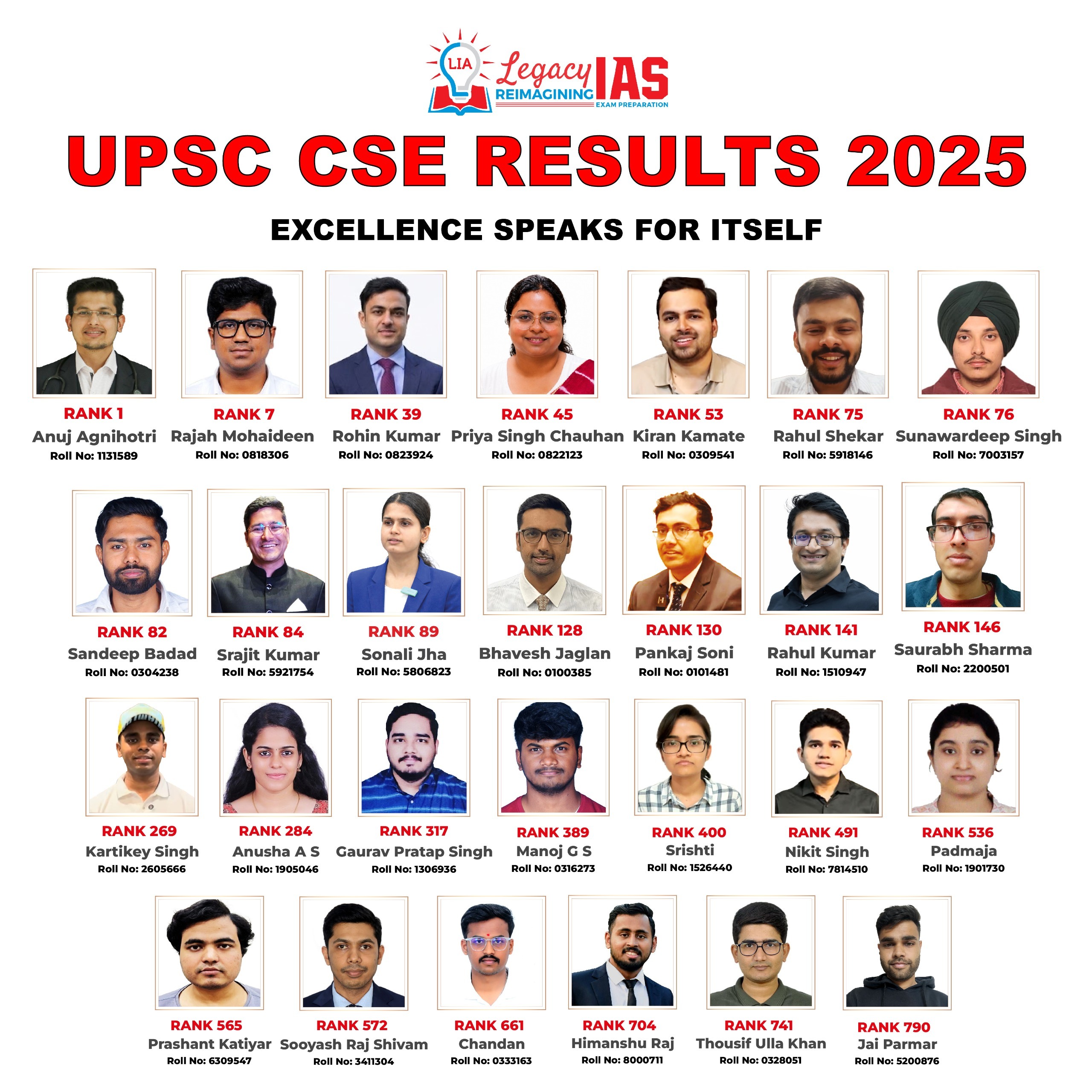
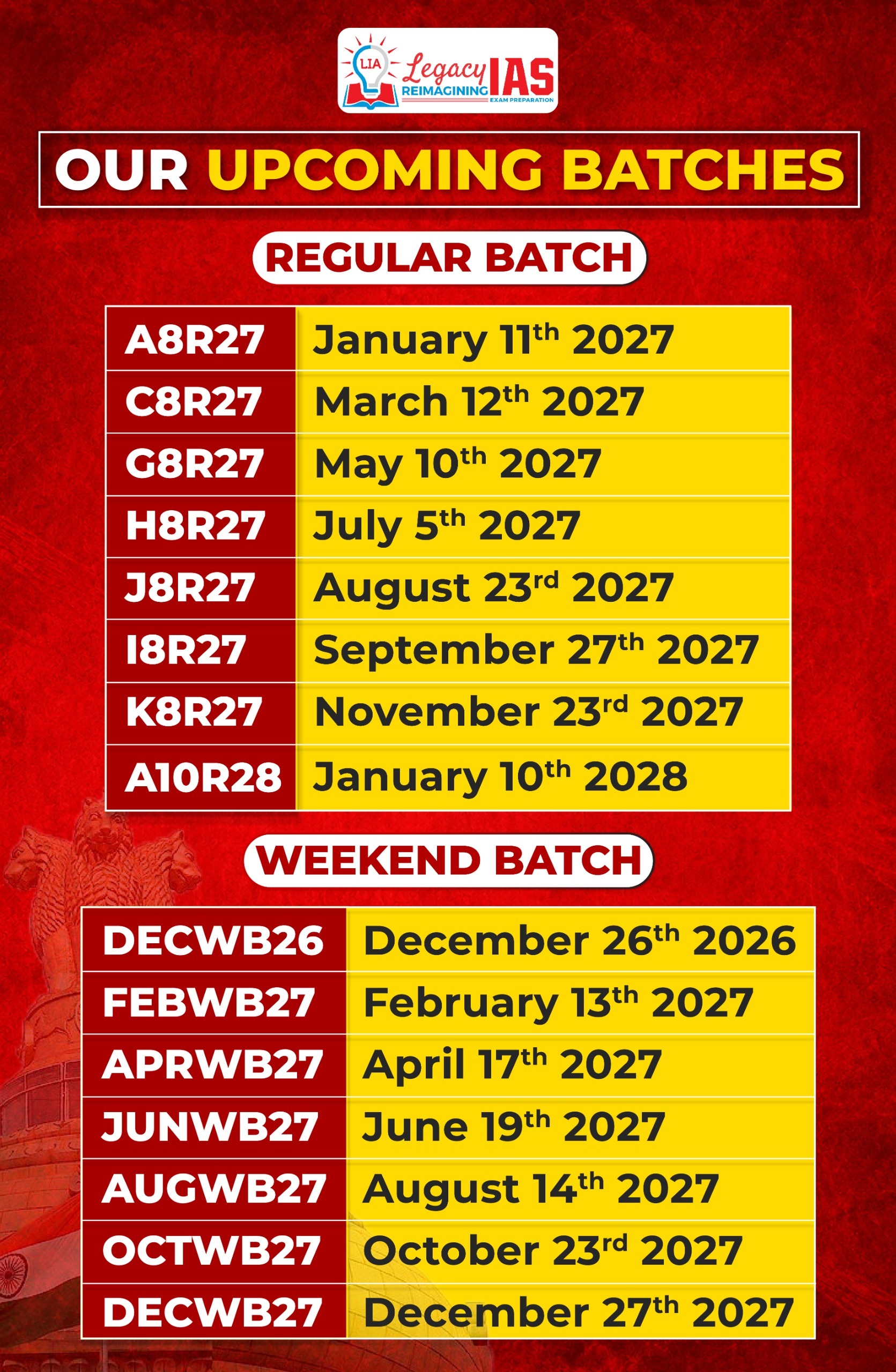
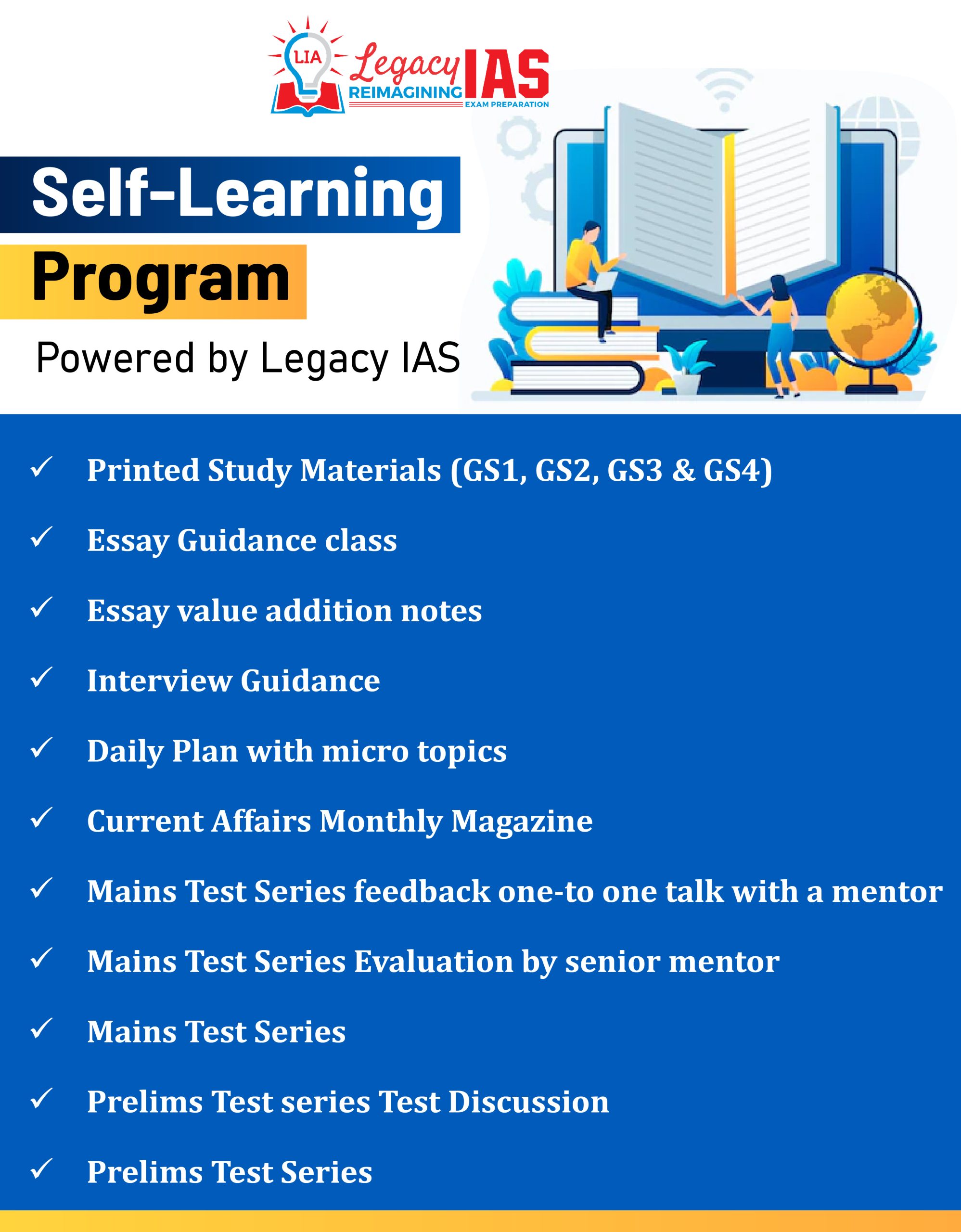
Serious about cracking UPSC CSE?
Join Legacy IAS Academy's structured Prelims + Mains programs, or get personalised mentorship from experienced faculty and toppers.
Legacy IAS Academy — Bengaluru
#1, 2nd Floor, KHB Colony, 5th Block, Koramangala, Bengaluru, Karnataka
Source: The Hindu, Delhi City Edition, 24 November 2026. Static background and frameworks have been added for exam preparation. Original article text has been paraphrased, not reproduced; this analysis is prepared independently for UPSC Civil Services exam preparation.