The Hindu — UPSC Analysis
Friday, 27 November 2026
Delhi City Edition · Vol. 16, No. 280 · Curated for Prelims & Mains | GS I · II · III · IV
📋 Today's Topics
- The Siang dam: strategic ambition, ecological falloutGS3 · GS1
- Bridging India's border infrastructure gap with ChinaGS3
- Pressure tactics: new U.S. tariffs and the trade dealGS2 · GS3
- Special sitting of Parliament and the Delimitation BillGS2
- SC sets deadline for front-of-pack nutrition labelsGS2
- Jharkhand opposes the amended MMDR ActGS2 · GS3
- Is India Inc to blame for low wages and unemployment?GS3
- The fiscal cost of cash-transfer schemesGS3 · GS2
- China tells Japan to stop 'stirring trouble' in the South China SeaGS2
- Myanmar rejects parts of the ICJ rulingGS2
- Quick Prelims Revision (MCQ Bank)Prelims
- FAQsRevision
The Siang dam: strategic ambition, ecological fallout
Context
Geoscientist C.P. Rajendran argues that the proposed Siang Upper Multipurpose Project (SUMP) in Arunachal Pradesh shows how China-India rivalry costs communities and ecosystems.
Background & Key Facts
- China's project: A 60 GW hydropower project at Medog uses tunnels to exploit a drop of about 2,000 m around the Great Bend of the Yarlung Tsangpo.
- India's project: A gravity dam of about 280-300 m with a reservoir of about 9.2 billion cubic metres, intended partly as a buffer against Chinese water releases.
- Displacement: About 27 villages could be submerged and over 1.5 lakh people displaced, nearly 11% of the State's population.
- Seismic risk: The site is in India's highest seismic category. The region saw the M 8.6 Assam-Tibet earthquake in 1950, and a reservoir this large could trigger quakes.
- Downstream impact: Trapped sediment could create "hungry water" that erodes riverbanks, starve Assam's floodplains of silt and threaten Majuli island.
Critical Analysis
Tribal protection: Arunachal is not under the Sixth Schedule. It relies on a State law on tribal land transfer that still allows acquisition for public purposes.
Cultural loss: The Siang, revered as "Anni" (Mother), sustains customary institutions that compensation cannot replace.
Government's view: The project is justified for water security, flood moderation and as a strategic counter to China's dam.
Way Forward
- Carry out transparent environmental and seismic assessments with free, prior and informed consent.
- Explore designs with less submergence.
- Push for a Himalayan river-sharing framework involving China, Nepal, Bhutan and Bangladesh.
Exam Relevance
"The Siang project reflects the trade-off between strategic security and ecological justice." Critically examine. (GS3, 15 marks, 250 words)
Which convention on shared rivers has neither India nor China ratified?
(a) Ramsar Convention (b) Helsinki Rules (c) 1997 UN Watercourses Convention (d) Bonn Convention
Bridging India's border infrastructure gap with China
Context
Former Corps Commander Harinder Singh argues that India must replace project-by-project border infrastructure with a long-term, coordinated frontier strategy.
Background & Key Facts
- China's advantage: Multi-year funding, with Tibet's 2021-25 plan committing over 600 billion yuan. Its 2022 Land Border Law puts border development on a statutory basis.
- BRO funding: The budget allocation was ₹12,107.41 crore in 2024-25, with actual spending of ₹16,690 crore.
- Projects: The Atal and Sela tunnels are complete. Zoji La, Shinku La and the Arunachal Frontier Highway are under way.
- Rail lines: The Bilaspur-Manali-Leh and Missamari-Tenga-Tawang lines are awaiting sanction.
- Fragmentation: Phase 1 of the Indo-China Border Roads (ICBR) took 16 years, from 2005 to 2021.
Critical Analysis
Reactive approach: India's push came mainly after Doklam (2017) and Galwan (2020).
India's edge: India has better airlift capacity because its bases are at lower altitudes.
Last mile: Roads need inhabited, connected villages to hold ground.
Way Forward (the author's proposals)
- Pass an India Border Infrastructure Act with a single development authority.
- Involve NHAI and private players in building core connectivity alongside the BRO.
- Track progress against China sector by sector using a Composite Frontier Infrastructure Index.
Exam Relevance
Why has India lagged behind China in border infrastructure? Suggest institutional reforms to bridge the gap. (GS3, 15 marks, 250 words)
The Sela Tunnel, which provides all-weather connectivity to Tawang, is located in:
(a) Sikkim (b) Arunachal Pradesh (c) Ladakh (d) Himachal Pradesh
Pressure tactics: new U.S. tariffs and the trade deal
Context
The editorial "Pressure tactics" says the USTR's proposed 25% tariff should not weaken India's position in trade talks. Exporters and trade experts say India should sign only a balanced, reciprocal deal.
Background & Key Facts
- Not final: Written comments are due by January 5, 2027, and public hearings begin on January 25, 2027.
- Back to square one: The 25% rate is close to the 26% "Liberation Day" tariff of April 2025, and equal to the July 2025 tariff.
- Deal rate: 17%, close to the 18% agreed in the February 2026 interim framework.
- Steel and aluminium: They still face a 50% duty, separately from these tariffs.
Critical Analysis
Limited new harm: Experts say the tariffs largely restore where things stood at the start of negotiations.
Leverage: The tariffs are a negotiating tactic, and India should not rush into concessions.
Red lines: Agriculture, dairy and data rules remain sensitive for India.
Way Forward
- File detailed submissions during the comment window.
- Negotiate a balanced deal with clear safeguards.
- Diversify export markets.
Exam Relevance
How should India respond to the use of tariffs as leverage in trade negotiations? Discuss with reference to India-U.S. talks. (GS2, 10 marks, 150 words)
U.S. tariffs on steel and aluminium imports on national security grounds are imposed under:
(a) Section 232, Trade Expansion Act, 1962 (b) Section 301, Trade Act, 1974 (c) Section 201 (d) IEEPA only
Special sitting of Parliament and the Delimitation Bill
Context
The Centre has called a special sitting of Parliament from November 30, more than 100 days after both Houses were adjourned without prorogation. An amended Delimitation Bill is likely to be tabled.
Background & Key Facts
- Dates: The Lok Sabha meets from November 30 and the Rajya Sabha from December 2. Both sittings end on December 3.
- Reported changes: A uniform 50% increase in Lok Sabha seats, a 25-year extension of the freeze on using the 1971 Census for inter-State seat shares, and use of the 2011 Census to redraw constituencies within States.
- Precedent: This replicates the approach of the 84th Amendment, 2001.
- Without prorogation: The previous record was 87 days, in 2008.
- Opposition: The Congress criticised the timing. The Home Minister says the Bill is needed to implement 33% reservation for women.
Critical Analysis
Federal balance: A uniform increase keeps each State's relative share, which addresses southern States' concerns.
Representation: A larger House raises seats without population-based reallocation, but the gap in voters per MP across States remains.
Process: A constitutional amendment needs a special majority, and broad consultation would strengthen its legitimacy.
Way Forward
- Refer the Bill to a parliamentary committee for scrutiny.
- Consult States and Opposition parties.
- Set a clear timeline for women's reservation.
Exam Relevance
Evaluate a uniform expansion of Lok Sabha seats as a solution to the delimitation dilemma. (GS2, 15 marks, 250 words)
Under the Constitution, a session of Parliament is ended (prorogued) by:
(a) The Speaker (b) The Prime Minister (c) The President (d) The Vice-President
SC sets deadline for front-of-pack nutrition labels
Context
The Supreme Court directed the FSSAI to finalise rules for front-of-pack nutrition labelling (FoPNL) within four months, including warning labels on packaged foods high in sugar, saturated fat or salt.
Background & Key Facts
- Case: A PIL by the NGO 3S and Our Health Society, heard by Justices J.B. Pardiwala and K. Vinod Chandran.
- Nutrients of concern: "Total sugars" and "saturated fat", rather than "added sugar" and "added fat", alongside salt. This follows the consensus before the 2024 Dietary Guidelines for Indians.
- Thresholds: They must be neither too high, which would let unhealthy products escape, nor too low.
- Principle: Consumers must be protected from practices that harm their health.
Critical Analysis
Public health: Warning labels can reduce consumption of ultra-processed foods and fight NCDs.
Label design: Many experts favour warning labels over star ratings, which can mislead.
Industry concerns: Industry worries about reformulation costs and the effect on traditional foods.
Way Forward
- Base thresholds on WHO models.
- Pair labels with public awareness campaigns.
- Regulate marketing of unhealthy foods to children.
Exam Relevance
Discuss the importance of front-of-pack nutrition labelling for tackling non-communicable diseases in India. (GS2, 10 marks, 150 words)
The 2024 Dietary Guidelines for Indians were released by:
(a) FSSAI (b) NITI Aayog (c) AIIMS (d) ICMR-National Institute of Nutrition
Jharkhand opposes the amended MMDR Act
Context
The Jharkhand Assembly passed a resolution, moved by CM Hemant Soren, seeking withdrawal of amendments to the MMDR Act, 1957. The State says they could cost it about ₹13,000 crore a year.
Background & Key Facts
- Amendment: Parliament passed it in August. It limits States' powers to levy cess on mineral rights and mineral-bearing land.
- Court ruling: A nine-judge Constitution Bench held in July 2024 that States can levy tax on mineral rights. This was the Mineral Area Development Authority case.
- Welfare link: Mineral revenue funds schemes for tribal, Backward Class and Dalit communities in mining areas.
- Earlier: The Assembly also passed a resolution against the SIR.
Critical Analysis
Federal tension: The amendment may be seen as reversing the effect of a Supreme Court ruling that favoured States.
Centre's view: Uniform rules prevent multiple levies and keep minerals competitive for industry.
Mineral-rich States: Jharkhand, Odisha and Chhattisgarh depend heavily on mining revenue.
Way Forward
- Discuss revenue compensation in the Inter-State Council.
- Strengthen District Mineral Foundation spending.
- Balance industrial competitiveness with States' fiscal autonomy.
Exam Relevance
Examine the federal implications of central legislation that limits States' power to tax mineral rights. (GS2, 10 marks, 150 words)
District Mineral Foundations (DMFs) were created through amendments to the MMDR Act in:
(a) 2010 (b) 2015 (c) 2020 (d) 2023
Is India Inc to blame for low wages and unemployment?
Context
After the PM urged industry to create jobs and raise wages, a Parley features former Wipro Infotech CEO K.S. Viswanathan and economist Gudavarthy Vijay of the University of Hyderabad.
Background & Key Facts
- Industry's case: Government support in the 1990s and 2000s helped IT grow, and it directly employs about 5.4-5.9 million people. Each direct job creates about 3.8-4 indirect jobs.
- AI: Viswanathan expects AI, like earlier technologies, to expand job opportunities.
- Economist's case: Appeals alone will not work. A wider rethink of the development model is needed.
- Political context: Unemployment has become a mobilising issue, including for Gen Z movements.
Critical Analysis
Incentives vs outcomes: Tax cuts have not reliably produced higher wages.
Structural issues: Low productivity, informality and skill gaps keep wages low.
AI uncertainty: Automation could change entry-level jobs in IT services.
Way Forward
- Tie incentives to employment and wage outcomes.
- Expand labour-intensive manufacturing.
- Invest in skilling and reskilling for AI.
Exam Relevance
"Appeals to industry cannot substitute for a policy framework on employment." Discuss. (GS3, 10 marks, 150 words)
The "employment multiplier" refers to:
(a) Wage growth per unit of GDP (b) The ratio of indirect to direct jobs created by a sector (c) The number of shifts per factory (d) Jobs per unit of FDI
The fiscal cost of cash-transfer schemes
Context
A Text & Context piece argues that cash transfers and subsidies are often introduced for electoral gain without any prior appraisal, and need evaluation and real-time monitoring.
Background & Key Facts
- Permanence: Such schemes are hard to reverse politically once started.
- Fiscal burden: States' spending on cash transfers has risen to about 1% of GDP. This figure comes from a report featured on November 18.
- Trade-off: Recurring transfers can crowd out capital spending.
Critical Analysis
Benefits: Transfers support consumption and women's agency, and reduce leakages through DBT.
Risks: Unfunded promises worsen State debt.
Evidence gap: Few schemes are appraised in advance or evaluated afterwards.
Way Forward
- Require fiscal impact statements for new schemes.
- Build in independent evaluation and sunset clauses.
- Prioritise targeting and outcome tracking.
Exam Relevance
"Cash transfers are politically easy to start and hard to stop." Discuss their fiscal implications for Indian States. (GS3, 10 marks, 150 words)
Spending on cash-transfer schemes is classified in government budgets as:
(a) Capital expenditure (b) Revenue expenditure (c) Capital receipts (d) Off-budget borrowings only
China tells Japan to stop 'stirring trouble' in the South China Sea
Context
China's Defence Ministry said Japan is not a party to the South China Sea disputes and has no right to comment on them. It accused Tokyo of using "external threats" to justify a stronger military presence.
Background & Key Facts
- Accusation: Beijing says Japan is forming "military cliques" in the region.
- Context: Japan has been revising its National Security and Defence Strategies.
- Disputed features: The paper's photograph shows harbour construction on Antelope Reef in the Paracel Islands.
- Award: The 2016 arbitral award under UNCLOS rejected China's "nine-dash line". This is general background.
Critical Analysis
Freedom of navigation: Countries outside the region argue they have a stake in sea lanes that are global commons.
Japan's security shift: Its defence posture is growing, alongside closer ties with India and the Philippines.
India's stance: India supports UNCLOS and freedom of navigation.
Way Forward
- Push for an ASEAN-China Code of Conduct based on UNCLOS.
- Continue Quad maritime domain awareness cooperation.
- Settle disputes peacefully through international law.
Exam Relevance
Why is the South China Sea dispute important for countries outside the region, including India? (GS2, 10 marks, 150 words)
The 2016 arbitral award rejecting China's "nine-dash line" claims was brought by:
(a) Vietnam (b) Malaysia (c) Indonesia (d) The Philippines
Myanmar rejects parts of the ICJ ruling
Context
Myanmar President Min Aung Hlaing said his country will not comply with parts of the ICJ ruling that held it responsible for genocide against the Rohingya, rejecting measures he called "inappropriate".
Background & Key Facts
- Ruling: The ICJ ordered safe return, prosecution of those responsible and compensation.
- Enforcement: Under Article 94 of the UN Charter, members must comply, and the UNSC can be asked to act. This is general background.
- Vetoes: China and Russia are likely to block enforcement action.
Critical Analysis
Limits of law: Without enforcement, rulings depend on political pressure.
Refugees: Safe return remains unlikely in the near term.
India's position: India must balance border security interests with humanitarian concerns.
Way Forward
- Sustain diplomatic pressure through ASEAN and the UN.
- Fund humanitarian support for refugees in Bangladesh.
- Encourage inclusive political dialogue in Myanmar.
Exam Relevance
"International courts can declare, but not enforce." Examine with reference to the ICJ ruling on Myanmar. (GS2, 10 marks, 150 words)
Under the UN Charter, if a state fails to comply with an ICJ judgment, the other party may approach:
(a) The UN General Assembly (b) The UN Secretary-General (c) The UN Security Council (d) The ICC
Quick Prelims Revision (MCQ Bank)
Q1. Majuli, threatened by downstream effects of the Siang dam, is:
(a) The world's largest river island, in Assam (b) A wetland in Manipur
(c) A national park in Arunachal (d) A delta island in Bangladesh
Answer: (a) — Majuli, on the Brahmaputra in Assam, is already shrinking because of erosion.
Q2. The Yarlung Tsangpo makes its "Great Bend" around which peak before entering India?
(a) Kangchenjunga (b) Namcha Barwa
(c) Gurla Mandhata (d) Kailash
Answer: (b) — The river drops about 2,000 m around Namcha Barwa, which China's Medog project exploits.
Q3. Nvidia has reportedly stopped shipping AI servers to four Southeast Asian countries. Which of these is NOT one of them?
(a) Malaysia (b) Singapore
(c) Vietnam (d) Indonesia
Answer: (c) — The four are Malaysia, Singapore, Thailand and Indonesia, following tighter U.S. export controls.
Q4. Infrastructure projects worth over ₹150 crore each recorded a cumulative cost overrun in October 2026 of about:
(a) ₹1.2 lakh crore (b) ₹2 lakh crore
(c) ₹5 lakh crore (d) ₹3.28 lakh crore
Answer: (d) — 1,862 projects across 17 Ministries were monitored, according to a monthly government report.
Q5. Net migration to the U.K. for the year ending June 2026 fell to its lowest since 1997 (excluding COVID years), at about:
(a) 77,000 (b) 2,00,000
(c) 4,30,000 (d) 7,70,000
Answer: (a) — The fall was driven mainly by lower migration from outside the EU.
Q6. NCLAT cleared ₹480 crore in pending dues for employees of which airline?
(a) Kingfisher Airlines (b) Go First
(c) Jet Airways (d) Air Deccan
Answer: (c) — NCLAT cleared the payment for Jet Airways' staff.
Q7. Which Schedule of the Constitution provides for Autonomous District Councils in parts of the Northeast (but does not cover Arunachal Pradesh)?
(a) Fifth Schedule (b) Sixth Schedule
(c) Seventh Schedule (d) Ninth Schedule
Answer: (b) — The Sixth Schedule applies to tribal areas in Assam, Meghalaya, Tripura and Mizoram.
Q8. China's 2022 law that puts border infrastructure development on a statutory basis is the:
(a) National Security Law (b) Coast Guard Law
(c) Foreign Relations Law (d) Land Border Law
Answer: (d) — The Land Border Law covers roads, rail, airfields, 5G and Xiaokang border settlements.
Frequently Asked Questions
Why is the Siang dam controversial?
It could submerge about 27 villages and displace over 1.5 lakh people, lies in a highly seismic zone, and may trap sediment that sustains Assam's floodplains and Majuli. The government sees it as a strategic buffer against China's Medog project.
What does the border infrastructure op-ed propose?
An India Border Infrastructure Act with a single development authority, bringing NHAI and private players in alongside the BRO, and inhabited, connected border villages.
What changes are reported in the Delimitation Bill?
A uniform 50% increase in Lok Sabha seats, another 25-year freeze on inter-State seat shares based on the 1971 Census, and use of the 2011 Census to redraw constituencies within States.
What did the SC order on food labels?
The FSSAI must finalise front-of-pack warning label rules within four months, treating total sugars, saturated fat and salt as nutrients of concern, with balanced thresholds.
Why does Jharkhand oppose the MMDR amendment?
It says limits on its power to levy cess on mineral rights could cost about ₹13,000 crore a year and hurt welfare spending in mining areas, despite the Supreme Court's 2024 ruling in favour of States.
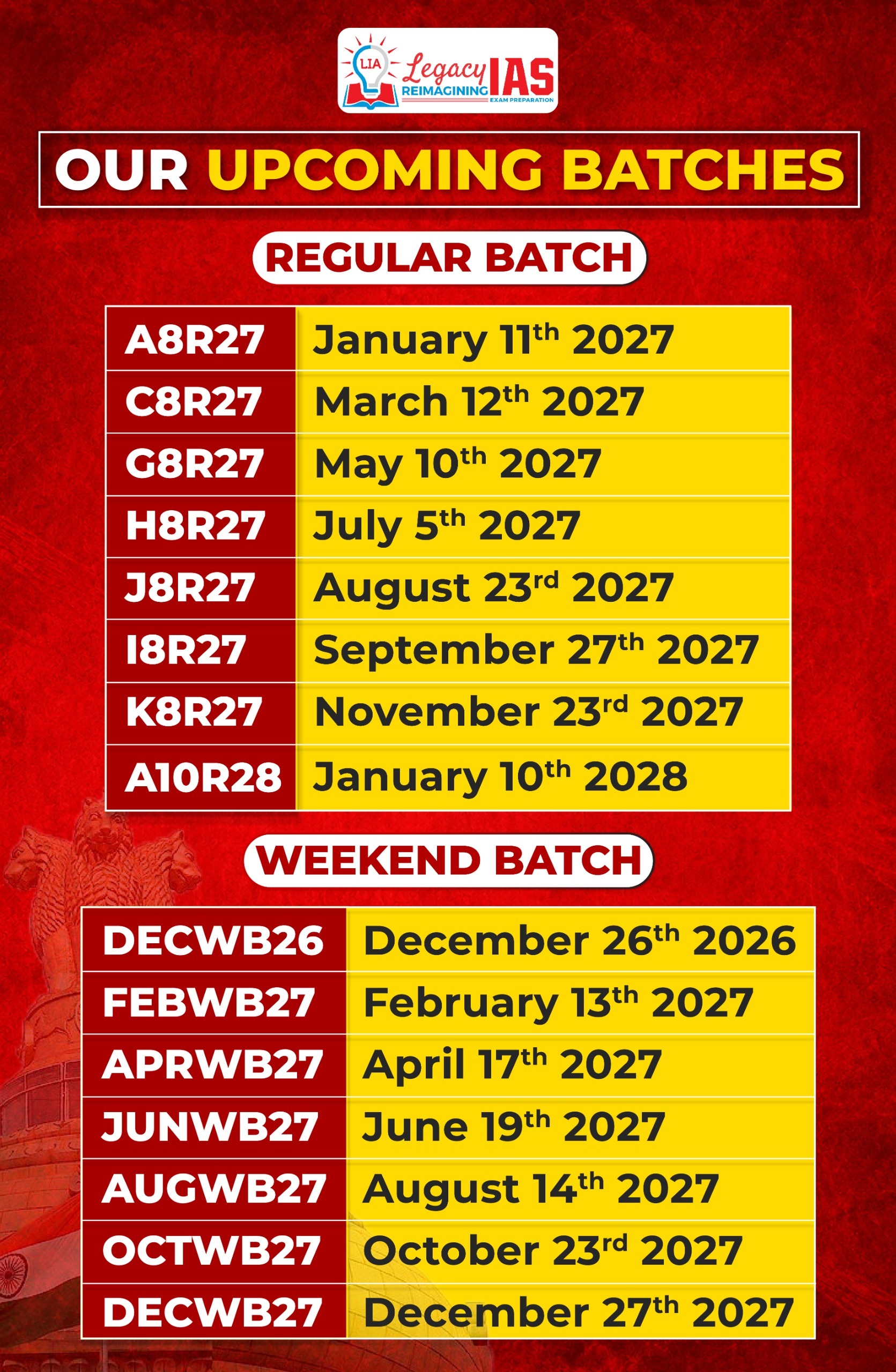
Serious about cracking UPSC CSE?
Join Legacy IAS Academy's structured Prelims + Mains programs, or get personalised mentorship from experienced faculty and toppers.
Legacy IAS Academy — Bengaluru
#1, 2nd Floor, KHB Colony, 5th Block, Koramangala, Bengaluru, Karnataka
Source: The Hindu, Delhi City Edition, 27 November 2026. Static background and frameworks have been added for exam preparation. Original article text has been paraphrased, not reproduced; this analysis is prepared independently for UPSC Civil Services exam preparation.