
- BBC Investigation into Instagram CSAM Ads and Social Media Regulation in IndiaGS2 / GS3
- Sahkar Se Samriddhi: Five Years of the Ministry of CooperationGS2 / GS3
- SpudCell: A Synthetic Cell Built from Non-Living ChemicalsGS3
- 250th Anniversary of United States’ IndependenceGS2
- India’s EV Transition and the Case for Vehicle RetrofitmentGS3
- Lifting of Emergency Natural Gas Supply CurbsGS3
- When Might Photosynthetic Life on Earth End?GS1
BBC Investigation into Instagram CSAM Ads and Social Media Regulation in India
GS Paper 2 / GS Paper 3 — Governance, Intermediary Liability, CybersecurityThe Central government has directed Meta, the parent company of Instagram, Facebook and WhatsApp, to take down advertisements on Instagram that were found promoting access to child sexual abuse material. The notice follows a BBC investigation that found the platform running paid ads redirecting users to channels on the messaging app Telegram, where such material could reportedly be purchased. The episode has renewed a wider debate on intermediary liability, algorithmic accountability and the need for a comprehensive, risk-based regulatory framework for digital platforms in India, amid parallel regulatory action against Meta, Telegram and Signal on issues ranging from digital fraud to piracy.
- Intermediaries such as social media platforms receive conditional immunity from liability for third-party content under Section 79 of the Information Technology (IT) Act, 2000, provided they observe due diligence obligations.
- The IT Rules, 2021 impose additional due-diligence requirements on platforms classified as Significant Social Media Intermediaries (SSMIs) based on user thresholds.
- The Protection of Children from Sexual Offences (POCSO) Act, 2012 provides stringent criminal provisions against the production, circulation and commercialisation of child sexual abuse material, alongside relevant IT Act provisions.
- This is not the first time Instagram’s handling of such content has been scrutinised: a 2023 investigation by a major American newspaper (with researchers from two US universities) had found Instagram’s algorithms actively connecting and promoting accounts and networks devoted to underage-sex content, and a 2025 investigative report had similarly flagged AI-generated sexualised imagery of minors circulating on the platform.
- Platform ads are meant to be screened by automated moderation tools before being published; Meta has stated it maintains a zero-tolerance policy on such material and uses AI systems to proactively detect violations, while acknowledging the challenge of policing a user base of roughly 3.5 billion people.
- The investigation found that the platform’s user-reporting mechanism was not always effective, with some flagged advertisements initially assessed as not violating community guidelines; Meta has stated that a number of the flagged ads and associated accounts were subsequently removed.
- The report linked the moderation gaps partly to the platform’s advertising-driven revenue model, given that advertising accounts for the overwhelming share of Instagram’s revenue.
- WhatsApp usernames: The Ministry of Electronics and IT (MeitY) has flagged concerns that a proposed feature allowing communication without displaying phone numbers could enable phishing, identity theft and impersonation offences under Sections 66C and 66D of the IT Act.
- Telegram piracy: The government identified over 3,100 Telegram channels allegedly distributing pirated films and OTT content and has asked the platform to proactively detect and disable such content, rather than rely solely on a channel-by-channel takedown approach; Telegram was also briefly blocked ahead of a national examination re-conduct over concerns about its use in facilitating paper leaks and cybercrime.
- Instagram CSAM: The government has directed Meta to disable the flagged content and submit an Action Taken Report (ATR).
- BGP (Border Gateway Protocol): the routing protocol that determines how data travels between different networks (Autonomous Systems) that make up the internet; it lacks built-in trust verification, making it vulnerable to hijacking.
- RPKI (Resource Public Key Infrastructure): a cryptographic framework that verifies the authenticity of network routes to secure BGP.
- DNS Hijacking: manipulation of the internet’s domain-name-to-IP-address directory to redirect users to malicious sites.
- Zero Trust Architecture (ZTA): a security model requiring continuous identity verification for every user and device, replacing the older assumption of trusting everything inside a network perimeter.
- Splinternet: the fragmentation of the global internet into separately controlled national or regional networks.
- Blurred intermediary status: as recommendation and advertising algorithms increasingly curate content, the line between a passive intermediary (protected under Section 79) and an active publisher becomes harder to draw.
- Reactive rather than preventive regulation: India’s framework largely relies on notice-and-takedown rather than ex-ante, risk-based oversight.
- Opaque algorithms: proprietary recommendation and moderation systems function as unauditable "black boxes," limiting regulatory oversight.
- Fragmented laws: platforms are simultaneously governed by the IT Act 2000, DPDP Act 2023, Copyright Act 1957, POCSO Act 2012 and Competition Act 2002, creating overlapping jurisdiction.
- Way forward: a dedicated Digital Networking Platforms law (reportedly under consideration for 2026) instead of piecemeal IT Act amendments; mandatory algorithmic audits for significant platforms; judicially supervised traceability mechanisms for grave offences without weakening end-to-end encryption for ordinary users; and safety-by-design standards with mandatory CSAM-detection technology.
- Section 79, IT Act 2000: grants intermediaries conditional "safe harbour" immunity, contingent on due diligence — not an absolute or unconditional protection.
- SSMI: Significant Social Media Intermediary — a category under the IT Rules, 2021 with enhanced compliance obligations, based on user-count thresholds.
- Shreya Singhal vs Union of India (2015): upheld Section 69A (blocking powers) as constitutional, citing procedural safeguards like a review committee.
- Ajit Mohan vs Delhi Legislative Assembly (2021): held that platforms like Facebook/Meta are "centres of concentrated power" and not merely passive intermediaries.
- Anuradha Bhasin vs Union of India (2020): recognised freedom of speech over the internet as protected under Article 19.
- BGP vs RPKI: BGP is the routing protocol; RPKI is the cryptographic safeguard that verifies route authenticity for it.
"Digital platforms today act as active curators of content rather than passive intermediaries." Examine this statement with reference to India’s regulatory framework for social media intermediaries and the challenges in enforcing child-safety obligations.
Match List-I (Judicial Pronouncement) with List-II (Key Principle Established) and select the correct answer using the codes given below:
| List-I | List-II |
|---|---|
| A. Shreya Singhal vs Union of India (2015) | 1. Freedom of speech over the internet is protected under Article 19 |
| B. Tehseen Poonawalla vs Union of India (2018) | 2. Platforms are "centres of concentrated power," not passive intermediaries |
| C. Anuradha Bhasin vs Union of India (2020) | 3. Upheld Section 69A citing adequate procedural safeguards |
| D. Ajit Mohan vs Delhi Legislative Assembly (2021) | 4. Directed governments to curb dissemination of content inciting mob violence |
Sahkar Se Samriddhi: Five Years of the Ministry of Cooperation
GS Paper 2 / GS Paper 3 — Governance, Cooperative Sector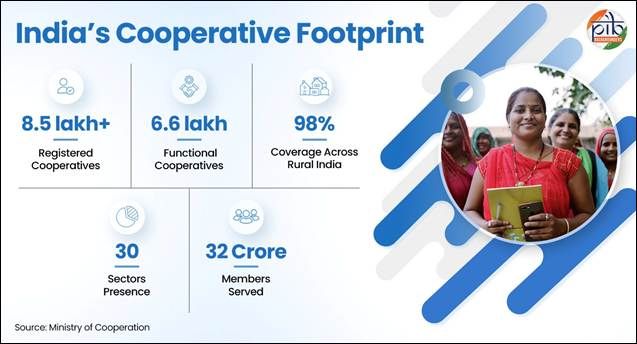
The Ministry of Cooperation marked its 5th Foundation Day on 6 July 2026 at Bharat Mandapam, New Delhi, highlighting the conversion of 50,000 Primary Agricultural Credit Societies (PACS) into e-PACS, foundation-laying for 47 grain storage godowns, launch of a Milk Supply Review Dashboard Portal for the National Dairy Development Board, and two new digital platforms from the National Urban Cooperative Finance and Development Corporation (NUCFDC) — Sahakar CBS, a centralised core banking solution for Urban Cooperative Banks, and Sahakar Sahyogi, a conversational AI platform for customer service.
- India’s cooperative movement draws on the philosophy of Vasudhaiva Kutumbakam ("the world is one family"), with cooperatives historically serving as vehicles of shared ownership across credit, dairy, fisheries, housing and marketing.
- The Ministry of Cooperation was carved out as a separate ministry on 6 July 2021 to give focused institutional attention to the sector.
- The 97th Constitutional Amendment Act, 2011 gave cooperatives constitutional recognition through Article 19(1)(c) (right to form cooperative societies), Article 43B (a Directive Principle directing the State to promote cooperatives) and Part IXB (Articles 243ZH–243ZT), which lays down a governance framework for cooperative societies.
- Cooperatives are regulated under a dual structure: State-level cooperatives fall under the State List (governed by State Registrars), while multi-state cooperatives are governed by the Multi-State Cooperative Societies (MSCS) Act, 2002 under a Central Registrar.
- The National Cooperation Policy 2025 replaces the 2002 policy, providing a roadmap for 2025–2045, including a target of establishing 2 lakh new multipurpose PACS (M-PACS) and promoting cooperative education through Tribhuvan Sahkari University in Anand, Gujarat.
- India has one of the world’s largest cooperative ecosystems — over 8.5 lakh cooperatives serving nearly 32 crore members across about 30 sectors, with a presence in almost 98% of rural India.
- Nearly 10 crore women are linked to cooperatives through Self-Help Groups (SHGs).
- Geographic concentration is high: Maharashtra alone accounts for more than a quarter of all cooperatives, and the top five states (Maharashtra, Gujarat, Telangana, Madhya Pradesh, Karnataka) together account for 57% of the national total.
- Model bye-laws have enabled PACS in 32 States/UTs to undertake more than 25 business activities beyond credit, including retail, storage, healthcare, fuel retailing and digital services.
- As of June 2026: 39,177 PACS function as PM Kisan Samriddhi Kendras, 54,117 as Common Service Centres, 394 have applied for retail fuel outlets (3 commissioned), and 4,248 have been approved as Jan Aushadhi Kendras (843 operational).
- Digitalisation outlay has risen from an initial ₹2,516 crore (2022) to ₹2,925.39 crore (2025), with a target to computerise 63,000 PACS by 31 March 2027; 63,428 PACS are currently on ERP software (available in 14 languages), with online audits completed in more than 42,700 PACS.
- 37,454 new multipurpose PACS, dairy and fisheries cooperative societies have been registered; PACS now cover more than 2.55 lakh Gram Panchayats, dairy cooperatives cover over 87,159, and fisheries cooperatives cover nearly 29,964 Gram Panchayats.
- National Cooperative Exports Limited (NCEL): an umbrella body for cooperative exports; recorded 15.4 lakh metric tonnes of exports worth ₹6,295 crore to 38 countries as of June 2026.
- National Cooperative Organics Limited (NCOL): handles aggregation, certification and marketing of organic products; has 14,286 member cooperatives.
- Bharatiya Beej Sahakari Samiti Limited (BBSSL): produces and distributes quality seeds under the "Bharat Beej" brand; has 38,665 member cooperatives.
- Tax relief: surcharge for cooperatives earning ₹1–10 crore reduced from 12% to 7%; Minimum Alternative Tax (MAT) cut from 18.5% to 15%; TDS cash-withdrawal limit raised from ₹1 crore to ₹3 crore.
- White Revolution 2.0: aims to raise milk procurement by 50% by 2028–29, with 25,282 dairy cooperative societies registered so far and a focus on women-led dairy cooperatives.
- NCDC financing: the National Cooperative Development Corporation sanctioned ₹1.55 lakh crore and disbursed ₹1.27 lakh crore in FY 2025-26, including ₹2,320 crore to Farmer Producer Organisations (FPOs)/Cluster-Based Business Organisations.
- Bharat Taxi: India’s first cooperative-based mobility platform (under Sahakar Taxi Cooperative Limited), with 6.37 lakh registered drivers and 35.77 lakh registered customers across seven cities, with expansion planned to seven more.
- Weak governance and professional management capacity in many primary-level cooperatives.
- Financial constraints and dependence on government support for modernisation.
- Regulatory overlaps between State and Central cooperative laws.
- Competition from private-sector and corporate players in retail, dairy and finance.
- 97th Constitutional Amendment Act, 2011: added Article 19(1)(c), Article 43B and Part IXB (Articles 243ZH–243ZT) — gave cooperatives constitutional status.
- MSCS Act, 2002: governs multi-state cooperative societies under the Union List; State-level cooperatives fall under the State List.
- National Cooperation Policy 2025: roadmap for 2025–2045; targets 2 lakh new M-PACS; replaces the 2002 policy.
- PACS: Primary Agricultural Credit Societies — grassroots short-term rural credit institutions, now diversifying into retail, fuel and digital services.
- Notable cooperatives: AMUL, IFFCO, Lijjat Papad.
Discuss the role of cooperatives in furthering inclusive, grassroots-led economic development in India. What structural challenges must be addressed to realise the vision of "Sahkar Se Samriddhi"?
As per the National Cooperation Policy 2025, how many new Multipurpose Primary Agricultural Credit Societies (M-PACS) does the policy target for establishment under its 2025–2045 roadmap?
Answer: CSpudCell: A Synthetic Cell Built from Non-Living Chemicals
GS Paper 3 — Science and Technology, BiotechnologyResearchers at the University of Minnesota have built a synthetic cell, informally referred to as SpudCell, entirely from non-living chemical components, that can grow, replicate its own DNA, divide into daughter cells, and even undergo evolutionary selection — a landmark achievement in synthetic biology.
- Synthetic biology involves designing and constructing new biological components or systems, sometimes from scratch, rather than only modifying existing living organisms as in conventional genetic engineering.
- A liposome is a small bubble made of fat (lipid) molecules; here it served as the starting artificial cell membrane.
- The PURE system is a cell-free protein-synthesis mixture containing the minimal set of molecular machinery required to translate DNA into proteins, without needing a living cell.
- Construction: the cell began as a liposome housing the PURE system and a custom-designed genome of 90,000 base pairs.
- Feeding mechanism: the DNA instructed the cell to produce a protein, alpha-hemolysin, that acted as a "hook" on the cell surface, allowing it to capture and fuse with smaller feeder liposomes to absorb lipids and nutrients needed for growth.
- DNA replication: as the cell grew, an enzyme called Phi29 copied its entire genome.
- Cell division: unlike natural cells, which rely on an internal cytoskeleton for division, the synthetic cell was engineered to divide through simple physical pressure created by proteins crowding its surface, causing the membrane to split into two daughter cells (researchers initially used mechanical force before achieving this biological method).
- Evolutionary selection: when a mutation allowing faster feeding was introduced, the more efficient variant reproduced quicker and came to dominate the population — demonstrating that artificial systems can undergo natural selection.
- SpudCell displays life-like behaviour but is not a fully autonomous living organism — it depends on an external supply of nutrients and ribosome-related machinery and cannot sustain itself the way a natural cell can.
- Commentators have noted that such experiments weigh against the idea that life requires some non-material vital force beyond ordinary chemistry, though this remains a minority scientific position historically.
- Potential applications: precision medicine, including programmable drug-delivery systems; sustainable industrial biomanufacturing; and engineered artificial organisms for environmental cleanup.
- Liposome: a lipid (fat) bubble used as an artificial cell membrane.
- PURE system: a cell-free chemical mixture that translates DNA into proteins outside a living cell.
- Phi29: the enzyme used to copy (replicate) the synthetic cell’s genome.
- Alpha-hemolysin: the "hook" protein enabling the synthetic cell to fuse with and absorb feeder liposomes.
- SpudCell divides via membrane pressure from surface protein crowding, not via a cytoskeleton as in natural cells.
What is a synthetic cell? Discuss the scientific significance and potential real-world applications of recent advances in synthetic biology, such as the development of cell-free, chemically-constructed synthetic cells.
Consider the following statements regarding "SpudCell", the synthetic cell recently developed by researchers:
Assertion (A): SpudCell is considered a landmark achievement in synthetic biology.
Reason (R): SpudCell is a fully autonomous living organism capable of self-sustenance without any external supply of nutrients or ribosomal machinery.
Which one of the following is correct?
250th Anniversary of United States’ Independence
GS Paper 2 — International RelationsPrime Minister Narendra Modi extended greetings to US President Donald J. Trump and the American people on the 250th anniversary of the United States’ independence (4 July 2026), describing the India-US relationship as anchored in shared democratic values, the rule of law, and faith in the potential of their peoples, rather than a purely strategic partnership.
- The US Declaration of Independence was adopted on 4 July 1776, proclaiming the independence of the 13 American colonies from British rule.
- It was drafted primarily by Thomas Jefferson as the principal author of the "Committee of Five".
- It proclaimed that individuals possess unalienable rights to Life, Liberty and the Pursuit of Happiness, and that governments derive their just powers from the "consent of the governed," rejecting the divine right of kings.
- It influenced the Universal Declaration of Human Rights (UDHR), 1948.
- The US Bill of Rights (a descendant of the Declaration’s individual-liberties philosophy) served as a model for Part III (Fundamental Rights) of the Indian Constitution, particularly Articles 14 and 21.
India’s EV Transition and the Case for Vehicle Retrofitment
GS Paper 3 — Energy Security, Infrastructure, EnvironmentThe recent conflict in West Asia has renewed attention on India’s energy-security vulnerability, given that the country imports over 85% of its crude oil requirement. While Electric Vehicles (EVs) now account for 8.5% of new vehicle sales in India in FY25-26, the transition is largely confined to new sales, while more than 30 crore Internal Combustion Engine (ICE) vehicles already on Indian roads continue to run entirely on imported petroleum — reviving the policy debate around vehicle retrofitment as a complementary pathway.
- Vehicle retrofitment is the process of replacing a vehicle’s engine, exhaust system and related components with an electric battery pack, motor and control systems, converting an existing ICE vehicle into an EV while retaining its chassis and structure.
- India has a long-standing cultural and economic ethos of repair, reuse and refurbishment — extending the utility of assets (including household appliances) before replacement — into which retrofitment fits naturally.
- The Faster Adoption and Manufacturing of Hybrid and Electric Vehicles (FAME) scheme initially included retrofitment support, though this component gradually faded from policy focus over time.
- Madhya Pradesh has taken early steps to build a supportive retrofitment ecosystem, including upfront subsidies, a one-stop subsidy-access portal, and statewide registration of retrofitment agencies (as opposed to case-by-case registration through Regional Transport Offices).
- Cost: retrofitting is argued to be cheaper than purchasing either a new EV or a new ICE vehicle.
- Inclusion: it could extend EV access to consumers who might otherwise be priced out of India’s emerging electric-vehicle market.
- Environmental case: retrofitting functioning vehicles reduces premature scrappage, avoidable waste and resource intensity, supporting a more circular mobility economy.
- Employment: a retrofit ecosystem could generate decentralised, distributed employment across technicians, service centres, battery-management specialists, software calibration and rural mobility entrepreneurship — unlike large centralised automotive manufacturing.
- Market signals: certified retrofit companies are reportedly now working with testing agencies, insurers and financiers, and enquiries are said to have doubled following the West Asia conflict; some European countries and Nepal have also begun exploring or supporting retrofit-based circular mobility models.
- Retrofit policies currently vary across States and need standardisation at the national level.
- Financing institutions do not uniformly recognise retrofitted vehicles as finance-worthy assets.
- Robust, uniform certification and safety standards are needed to weed out low-quality informal conversions that could erode consumer trust.
- Goods and Services Tax (GST) treatment of retrofit kits may need rationalisation so they are not taxed at a disadvantage relative to new EVs.
- Retrofitment-related data should be made publicly available, and schemes such as PM E-DRIVE (which currently extends subsidy support to zero-emission trucks) could be considered for extension to retrofitment as well.
- India imports over 85% of its crude oil requirement.
- EVs accounted for 8.5% of new vehicle sales in India in FY25-26.
- More than 30 crore ICE vehicles currently ply on Indian roads.
- FAME scheme: originally included retrofitment support, which later diminished in policy emphasis.
- PM E-DRIVE scheme: currently extends subsidy support to zero-emission trucks; suggested for possible extension to retrofitment.
Examine the case for vehicle retrofitment as a strategy to reduce India’s oil-import dependency and complement its EV transition. What policy measures are needed to mainstream retrofitment in India?
Consider the following statement: "The FAME (Faster Adoption and Manufacturing of Hybrid and Electric Vehicles) scheme has never included any provision for vehicle retrofitment support." Is this statement correct?
Answer: BLifting of Emergency Natural Gas Supply Curbs
GS Paper 3 — Energy Security, EconomyOn 4 July 2026, the government lifted the emergency curbs it had imposed in March 2026 on the supply of natural gas during the West Asia crisis, citing the ceasefire, ongoing negotiations, and the resumption of sea traffic through the Strait of Hormuz. The Petroleum and Natural Gas Ministry amended the Natural Gas (Supply Regulation) Order, 2026 to remove the priority-based allocation list that had governed supply to fertilizer plants, refineries, distributors and industrial users during the crisis.
- On 12 March 2026, Union Minister for Petroleum and Natural Gas Shri Hardeep Singh Puri had informed Parliament of an "immediate priority sequence" for gas allocation: domestic piped gas and CNG for vehicles received 100% supply with no cuts; industrial and manufacturing consumers received up to 80% of their previous six-month average; fertilizer plants received up to 70% (to protect the agricultural input chain ahead of the sowing season); and refineries/petrochemical units absorbed a managed reduction, with the freed-up gas redirected to higher-priority sectors.
- On 25 June 2026, the government had already restored industrial and commercial LPG supply to pre-crisis levels, ahead of the broader gas-curb rollback.
- Sectorally, roughly 30% of India’s natural gas use goes into fertilizer production, about 13% into power generation, and about 21% into city gas distribution.
- The biggest beneficiaries are expected to be industrial and commercial users of natural gas, since supplies to fertilizer units and domestic households had already been largely normalised even before this latest step.
- City gas distributors, refineries, and industries such as ceramics, power, sponge iron and petrochemicals — whose supplies had been curtailed — can now ramp up capacity utilisation as fuel supply resumes.
- During the peak of the crisis, ceramic manufacturing units in Gujarat’s Morbi cluster were among the worst affected, with reports indicating around 600 factories and roughly 4 lakh workers impacted by the shortage of propane and natural gas.
- Urea — the most common nitrogen fertilizer, containing around 46% nitrogen — is produced by converting natural gas (methane) into ammonia and combining it with carbon dioxide, making natural gas supply central to fertilizer output.
- The government has highlighted its ongoing energy-diversification efforts as having helped cushion the crisis: the crude-oil sourcing basket has widened from 27 to 41 countries, import-terminal capacity has doubled, and pipeline and reserve infrastructure has been built up over the past decade.
- The Petroleum Ministry has indicated that lessons from the disruption will inform further capability-building to strengthen India’s long-term energy resilience.
- The Strait of Hormuz carries roughly 20% each of the world’s crude oil, natural gas and LPG trade.
- Urea production converts natural gas (methane) into ammonia, combined with carbon dioxide.
- Sectoral natural gas use in India: ~30% fertilizers, ~13% power, ~21% city gas distribution.
- The Natural Gas (Supply Regulation) Order, 2026 was the instrument used to impose and later lift the emergency priority-allocation regime.
Discuss how the 2026 West Asia energy-supply disruption exposed vulnerabilities in India’s energy security. What measures can help strengthen India’s long-term energy resilience?
With reference to the emergency natural gas priority-allocation sequence announced in March 2026, consider the following statements:
1. Domestic piped gas and CNG for vehicles received 100% supply with no cuts.
2. Fertilizer plants were entitled to up to 70% of their previous six-month average gas supply.
3. Refineries and petrochemical units were given top priority over all other categories of consumers.
Which of the statements given above is/are NOT correct?
When Might Photosynthetic Life on Earth End?
GS Paper 1 — Geography, Earth ScienceResearchers in the United States, using a more sophisticated climate model that accounts for clouds, humidity and planetary circulation, have estimated that photosynthetic life on Earth could persist for roughly another 1.68 billion years, with the complete extinction of land plants projected by around 1.87 billion years, as the ageing Sun grows brighter and eventually too hot for plants to survive.
- Earlier, simpler climate models had estimated the biosphere’s "twilight" occurring anywhere between 100 million and 900 million years from now.
- Plants generally need a minimum of about 10 parts per million (ppm) of atmospheric carbon dioxide to survive; certain crassulacean acid metabolism (CAM) plants and aquatic species may survive down to as low as 1 ppm.
- Under a "strong weathering" scenario (where the carbon cycle draws down CO₂ to offset solar heating), the vegetative biosphere could persist for up to ~1.84 billion years.
- Under a "weak weathering" scenario (CO₂ levels remain constant while temperature rises), the thermal limit for complex life is reached in ~1.68 billion years, and all land plants go extinct by ~1.87 billion years.
- Earth is projected to begin losing its oceans to space in about 2.1 billion years.


