
- India’s Statistical Database Upgrade — GDP, IIP, CPI, WPI & PPI Explained GS3
- Ashtalakshmi — A 12-Year Review of North-East Development GS2
- The Antarctic Treaty System Turns 65 GS1
- Centre Tightens FCRA Rules for NGOs Receiving Foreign Funds GS2
- Delhi High Court Upholds Telegram Ban — Reinterpreting “Information” Under the IT Act GS2
- AI Hallucination and Creativity — The Temperature Dial GS3
- 3I/ATLAS — The Oldest Interstellar Comet Ever Observed GS3
- RAD-BAARG — India’s Citizen Scientists Discover a Bow-and-Arrow Radio Galaxy GS3
Over the past year, the Government of India has carried out a wide-ranging modernisation of its core statistical databases — updating the base years and methodology of GDP/GVA, the Index of Industrial Production (IIP), the Consumer Price Index (CPI), and the Wholesale Price Index (WPI) — while introducing India’s first-ever Producer Price Index (PPI). This explainer consolidates what changed, why it was needed, and what gaps remain in India’s statistical architecture.
- IMF ‘C’ Grade: In late 2025, the International Monetary Fund assigned India’s national accounts statistics a ‘C’ grade — the second-lowest rating — on quality, representativeness, and timeliness, creating institutional pressure for rapid correction.
- Outdated Base Years: GDP, GVA, and IIP were anchored to a 2011-12 base; CPI to 2012; WPI to 2011-12. Fifteen years of structural change — GST-driven formalisation, the digital payments revolution, and a shifting services footprint — had rendered these weights unrepresentative.
- Obsolete Consumption Baskets: Legacy CPI continued tracking items such as VCRs, cassette tapes, and radios while omitting modern consumption items like online streaming, CNG, and PNG.
- Policy Precision: The RBI’s Monetary Policy Committee relies on CPI for repo rate decisions; Dearness Allowance/Relief for government employees is pegged to these indices. Distorted base data weakens both monetary policy and the GDP deflation process used to calculate real growth.
| Index | Measures | Published By | New Base Year |
|---|---|---|---|
| GDP/GVA | National output and value addition | MoSPI | 2022-23 |
| IIP | Volume of industrial production | MoSPI | 2022-23 |
| CPI | Retail prices paid by consumers | MoSPI | 2024 |
| WPI | Wholesale prices of goods only | DPIIT (Commerce Ministry) | 2022-23 |
| PPI (new) | Prices received/paid by producers, goods & services | DPIIT (Commerce Ministry) | 2022-23 |
- Double Deflator Method: Adopted for agriculture and manufacturing — deflates input and output prices separately for a more accurate real-GDP estimate; expected to extend to other sectors over time.
- Proportionate Sectoral Allocation: Multi-activity enterprises’ output is now distributed proportionately across sectors instead of being assigned entirely to the primary sector.
- New Data Sources: Goods and Services Tax (GST) returns and the Periodic Labour Force Survey (PLFS) have been integrated to reduce discrepancies.
- Basket expanded from 839 items/407 item groups to 1,042 items/463 item groups.
- New coverage: gas supply, water supply, sewerage, and waste management activities.
- Electricity is now split into renewable and non-renewable sources for the first time.
- Base year shifted to 2024; weights now pegged to the Household Consumption Expenditure Survey (HCES) 2023-24.
- Items measured increased from 299 to 358, reorganised into 12 categories (up from 6).
- New inclusions: rural house rent, online media/streaming services, CNG, and PNG. Outdated items such as VCRs, cassette recorders, and radios were removed.
- Linking Factor: A linking factor derived from parallel 2025 data collection under both old and new methodologies allows construction of a back-series for seamless long-term trend analysis.
- WPI item basket expanded from 697 to 957; crude petroleum and natural gas reclassified from ‘Primary Articles’ to ‘Fuel and Power’.
- Output PPI measures prices received by producers, excluding net taxes and trade/transport margins — designed to eventually replace WPI as the principal non-retail inflation gauge and GDP deflator.
- Input PPI (experimental, ~2-year trial) measures prices paid by producers for inputs, using purchaser prices (margins included) — methodologically closer to CPI.
- Services PPI (quarterly, first-of-its-kind) covers seven sectors: banking, securities transactions, insurance, pension fund management, railways, air passenger transport, and telecom.
- WPI and PPI will run in parallel for roughly five years before WPI is phased out; long-term contracts extending beyond this window must shift price-escalation clauses to PPI.
- Global Alignment: Introducing a PPI brings India in line with IMF recommendations and the practice of most advanced economies, which already separate producer-level and consumer-level price measurement.
- Services Coverage Gap Closed: WPI historically covered only goods; PPI captures price dynamics in services, which make up over half of India’s GDP.
- Sharper GDP Deflation: Output PPI is set to replace the current WPI+CPI combination used to convert nominal GDP into real GDP.
- Census Delay: The decennial Census (due 2021) remains delayed; without updated demographic multipliers, per-capita and poverty estimates rely on ageing 2011 population projections. Census 2027 is planned as India’s first digital, app-based census.
- Informal Sector Blind Spot: The informal sector employs nearly 80% of India’s workforce but is poorly captured by GST/MCA-based formal-sector data sources, risking an overstated GDP if formal-sector growth outpaces informal-sector reality.
- Institutional Autonomy Concerns: The 2019 merger of the CSO and NSSO into the National Statistical Office (NSO) diluted the oversight role of the National Statistical Commission (NSC); the draft Indian Statistical Institute (ISI) Bill, 2025 has drawn academic concern over proposed government-nominated governance replacing an elected council.
- Outdated Poverty Line: India has not officially revised its poverty line since the Tendulkar Committee methodology (based on 2011-12 data).
- Lack of Granular Data: District-level and block-level economic statistics remain scarce, limiting evidence-based local governance.
- Statutory Autonomy for NSC: Granting the National Statistical Commission constitutional-style independence (on lines of the CAG), as recommended by the C. Rangarajan Commission (2000) and the Standing Committee on Finance (2025).
- District Domestic Product (DDP): Standardising DDP compilation across states, integrated with PLFS block-level sampling, per NITI Aayog’s Governing Council recommendation.
- Capacity Building: Expanding the Support for Statistical Strengthening (SSS) scheme to help states adopt CAPI tablets and AI-driven validation tools.
- Open Data Architecture: Moving toward fully open, anonymised microdata access for researchers via portals such as e-Sankhyiki.
- Base Year = the reference year against which an index is measured, set at 100; periodic revision keeps indices representative of current consumption/production patterns.
- Double Deflator Method = a GDP estimation technique that deflates input and output prices separately, rather than using a single deflator, for greater accuracy.
- GDP Deflator = the ratio used to convert nominal GDP into real GDP; India is transitioning from a WPI+CPI combination to Output PPI.
- WPI = published by DPIIT, Ministry of Commerce and Industry; covers goods only; new base year 2022-23; basket expanded to 957 items.
- PPI = India’s first Producer Price Index; covers both goods and services; excludes taxes and trade/transport margins (Output PPI); aligned with IMF standards.
- CPI = published by MoSPI; new base year 2024, weights from HCES 2023-24; used by RBI’s MPC for inflation targeting.
- IIP = published monthly by MoSPI; new base year 2022-23; basket now 1,042 products/463 item groups.
- NSC = National Statistical Commission; functions via executive resolution (not statutory backing); oversight diluted since the 2019 CSO-NSSO merger into the NSO.
- HCES = Household Consumption Expenditure Survey; its 2023-24 round supplied the weights for the new CPI series.
- Tendulkar Committee = basis of India’s last officially defined poverty line, using 2011-12 consumption data.
“India’s recent statistical modernisation addresses representativeness but leaves institutional autonomy and coverage gaps unresolved.” Examine the key changes introduced to India’s GDP, price, and industrial production statistics, and discuss the structural challenges that continue to affect the reliability of India’s statistical system.
With reference to India’s recently revised economic indices, consider the following statements:
1. The new Wholesale Price Index (WPI) series, with base year 2022-23, covers both goods and services.
2. The Output Producer Price Index (PPI) excludes net taxes and trade/transport margins from its price measurement.
3. The double deflator method has been adopted for estimating real GDP growth in the agriculture and manufacturing sectors.
Which of the statements given above is/are correct?
The Government has released a consolidated review of development in India’s North Eastern Region (NER) over the 2014–2026 period, branding the eight states — Arunachal Pradesh, Assam, Manipur, Meghalaya, Mizoram, Nagaland, Sikkim, and Tripura — collectively as “Ashtalakshmi”, after the eight forms of Goddess Lakshmi in Indian tradition. The review covers connectivity, energy, social infrastructure, and agriculture under the framework of the Act East Policy.
- National Highway length in the NER rose from 10,905 km (2014) to 16,207 km (April 2025), driven by the Bharatmala Pariyojana and rural last-mile connectivity under PMGSY (50,850 km of rural roads built in the NER over 12 years).
- Rail track commissioning increased from 333 km (2009–14) to over 1,900 km (2014–26); five of eight states have achieved 100% rail electrification.
- Landmark engineering projects: the Bogibeel Bridge (Assam, 2018, combined road-rail bridge over the Brahmaputra), the Dhola-Sadiya/Bhupen Hazarika Setu (2017), the Noney Bridge (Manipur — the world’s tallest railway pier bridge at 141 metres), and the Sela Tunnel (Arunachal Pradesh, 2024, built by the BRO at 13,000 feet).
- Operational airports increased from 9 (2014) to 17 (2026) under the UDAN scheme, including new airports such as Pakyong and Tezu.
- National Waterways in the region increased from 1 (2014) to 20 (2024); the Brahmaputra (National Waterway-2) links the NER to mainland India via the Indo-Bangladesh Protocol Route.
- The India–Myanmar–Thailand Trilateral Highway aims to connect Moreh (Manipur) to Mae Sot (Thailand) via Myanmar.
- The Kaladan Multi-Modal Transit Transport Project connects Sittwe port in Myanmar to Paletwa via inland waterway, benefiting Tripura’s trade access.
- Integrated Check Posts (e.g., Moreh) and Border Haats (e.g., Kamalasagar, Bholaganj) support formal trade and local cross-border commerce.
- Hydropower: The 2,880 MW Dibang Multipurpose Project (Arunachal Pradesh, foundation laid 2024) and the 2,000 MW Subansiri Lower Project (Assam-Arunachal Pradesh border) are under development.
- North East Gas Grid: A planned 1,656 km pipeline network to connect all eight states with the national gas grid, including a Brahmaputra river-crossing pipeline using Horizontal Directional Drilling.
- Solar & Decentralised Energy: A 20 MW solar park in Champhai (Mizoram) and rooftop solar promotion under PM Surya Ghar.
- Water & Sanitation: Arunachal Pradesh and Mizoram have achieved 100% rural tap water coverage under the Jal Jeevan Mission; all eight states are declared Open Defecation Free under the Swachh Bharat Mission.
- Health & Education: AIIMS Guwahati is fully operational; 12 new medical colleges approved; IIT Guwahati, NIT Sikkim, and NIT Nagaland anchor regional higher education.
- Housing: Over 28 lakh rural houses completed under PMAY-Gramin; 100% household electrification achieved under Saubhagya.
- Agriculture: Inland fish production grew over 68% (2014-15 to 2024-25), with Assam contributing over 70% of regional output; the NER hosts 89 GI-tagged products including Lakadong Turmeric and King Chilli; the region holds roughly 90% of India’s estimated 150 million agarwood trees.
- Ecological Sensitivity of Mega-Projects: Large hydropower projects such as Dibang and Subansiri Lower have drawn concerns from environmental groups and local communities over seismic risk, downstream flow impacts, and submergence of forest land in an ecologically fragile and seismically active region.
- Self-Reported Metrics: Many progress figures (project completion counts, coverage percentages) originate from the implementing ministries themselves; independent third-party verification of outcomes — as opposed to expenditure or physical targets — remains limited.
- Uneven Progress Across States: Aggregate regional figures can mask wide variation between states; for instance, full electrification of rail tracks has been achieved in five of eight states, with Assam still nearing completion.
- Land and Displacement Sensitivities: Infrastructure and hydropower expansion in tribal-majority areas requires careful navigation of land rights, Sixth Schedule protections, and local consent processes.
- Ashtalakshmi = collective branding of the eight North Eastern states, after the eight forms of Goddess Lakshmi.
- MDoNER = Ministry of Development of North Eastern Region; channels funds via five Central Sector Schemes including PM-DevINE and NESIDS.
- PM-DevINE = 100% centrally funded scheme (2022–23 to 2025–26, outlay ₹6,600 crore) for high-impact NER infrastructure and social development projects.
- NESIDS = North East Special Infrastructure Development Scheme; ‘Roads’ and ‘Other Than Roads Infrastructure (OTRI)’ components.
- Kaladan Project = connects Kolkata (India) to Sittwe and Paletwa (Myanmar) via sea and inland waterway, benefiting Mizoram and Tripura.
- Bogibeel Bridge = India’s longest combined rail-cum-road bridge, across the Brahmaputra in Assam.
- Noney Bridge = world’s tallest railway pier bridge (141 m), part of the Jiribam–Imphal railway project in Manipur.
- National Waterway-2 = the Brahmaputra River.
- UDAN = Ude Desh ka Aam Nagrik scheme for regional air connectivity to underserved/unserved airports.
- Sixth Schedule = provides for autonomous district/regional councils in tribal areas of Assam, Meghalaya, Tripura, and Mizoram — relevant to land and governance issues in NER infrastructure projects.
The North Eastern Region has witnessed significant infrastructure expansion over the past decade under the Act East Policy. Discuss the major connectivity and energy initiatives undertaken, and examine the ecological and social challenges associated with large infrastructure projects in this region.
Consider the following pairs:
1. Bogibeel Bridge — Manipur
2. Sela Tunnel — Arunachal Pradesh
3. Noney Bridge — Assam
4. Dhola-Sadiya Bridge — Assam-Arunachal Pradesh
How many of the above pairs are correctly matched?
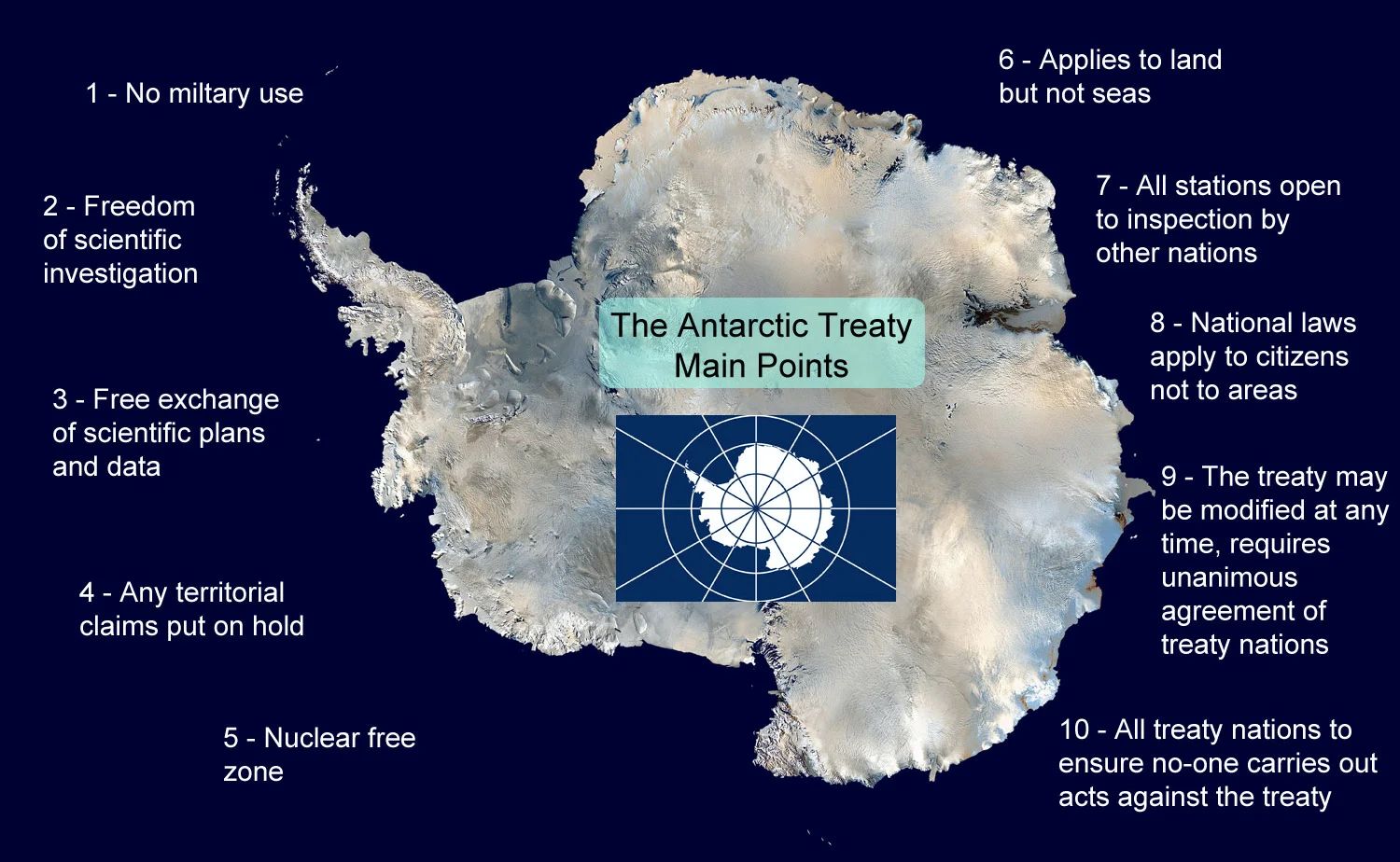
The Antarctic Treaty, which entered into force on 23 June 1961, completed 65 years on 23 June 2026. As the foundational instrument preserving Antarctica for peaceful purposes and scientific research, the Treaty remains a landmark example of Cold War-era international cooperation, even as it faces new pressures from geopolitical competition, climate change, and interest in the continent’s resource potential.
- Signed in Washington on 1 December 1959; entered into force 23 June 1961, following the International Geophysical Year (IGY) of 1957–58.
- Applies to the entire area south of 60°S latitude — nearly 10% of Earth’s surface — reserved strictly for peace and science.
- Original 12 signatories: Argentina, Australia, Belgium, Chile, France, Japan, New Zealand, Norway, South Africa, the Soviet Union, the UK, and the US.
- Orcadas Base (Laurie Island), transferred to Argentina in 1904, is the first permanently inhabited research station in Antarctica and has operated continuously since.
| Article | Provision |
|---|---|
| Article I | Peaceful purposes only — prohibits military bases and weapons testing |
| Articles II & III | Freedom of scientific investigation; free exchange of scientific results |
| Article IV | Freezes all territorial claims while the Treaty is in force (cornerstone provision) |
| Article V | Nuclear-free zone — bans nuclear explosions and radioactive waste disposal |
Seven nations — Argentina, Australia, Chile, France, New Zealand, Norway, and the UK — hold historical territorial claims that remain effectively frozen under Article IV.
- CCAS (1972): Convention for the Conservation of Antarctic Seals.
- CCAMLR (1980): Convention on the Conservation of Antarctic Marine Living Resources; applies an ecosystem approach to fishing, particularly krill.
- Madrid Protocol (1991): Designates Antarctica a “natural reserve, devoted to peace and science”; bans all commercial mineral resource extraction.
- The Treaty has 58 Parties in total.
- Of these, 29 are Consultative Parties with voting rights at the annual Antarctic Treaty Consultative Meeting (ATCM) — comprising the 12 original signatories plus 17 acceding countries that have demonstrated substantial scientific research activity in Antarctica.
- The remaining 29 are Non-Consultative Parties, who may attend ATCMs but do not vote.
- India signed the Treaty in 1983 and was granted Consultative status the same year; ratified the Madrid Protocol in 1998.
- Research stations: Dakshin Gangotri (1983, now a supply base), Maitri (1989, operational, Schirmacher Oasis), and Bharati (2012, near Thala Fjord).
- Maitri II — India’s planned fourth Antarctic station, approved in-principle, targeted for completion by 2032 as a solar/wind-powered “green research base.”
- National Centre for Polar and Ocean Research (NCPOR), Goa, established 1998 under the Ministry of Earth Sciences, is India’s nodal agency for the Indian Antarctic Programme.
- The Indian Antarctic Act, 2022 gives domestic legal effect to the Treaty, the Madrid Protocol, and CCAMLR, and extends Indian court jurisdiction to Antarctic expeditions.
- India hosted the 46th ATCM in Kochi (2024), which held the first dedicated working-group discussions on regulating Antarctic tourism.
- Antarctic Treaty = signed 1 December 1959; entered into force 23 June 1961; applies south of 60°S latitude.
- Total Parties = 58; Consultative (voting) Parties = 29 — a frequently tested distinction; total membership is not the same as voting membership.
- International Geophysical Year (IGY) = 1957–58; the scientific cooperation that directly led to the Treaty’s negotiation.
- Orcadas Base = Argentina’s station on Laurie Island; first permanently inhabited Antarctic station, operating continuously since 1904.
- Madrid Protocol (1991) = bans commercial mineral extraction; designates Antarctica a natural reserve for peace and science.
- CCAMLR (1980) = conserves Antarctic marine living resources, notably krill, via an ecosystem approach.
- Seven claimant nations = Argentina, Australia, Chile, France, New Zealand, Norway, UK — claims frozen, not extinguished, under Article IV.
- Maitri II = India’s planned fourth Antarctic station (after Dakshin Gangotri, Maitri, Bharati), targeted by 2032.
- NCPOR = National Centre for Polar and Ocean Research, Goa; under the Ministry of Earth Sciences; also manages India’s Arctic and Himalayan (Himansh) research stations.
- Indian Antarctic Act, 2022 = domestic legislation giving effect to the Antarctic Treaty, Madrid Protocol, and CCAMLR.
The Antarctic Treaty has been described as a unique model of international cooperation that froze territorial claims and demilitarised an entire continent. Discuss the key provisions of the Treaty and examine the emerging challenges to its effectiveness in the 21st century.
With reference to the Antarctic Treaty System, which one of the following statements is correct?
Correct Answer: (b)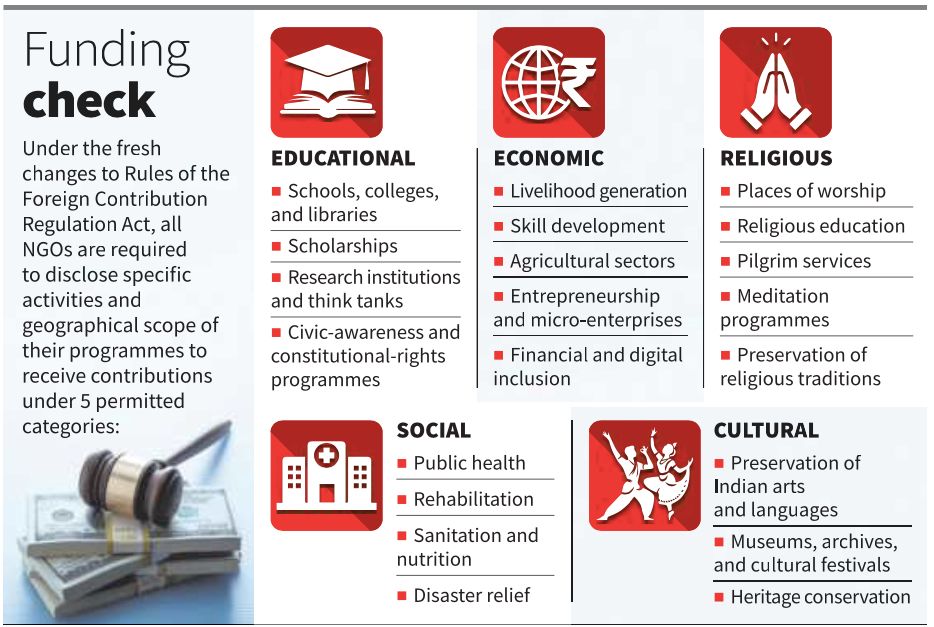
The Union Home Ministry has notified amendments to the Rules under the Foreign Contribution (Regulation) Act (FCRA), 2010, requiring NGOs seeking foreign funds to select from a defined list of permissible activities within their registered category, and to disclose significantly more information than under the earlier framework.
- Activity Lists: NGOs register under one of five categories — social, economic, educational, cultural, and religious — and must now choose from a specific list of permitted activities within that category for the first time; the geographical scope of programmes must also be disclosed.
- Expanded Disclosures: Applicants must disclose websites, social media accounts, and publications, and pay separate registration fees for each category and each State/UT of operation (replacing the earlier single flat fee).
- Religious Category Narrowed: Proselytisation has been explicitly excluded from eligible religious-category activities, while a range of other faith-based activities continue to be permitted.
- Broadened ‘Key Functionary’ Definition: Now includes trustees, partners, the Karta of a Hindu Undivided Family, governing body members, and any person controlling or managing the organisation — not just office-bearers and directors.
- Foreign Nationals as Key Functionaries: Organisations with foreign nationals (other than Persons of Indian Origin) as key functionaries will ordinarily be ineligible for registration or prior permission, unless the Centre specifically permits an exception.
- Utilisation Thresholds: NGOs must have spent at least ₹10 lakh of foreign contributions on permitted activities over the previous two financial years to qualify for renewal; under prior-permission cases, the next tranche is released only after at least 75% of the previous tranche has been utilised, subject to field verification.
- Donor Disclosure: NGOs must reveal the ultimate donor where funds are routed through intermediary remittance vehicles or Donor Advised Funds.
- Penalties: Violations attract a minimum fine of ₹1 lakh.
- The FCRA, 2010 regulates acceptance and utilisation of foreign contributions by individuals, associations, and companies, administered by the Union Home Ministry.
- The 2020 amendment mandated that all FCRA funds be received only into a designated account at the SBI’s New Delhi Main Branch and capped administrative expenses at 20% of total foreign contributions utilised (reduced from 50%).
- Earlier Rules only required NGOs to give an undertaking that accepting foreign funds would not affect India’s sovereignty, integrity, friendly relations with foreign states, or communal harmony — without a defined activity list.
- Compliance Burden: Smaller NGOs may find the category-wise fee structure, activity-list compliance, and disclosure requirements administratively demanding.
- Civil Society Space: Civil society organisations have previously raised concerns that successive FCRA tightening measures could constrain the operating space for advocacy and rights-based NGOs.
- Government’s Rationale: The Home Ministry has maintained that the changes aim to bring uniformity to Foreign Contribution forms, prevent duplication, and improve transparency and accountability in the use of foreign funds.
- FCRA, 2010 = regulates foreign contributions to individuals, associations, and companies in India; administered by the Ministry of Home Affairs.
- Five FCRA categories = social, economic, educational, cultural, and religious.
- Key Functionary (amended definition) = now includes trustees, partners, Karta of an HUF, and governing body members, beyond office-bearers/directors.
- FCRA designated bank account = must be maintained at the SBI, New Delhi Main Branch (since the 2020 amendment).
- Administrative expense cap = 20% of utilised foreign contribution (reduced from 50% by the 2020 amendment).
- Persons of Indian Origin (PIOs) = exempted from the ‘foreign national key functionary’ restriction under the new Rules.
Examine the objectives of the Foreign Contribution (Regulation) Act, 2010, and discuss the implications of the recent amendments to its Rules for the functioning of NGOs in India.
Which of the following is NOT one of the five categories under which an NGO may register to receive foreign contributions under the FCRA?
Correct Answer: (c)The Union Government temporarily restricted access to the messaging platform Telegram ahead of the NEET-UG 2026 re-examination (held 21 June 2026), citing concerns over circulation of exam-related misinformation and leaked question papers. In a judgment delivered on 19 June 2026 in Telegram FZ LLC & Anr. v. Union of India & Ors., Justice Tejas Karia of the Delhi High Court upheld the government’s blocking order under Section 69A of the Information Technology Act, 2000, finding it proportionate and procedurally valid. Access to Telegram was restored on 23 June 2026 after the blocking order (valid until 22 June) expired; a separate direction disabling Telegram’s message-editing feature remains in force until 30 June 2026.
- Section 2(1)(v), IT Act traditionally defines “information” in narrow units — data, messages, text, images, sound, codes, software, and databases.
- The Government argued that an entire platform such as Telegram is an aggregation or compilation of these units, and that the blocking power under Section 69A therefore extends beyond individual pieces of content to the platform’s “software architecture, codebase, databases, and programmatic ecosystem.”
- Telegram contested this expansive reading, arguing Section 69A permits blocking only of specific information, not an entire intermediary platform.
- The Delhi High Court accepted the Government’s wider interpretation, holding the action was the least restrictive and proportionate measure available given the scale of the threat (the order cited the interest of nearly 2.2 million NEET-UG 2026 candidates) and the ease with which blocked content could resurface via “mirror channels.”
- Section 69A, IT Act, 2000 empowers the Government to direct blocking of public access to information through a computer resource, on specified grounds including public order and sovereignty/integrity of India.
- In Shreya Singhal v. Union of India (2015), the Supreme Court struck down Section 66A as unconstitutionally vague but upheld Section 69A, subject to its procedural safeguards (recorded reasons, review committee, opportunity of hearing where feasible).
- In Anuradha Bhasin v. Union of India (2020), the Supreme Court held that restrictions on fundamental rights (including internet shutdowns) must satisfy a proportionality test — the measure must be the least restrictive option capable of achieving the stated objective.
- Collateral Impact: Many of Telegram’s users in India — reportedly numbering in the hundreds of millions — used the platform for legitimate purposes, including sharing study material; a platform-wide ban affects this wider user base, not just those engaged in the leak.
- Expansive Reading of “Information”: Extending Section 69A’s scope from discrete content to an entire platform’s architecture sets a precedent that may be invoked in future platform-blocking cases, raising questions about the limits of executive discretion.
- Judicial Balancing: The Court’s finding of proportionality rested on the scale of the examination-integrity threat and the time-bound, narrowly-scoped nature of the order — factors that may not automatically apply to future, less time-bound blocking orders.
- Section 69A, IT Act, 2000 = empowers the Government to block public access to information via a computer resource.
- Section 2(1)(v), IT Act = statutory definition of “information,” traditionally read as discrete content units (text, data, images, etc.).
- Shreya Singhal v. UOI (2015) = struck down Section 66A (vague, unconstitutional); upheld Section 69A with safeguards.
- Anuradha Bhasin v. UOI (2020) = established the proportionality/least-restrictive-measure test for restrictions on digital fundamental rights.
- NTA = National Testing Agency; conducts NEET-UG; recommended the Telegram restriction to MeitY.
- MeitY = Ministry of Electronics and Information Technology; issued the blocking direction under Section 69A.
Discuss the scope of Section 69A of the Information Technology Act, 2000, in light of the Delhi High Court’s ruling upholding the temporary blocking of an entire messaging platform. Examine the constitutional principle of proportionality as applied to digital governance in India.
Assertion (A): The Delhi High Court held that the temporary blocking of Telegram under Section 69A of the IT Act, 2000 was proportionate and procedurally valid.
Reason (R): The Supreme Court in Shreya Singhal v. Union of India (2015) struck down Section 69A of the IT Act as unconstitutional.
Which one of the following is correct in respect of the above two statements?
Recent research has highlighted a structural link between two seemingly opposite qualities of Large Language Models (LLMs): their tendency to hallucinate (produce plausible-sounding but factually incorrect content) and their capacity for creativity. Both are governed by the same underlying mechanism — a sampling parameter called “temperature.”
- AI Hallucination: When a model generates an answer that sounds plausible but is factually wrong — for example, inventing a citation, misstating a number, or fabricating a legal case.
- Temperature: A setting that controls how predictable or adventurous a model’s word choices are. Low temperature favours the safest, most predictable next word (accurate but dull); high temperature allows the model to pick less-likely options, producing more creative but also more error-prone output.
- The Shared Mechanism: 2025 research found that the same mechanisms enabling novel, imaginative text generation are also the mechanisms that open the door to hallucinations — creativity and hallucination rise together as temperature increases.
- Computability Limits: Drawing on foundational theorems of computer science (the work of Alan Turing and Kurt Gödel), researchers argue that no computable model can be universally correct on all questions — framing hallucination as a structural feature of computation rather than a fixable engineering bug.
- Training Incentives: Some researchers note that models are often rewarded for confidently guessing rather than admitting uncertainty, since a confident wrong answer may score better in evaluation than an honest “I don’t know.”
- Temperature (in LLMs) = a parameter controlling the randomness of an AI model’s word choices; low temperature gives predictable output, high temperature gives more varied/creative but error-prone output.
- AI Hallucination = when a model produces plausible-sounding but factually incorrect content.
- Large Language Model (LLM) = an AI system trained on large text corpora to predict and generate human-like language, one token at a time.
In the context of Large Language Models (LLMs), the parameter “temperature” primarily controls which of the following?
Correct Answer: (b)A study published in Nature on 22 June 2026, led by Martin Cordiner of NASA’s Goddard Space Flight Center, has estimated that the interstellar comet 3I/ATLAS formed as long as 10 to 12 billion years ago — making it nearly three times older than our own Solar System (4.5 billion years) and dating to a period known as the universe’s “cosmic noon,” when star formation was at its peak.
| Feature | Detail |
|---|---|
| Discovery | Detected 1 July 2025 by the ATLAS (Asteroid Terrestrial-impact Last Alert System) survey |
| Classification | Third confirmed interstellar object, after 1I/‘Oumuamua (2017) and 2I/Borisov (2019) |
| Estimated Age | 10–12 billion years (carbon isotope dating) |
| Formation Environment | Colder (−243°C) and less metal-rich than our Solar System’s formation environment |
| Trajectory | Travelling at over 60 km/second; will exit the Solar System permanently |
- Researchers used NASA’s James Webb Space Telescope (JWST), specifically its Near-Infrared Spectrograph (NIRSpec), to measure isotope ratios in gases released by the comet.
- Carbon-13 vs. carbon-12 ratio: Stars gradually convert carbon-12 into carbon-13 through a process called “hot bottom burning.” A lower proportion of carbon-13 indicates formation earlier in the galaxy’s history, when less carbon-13 had yet accumulated — 3I/ATLAS showed an unusually low carbon-13 fraction.
- Hydrogen isotopes (deuterium): The comet’s water contained roughly 30 times more deuterium than typical Solar System comets, pointing to a colder, more heavily irradiated birth environment.
- A separate, complementary study using the European Southern Observatory’s Very Large Telescope analysed cyanide-related carbon and nitrogen isotopes, reinforcing the ancient-origin conclusion.
- 3I/ATLAS is rich in organic molecules containing carbon, hydrogen, nitrogen, oxygen, and sulfur, showing that volatile, life-relevant elements were present even in a cold, ancient planet-forming disk far removed from our own.
- It offers a rare direct sample of material from a planetary system that formed early in the Milky Way’s history and likely no longer exists in its original form.
- The upcoming Vera C. Rubin Observatory survey is expected to detect more interstellar objects, expanding this emerging field of comparative planetary-system science.
- 3I/ATLAS = third confirmed interstellar object; estimated 10–12 billion years old; detected by the ATLAS survey in July 2025.
- 1I/‘Oumuamua (2017) = first interstellar object ever detected passing through the Solar System.
- 2I/Borisov (2019) = second confirmed interstellar object; the first interstellar comet.
- Isotopes = atoms of the same element with differing numbers of neutrons (e.g., carbon-12 vs. carbon-13); used to date and trace the origin of celestial material.
- James Webb Space Telescope (JWST) = NASA’s flagship infrared space observatory used to study the comet’s chemical composition.
- “Cosmic Noon” = the period of peak star-formation activity in the universe’s history.
Discuss how isotope analysis of interstellar objects such as comet 3I/ATLAS contributes to scientific understanding of the early universe and the diversity of planetary system formation.
Match the following interstellar objects with their year of discovery:
List-I (Object) List-II (Year)
A. 1I/‘Oumuamua 1. 2025
B. 2I/Borisov 2. 2017
C. 3I/ATLAS 3. 2019
Select the correct match:

A volunteer with RAD@home, an Indian citizen-science astronomy network, identified a previously unrecognised radio galaxy with a striking bow-and-arrow-shaped structure during a weekend online training session. Named RAD-BAARG (Bow-And-Arrow Radio Galaxy), the discovery has been published in Monthly Notices of the Royal Astronomical Society: Letters, and is described by researchers as a structure “unlike that of any radio galaxy” previously catalogued.
- Most large galaxies host a supermassive black hole at their centre; when matter spirals inward, the black hole can launch twin jets of energetic plasma, visible in radio waves, usually in a broadly symmetrical pattern.
- In RAD-BAARG, the jets are highly asymmetric: on one side, a narrow jet feeds a sector-shaped arc spanning roughly 560,000 light years (~560 kpc); on the other side, the jet bends into an S-shaped tail extending further still.
- Including both the arc and the trailing tail, the full structure spans approximately 1.8 million light years — among the largest such radio structures observed.
- The galaxy was identified using data from the LOFAR Two-metre Sky Survey (LoTSS), captured by the Low-Frequency Array (LOFAR) radio telescope.
- Researchers believe RAD-BAARG is moving at supersonic speed (roughly 1,000–3,500 km/second) through the hot, dense gas of a multi-halo cluster environment.
- As the galaxy ploughs through this intergalactic medium, it generates a bow shock ahead of itself — similar to the sonic boom produced by a supersonic aircraft.
- This shockwave compresses one radio jet into a broad arc while stretching the other into a curved, trailing tail — producing the bow-and-arrow appearance.
- Scientists had long theoretically predicted that such bow shocks should form when a galaxy falls into a cluster at high speed, but a clear radio-wave detection had remained elusive until this discovery.
- Automated machine-learning classification systems had previously catalogued this object as an ordinary giant radio galaxy, missing its unusual morphology entirely.
- A trained human volunteer, comparing shapes and positions across multiple datasets, was able to recognise the unusual pattern that automated systems overlooked — illustrating the continued value of human pattern recognition alongside AI-based astronomical surveys.
- RAD@home is an Indian citizen-science astronomy collaboratory that trains volunteers to analyse publicly available radio-telescope data.
- RAD-BAARG = Bow-And-Arrow Radio Galaxy; discovered by India’s RAD@home citizen-science network; full structure spans ~1.8 million light years.
- RAD@home = Indian citizen-science astronomy collaboratory training volunteers to analyse radio-telescope data.
- LOFAR = Low-Frequency Array, a European radio telescope network; the LoTSS survey provided the data for this discovery.
- Bow Shock = a shockwave formed ahead of an object moving faster than the surrounding medium’s sound speed — analogous to a sonic boom.
- Radio Galaxy = a galaxy emitting powerful radio-wave jets, typically powered by a supermassive black hole at its centre.
- Published Journal = Monthly Notices of the Royal Astronomical Society: Letters (MNRAS Letters).
Discuss the role of citizen science initiatives in advancing scientific discovery, with reference to the recent identification of the RAD-BAARG radio galaxy by an Indian citizen-science network.
Which one of the following statements about the recently discovered RAD-BAARG radio galaxy is NOT correct?
Correct Answer: (c)

