
Contents
India–UK CETA Comes into Effect: A New Chapter in Bilateral Trade
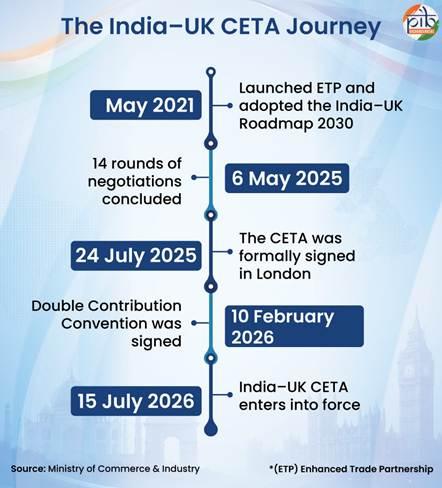
- The India–UK Comprehensive Economic and Trade Agreement (CETA) came into effect on 15 July 2026, cutting tariffs on thousands of goods and widening access for services firms and professionals in both countries.
- Negotiations began in January 2022; after 14 rounds, an agreement in principle was reached on 6 May 2025. The agreement was formally signed on 24 July 2025 in London by Commerce Minister Piyush Goyal and UK Secretary Jonathan Reynolds in the presence of PMs Modi and Starmer.
- Described by India’s Commerce Secretary as “India’s most aspirational trade deal” — the first comprehensive FTA with a G7 nation, and the UK’s most economically significant FTA since Brexit.
- India has historically been cautious about FTAs: notable agreements include ASEAN Trade in Goods Agreement (2009), SAFTA, UAE CEPA (2022), and India-EFTA TEPA (2024). The CETA is India’s first comprehensive FTA with a major developed G7 economy.
- India’s FTA policy is guided by the principle of protecting strategic sectors (agriculture, MSMEs, PLI sectors) while liberalising competitive export sectors — a calibration clearly visible in CETA’s architecture.
- Following the UK’s exit from the EU in 2020 (Brexit), the UK lost access to the EU single market and began negotiating fresh bilateral trade deals. CETA is described by the UK’s House of Commons Business and Trade Committee as “the UK’s most economically significant bilateral FTA since leaving the EU.”
- Bilateral engagement deepened under the India–UK Roadmap 2030 and the Enhanced Trade Partnership (May 2021) agreed between PMs Boris Johnson and Narendra Modi, which set a framework for FTA negotiations.
- The Migration and Mobility Partnership (MMP) was signed on 4 May 2021; the Young Professionals Scheme (announced at G20 Bali, November 2022) issues 3,000 annual visas to graduates aged 18–30 for a two-year stay.
- The UK is home to an Indian diaspora of 1.864 million people (2021 UK Census, 2.6% of the UK population), over 65,000 diaspora-owned companies, and approximately 971 Indian companies employing over 1 lakh people as of July 2025.
- In 2025, the UK imported goods worth USD 928.9 billion globally but only USD 15.2 billion (1.6%) from India — signalling enormous untapped trade potential that CETA directly addresses.
- The UK immediately eliminated duties on 96.8% of tariff lines, covering 97.7% of trade value — removing tariffs of up to 70% on processed foods, 21.5% on marine products, 18% on engineering goods, 16% on leather & footwear, 12% on textiles, and 8% on chemicals and pharmaceuticals.
- India’s top exports to the UK include: electrical machinery (USD 2.13 bn), textiles and apparel (USD 1.94 bn), mechanical machinery (USD 1.34 bn), gems and jewellery (USD 1.03 bn), plastics (USD 0.57 bn), organic chemicals (USD 0.56 bn), iron and steel (USD 0.44 bn), and pharmaceuticals (USD 0.41 bn).
- India has offered tariff concessions on 89.5% of its tariff lines covering 91% of UK exports, but only 24.5% of UK export value gets immediate duty-free access — the remainder is phased over 5, 7, or 10 years.
- Agricultural zero-duty access is provided across 1,437 UK agricultural tariff lines; India’s agricultural export opportunity is significant given that the UK imports over USD 90 billion of agri-products globally but sources only USD 1.11 billion from India.
- India has excluded or deferred concessions on: dairy, cereals, millets, pulses, apples, edible oils, oats, vegetables, gold, jewellery, lab-grown diamonds, critical energy fuels, marine vessels, smartphones, and optical fibres.
- Automobiles: Calibrated quota-based liberalisation with an annual quota of 37,000 passenger vehicle CBUs at preferential tariffs. EV access commences only from Year 6 — protecting domestic manufacturers scaling under Production Linked Incentive (PLI) scheme.
- Scotch Whisky: Duties cut from 150% to 75% on day one, with staged reductions to 40% from Year 10 onwards — a significant but carefully phased opening of a 97% domestically dominated market.
- Strategic sectors under Make in India and PLI enjoy phased reductions aligned with domestic capacity-building timelines — demonstrating India’s maturing FTA negotiation capacity.
- India secured commitments from the UK across all 12 major service sectors and 137 sub-sectors, covering over 99% of India’s services export interests — one of the most ambitious services commitments in any FTA signed by the UK.
- Double Contribution Convention (DCC), signed 10 February 2026 and effective alongside CETA: eliminates dual social security contributions for Indian professionals on temporary UK assignments for up to 60 months (5 years). Over 75,000 professionals and 900 Indian companies benefit; estimated annual saving of approximately USD 600 million.
- Mobility chapter provisions: short-term business visitors (90 days, no labour market test); intra-corporate transferees (up to 3 years + 2-year extension); 20,000 annual UK service-supplier visas for Indian nationals; 3,000 post-study work visas/year for Indian graduates; 1,800 annual slots reserved for Indian chefs, yoga instructors and classical musicians.
- UK’s Economic Needs Test (ENT) waived for Indian contractual service suppliers; Mutual Recognition Agreements (MRAs) for professional qualifications (nursing, accountancy, architecture) to be negotiated within 12 months of entry into force.
- Government Procurement: Indian suppliers gain access to the UK’s procurement market worth GBP 90 billion (USD 122 billion); the UK gains reciprocal access to India’s USD 114 billion procurement market. UK tenders above USD 270,880 (goods/services) are open to Indian bidders.
- Digital Trade Chapter (30 chapters total): electronic contracts and signatures with legal equivalence; cross-border data flows with limited exceptions; prohibition on forced disclosure of source code or proprietary algorithms; cooperation on AI, cybersecurity and e-governance; digital single-window customs clearance; expedited treatment for Authorised Economic Operator (AEO) enrolled traders.
- MSMEs benefit from simplified customs procedures, paperless trade, self-certification of origin, duty-free access for textiles, leather, jewellery, and food products saving 4–16% in tariffs.
- Rules of Origin: Self-certification allowed; minimum 40–45% Regional Value Content (RVC) required for manufactured goods; customs clearance — perishable goods within 6 hours, others within 24–48 hours.
- Historic tariff access for Indian exporters: Near-total zero-duty entry into the UK market creates immediate competitive advantage over non-FTA suppliers (China, Bangladesh in garments) in a market where India’s share was only 1.6% of UK imports.
- Services chapter as the real prize: The DCC savings (USD 600 mn/year) and mobility provisions directly benefit India’s IT and professional services sector — India’s exports to the UK already at USD 21.66 bn, generating a services surplus of USD 7.88 bn.
- Protective architecture is well-designed: India successfully excluded sensitive agricultural products, deferred EV access, and created phase-in periods aligned with PLI development — demonstrating institutional learning from past FTAs that caused domestic disruption.
- Strategic signalling: Described as India’s “gold standard” FTA, CETA benchmarks the template for ongoing negotiations with the EU, US, and GCC — particularly its digital trade, gender, and MRA chapters.
- Diaspora leverage: The 1.864 million-strong Indian diaspora is a natural market bridge creating demand for Indian goods, services, and cultural products, amplifying CETA’s economic impact.
- Asymmetric pace of liberalisation: The UK opens nearly fully on day one while India phases over 5–10 years. While protective for Indian industry, this asymmetry has drawn concerns from UK exporters expecting faster reciprocal access and may generate political friction.
- Non-tariff barriers remain: India’s agricultural export opportunity is large (UK imports USD 90 bn agri-products globally; India’s share only USD 1.11 bn), but realising this requires meeting stringent UK Sanitary and Phytosanitary (SPS) and food safety standards — a formidable non-tariff barrier for many Indian exporters.
- Rules of origin compliance burden: Self-certification is efficient but demands documentation systems that many Indian MSMEs currently lack — risk that smaller exporters are unable to leverage preferential access in practice.
- No Bilateral Investment Treaty (BIT): CETA does not include investor-state dispute settlement mechanisms — a gap that may deter long-term UK FDI in certain sectors and leaves investment protection in a legal grey zone.
- MRA timelines aspirational: The 12-month deadline for MRAs on professional qualifications (nursing, accountancy, architecture) is ambitious; regulatory divergences between professional bodies in both countries could cause significant delays in realising mobility benefits.
- Build export capacity, not just access: Invest in SPS compliance upgradation, quality certification, and cold-chain logistics for agri and food processing sectors — market access without supply-side readiness will not translate into exports.
- Fast-track MRA negotiations by giving regulatory bodies clear mandates, timelines, and ministerial-level oversight so professional mobility provisions are operationalised within the 12-month window.
- MSME handholding: Create CETA compliance portals, rules-of-origin documentation support, and export consortia for handicrafts, gems, and leather — ensuring that small exporters are not priced out of the agreement’s benefits.
- Use CETA as FTA template: The self-certification, digital trade, and gender chapter frameworks should be proactively replicated in ongoing India-EU, India-US, and India-GCC negotiations.
- Monitor for non-tariff substitution: Proactively engage with UK’s Technical Barriers to Trade (TBT) mechanisms and labelling standards to ensure tariff elimination is not replaced by regulatory barriers.
- Accelerate BIT negotiations in parallel to provide investor-state protections that encourage long-term UK FDI into India’s manufacturing and infrastructure sectors.
Q1. Consider the following statements regarding the India–UK CETA: (1) It came into effect on 15 July 2026 after 14 rounds of negotiations. (2) The UK has offered zero-duty access to 89.5% of Indian tariff lines immediately. (3) The Double Contribution Convention exempts Indian professionals from UK social security contributions for up to 60 months. Which of the above are correct?
A) 1 and 2 only B) 1 and 3 only C) 2 and 3 only D) 1, 2 and 3Q2. (Assertion–Reasoning) Assertion (A): India has deferred tariff concessions on electric vehicles to Year 6 under CETA. Reason (R): India’s domestic EV manufacturing sector is still scaling up under PLI schemes and requires time to achieve cost and technology competitiveness.
A) Both A and R are true, and R is the correct explanation of A B) Both A and R are true, but R is NOT the correct explanation of A C) A is true but R is false D) A is false but R is trueQ3. Which of the following is NOT a feature of the India–UK CETA?
A) Self-certification of rules of origin B) Mutual Recognition Agreements for nursing, accountancy and architecture C) A Bilateral Investment Treaty with investor-state dispute settlement D) 1,800 annual mobility slots for Indian chefs, yoga instructors and classical musiciansElderline 14567: National Helpline and the Ageing with Dignity Campaign
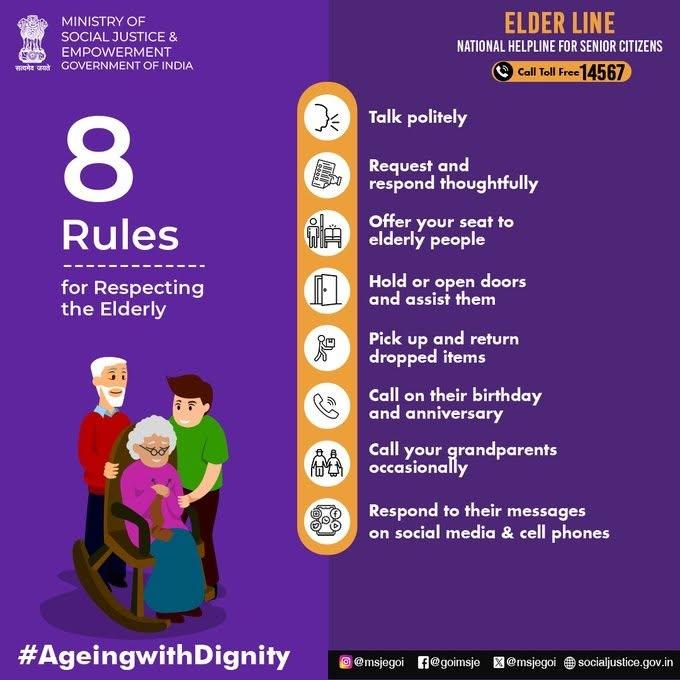
- The Ministry of Social Justice and Empowerment (MoSJ&E) is running two complementary elder-care initiatives: Elderline 14567 (National Helpline for Senior Citizens) and the “Take a Pledge” campaign under the Ageing with Dignity programme.
- Elderline was dedicated to the nation on 1 October 2021 (International Day for Older Persons) as a toll-free, pan-India helpline (14567), operating 8 AM–8 PM, seven days a week across all States and UTs.
- The “Take a Pledge” campaign has seen over 5.36 lakh citizens commit to elder care; participants receive a digital Certificate of Commitment.
- India’s demographic shift: The elderly population (60+) is projected to more than double from 100 million (2011) to 230 million by 2036 — meaning nearly 1 in 7 Indians will be a senior citizen. Currently about 8.6% of the total population (8.2% male, 9% female) is aged 60+.
- Urbanisation, nuclear family structures, and migration have eroded traditional joint-family support systems, increasing social isolation, financial insecurity, and elder abuse — the structural drivers that necessitate institutional elder care.
- India’s silver economy is valued at approximately ₹73,000 crore (2024), with multi-fold growth projected, driven by demand for healthcare, caregiving, senior housing, and financial products.
- Maintenance and Welfare of Parents and Senior Citizens Act, 2007: Came into force December 2007; legally obligates children and heirs to provide maintenance; provides for Maintenance Tribunals to adjudicate disputes within 90 days; mandates states to establish old age homes. Defines “senior citizen” as any Indian citizen aged 60 years or above.
- Maintenance and Welfare of Parents and Senior Citizens (Amendment) Bill, 2019: Proposes expansion of definitions (to include stepchildren, non-blood relatives) and stronger enforcement mechanisms — pending parliamentary passage.
- National Policy on Older Persons (NPOP), 1999 (revised draft 2011): Overarching framework for financial security, healthcare, welfare, and protection of the elderly.
- National Programme for Health Care of Elderly (NPHCE), 2010–11: Promotes geriatric care at district/community levels; established 2 National Centres for Ageing and 20 Regional Geriatric Centres.
- Ayushman Bharat PM-JAY expansion (October 2024): Extended free health coverage of ₹5 lakh/year to approximately 6 crore senior citizens aged 70 and above from 4.5 crore families, regardless of socio-economic background. As of January 2025, over 40 lakh seniors enrolled.
- Indira Gandhi National Old Age Pension Scheme (IGNOAPS): A key component of the National Social Assistance Programme (NSAP), providing financial support to eligible elderly citizens.
- Elderline 14567 is set up by MoSJ&E in partnership with National Institute of Social Defence (NISD) and State/UT governments. Implementation leveraged experience from Telangana’s “Elder Spring” — a state-level pilot by Tata Trusts + Vijayavahini Charitable Foundation (VCF) — reducing implementation risk through proven model adaptation.
- Four service domains (single-window platform):
- Information: healthcare facilities, old age homes, day-care centres, caregivers, elder-friendly products.
- Guidance: legal issues, pension, government schemes, maintenance disputes.
- Field Intervention: abuse, neglect, rescue, reunion of homeless elderly.
- Emotional Support: loneliness, anxiety, family disputes, psychosocial counselling.
- A Technical Support Unit (TSU) set up by MoSJ&E handles backend software, standardised processes, staff training modules, and data aggregation from state systems with dashboards — ensuring quality and uniformity across States and UTs.
- Citizens pledge to: respect, love, care for elderly; treat them with kindness, compassion and empathy; value their knowledge, wisdom and experience; actively stand against elder abuse and mistreatment.
- The campaign operates on the correct insight that legal frameworks alone cannot change behaviour — bridging the gap between legislation and lived reality through attitudinal change.
- Elder abuse is pervasive: A global meta-analysis estimates 1 in 6 senior citizens worldwide is affected by abuse. Indian studies report prevalence rates of 25.6% to 41.6% (LASI wave, 2017–18: 5% in past year — likely an undercount due to stigma). Types include financial, physical, psychological, sexual abuse and neglect — predominantly by family members.
- Participants in the pledge receive a digital Certificate of Commitment — a technology-enabled symbolic mechanism to formalise and personalise the commitment to elder welfare.
- Single-window design reduces coordination burden on elderly callers — particularly important for those with cognitive limitations or digital illiteracy, who cannot navigate multiple agencies.
- The 7-day, 8 AM–8 PM window is practically accessible — addressing the reality that seniors may face crises outside conventional working hours.
- AB-PMJAY expansion (70+) paired with Elderline creates an integrated access architecture: the helpline channels elderly citizens towards health entitlements they may not know about.
- Rooted in a tested state-level model (Telangana’s Elder Spring), reducing implementation risk compared to untested central schemes — a sound design approach.
- Awareness and reach remain patchy: The 5.36 lakh pledge figure, while positive, represents a tiny fraction of India’s 100+ million elderly population. Elderline awareness is especially limited in rural areas and among digitally excluded seniors.
- Field intervention capacity is uneven: Helplines can receive calls, but actual rescue, reunions, and abuse intervention require trained personnel, vehicles, and real-time coordination with local police and administration — all unevenly available across States.
- Enforcement gap in the 2007 Act: Despite the 90-day deadline for maintenance petitions under Section 5(4), judicial delays persist. Delhi and Allahabad High Courts have had to suo motu direct governments to enforce the Act’s provisions — indicating weak ground-level implementation.
- 2019 Amendment remains pending: Stronger protections (expanded definitions, higher maintenance caps) are delayed, leaving the 2007 Act’s limitations unresolved while India’s elderly population grows rapidly.
- Mental health dimension underserved: India has a severe shortage of geriatric psychiatrists and trained mental health counsellors — Elderline can refer but cannot treat, leaving the emotional support function structurally constrained.
- Data and accountability deficit: No publicly visible dashboard tracks Elderline call volumes, resolution rates, or field intervention outcomes — limiting civil society oversight and evidence-based policy correction.
- Scale awareness using ASHA workers, Anganwadi centres, and panchayat networks as outreach channels — prioritising rural elderly and family caregivers who remain largely unaware of Elderline.
- Pass the 2019 Amendment to strengthen the Maintenance Act: expand definitions, raise maintenance limits, and mandate faster Tribunal proceedings aligned with the 90-day statutory deadline.
- Institutionalise field response through formal MoUs between NISD, district administrations, police, and hospitals — so field interventions have a structured pathway rather than relying on ad hoc referrals.
- Geriatric mental health skilling: Train community health workers and ASHA workers in basic mental health first-aid for the elderly, bridging the specialist shortage at the community level.
- Open data: Publish quarterly public reports on Elderline call volumes, complaint types, resolution rates, and field interventions — enabling civil society monitoring and policy course correction.
- Formalise a National Silver Economy Policy to leverage the ₹73,000 crore market for elder care into employment and innovation, with regulatory oversight of private senior care facilities and quality standards for old age homes.
Q1. Consider the following statements about Elderline 14567: (1) It was launched by the Ministry of Health and Family Welfare. (2) It operates from 8 AM to 8 PM, seven days a week. (3) It was dedicated to the nation on 1 October 2021 — International Day for Older Persons. Which of the above are correct?
A) 1 and 2 only B) 2 and 3 only C) 1 and 3 only D) 1, 2 and 3Q2. Match List I (Welfare instrument) with List II (Key feature): A. Maintenance and Welfare of Parents and Senior Citizens Act, 2007 · B. AB-PMJAY expansion (October 2024) · C. IGNOAPS // 1. Free health coverage up to ₹5 lakh for all citizens aged 70+ · 2. Legal obligation on children to provide maintenance via Maintenance Tribunals · 3. Financial assistance for elderly under the National Social Assistance Programme. Choose the correct match:
A) A-2, B-1, C-3 B) A-1, B-2, C-3 C) A-2, B-3, C-1 D) A-3, B-1, C-2Q3. (Odd One Out) Which of the following is NOT a service provided under Elderline 14567?
A) Information on old age homes and caregivers B) Guidance on pension and legal issues C) Issuing Aadhaar cards for senior citizens D) Field intervention in cases of elder abuse and rescue

