
Contents
Vikas Bhi, Virasat Bhi: Revitalising India’s Cultural Legacy
- Over the last 12 years (2014–2026), the government has pursued heritage conservation under the philosophy “Vikas Bhi, Virasat Bhi” — development as well as heritage — linking monument restoration, pilgrimage infrastructure and digitisation with tourism-led growth.
- The release consolidates achievements across monument conservation, pilgrimage development, repatriation of antiquities, museums, UNESCO recognition, and digitisation of manuscripts and films.
- India’s heritage spans monuments, antiquities, manuscripts and intangible traditions, protected primarily under the Ancient Monuments and Archaeological Sites and Remains (AMASR) Act, 1958 (amended 2010, barring construction within 100 m of a protected monument).
- The Archaeological Survey of India (ASI), under the Ministry of Culture, is the nodal conservation body, operating through roughly 38 regional Circles.
- India ratified the UNESCO World Heritage Convention (1972) in 1977; its first four sites — Taj Mahal, Agra Fort, Ajanta and Ellora Caves — were inscribed in 1983.
- The 74th Constitutional Amendment, 1992 created Urban Local Bodies (ULBs) as the implementing tier for city-level heritage schemes such as HRIDAY.
- Adopt a Heritage 2.0 (2017, revamped Sept 2023): a PPP/CSR-based framework with companies, PSUs, NGOs and trusts to upgrade visitor amenities at Protected Monuments of National Importance; 30 MoUs signed; 13.59 million footfall at adopted monuments in FY 2024–25.
- PRASHAD Scheme (Jan 2015): pilgrimage/heritage tourism development; 54 projects across 28 States/UTs (₹1,726.74 cr), 32 completed; positively evaluated in a 2021 IIM Rohtak report, “Evaluation of Central Sector Scheme PRASHAD”.
- Swadesh Darshan 1.0 → 2.0: shifted from circuit-based development (76 projects, ₹5,290.33 cr; 75 completed) to a destination-centric approach (53 SD2.0 projects, ₹2,208.31 cr); Challenge Based Destination Development (CBDD), March 2024, adds a competitive framework (38 projects, ₹697.94 cr).
- HRIDAY (Jan 2015–March 2019): integrated heritage conservation with urban infrastructure in 12 cities (e.g. Varanasi, Amritsar, Mathura, Gaya); the mission period has formally ended.
- ASI protects 3,686 monuments (April 2026); around ₹374 crore allocated (2024–25) for conservation and maintenance.
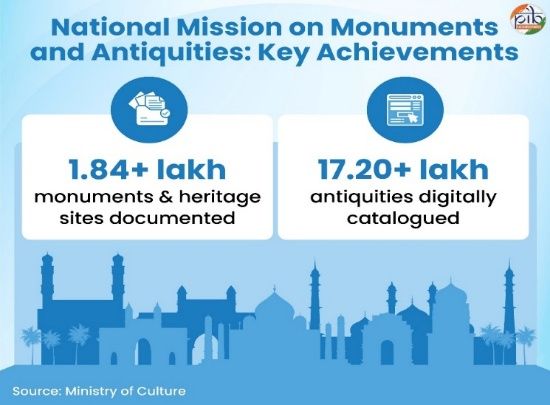
- National Mission on Monuments and Antiquities (NMMA), implemented under ASI, has documented 1.84 lakh monuments and 17.20 lakh antiquities (March 2026) — a planning backbone for conservation prioritisation.
- 653 antiquities retrieved since 2014 (May 2026), with 613 in the last five years alone — indicating sharp recent acceleration, largely PPP-driven.
- Landmark returns: Piprahwa relics of the Buddha (2025, after 127 years, via a Government–Godrej Industries Group PPP that halted a Sotheby’s Hong Kong auction); the Annapurna idol from Canada (2021, after 108 years); Rama–Sita–Lakshmana bronzes from the UK (2020).
- Global expositions of Buddha relics in Vietnam, Russia (Kalmykia), Bhutan and Sri Lanka extend Buddhist cultural diplomacy, aligned with India’s soft-power outreach.
- Archaeological Experiential Museum, Vadnagar (Gujarat) — opened January 2025; India’s first of its kind, with a 4,000 sq.m open excavation site visible to visitors.
- India now has 44 UNESCO World Heritage Sites (36 cultural, 7 natural, 1 mixed) and 15 UNESCO Intangible Cultural Heritage elements; hosted the 46th World Heritage Committee Session, New Delhi (2024).
- Gyan Bharatam Mission (2025): manuscript digitisation via a National Digital Repository (NDR); complemented by the Vedic Heritage Portal (2023, under IGNCA) and the National Film Heritage Mission (2015), which has digitised 1,469 film titles.
- Conservation increasingly uses LiDAR, GIS mapping, drone surveys and emerging AI-based documentation tools.
- Convergence of heritage with tourism and livelihoods (PRASHAD, Swadesh Darshan) creates local economic multipliers beyond pure conservation.
- PPP-driven repatriation (e.g. Piprahwa) demonstrates a scalable, low-fiscal-cost model for recovering stolen heritage.
- Institutional digitisation (NMMA, Gyan Bharatam, NDR) builds a long-term evidence base for planning and academic research.
- HRIDAY’s mission period ended in 2019; city-level outcomes are self-reported without an independent third-party audit cited in the release.
- Adopt a Heritage 2.0’s 30 MoUs over nearly a decade suggest slow private-sector uptake relative to India’s ~3,686 protected monuments.
- The release does not clarify post-repatriation custodianship standards — long-term storage and display protocols for the 653 returned antiquities.
- A PPP-based repatriation model raises questions on transparency of valuation and provenance verification, meriting codification under instruments like the Antiquities and Art Treasures Act, 1972.
- Institute independent, periodic outcome audits (e.g. by CAG) for legacy schemes like HRIDAY and PRASHAD instead of relying solely on ministry self-assessment.
- Expand Adopt a Heritage 2.0 uptake through clearer CSR incentive structuring to accelerate MoU signings.
- Strengthen provenance-verification protocols for repatriated antiquities with transparent custodial allocation across museums and research institutes.
- Scale AI and LiDAR-based documentation across all ASI Circles to accelerate the NMMA inventory.
Q1. Consider the following statements: (1) The Piprahwa relics were repatriated to India through a public–private partnership. (2) The relics were excavated in 1898 and returned in 2025. (3) The HRIDAY scheme is currently an ongoing central sector scheme. Which are correct?
A) 1 and 2 only B) 2 and 3 only C) 1 and 3 only D) 1, 2 and 3Q2. Match List I (Scheme) with List II (Focus Area): A. PRASHAD · B. Adopt a Heritage 2.0 · C. Swadesh Darshan 2.0 // 1. Destination-centric tourism development · 2. Pilgrimage rejuvenation · 3. CSR-based monument amenities. Choose the correct match:
A) A-2, B-3, C-1 B) A-1, B-2, C-3 C) A-3, B-1, C-2 D) A-2, B-1, C-3Q3. The Archaeological Experiential Museum, showcasing India’s open excavation walkway for visitors, is located at:
A) Hampi B) Vadnagar C) Lothal D) DholaviraAdvancing Electrolyte Engineering for Durable, Affordable Aqueous Batteries
- Scientists at the Institute of Nano Science and Technology (INST), Mohali (autonomous institute under DST) developed a new electrolyte additive, BDIM, to improve the stability and lifespan of aqueous zinc-ion batteries (AZIBs).
- The work addresses zinc dendrite growth, hydrogen evolution reaction (HER), and corrosion — long-standing barriers to commercialising AZIBs as a cheaper, safer alternative to lithium-ion batteries.
- AZIBs use water-based electrolytes instead of flammable organic solvents in lithium-ion batteries, making them inherently safer and lower-cost, but historically less stable over repeated cycles.
- The electric double layer (EDL), and specifically the Inner Helmholtz Plane (IHP) — the molecular layer closest to the electrode surface — is where key electrochemical reactions, including unwanted ones like HER, occur.
- INST Mohali is an autonomous nanoscience research institute under the Department of Science and Technology (DST), contributing to India’s indigenous energy-storage R&D push.
- Researchers developed BDIM — 1,3-bis(1,3-dicarboxypropyl)-1H-imidazole-3-ium chloride — synthesised from glutamic acid, NaOH, glyoxal, formaldehyde and acetic acid, heated under nitrogen at 70°C for 24 hours and lyophilised into a crystalline powder.
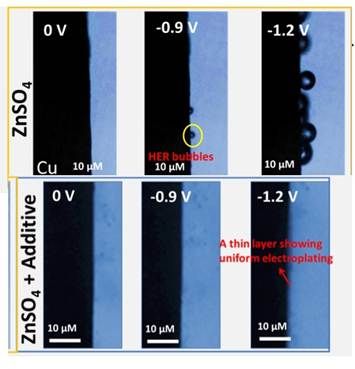
- BDIM contains oxygen and nitrogen donor sites that adsorb strongly onto the zinc anode surface, displacing water molecules at the Inner Helmholtz Plane and thereby suppressing hydrogen evolution, corrosion, and dendrite formation.
- The approach is interface engineering rather than expensive material redesign — a scalable, lower-cost route to battery improvement.
- An ultramicroelectrode (UME) (under ~50 micrometres) combined with fast-scan cyclic voltammetry (FSCV) was used to study how additives shift charge-transfer and mass-transfer kinetics during zinc deposition.
- Findings can apply to AZIBs, grid-scale energy storage, renewable-energy backup systems, and battery safety/lifetime technologies, relevant to India’s renewable integration goals.
- Published in ACS Electrochemistry, the research was led by Dr. Ramendra Sundar Dey at INST Mohali.
- An interface-level fix (rather than a new whole-battery material) is typically cheaper and faster to scale industrially.
- Use of UME + FSCV demonstrates methodological rigour in directly probing nanoscale reaction kinetics, not just end-performance metrics.
- Addresses three simultaneous failure modes (dendrites, HER, corrosion) with a single additive — an efficient problem-solving approach.
- The release describes lab-scale synthesis and electrochemical testing; no data on full-cell cycle life, cost-per-kWh, or third-party validation is given — commercialisation readiness remains unclear.
- Long-term chemical stability of BDIM under repeated cycling, and possible degradation byproducts, are not addressed.
- No comparison is provided against competing zinc-anode additives already explored globally, making relative advantage difficult to assess.
- Validate BDIM in full-cell, pouch-format batteries under realistic charge-discharge cycling before claims of commercial viability.
- Pursue industry partnerships or technology-transfer mechanisms to move from lab-scale synthesis to pilot production.
- Conduct comparative benchmarking against existing AZIB stabilisation techniques in peer-reviewed follow-up work.
Q1. Consider the following statements regarding Aqueous Zinc-Ion Batteries (AZIBs): (1) They use water-based electrolytes, making them inherently safer than lithium-ion batteries. (2) Their commercialisation has been hindered by issues including zinc dendrite growth and hydrogen evolution. (3) The Inner Helmholtz Plane refers to the outermost layer of the battery casing. Which are correct?
A) 1 and 2 only B) 2 and 3 only C) 1 and 3 only D) 1, 2 and 3Q2. (Assertion–Reasoning) Assertion (A): The BDIM additive suppresses hydrogen evolution and corrosion at the zinc anode. Reason (R): BDIM’s oxygen and nitrogen donor sites displace water molecules from the Inner Helmholtz Plane.
A) Both A and R are true, and R is the correct explanation of A B) Both A and R are true, but R is NOT the correct explanation of A C) A is true, R is false D) A is false, R is trueQ3. INST Mohali, mentioned in the news for zinc-battery research, functions as an autonomous institute under which ministry/department?
A) Ministry of Mines B) Department of Science and Technology (DST) C) Ministry of New and Renewable Energy D) Department of Atomic Energy

