
Contents
White Gold: India’s Cotton Story — From Seed to Shirt
- Cotton is India’s most important commercial fibre crop, called “White Gold” for its dual role as an agricultural commodity and an industrial raw material; it accounts for around 23% of global fibre production.
- The crop supports 6 million cotton farmers directly and sustains 40–50 million people in allied activities — ginning, spinning, processing, and trade.
- Despite ranking 1st in area and 2nd in production and consumption globally, India faces a structural paradox: production (290.91 lakh bales, 2025–26) falls short of domestic consumption (328 lakh bales), creating a supply gap that constrains the textile sector.
- Policy responses — MSP operations, Mission for Cotton Productivity, and Kasturi Cotton Bharat — aim to bridge this gap through productivity, quality, and value addition.
- Historical roots: India has cultivated cotton for over 5,000 years; the Indus Valley Civilisation is among the world’s earliest cotton-using cultures, and in ancient trade, cotton cloth functioned as a medium of exchange.
- The modern mill era began in the 19th century — mills in Kolkata (1818), Mumbai, and Ahmedabad (dubbed “Manchester of India”); the Swadeshi Movement (1905) gave a nationalist impetus to indigenous mill expansion.
- Botanical uniqueness: India is the only country in the world cultivating all four recognised cotton species — G. arboreum and G. herbaceum (Asian), G. barbadense (Egyptian), and G. hirsutum (American Upland); G. hirsutum accounts for ~90% of hybrid production and all Bt cotton hybrids belong to this species.
- Staple classification determines fibre quality and end-use: Short staple (<24.5 mm) → coarse/industrial; Medium staple (24.5–27.5 mm) → standard apparel; Long staple (28–34 mm) → premium apparel; Extra Long Staple (ELS) (≥35 mm) → luxury fabrics.
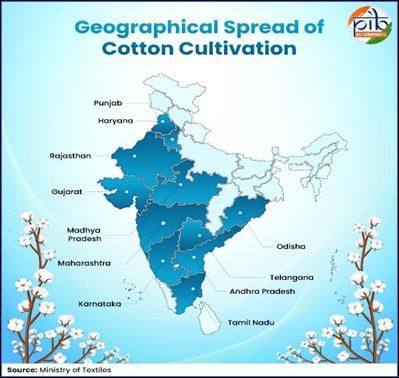
- Agro-ecological zones: Cotton is grown in 9 major states across three zones — Northern (Punjab, Haryana, Rajasthan), Central (Gujarat, Maharashtra, Madhya Pradesh), Southern (Telangana, Andhra Pradesh, Karnataka); also Odisha and Tamil Nadu.
- Rain-fed dependence: Approximately 62% of cotton is grown in rain-fed regions; only 38% is irrigated — making yields highly sensitive to monsoon variability.
- Key institutions: CCI (Cotton Corporation of India) — nodal MSP procurement agency; CACP (Commission for Agricultural Costs and Prices) — recommends MSP; TEXPROCIL (Cotton Textiles Export Promotion Council) — apex export body; CICR (Central Institute for Cotton Research, Nagpur) — apex research institute.
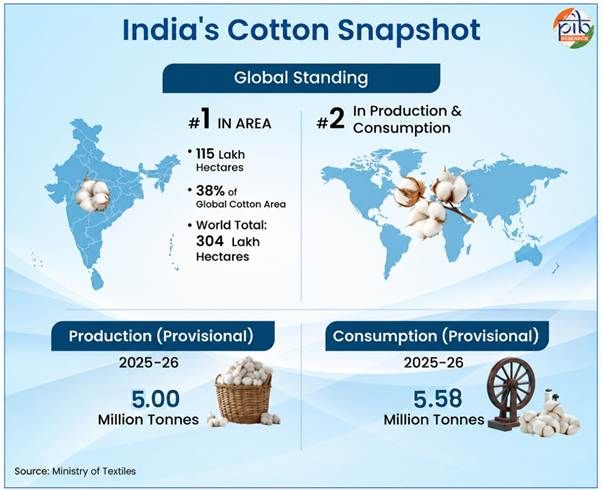
- India holds 1st rank globally in cotton cultivation area: 114.84 lakh hectares (~38% of the global cotton area of 304.08 lakh hectares); it ranks 2nd in production, contributing ~20% of global cotton output.
- Production 2024–25: 297.24 lakh bales (5.06 MT); 2025–26 (provisional): 290.91 lakh bales (4.95 MT); each bale = 170 kg — the standard trade unit.
- Domestic consumption 2025–26: 328 lakh bales (MSME + non-MSME + non-textile segments), creating a structural deficit of ~37 lakh bales that is met through imports.
- Exports 2024–25: 18 lakh bales (0.31 MMT) = ~3.37% of global exports; value: US$ 11.49 billion (FY25); top destinations: USA (26.35%) > Bangladesh (19.81%) > Sri Lanka (5.11%) > UK (2.38%) > UAE (2.32%).
- MSP is recommended by the CACP before each cotton year (October – September) for Medium Staple and Long Staple seed cotton (kapas); principle: farmers receive at least 50% returns over production costs.
- MSP 2025–26: ₹7,710/quintal (medium staple); ₹8,110/quintal (long staple). MSP 2026–27: ₹8,267/quintal (medium); ₹8,667/quintal (long) — increase of ₹557/quintal for both varieties.
- CCI procurement 2025–26: 105.09 lakh bales valued at ₹41,530 crore via 24 lakh transactions at 571 centres across 152 districts in 11 states (up from 508 centres in 2024–25).
- Mission for Cotton Productivity (launched 2025–26): five-year mission with outlay of ₹5,659.22 crore; covers ~24 lakh hectares, 140 districts, 14 states, ~32 lakh farmers.
- Production target: 297 lakh bales → 498 lakh bales by 2031; focus on climate-resilient, pest-resistant, high-yielding varieties and Extra Long Staple (ELS) cotton via advanced breeding and biotechnology.
- Aligned with the ‘5F’ vision: Farm → Fibre → Factory → Fashion → Foreign — an integrated textile-to-export framework.
- Special Project on Cotton under NFSM (since 2023–24): covers 8 major cotton states; pilots three technologies — High-Density Planting System (HDPS) (~40% yield gain), Closer Spacing Planting System (>32% yield gain), and ELS cotton production technology.
- Outlays: ₹41.87 cr (2023–24, 9,175 ha) → ₹50.98 cr (2024–25, 14,740 ha) → ₹60.32 cr (2025–26).
- Kapas Kisan App: enables self-registration, 4-week rolling slot booking, Aadhaar-linked payments, and real-time SMS alerts; 41 lakh+ farmers registered; converts MSP procurement into a paperless, queue-free system.
- Kasturi Cotton Bharat (launched 7 October 2022, World Cotton Day): flagship branding initiative of Ministry of Textiles + CCI + TEXPROCIL; total outlay ₹30 crore (₹15 cr government + ₹15 cr trade and industry).
- Covers Long Staple (≥28 mm) and ELS (≥35 mm) cotton; tested by NABL-accredited laboratories; features QR-based certification + blockchain traceability (farm to garment) — comparable to global brands Supima (USA) and Giza/Egyptian Giza (Egypt).
- Status (30 June 2026): 3,29,550 bales certified (3,22,400 by CCI); 116 registered units (41 ginners + 75 supply chain members).
- Raw cottonseed is ~1/3 lint and ~2/3 seed; the seed contains ~18% edible oil — called “heart oil” for its ~50% polyunsaturated fatty acids (vs ~30% in many traditional oils).
- Deoiled cake: high-protein animal feed (cattle, poultry, fish); linters and hulls: industrial and paper uses; cotton stalks: biomass fuel for rural energy.
- Surgical/absorbent cotton: short-staple fibres unsuitable for spinning are processed for healthcare use due to high absorbency and purity.
- India’s botanical diversity (four species) gives unmatched flexibility to serve market segments from coarse to luxury fibre — a structural competitive advantage.
- CCI’s expanded network (571 procurement centres, 2025–26) provides genuine price-floor protection; Kapas Kisan App integrates Aadhaar and digital payments to reduce rent-seeking and leakage.
- Kasturi Cotton’s blockchain traceability directly addresses a global buyer concern — supply chain transparency — and positions India to compete in premium segments alongside Supima and Giza.
- HDPS and closer-spacing demonstrations show tangible yield gains (40%+ and 32%+), offering a low-cost, technology-first route to productivity improvement without expanding area.
- Chronic supply deficit: domestic consumption (328 lakh bales) persistently exceeds production (~291 lakh bales), raising import dependency and vulnerability to global price volatility — a structural weakness no single mission can quickly resolve.
- ~62% rain-fed cultivation makes yields highly sensitive to monsoon variability and climate shocks; with changing precipitation patterns, this risk is amplified.
- Low yield productivity: India’s average cotton yield (~450–480 kg/ha) lags far behind Australia (~2,000 kg/ha) and Brazil (~1,700 kg/ha), reflecting gaps in irrigation, seed quality, and integrated pest management.
- Bt cotton pest resistance: Pink Bollworm (Pectinophora gossypiella) has developed resistance to first-generation Bt technology — next-generation biotech seed development is urgent.
- ELS gap: India imports significant ELS cotton (from Egypt, USA, Peru) for its premium textile sector; domestic ELS development remains nascent despite policy emphasis.
- Large CCI procurement (105.09 lakh bales) while holding unsold stocks raises questions of fiscal cost, storage capacity, and market distortion.
- Accelerate irrigation coverage in cotton-growing regions; reducing the 62% rain-fed share is the single most effective lever for yield stabilisation and supply security.
- Invest in next-generation Bt and non-Bt seed development through CICR and public-private partnerships to counter pest resistance.
- Scale ELS cotton production through Mission for Cotton Productivity and NFSM demonstrations to substitute costly imports and capture premium export markets.
- Integrate Kasturi Cotton branding with global retail supply chains; Indian manufacturers supplying European and luxury buyers need robust chain-of-custody certification.
- Strengthen Farmer Producer Organisations (FPOs) in cotton belts to aggregate supply, improve bargaining power, and reduce intermediary costs in MSP and private procurement.
- Rationalise CCI operations: unsold procurement stocks must be liquidated efficiently to avoid fiscal drag and price distortions in the market.
- Develop cottonseed oil and by-product value chains through targeted MSME processing units — an under-exploited source of non-fibre rural income in cotton belts.
Q1. Consider the following statements about India’s cotton sector:
1. India is the only country in the world cultivating all four recognised species of cotton.
2. G. hirsutum accounts for nearly 90% of India’s hybrid cotton production.
3. India ranks first globally in both cotton production and cotton cultivation area.
Which of the above are correct?
Q2. Match List I (Body/Scheme) with List II (Function):
A. CACP 1. Nodal MSP procurement of cotton
B. CCI 2. Recommends MSP annually for kapas
C. TEXPROCIL 3. Manages Kasturi Cotton branding on behalf of trade & industry
Choose the correct match:
Q3. (Assertion–Reasoning) Assertion (A): India imports significant quantities of Extra Long Staple (ELS) cotton despite being the world’s largest cotton-growing nation by area. Reason (R): India’s domestic production is dominated by G. hirsutum, which primarily yields medium to long staple cotton, not ELS.
A) Both A and R are true, and R is the correct explanation of A B) Both A and R are true, but R is NOT the correct explanation of A C) A is true, R is false D) A is false, R is trueNational Mission on Cultural Mapping — NMCM & Mera Gaon Meri Dharohar
- The National Mission on Cultural Mapping (NMCM) and its ground-level programme Mera Gaon Meri Dharohar (MGMD) represent India’s first systematic, digital effort to document village-level cultural heritage across all ~6.5 lakh villages.
- A Parliamentary reply (July 2026) highlighted a critical policy gap: NMCM does not register artists, provide financial assistance, insurance, or social security, and has no provision for integration with tourism, education, or skill development initiatives.
- This reveals a data silo problem — India’s largest cultural database is disconnected from welfare and economic opportunity systems for the same artists it documents.
- Constitutional mandate: Article 29 (Right of minorities to conserve culture) and Article 51A(f) (Fundamental Duty to value and preserve India’s composite culture) provide the foundational obligations for cultural preservation.
- UNESCO’s 2003 Convention on Safeguarding Intangible Cultural Heritage — ratified by India in 2005 — obligates states to identify, document, and protect living heritage: performing arts, oral traditions, rituals, and traditional craftsmanship.
- India’s cultural diversity spans 8 classical dance forms (Bharatanatyam, Kathak, Odissi, Manipuri, Kuchipudi, Mohiniattam, Sattriya, Kathakali), dozens of folk forms, and over 700 tribal groups with distinct traditions.
- NMCM (2017): launched by Ministry of Culture; implemented by IGNCA (Indira Gandhi National Centre for the Arts) in partnership with Common Service Centres (CSCs) under MeitY.
- MGMD Portal (mgmd.gov.in): launched June 2023; inaugurated as a national programme on 27 July 2023 during Azadi Ka Amrit Mahotsav; community-updatable through a ‘Contribute’ tab; 6.23 lakh villages covered so far.
- Village Level Entrepreneurs (VLEs) — CSC operators — are the frontline surveyors who collect primary textual, photo, audio, and video data using the ‘Culture Map of India’ mobile app.
- MGMD produces village cultural profiles documenting: oral traditions, festivals, folk art, dress, food, folklore, and artisans — data stored village-wise, not category-wise.
- Data is available on the MGMD portal and is community-updatable — enabling participatory, bottom-up heritage documentation at a national scale.
- What it does NOT do (confirmed by Parliamentary reply, July 2026): register artists formally; provide financial assistance, insurance, or social security; maintain category-wise or state-wise artist data; integrate with tourism, education, or skill development platforms.
- Separate data on cultural clusters is also not maintained under the Mission.
- MGMD at scale: coverage of 6.23 lakh villages is a logistical achievement, creating what is arguably the world’s largest village-level cultural database — a foundation for heritage tourism, academic research, and policy targeting.
- Community updatability distinguishes MGMD from top-down archiving; local communities can contribute and correct their own cultural records, fostering ownership and accuracy.
- Integration with CSC infrastructure ensures grassroots reach even in remote, digitally under-served villages without requiring specialised field staff.
- Documentation ≠ Preservation: MGMD maps villages but provides no financial, legal, or institutional support to the artists documented — a critical disconnect; documented artists remain ineligible for welfare through NMCM.
- No integration with tourism or education: India’s cultural tourism potential — folk routes, craft trails, living heritage villages — remains unrealised because MGMD data is not linked to the Ministry of Tourism, NCERT curricula, or NSDC skill databases.
- Data silo risk: without integration, the massive cultural database risks becoming a static archive rather than a living tool for cultural economy development.
- No category-wise data under MGMD weakens evidence-based policy targeting of underserved art forms or regions.
- Create a unique artist ID from MGMD documentation that enables automatic eligibility verification for welfare schemes like KSVY — closing the data-to-benefit gap.
- Link MGMD to tourism and education: integrate the portal with Incredible India campaign, Ministry of Tourism’s e-portal, and NCERT’s cultural curriculum — turning documentation into economic opportunity.
- Enact a dedicated Intangible Cultural Heritage (ICH) protection law to give legal teeth to NMCM’s documentation work — India currently lacks such a standalone statute.
- Introduce category-wise and cluster-wise data collection under MGMD to enable targeted policy interventions for endangered art forms and underserved communities.
Q1. With reference to the National Mission on Cultural Mapping (NMCM), consider the following statements:
1. It is implemented by the Indira Gandhi National Centre for the Arts (IGNCA).
2. The Mera Gaon Meri Dharohar programme aims to map 6.5 lakh villages.
3. Documented artists under MGMD receive automatic financial support from the Ministry of Culture.
Which are correct?
Q2. The primary objective of Mera Gaon Meri Dharohar (MGMD) is:
A) Providing financial grants to village-level folk artists B) Documentation of village-level cultural heritage across India C) Integrating cultural data with tourism and skill development databases D) Registering artists under a national welfare schemeQ3. Who are the frontline data collectors under the Mera Gaon Meri Dharohar programme?
A) IGNCA Fellows deputed to each district B) Village Level Entrepreneurs (VLEs) operating through Common Service Centres C) NSDC-certified cultural trainers D) Panchayat secretaries appointed by state governmentsKala Sanskriti Vikas Yojana — Supporting India’s Artists and Cultural Ecosystem
- Kala Sanskriti Vikas Yojana (KSVY) is the Ministry of Culture’s central sector scheme providing financial support to cultural organisations and individual artists — including tribal and rural artists engaged in performing arts — across India.
- Funds flow from the Consolidated Fund of India through the annual budget; KSVY covers six major scheme components spanning repertory grants, infrastructure, scholarships, fellowships, and veteran artist welfare.
- Complemented by the new Rachnatmak Bharat intervention and seven Zonal Cultural Centres (ZCCs), KSVY represents India’s patronage arm for the living cultural ecosystem — distinct from NMCM’s documentation role.
- Guru-Shishya Parampara is the ancient Indian system of knowledge transfer from master to disciple in a residential, oral, experiential tradition — the pedagogical foundation of all classical Indian arts.
- Zonal Cultural Centres (ZCCs) were established by the Ministry of Culture to promote, preserve, and disseminate India’s folk and tribal arts; there are seven ZCCs, each serving a cluster of states: Patiala (North Zone), Nagpur (Central), Udaipur (West), Prayagraj (North-Central), Kolkata (East), Dimapur (North-East), Thanjavur (South).
- Central Sector Scheme means 100% centrally funded; no state matching share, and funds released directly to beneficiaries (unlike Centrally Sponsored Schemes which share costs with states).
- Akademies under the Ministry — Sangeet Natak Akademi, Sahitya Akademi, Lalit Kala Akademi, and National School of Drama — work in tandem with KSVY to provide platforms and recognition for emerging and established artists.
- Guru-Shishya Parampara (Repertory Grant): supports 1 Guru + up to 18 Shishyas in theatre, music, and dance; Guru: ₹15,000/month; Shishyas: ₹2,000–10,000/month (age-dependent); disbursed via DBT mode since 2024–25.
- Cultural Organisations (National Presence): organisations with pan-India character having spent ₹1 crore or more on cultural activities in 3 of the last 5 years; grant: ₹1 crore (up to ₹5 crore in exceptional cases).
- Cultural Function & Production Grant (CFPG): for NGOs, trusts, universities for seminars, workshops, festivals, drama, music productions; ₹5 lakh (up to ₹20 lakh in exceptional cases).
- Himalayan Cultural Heritage: organisations in J&K, HP, Uttarakhand, Sikkim, and Arunachal Pradesh; ₹10 lakh (up to ₹30 lakh).
- Buddhist/Tibetan Organisations: monasteries and voluntary orgs for Buddhist/Tibetan cultural propagation and research; ₹30 lakh (up to ₹1 crore).
- Building Grants / Studio Theatres: for cultural infrastructure creation (studio theatre, auditorium, rehearsal hall); up to ₹50 lakh (metro); ₹25 lakh (non-metro).
- Scholarships (Young Artists): age 18–25 years; fields: Indian Classical Music, Dance, Theatre, Mime, Visual Art, Folk & Traditional Arts, Light Classical Music; ₹5,000/month for 2 years; up to 400 scholarships per batch year.
- Fellowships: up to 200 Junior (age 25–40, ₹10,000/month) and 200 Senior (age >40, ₹20,000/month) fellowships per batch year for cultural research; 2-year duration, released in four six-monthly instalments.
- Tagore National Fellowship for Cultural Research: up to 15 Fellowships (₹80,000/month + contingency) and 25 Scholarships (₹50,000/month + contingency) for 2 years; links scholars/academicians with cultural institutions under the Ministry.
- Veteran Artist Assistance: artists ≥60 years with annual income ≤₹72,000 who have significantly contributed to arts and letters; up to ₹6,000/month; on death of beneficiary, support transfers to spouse.
- Tagore Cultural Complexes (TCC): supports creation of new large cultural spaces (auditoriums, Rangshalas, Rabindra Bhawans) and restoration of existing ones; max grant ₹15 crore; funding ratio: NER — 90% Centre : 10% State; others — 60% Centre : 40% State.
- Rashtriya Sanskriti Mahotsavs (RSMs): national cultural festivals organised by ZCCs engaging artists from across India; 14 RSMs held since November 2015; artists receive honorarium, TA/DA, boarding, lodging, and local transport.
- Rachnatmak Bharat (new initiative): Ministry of Culture’s Cultural and Creative Economy intervention; focus areas: capacity building, market access, innovation, digital enablement, and institutional strengthening for creative practitioners.
- Guru-Shishya Parampara grants directly preserve intergenerational knowledge transfer in endangered classical and folk traditions — addressing a form of cultural loss that documentation alone cannot prevent.
- Veteran Artist scheme addresses a welfare blind spot: aged artists who served cultural life often lack pension or savings; the scheme’s spousal transfer provision is a notable social protection feature.
- DBT mode for Repertory Grants (2024–25 onwards) reduces leakage and ensures direct artist payment, improving scheme efficiency.
- ZCCs and RSMs provide platforms for emerging artists to earn honoraria, gain national exposure, and sustain art as a viable livelihood — particularly important for tribal and rural performers.
- No district/category/constituency-wise data is maintained under KSVY — weakening the ability to identify underserved art forms or regions for targeted intervention.
- Awareness gap: Ministry information campaigns are primarily through digital media and print — small and emerging artists in remote areas have limited access to the scheme.
- Rachnatmak Bharat remains a vision without publicly available outlay, implementation timelines, or measurable targets — limiting accountability.
- KSVY and NMCM are disconnected: an artist documented under MGMD has no automatic pathway to KSVY support; bridging this gap requires institutional coordination between documentation and patronage systems.
- Shift KSVY to outcome-based funding: track not just funds disbursed but repertory performances held, students retained, and art form vitality indices.
- Bridge NMCM and KSVY through a unique artist ID from MGMD documentation that enables automatic eligibility check for KSVY components.
- Maintain category-wise and district-wise KSVY data to identify coverage gaps and prioritise endangered art forms in allocation decisions.
- Scale Rachnatmak Bharat with specific allocations, implementation timelines, and a dedicated creative economy hub linking artisans, designers, exporters, and digital market platforms.
- Empower ZCCs as year-round incubators for emerging artists — not just festival organisers — by strengthening budgets, mandates, and digital reach into smaller towns and tribal belts.
Q1. Consider the following statements about the Veteran Artist Assistance scheme under KSVY:
1. Eligibility requires the artist to be above 60 years of age.
2. Annual income of the beneficiary must not exceed ₹72,000.
3. Financial assistance is limited to those who have received a national award.
Which are correct?
Q2. (Odd One Out) Which of the following is NOT a Zonal Cultural Centre (ZCC) headquarters in India?
A) Dimapur B) Thanjavur C) Bhopal D) PrayagrajQ3. Match List I (KSVY Component) with List II (Grant/Support Amount):
A. Building Grant (metro city) 1. Up to ₹15 crore
B. Tagore Cultural Complex 2. Up to ₹50 lakh
C. Cultural Org (National Presence) 3. Up to ₹1 crore (normally)
Choose the correct match:


