
Content
- Strengthening India’s Food Processing Ecosystem
- World Earth Day 2026: Celebrating ‘Our Power, Our Planet’
Strengthening India’s Food Processing Ecosystem
Why in News?
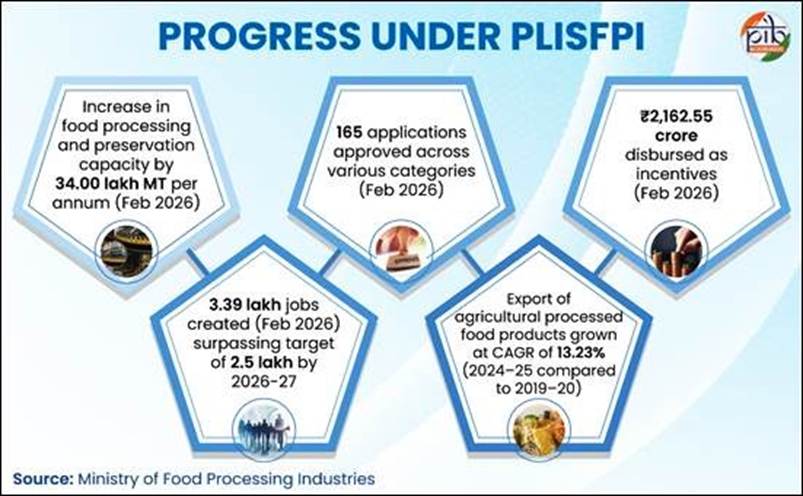
- Production Linked Incentive Scheme for Food Processing Industry (PLISFPI) has delivered strong outcomes by Feb 2026, including ₹2,162 crore incentives disbursed, 3.39 lakh jobs created, and 13.23% CAGR in processed food exports, indicating policy effectiveness.
- The scheme reflects India’s shift towards value-added agriculture and manufacturing integration, reinforcing export competitiveness and domestic food value chains under broader economic transformation goals.
Relevance
GS III (Economy)
- Agro-processing, value addition, supply chains, exports
- Industrial policy (PLI), MSME integration, GVC participation
GS III (Agriculture)
- Post-harvest losses, farmer income, agri-value chains
Practice Question
Q1.“Food processing is the missing link in India’s agricultural transformation.”Discuss in the context of recent policy initiatives. (250 words)
Static Background
- Food Processing Sector refers to transformation of raw agricultural produce into value-added consumables, improving shelf life, reducing wastage, enhancing farmer income, and ensuring food security.
- India faces post-harvest losses (5–16%), making food processing critical for efficient resource utilisation and price stabilisation.
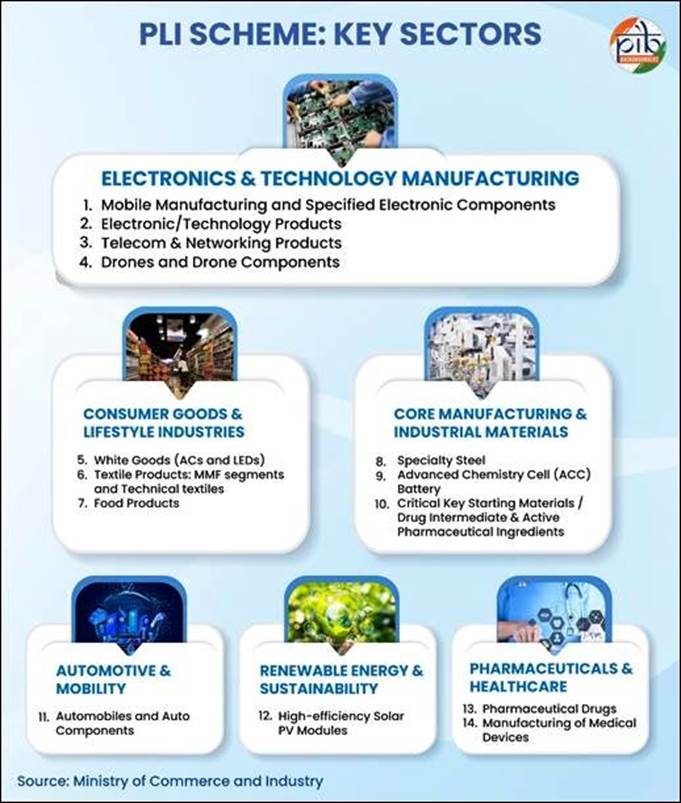
- Production Linked Incentive Scheme (2020) is designed to incentivise incremental sales, boost manufacturing competitiveness, and integrate India into global value chains (GVCs).
- Covers 14 sectors with ₹1.97 lakh crore outlay, focusing on scale, efficiency, and exports.
- PLISFPI (2021–27) under Ministry of Food Processing Industries aims to generate ₹33,494 crore output and 2.5 lakh jobs, while strengthening agro-processing ecosystems.
- Implementation through Industrial Finance Corporation of India Limited ensures project appraisal, MIS monitoring, and performance tracking.
Core Issue & Key Findings
- Sectoral growth: GVA increased from ₹1.34 lakh crore (2014-15) to ₹2.24 lakh crore (2023-24), indicating rising importance in the economy.
- Export performance: Processed food share in agri-exports rose from 13.7% to 20.4% (2014-15 to 2024-25), reflecting structural shift towards value addition.
- Scheme performance (Feb 2026):
- 165 approved applications across 274 locations, showing wide geographic spread and industrial uptake.
- ₹9,207 crore investment mobilised, indicating strong private sector participation.
- 34 lakh MT/year additional processing capacity, strengthening supply-side infrastructure.
- 3.39 lakh jobs created, exceeding target of 2.5 lakh jobs by 2026-27.
- ₹89,053 crore cumulative exports (2021–25), demonstrating export-led growth potential.
- MSME participation significant: 69 MSMEs + 40 contract manufacturing units, ensuring inclusive industrial growth.
Overview
- The scheme represents a structural shift from raw agricultural exports to processed, high-value exports, improving terms of trade for Indian agriculture.
- By linking incentives to incremental sales, it introduces performance-based industrial policy, reducing inefficiencies associated with input-based subsidies.
- Integration of farm-to-fork value chains strengthens market linkages, ensuring better price discovery and reduced intermediation losses.
- Emphasis on branding and marketing abroad addresses a long-standing gap where India exported commodities but lacked global consumer brands.
- Millet-focused component (PLISMBP) aligns with climate-resilient agriculture, nutritional security, and International Year of Millets momentum.
- Encourages adoption of advanced technologies such as cold chains, automation, quality certification (HACCP, Codex standards), improving global acceptance.
- Enhances rural industrialisation, generating employment across processing, logistics, packaging, and retail segments.
- Supports India’s aspiration to become a global food processing hub, leveraging its status as second-largest producer of fruits and vegetables.
Challenges & Concerns
- India’s value addition in food processing (~10%) remains low compared to 40–60% in developed economies, indicating untapped potential.
- Infrastructure deficits in cold storage, logistics, and warehousing continue to constrain efficiency and increase wastage.
- Fragmented landholdings and supply chains hinder standardisation, quality consistency, and economies of scale.
- MSMEs face credit constraints, technological gaps, and compliance burdens, limiting their full participation despite policy support.
- Export competitiveness affected by stringent SPS standards and non-tariff barriers, especially in developed markets.
- Regional imbalance persists, with processing clusters concentrated in select states, leaving eastern and northeastern regions underdeveloped.
- Rising processed food consumption raises concerns about nutrition transition and health impacts, requiring regulatory oversight.
- Implementation risks include accurate baseline determination, monitoring inefficiencies, and potential misuse of incentives.
Key Takeaways
- Demonstrates shift towards performance-linked incentives, reflecting evolution from traditional subsidy regimes to outcome-based governance.
- Highlights role of MSMEs, branding, and GVC integration in achieving Atmanirbhar Bharat and Make in India objectives.
- Shows synergy between agriculture, manufacturing, and trade policy, crucial for doubling farmer income and rural development.
- Useful case study for inclusive growth, state capacity, and public-private partnership in industrial ecosystems.
Prelims Pointers
- PLISFPI launched in 2021, with ₹10,900 crore outlay, valid till 2026-27.
- Covers RTC/RTE foods, processed fruits & vegetables, marine products, mozzarella cheese under Category I.
- Has three components: manufacturing incentives, SME innovation support, and global branding assistance.
- Branding incentives provide 50% reimbursement, capped at ₹50 crore/year or 3% of sales.
- PLISMBP (₹800 crore) promotes millet-based processed food products.
- Implemented by IFCI with MIS-based monitoring, ensuring transparency and performance tracking.
World Earth Day 2026: Celebrating ‘Our Power, Our Planet’
Why in News?
- World Earth Day (22 April 2026) celebrated with theme “Our Power, Our Planet”, emphasising collective responsibility for environmental protection and sustainability.
- National Science Centre hosting science lecture and quiz, promoting environmental awareness, scientific temper, and youth engagement in sustainability discourse.
Relevance
GS III (Environment)
- Climate change, sustainability, biodiversity
- Environmental awareness, behavioural change
GS II (Polity)
- Constitutional provisions: Articles 48A, 51A(g)
- Role of institutions in awareness & participation
Practice Question
Q1.“Environmental sustainability requires behavioural change as much as policy intervention.”Discuss in the context of global and national initiatives. (250 words)
Static Background
- World Earth Day originated in 1970 (USA), now coordinated globally by Earth Day Network, involving 190+ countries.
- Aligns with principles of sustainable development, intergenerational equity, and ecological balance.
- Constitutional backing:
- Article 48A: State shall protect and improve environment.
- Article 51A(g): Duty of citizens to protect natural environment.
- Linked with global frameworks: Paris Agreement, Convention on Biological Diversity, and SDGs (especially Goals 13, 14, 15).
Core Issue & Key Findings
- Theme highlights human agency (“Our Power”) in tackling climate change, biodiversity loss, and pollution (“Our Planet”).
- Focus on community-driven climate action, renewable energy adoption, and sustainable lifestyles.
- Event features:
- Lecture on Antarctica exploration, reflecting importance of polar science in climate studies.
- Quiz competition to enhance environmental literacy among youth.
- Antarctica relevance: climate regulation, ice-core data, sea-level rise indicators, critical for global climate modelling.
Overview
- Theme signifies shift from state-centric environmental governance to participatory sustainability, empowering citizens, communities, and youth.
- Highlights need for behavioral change (LiFE—Lifestyle for Environment) alongside technological solutions.
- Antarctica-focused lecture underscores cryosphere’s role in Earth system, influencing ocean currents, albedo effect, and global temperature regulation.
- Science outreach initiatives bridge gap between policy and public awareness, strengthening evidence-based environmental decision-making.
- Reinforces role of institutions like science centres in cultivating scientific temper (Article 51A(h)), critical for climate action acceptance.
- Integrates education, awareness, and participation, aligning with bottom-up governance models in environmental management.
Challenges & Concerns
- Awareness-action gap: High awareness does not always translate into sustainable behavioural change.
- Climate fatigue and misinformation weaken public engagement in long-term environmental issues.
- Limited reach of such events to rural and marginalised populations, restricting inclusivity.
- Scientific literacy deficits hinder understanding of complex issues like climate change and biodiversity loss.
- Institutional efforts often remain event-centric rather than continuous engagement mechanisms.
Key Takeaways
- Demonstrates importance of public participation and awareness in environmental governance.
- Highlights role of science communication in policy acceptance and sustainability transitions.
- Useful example of integration of education, science, and environmental policy.
Prelims Pointers
- World Earth Day observed annually on 22 April, first celebrated in 1970.
- Coordinated globally by Earth Day Network, covering 190+ countries.
- Theme 2026: “Our Power, Our Planet” focuses on collective environmental responsibility.
- Antarctica is crucial for global climate regulation and sea-level monitoring.
- Indian constitutional provisions: Article 48A (State duty) and Article 51A(g) (citizen duty).
- Linked to SDGs 13 (Climate Action), 14 (Life Below Water), 15 (Life on Land).


