
Why is it in News?
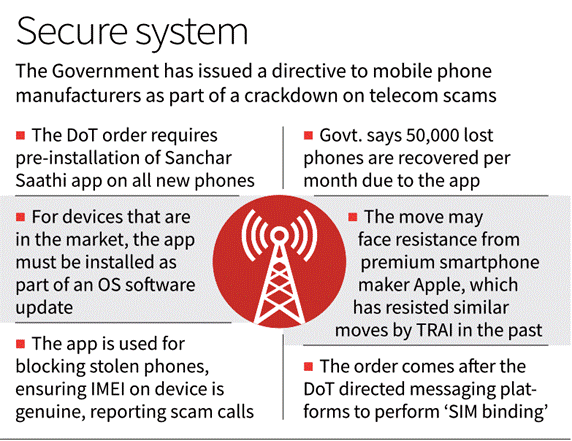
- Department of Telecommunications (DoT) has ordered all smartphone manufacturers to pre-install the Sanchar Saathi app on devices sold from March 2026.
- Manufacturers must ensure the app cannot be disabled or restricted.
- Move follows rising concerns about IMEI tampering, SIM misuse, cross-border digital frauds, and second-hand phone black markets.
Relevance
GS 2 – Governance
- Regulatory power of DoT.
- Device-level regulation, digital governance.
- Privacy vs security debate.
- Mandatory pre-installation and consumer rights.
GS 3 – Internal Security / Cybersecurity
- IMEI tampering, SIM fraud, digital impersonation scams.
- CEIR integration for stolen device tracking.
- Telecom security architecture strengthening.
What is Sanchar Saathi?
- Launched in 2023 as a portal; later developed into a mobile app.
- Provides services via CEIR (Central Equipment Identity Register).
- Core functions:
- Check mobile connections issued in your name.
- Report scam calls, financial fraud attempts.
- Identify and report IMEI tampering.
- Block, track, and remotely disable stolen/lost devices.
- Prevent re-activation of stolen phones using new SIMs.
What Has the Government Ordered Now?
- Mandatory pre-installation of Sanchar Saathi on all phones sold after March 2026.
- Manufacturers must ensure no disabling, no removal, and no restriction of functions.
- Objective:
- Verify authenticity of IMEIs.
- Prevent second-hand market fraud, resale of stolen/blacklisted phones.
- Curb scam calls, cross-border digital fraud operations.
Why This Mandate? Rising Telecom Security Threats
IMEI tampering
- Single IMEI used simultaneously on multiple devices.
- Makes legal action, tracing, and blacklisting difficult.
Cross-border digital fraud
- Fraudsters use Indian numbers abroad even after the original SIM is removed.
- Enables government impersonation scams, “digital arrest” frauds, UPI extortion attempts.
Second-hand smartphone black market
- India has one of the world’s biggest used-phone markets.
- Stolen/blacklisted phones resold → buyers unknowingly become legal abettors.
Cybercrime explosion
- Over 2.48 lakh complaints on Sanchar Saathi.
- Over 2.9 crore requests to check mobile connections linked to users.
- In October alone, 50,000 lost/stolen devices recovered via the app.
Technical Layer: IMEI Authentication Push
- Device IMEI must match the one registered on the telecom network.
- Sanchar Saathi + CEIR enables:
- Real-time detection of tampered/spoofed IMEI.
- Auto-blocking of cloned devices.
- Permanent blacklisting of stolen phones.
What About Privacy Concerns?
- DoT claims:
- The app collects no user data (as per Google Play declaration).
- Only helps verify IMEI and SIM-linkage.
- However:
- Pre-installation without option to disable → risk of perceived surveillance.
- Unclear whether the app will auto-access IMEI or require manual input.
- Past concerns:
- Apple earlier resisted mandatory pre-installed TRAI DND app due to permissions (access to SMS/call logs).
Industry Reaction & Global Context
- Smartphone makers typically resist government-mandated apps.
- Apple has protested similar mandates in India before.
- Internationally, tech firms resist “bloatware” and privacy-sensitive pre-loads.
- The 2026 mandate may cause:
- Industrial pushback
- Negotiations on permissions
- Possible technical challenges for foreign OEMs
Governance & Regulatory Perspective
DoT’s rationale
- SIM-binding + IMEI-verification essential to:
- Eliminate anonymous numbers.
- Reduce cross-border scam ecosystems.
- Improve national telecom security architecture.
Target outcome
- Unified system connecting device (IMEI), SIM, user identity, and operator’s network.
- A core element of India’s cyber-fraud prevention strategy.
Benefits Expected
- Reduced resale of stolen phones.
- Faster recovery of lost devices.
- Curbing large-scale OTP, UPI, and impersonation scams.
- Greater transparency in second-hand sales.
- Strengthened digital public infrastructure security.
Challenges Ahead
- Manufacturer resistance (Android & iOS).
- Potential privacy debates.
- Usability issues if app requires repeated verification.
- Risk of government overreach perception.
- Ensuring app does not become a surveillance pipeline.
Overall Significance
- Strengthens India’s telecom cybersecurity ecosystem.
- Part of the trend toward device-level and SIM-level regulation.
- Linked to larger frameworks:
- CEIR
- Digital India
- National Cyber Security Strategy (pending)
- Shows government’s increasing focus on fraud prevention and digital trust


