
Why is is in News?
- Multiple instances of GPS spoofing and GNSS (Global Navigation Satellite System) interference have been reported near major Indian airports.
- Delhi airport saw repeated spoofing incidents, with similar reports from Kolkata, Amritsar, Mumbai, Hyderabad, Bengaluru, Chennai.
- Ministry of Civil Aviation informed Parliament that the Wireless Monitoring Organisation (WMO) has been directed to identify the source of interference/spoofing.
- These incidents pose a serious aviation safety risk, prompting DGCA and AAI to mandate reporting of any such events.
Relevance
GS 1 – Geography
- GNSS systems (GPS, GLONASS, Galileo, BeiDou).
- Satellite signal vulnerabilities in dense airspace.
GS 2 – Governance / IR
- Civil aviation regulation by DGCA, AAI.
- Cross-border interference and geopolitical angle.
GS 3 – Internal Security / Cybersecurity
- Electronic warfare, jamming, spoofing.
- Aviation cyber risks and national security.
- Protection of critical infrastructure.
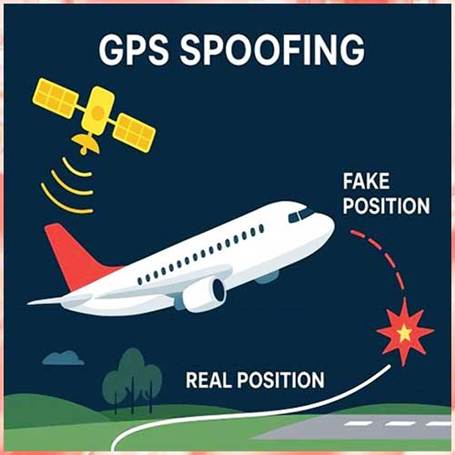
What is GPS Spoofing?
- GPS spoofing = broadcasting fake GPS signals stronger than the real satellite signals.
- Aircraft navigation systems may lock onto counterfeit coordinates, causing incorrect:
- Position
- Altitude
- Speed
- Flight path
- Creates dangerous navigation deviations, especially during approach and landing.
What is GNSS Interference?
- GNSS = GPS + other satellite systems (GLONASS, Galileo, BeiDou).
- Interference includes:
- Jamming: blocking signal reception.
- Spoofing: altering positional data.
- Both severely impact aviation safety, particularly in low-visibility or conflict zones.
What’s Happening in India?
- Delhi airport reported multiple GPS spoofing events, especially near Runway 10.
- Fake signals appear during approach and landing, when precision is critical.
- Other airports (Kolkata, Mumbai, Bengaluru, Hyderabad, Chennai, Amritsar) also reported similar patterns.
- November saw unusually high number of events around IGI Airport.
Why is This Dangerous?
Direct risks
- Incorrect aircraft position → flight deviations.
- Confusion between runways/flight paths.
- Possible near-miss or runway excursions.
- Overreliance on GNSS makes aircraft vulnerable.
Indirect risks
- Increased pilot workload.
- Potential exploitation by cyber actors during geopolitical tensions.
- Compromised ATC situational awareness.
Government & Regulatory Response
DGCA
- Made reporting of spoofing mandatory since 2023.
- Working with AAI to enhance detection networks.
AAI
- Monitoring interference near Delhi and other airports.
- Engaging with WMO to trace source.
DoT/WMO
- Mobilised resources to locate approximate spoofing location.
- Investigating signal strength, direction, timestamps.
Airlines & Pilots
- Instructed to report incidents immediately.
- Asked to maintain heightened situational vigilance.
Possible Sources of Spoofing (Experts’ View)
- Rogue personal or commercial jammers.
- Cross-border interference drift.
- Criminal networks using spoofers for evasion.
- Malicious cyber actors (ransomware/malware targeting aviation infrastructure).
- Faulty or misconfigured commercial GNSS repeaters.
No official source has been identified yet.
Global Context
- GPS spoofing has risen worldwide:
- Middle East conflict zones
- Russia–Ukraine war
- China and South-East Asia maritime regions
- Civil aviation globally is increasingly vulnerable.
- ICAO has warned of “GNSS-denied environments” becoming common in geopolitically sensitive areas.
Why India is More Vulnerable ?
- High-density aviation routes.
- Heavily GNSS-dependent landing procedures (RNP/GLS).
- Growing electronic warfare capabilities in neighbourhood.
- Widespread availability of cheap spoofers online.
Technical & Security Measures Needed
- Deploy GNSS interference monitoring stations around airports.
- Integrate RAIM, SBAS, and inertial navigation fallback systems.
- Combine radar + ADS-B + multilateration for redundancy.
- Strict DoT controls on illegal RF devices.
- Cybersecurity upgrades across airports and ATC.


