
Content
- A template for security cooperation in the Indian Ocean
- Zero stars
A template for security cooperation in the Indian Ocean
Why is it in News?
- India hosted the 7th NSA-level Colombo Security Conclave (CSC) Summit on 20 Nov 2025.
- Chaired by NSA Ajit Doval; attended by Sri Lanka, Maldives, Mauritius, Bangladesh; Seychelles joined as a full member; Malaysia participated as a guest.
- Summit signals deepening cooperation in Indian Ocean maritime security, non-traditional threats, and India’s growing role amid China’s expanding footprint in the region.
Relevance
GS 2 – International Relations
- India’s neighbourhood-first policy
- Sub-regional groupings (CSC vs IORA vs BIMSTEC)
- India’s maritime diplomacy
- Impact of China’s presence in Indian Ocean
- Regional security cooperation and institutional mechanisms
GS 3 – Internal Security
- Maritime security
- Non-traditional threats (trafficking, cyber, HADR)
- Coastal security architecture
- Undersea cable protection
- Blue economy–security linkages
GS 3 – Disaster Management
- HADR coordination
- Climate-driven maritime vulnerabilities
Practice Question
- “The Colombo Security Conclave has emerged as India’s most effective sub-regional maritime security platform, but its long-term relevance depends on institutionalisation and consensus-building.” Analyse.(250 Words)
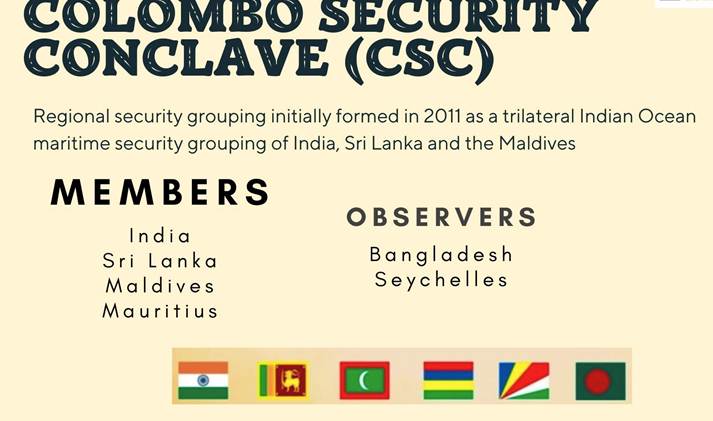
What is the Colombo Security Conclave (CSC)?
- Origin: Started in 2011 as a trilateral (India–Sri Lanka–Maldives).
- Dormancy: Lost momentum due to political transitions in Sri Lanka & Maldives; lack of convergence.
- Revival: Reborn in 2020 with a renewed mandate and expanded scope.
- Full Members (2025): India, Sri Lanka, Maldives, Mauritius (joined 2022), Bangladesh (2024), Seychelles (2025).
- Observers/Guests: Seychelles (earlier), Mauritius (earlier), Malaysia (guest 2025).
- Objective: A sub-regional security grouping aimed at strengthening cooperation in the Indian Ocean Region (IOR) on
- Maritime Security
- Counter-terrorism
- Trafficking & Transnational Crime
- Cybersecurity
- HADR (increasingly linked)
Significance of CSC in the IOR
- IOR = high-stakes region
- World’s busiest sea lanes
- 80% of global seaborne trade, 65% of oil shipments
- Hub for great-power rivalry
- Security architecture fragmented: No single comprehensive IOR security framework → CSC fills a sub-regional vacuum.
- Focus on Non-Traditional Security (NTS):
- Illegal fishing
- Maritime accidents
- Climate-driven disasters
- Drug trafficking
- Terror routes
- Cyber threats to ports & shipping
Why CSC Matters Now (2025 Context) ?
- Geopolitical churn: Indo-Pacific realignments; Chinese naval expansion (bases, surveillance network, dual-use ports).
- Regional instabilities:
- Sri Lanka’s debt crisis legacy
- Maldives’ foreign-policy swings
- Bangladesh’s domestic uncertainties
- Development-security nexus: Small island states depend on oceans for GDP, trade, tourism, fisheries → require secure seas.
- New opportunities: Blue Economy, undersea cable protection, marine minerals, maritime connectivity.
Key Outcomes/Highlights of the 2025 Summit
- Seychelles inducted as full member → major strengthening of western Indian Ocean representation.
- Malaysia participates as guest → signals possible future expansion into a wider Indo-Pacific security cluster.
- Reinforces India’s leadership in shaping sub-regional security architecture.
- Shows momentum toward institutionalisation and deeper multi-level cooperation.
Strategic Drivers
China Factor
- India’s Priority:
- Growing Chinese naval deployments, survey ships, PLA support bases (Djibouti; potential in Maldives/Sri Lanka).
- Dual-use ports (Hambantota)
- Undersea mapping → military relevance
- Member-State Divergence:
- Sri Lanka, Maldives, Bangladesh, Mauritius → rely on China for infrastructure and investments.
- Do not publicly label China as a security threat.
- Implication:
- India must calibrate CSC agenda without framing it as an “anti-China bloc”.
- Need consensus on NTS issues to avoid politicisation.
Institutional Weakness
- Structure limited to NSA-level consultations.
- No permanent secretariat, working groups inconsistent across members.
- Requires:
- Permanent institutional mechanism
- Regular technical exercises
- Data-sharing agreements
- Maritime domain awareness (MDA) integration
- Legal harmonisation on transnational crimes
Domestic Political Volatility
- Bangladesh’s internal political transition → uncertain continuity in foreign policy.
- Maldives’ cycles of pro-India/pro-China shifts affect CSC stability.
- Sri Lanka’s slow economic recovery risks inconsistent engagement.
Development–Security Interlinkages (Core to CSC)
- Coastal livelihoods (fisheries, ports): directly dependent on safe seas.
- Tourism economies threatened by maritime crime and climate events.
- Blue Economy requires stable waters.
- Undersea cables (carry 95% of global data) → high vulnerability; CSC crucial for coordinated protection.
Strengths of CSC
- India provides:
- Surveillance aircraft, coastal radars, joint patrols
- Training & capacity-building
- Disaster relief logistics
- Cybersecurity assistance
- Expanding membership → rising legitimacy
- NTS focus → less geopolitical friction among members.
Challenges to CSC
- Divergent threat perceptions on China
- Resource asymmetry among small islands
- Coordination overlaps with other IOR groups (IORA, IOC, QUAD maritime initiatives)
- Ensuring continuity amidst domestic political flux
- Limited institutional depth
Way Forward
- Institutionalisation:
- Secretariat, annual calendar, joint working groups
- Permanent MDA fusion cell integrating coastal radars and naval inputs
- Capacity-Building:
- Indian assistance in maritime law enforcement, cyber, digital forensics
- Legal Harmonisation:
- Anti-trafficking conventions, drug laws, maritime rules
- Expand Agenda:
- Climate-security
- Blue economy regulation
- Undersea cable protection
- Joint disaster response
- Balanced Diplomacy:
- Address China-related concerns subtly without alienating members.
Conclusion
- CSC has emerged as India’s most effective sub-regional maritime security platform.
- 2025 summit marks greater cohesion, expanded membership, and strategic relevance amid evolving Indo-Pacific dynamics.
- Future success depends on institutional resilience, consensus-building, and addressing member-state asymmetries while navigating China’s growing footprint in the Indian Ocean.
Zero stars
Why is it in News?
- On Nov 28 and Dec 1, 2025, the Department of Telecommunications (DoT) issued two directives:
- SIM Binding: Messaging accounts must be disabled if the physical SIM is removed.
- Mandatory Pre-installation of Sanchar Saathi App on all new smartphones by March 2026, visible during device setup and not allowed to be disabled.
- Aim: Combat cybercrime, spoofed IMEIs, digital impersonation, and fake devices.
- Trigger: Rise in “digital arrests”, spoofed IMEIs, cross-border fraud, government impersonation scams.
- Controversy: Concerns over privacy, surveillance, proportionality, and OS-level privileges.
Relevance
GS Paper 2 – Governance
- Privacy vs security
- Digital regulation
- Policy proportionality (Puttaswamy Judgment)
- Executive directives vs legislative oversight
GS Paper 3 – Internal Security
- Cybercrime rise
- IMEI spoofing, digital arrests, cross-border fraud
- Cyber forensics and device traceability
- Surveillance concerns & cybersecurity risks
GS Paper 3 – Science & Tech
- Mobile security architecture
- Device authentication mechanisms
- OS-level permissions and backdoor vulnerabilities
Practice Question
- Critically examine whether mandating compulsory pre-installation of the Sanchar Saathi app satisfies the constitutional standards of necessity and proportionality in addressing rising cybercrime in India.(250 Words)
What is Sanchar Saathi?
- Government’s digital platform by DoT to help citizens:
- Verify IMEI authenticity, report lost/stolen phones, block/unblock devices.
- Identify SIMs issued under one’s name.
- Existing verification channels already available:
- Web portals, SMS verification, USSD codes.
What is SIM Binding?
- Enforces that messaging apps deactivate an account if the physical SIM is removed.
- Goal: Prevent criminals from using apps anonymously after discarding SIMs.
- Effect: Reduces fake identities used in “digital arrest” and impersonation scams.
RISING CYBERCRIME: Why the Government Acted ?
- Surge in:
- Digital arrest scams (fake police/CBI calls).
- Cross-border fraud networks using encrypted apps.
- Spoofed IMEI devices → untraceable.
- SIM discard anonymity loopholes in messaging apps.
- Law enforcement struggles due to:
- No device-user linkage,
- Easily cloned IMEI numbers,
- App accounts functioning without SIM presence.
Benefits the Government Intends
- Stronger device traceability through verified IMEI.
- Crackdown on fake devices (15–20% of low-cost market estimated counterfeit).
- Better crime attribution to a specific handset.
- Reduces anonymity of cyber-fraudsters.
Why Critics Call It “Overkill” ?
Excessive Access inside Operating System
- Directive demands the app be visible at setup and cannot be disabled.
- This implies higher OS privileges, likely including:
- Camera access
- Phone/SMS logs
- Device identifiers
- Background activity
- Creates surveillance infrastructure even if not used abusively.
Fails the Constitutional Test of Proportionality
(K.S. Puttaswamy Judgment, 2017)
- Legality: Exists under executive directive, but not legislated.
- Necessity: There are less intrusive verification mechanisms.
- Proportionality: Mandating a high-privilege app for an entire population is disproportionate to the goal.
Alternatives Already Exist
- Website IMEI check
- SMS-based verification
- USSD codes
- These require no intrusive OS-level application.
Precedent of Surveillance Misuse
- Past Pegasus controversy → creates fear of state monitoring.
- Larger implications:
- Democratic chilling effect
- Self-censorship
- Undermining trust in government digital systems.
High Cybersecurity Risk
- If app has elevated permissions, a compromise/hack can impact millions of devices simultaneously.
- Creates a single point of failure in national cybersecurity.
Pushback from Industry
- Reports indicate privacy-sensitive manufacturers like Apple resisting compliance.
- Major concerns:
- OS integrity
- User experience disruption
- Global data protection compliance.
SIM Binding: A Mixed Measure
Pros
- Closes an important anonymity loophole.
- Directly addresses many fraud techniques.
Cons
- May disrupt messaging app usability (e.g., WhatsApp while switching devices/SIMs).
- Raises interoperability issues for eSIM users.
Implications for Citizens
- Constant device-level monitoring possibility.
- Compulsory presence of a government app, non-removable.
- Erosion of “informed consent”, a cornerstone of digital rights.
Broader Governance and Security Implications
- India is moving toward hard security approaches to cybercrimes.
- Risk of turning smartphones into surveillance endpoints under the pretext of security.
- Absence of a comprehensive Data Protection Law exacerbates concerns.
Way Forward
1. Use Less Intrusive Tools
- Strengthen USSD/SMS/portal-based verification.
- Encrypt IMEI linking at telecom-provider level.
2. Avoid Mandatory Pre-Installation
- Instead, offer it as opt-in, with clear permissions.
3. Legislative Backing
- Enact a law regulating device verification and privacy safeguards.
4. Independent Audits
- Conduct regular cybersecurity audits of the app.
5. Public Transparency
- Publish:
- Data flow
- Access logs
- Permission rationale
- Third-party evaluations.
Conclusion
- Mandating Sanchar Saathi pre-installation with non-removable functionality is a disproportionate response to legitimate cybercrime challenges.
- The approach increases risk of surveillance, OS-level vulnerabilities, and fails the privacy proportionality test.
- Strengthening existing low-intrusion verification tools and enhancing telecom-level security offers a more balanced, constitutionally sound path forward.


