
Content
- Digital Constitutionalism
- Chile’s lesson for India’s coal conundrum
Digital Constitutionalism
WHAT WAS THE ORDER?
- Govt announced (2025) that all mobile manufacturers must pre-install Sanchar Saathi on phones sold from 2026 onwards.
- App’s functions include CEIR, stolen-phone tracking, SIM misuse detection, user safety, and police assistance.
- The rule required mandatory installation at manufacturing level, not optional download by users.
Relevance
- GS-II | Polity: Fundamental Rights, privacy, state surveillance, constitutional governance.
- GS-II | Governance: Algorithmic decision-making, administrative fairness, accountability, opaque technologies.
- GS-III | Cyber Security: Rising digital crimes, digital policing, metadata risks.
- GS-III | Economy & Technology: Regulatory tensions between state control and global tech industry.
Practice Questions
- The Sanchar Saathi rollback highlights the tension between citizen privacy and state surveillance. Discuss how this episode strengthens the case for Digital Constitutionalism in India. (10 marks)
WHY IS THIS IN NEWS? (The 48-hour rollback)
- In 48 hours, the government revoked the mandatory installation order after:
- Opposition from foreign smartphone companies, especially Apple, which refused compliance.
- Concerns raised by civil society, privacy researchers, and industry bodies.
- Fears of ambiguous data collection, lack of user consent, unlimited storage, and surveillance risks.
- Reuters broke the story → triggered global scrutiny.
- Government clarified that the intention was consumer safety, citing rising cybercrimes (15.9 lakh → 20.4 lakh between 2023–2024), but concerns of digital overreach took precedence.
WHAT THIS CONTROVERSY SIGNALS ?
- Escalating tension between state surveillance authority and digital privacy rights.
- Increasing dependence of government on platforms, metadata, AI tools → blurred lines between governance and surveillance.
- Exposes weaknesses in India’s evolving data protection, algorithmic accountability, and digital rights frameworks.
DEEPER ISSUE: THE EMERGENCE OF DIGITAL CONSTITUTIONALISM
Meaning
- Application of constitutional values—liberty, privacy, dignity, equality, non-arbitrariness, natural justice—to the digital domain.
Why needed
- Governance increasingly relies on invisible systems:
- biometrics
- predictive algorithms
- behavioural modelling
- facial recognition
- metadata analysis
- Without constitutional safeguards, these technologies expand state and private power beyond citizen control.
KEY ARGUMENTS FROM THE ARTICLE
A. Threats from Algorithmic Governance
- Automated decisions regulate:
- KYC
- welfare delivery
- job eligibility
- credit scoring
- moderation of speech
- These systems operate as “black boxes” → no explanation, no appeal, high risk of unfair exclusion.
B. Rise of Invisible Surveillance
- Surveillance today is not Orwellian in a visible sense; it is ambient and silent:
- location tracing
- metadata
- facial recognition
- device identifiers
- Creates self-censorship and a chilling effect on dissent.
C. Inadequacy of existing legal protections
- Justice K.S. Puttaswamy (2017) recognised privacy as fundamental right.
- DPDP Act 2023 offers protections but has:
- broad government exemptions
- weak oversight
- limited remedies
- prioritisation of state interests over liberty
D. Global examples of caution
- Facial recognition restrictions across U.S. cities due to discrimination & misidentification.
- DigiYatra storing biometric data with private entities → ownership ambiguities.
E. Structural democratic dangers
- Concentration of digital power with:
- governments
- law enforcement
- tech platforms
- Citizens reduced to data subjects, not constitutional right-holders.
WHAT DIGITAL CONSTITUTIONALISM SHOULD INCLUDE ?
- Independent Digital Rights Commission.
- Strict necessity and proportionality for surveillance.
- Mandatory judicial warrants for sensitive data access.
- Public transparency reports.
- Regular bias/audit tests for high-risk AI.
- Right to explanation in algorithmic decisions.
- Right to appeal automated decisions.
- Strong purpose limitation and harsh penalties for misuse.
- Digital literacy as a constitutional right-enabler.
BROADER IMPLICATIONS FOR INDIA
A. India’s digital state is expanding rapidly
- Aadhaar
- DigiLocker
- FASTag
- DigiYatra
- AI-powered policing
- Predictive governance
→ All operate with limited constitutional guardrails.
B. Economic considerations constrain regulatory choices
- Apple, global tech companies have leverage → government cannot risk “manufacturing exit”.
C. India lacks a comprehensive surveillance law
- Surveillance currently governed by colonial-era or patchwork IT rules.
- No statute requiring judicial authorization for digital surveillance.
CONCLUSION
The Sanchar Saathi rollback underscores an emerging constitutional challenge: state-led digital expansion without adequate rights-based safeguards. As governance becomes increasingly algorithmic, surveillance-driven, and data-centric, India must embed constitutional protections—privacy, transparency, due process, proportionality—into its digital architecture.
Digital constitutionalism is not merely a theoretical construct but a democratic necessity to ensure that technology serves citizens and not the other way around.
Chile’s lesson for India’s coal conundrum
WHAT IS THE ISSUE?
- India has achieved dramatic renewable energy gains, doubling clean energy capacity during 2021–25.
- Yet, India remains heavily dependent on coal, especially for electricity generation (≈75% in 2024).
- Coal provides jobs + cheap power in several States, but also results in air pollution, health loss, climate risk, and global warming.
Relevance
GS-III | Environment & Climate Change
- Coal phaseout, decarbonisation pathways, CCPI rankings, global comparisons (Chile).
- Air pollution, climate vulnerability, energy transition strategies.
GS-III | Economy – Infrastructure & Energy
- Power sector reforms, energy security, renewable integration, market design, carbon pricing.
GS-I & GS-II | Social Justice & Governance
- Just Transition for coal-dependent regions.
- Worker protection, reskilling, community rehabilitation.
GS-II | International Relations
- Climate leadership, global expectations from India, COP negotiations.
Practice Question
- India’s fall in the CCPI ranking despite renewable gains exposes contradictions in its energy transition pathway. Examine the factors behind this decline. (10 marks)
WHY IS THIS IN NEWS? (COP30, Brazil, Nov 2025)
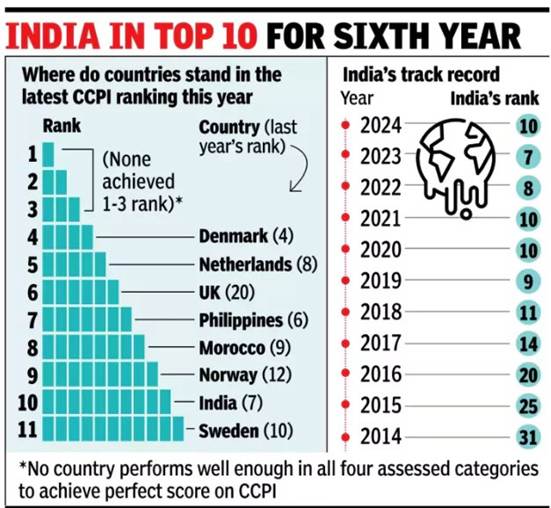
- India fell 13 places to 23rd in the Climate Change Performance Index (CCPI) 2025.
- Reason: Lack of progress in coal phaseout, despite strong renewable expansion.
- Highlights the coal conundrum: socio-economic dependence vs. ecological and public health costs.
- Chile’s successful coal transition is highlighted as a comparative model relevant to India.
INDIA’S ENERGY STATUS (2024–25)
Coal Dependence
- Coal accounts for over half of India’s total energy use.
- 75% of electricity was coal-generated in 2024.
- Domestic coal production is increasing, not declining.
Renewables
- Renewables (wind, solar, hydro, nuclear) = ~50% of installed capacity, but only 20% of actual generation.
- Growth strong but inadequate to replace coal in dispatch.
CHILE’S EXPERIENCE: WHAT DID IT DO DIFFERENTLY?
Key Actions (2014–24)
- Carbon tax: USD 5 per tonne of CO₂ in 2014.
- Strict emission norms: raised coal plant compliance costs by 30%.
- Competitive solar/wind auctions lowered renewable tariffs.
- Large-scale energy storage rollout for grid stability.
- Commitment to phase out all coal by 2040.
Outcomes
- Coal generation dropped from 43.6% → 17.5% (2016–24).
- Renewables > 60% of energy mix.
- Worker transition aided by:
- diversified economy
- strong renewable industry
- supportive political environment
WHY INDIA’S TRANSITION IS MORE COMPLEX ?
- Coal’s share far higher than Chile → more plants to retire.
- Millions depend on coal economy in Jharkhand, Chhattisgarh, Odisha, West Bengal → risk of social disruption.
- Fewer alternative industries in coal districts.
- Grid integration challenges → renewables intermittent; storage insufficient.
- Political economy resistance due to tariffs, subsidies, and state-owned coal interests.
WHY COAL PHASEOUT IS A “NO REGRETS” POLICY ?
A. Economic Loss
- Climate change could cause 3–10% GDP loss by 2100 due to heat stress & productivity decline.
B. Health Impact
- A 1 GW increase in coal capacity → 14% rise in infant mortality in nearby districts.
- Also contributes to PM2.5, respiratory diseases, and chronic illness.
C. Climate Leadership
- Without a coal exit plan, India’s renewable achievements lack credibility in global negotiations.
Three Key Thrust Areas
1. Physical Transition
- Remove oldest & most polluting units on priority.
- Cancel new coal approvals.
- Replace coal output with firm renewable power + storage.
- Scale up electrification of transport, industry, households.
2. Market & Regulatory Reform
- Introduce carbon pricing.
- Remove coal subsidies & cross-subsidies.
- Implement clean dispatch rules (renewables-first).
- Reform procurement contracts to incentivise RE+storage.
3. Social Protection & Just Transition
- Reskilling, alternative livelihoods, and robust worker support.
- Set up a dedicated transition fund – e.g., Green Energy Transition India Fund.
- Use District Mineral Foundation (DMF) for industry diversification in coal regions.
FINANCE FOR COAL PHASEOUT
- Needs blended finance:
- Public funds → social welfare, worker protection.
- Private capital → renewable infrastructure, battery storage, green hydrogen.
- International climate finance flows crucial.
- DMF + CSR + sovereign green bonds can support district-level transition.
CONCLUSION
India’s fall in the CCPI rankings highlights a structural contradiction: rapid renewable expansion without a parallel coal exit strategy. The Chile experience demonstrates that coal-dependent economies can transition if supported by decisive policy, market reform, carbon pricing, and worker protection.
For India, the challenge is larger but the imperative is unavoidable — climate losses, health impacts, and economic risks make coal phaseout a no-regrets pathway. A credible transition roadmap, with timelines, financing mechanisms, regulatory reforms, and Just Transition policies, is essential to align India’s growth trajectory with its net-zero ambitions and global climate responsibility.


