
Content
- How is the Aravalli range to be protected?
- Preah Vihear Temple and Thailand–Cambodia Border Dispute
- KAVACH Anti-Collision System
- Desert Cyclone-II
- India–Oman Free Trade Agreement
- UNEA-7 talks end with 11 resolutions and lingering division
How is the Aravalli range to be protected?
Why is it in News?
- Supreme Court order (Nov 2025):
- Settled on a uniform definition of Aravalli hills & ranges.
- Paused fresh mining leases across Delhi, Haryana, Rajasthan, Gujarat.
- Follow-up to:
- Long-standing illegal & excessive mining.
- Conflicting State-wise definitions enabling regulatory evasion.
- Linked with:
- India’s obligations under UN Convention to Combat Desertification (UNCCD).
- Centre’s Aravalli Green Wall Project (June 2025).
Relevance
- GS II:
- Role of Supreme Court in environmental governance.
- Federal issues: Centre–State coordination in environmental regulation.
- GS III:
- Environment & ecology: land degradation, mining impacts.
- Climate change adaptation, UNCCD commitments.
What are the Aravalli Hills?
- Geological age: ~2 billion years (oldest mountain range in India).
- Extent: ~650 km (Delhi → Haryana → Rajasthan → Gujarat).
- Major rivers sourced/recharged:
- Chambal, Sabarmati, Luni.
- Mineral-rich:
- Sandstone, limestone, marble, granite.
- Lead, zinc, copper, gold, tungsten.
Ecological Significance
- Natural climate barrier:
- Prevents eastward expansion of the Thar Desert.
- Groundwater recharge:
- Acts as a major aquifer recharge zone for NW India.
- Air quality regulation:
- Reduces dust storms and particulate load in NCR.
- Biodiversity support:
- Wildlife corridors, scrub forests, semi-arid ecosystems.
- Food & water security linkage:
- Protects Indo-Gangetic agricultural belt.
How Do Aravallis Prevent Desertification of the Indo-Gangetic Plain?
- Topographic barrier:
- Blocks desert winds and sand movement eastwards.
- Rainfall modulation:
- Enhances local convection and moisture retention.
- Vegetative anchoring:
- Forests and scrub bind soil, reduce erosion.
- Hydrological function:
- Recharge of shallow & deep aquifers prevents aridification.
- Climate buffering:
- Reduces temperature extremes and land degradation.
Problem: Mining & Ecological Degradation
- Since 1980s:
- Rampant quarrying for stone & sand.
- Impacts:
- Groundwater depletion.
- Air pollution (stone crushing).
- Habitat fragmentation.
- Rise of illegal mining syndicates.
- Regulatory failure:
- MoEFCC rules (1990s onwards) frequently violated.
Why Was a Uniform Definition Necessary?
- State-level manipulation:
- Different criteria used to exclude areas from protection.
- Conflicting expert definitions:
- Forest Survey of India (2010) used slope, buffers, valley width.
- Regulatory arbitrage:
- Enabled selective mining approvals.
- Judicial clarity needed:
- For enforcement, mapping, and EIA consistency.
What Definition Did the SC Settle On?
- Aravalli hills = elevations above 100 metres.
- Debate:
- Amicus Curiae: Too narrow, risks fragmentation.
- Centre: FSI definition would exclude even more areas.
- Court’s view:
- 100m criterion is more inclusive and administratively workable.
Central Empowered Committee (CEC): Key Recommendations
- Scientific mapping of entire Aravalli range across States.
- Macro-level Environmental Impact Assessment.
- Zonation approach:
- Absolute no-mining zones:
- Protected forests.
- Water bodies.
- Tiger corridors.
- Aquifer recharge zones.
- NCR areas.
- Limited, highly regulated mining zones elsewhere.
- Absolute no-mining zones:
- No new leases or renewals until mapping & EIAs completed.
- Strict regulation of stone-crushing units.
- Restoration & rehabilitation plans for degraded areas.
- Cumulative ecological carrying capacity assessment.
Has the Supreme Court Completely Banned Mining?
- No blanket ban.
- Calibrated approach adopted:
- Existing legal mining may continue under strict regulation.
- Fresh mining paused until scientific plan finalised.
- Ecologically sensitive zones permanently off-limits.
- Rationale:
- Total bans often fuel illegal mining & sand mafias.
Government Initiative: Aravalli Green Wall Project (2025)
- Coverage:
- 5 km buffer around Aravallis.
- 29 districts (Gujarat, Rajasthan, Haryana, Delhi).
- Objective:
- Restore 26 million hectares of degraded land by 2030.
- Alignment:
- UNCCD targets.
- India’s land degradation neutrality goals.
Way Forward
- Science-based environmental regulation over ad-hoc bans.
- Uniform definitions as tools of ecological justice.
- Balance livelihood concerns with irreversible ecosystem loss.
- Aravallis as a national ecological security asset, not a State-wise resource.
Preah Vihear Temple and Thailand–Cambodia Border Dispute
Why is it in News?
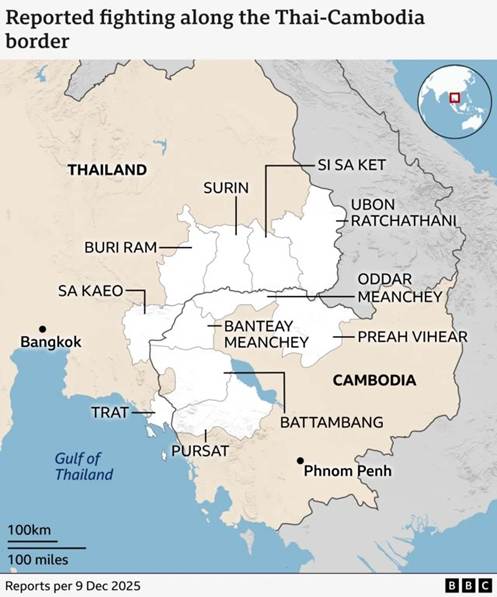
- December 2025 escalation:
- Thailand launched airstrikes inside Cambodia after renewed border clashes.
- Both sides accused each other of violating a U.S.-brokered ceasefire (Oct 2025).
- U.S. intervention:
- After calls with both leaders, President Donald Trump announced a ceasefire on December 12.
- Marks the worst flare-up since July 2025 fighting, which killed dozens and displaced over 3 lakh civilians.
Relevance
GS II:
- International relations: border disputes, ICJ rulings, ASEAN role.
- Role of external powers (U.S. mediation).
GS III:
- Internal security (regional instability spillovers).
Basics: Thailand–Cambodia Border
- Length: ~817 km.
- Nature: Partially demarcated, heavily forested, mountainous.
- Dispute origin: Colonial-era boundary treaties (1904 & 1907).
- Strategic-cultural sensitivity:
- Hosts ancient Khmer temples, especially Preah Vihear.
What is the Border Dispute About?
- Core issue:
- Sovereignty over un-demarcated stretches of the border.
- Colonial legacy:
- Treaties between France (Cambodia) and Siam (Thailand).
- Boundary supposed to follow Dangrek Mountains watershed.
- French maps placed key temples on the Cambodian side.
- Result:
- Thailand disputes map validity; Cambodia relies on them for claims.
Centrality of Preah Vihear Temple
- Temple:
- 11th-century Hindu temple (Shaivite), symbol of Khmer civilisation.
- History: Construction began in the 9th century, with major expansions in the 11th and 12th centuries under Khmer kings Suryavarman I and Suryavarman II.
- Architecture: Unlike most Khmer temples, which face east, Preah Vihear follows a linear north-south axis over an 800-meter length, with a series of sanctuaries, pavements, and staircases. It is known for its exceptional stone carvings.
- ICJ rulings:
- 1962: Temple belongs to Cambodia.
- 2013 clarification: Cambodia has sovereignty over most surrounding area.
- Continuing friction:
- Thailand accepts temple ruling but disputes adjacent land.
- Nationalism factor:
- Cambodia: Cultural heritage & post-colonial sovereignty.
- Thailand: Territorial integrity & resistance to perceived loss.
KAVACH Anti-Collision System
Why is it in News?
- December 2025: Union Railway Minister Ashwini Vaishnaw informed Lok Sabha that:
- KAVACH has been fully commissioned on over 2,000 km of the Indian Rail network.
- Consequential train accidents reduced by ~90% (from 135 in 2014 to 11 now).
- Comes amid:
- Recurrent concerns on rail safety.
- Push for indigenous, tech-driven accident prevention.
- Expansion under Atmanirbhar Bharat and Viksit Bharat vision.
Relevance
- GS III:
- Infrastructure: railways, public safety systems.
- Science & technology: indigenous innovation, ATP systems.
What is KAVACH?
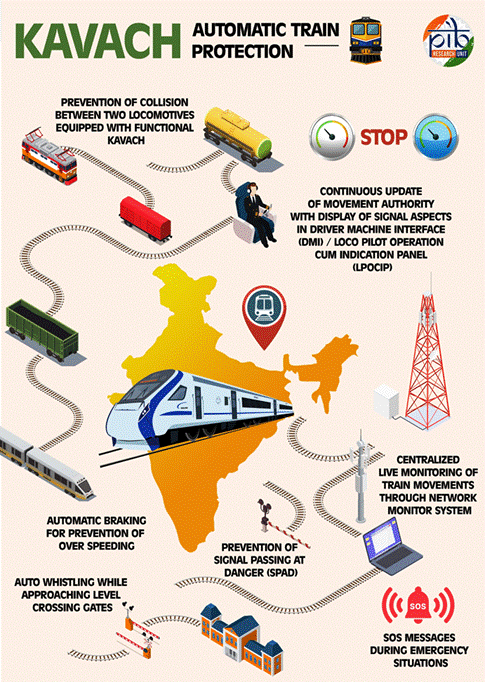
- KAVACH is India’s indigenous Automatic Train Protection (ATP) system.
- Objective:
- Prevent train collisions due to human error.
- Developed by:
- Research Designs & Standards Organisation (RDSO).
- In collaboration with Indian industry.
- Comparable to:
- ETCS (Europe), PTC (USA) — but much cheaper.
What Problems Does KAVACH Address?
- Human errors by:
- Loco pilots.
- Station masters.
- Signal misinterpretation.
- High-risk scenarios:
- Signal Passed At Danger (SPAD).
- Head-on collisions.
- Rear-end collisions.
- Overspeeding.
- Limitation of legacy signalling systems.
How Does KAVACH Work? (Core Architecture)
KAVACH is a real-time, fail-safe system built on continuous communication.
Five Major Components
- On-board unit (Loco KAVACH):
- Installed on locomotives.
- Applies automatic braking if danger detected.
- Track-side equipment:
- Along tracks to relay movement authority.
- Station KAVACH:
- Integrated with interlocking & signalling.
- Telecom network:
- Optical Fibre Cable (OFC).
- Telecom towers.
- Central data systems:
- Real-time monitoring & diagnostics.
Operational Features
- Automatic braking when:
- Train overshoots signal.
- Collision risk detected.
- Speed exceeds permissible limit.
- Continuous loco-to-loco & loco-to-station communication.
- Works even in:
- Fog.
- Low visibility.
- Designed for:
- High-density mixed traffic (passenger + freight).
Current Implementation Status (as per Govt)
- >2,000 km fully commissioned.
- 7,129 km OFC laid.
- 860 telecom towers installed.
- 767 stations connected to data centres.
- 3,413 km trackside equipment deployed.
- 4,154 locomotives equipped.
- ~40,000 staff trained.
- Expansion pace described as “very fast”.
Why is KAVACH Considered Strategic?
- Safety dividend:
- Sharp fall in consequential accidents.
- Indigenous technology:
- Reduces import dependence.
- Cost-effective:
- ~₹50 lakh per km (far cheaper than global ATP systems).
- Scalable:
- Designed for India’s vast and diverse rail network.
- Employment & skilling:
- Large-scale technician training.
Challenges & Limitations
- High upfront capital cost for pan-India rollout.
- Requires:
- Dense telecom infrastructure.
- Precision mapping & calibration.
- Integration with:
- Multiple signalling systems across zones.
- Not yet universal across:
- All routes.
- All locomotives.
Policy & Governance Angle
- Linked schemes:
- Amrit Bharat Station Scheme (station modernisation).
- Governance challenge:
- Upgrading safety without suspending rail operations.
- India handles ~7.5 crore passengers daily.
- Minister highlighted:
- Unlike other countries, India cannot shut rail services for years.
Conclusion
KAVACH is India’s indigenous Automatic Train Protection system that uses real-time communication to automatically prevent train collisions, significantly improving rail safety while reinforcing technological self-reliance.
Desert Cyclone-II
Why is it in News?
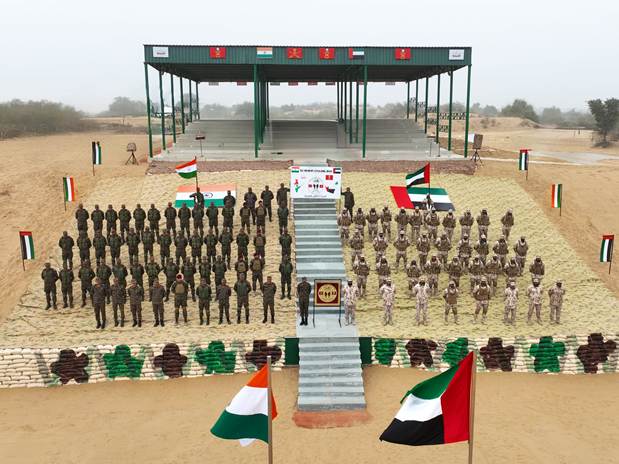
- December 2025: An Indian Army contingent has departed for the UAE to participate in DESERT CYCLONE–II.
- Exercise scheduled at Abu Dhabi from December 18–30, 2025.
- Part of India’s expanding defence diplomacy in West Asia.
Relevance
- GS II:
- India–UAE relations; defence diplomacy in West Asia.
- GS III:
- Security: military preparedness, joint exercises, interoperability.
What is DESERT CYCLONE?
- Type: Bilateral joint military exercise.
- Participants:
- India: 45 personnel, mainly from Mechanised Infantry Regiment.
- UAE: 53 Mechanised Infantry Battalion.
- Edition: Second (DESERT CYCLONE–II).
- Domain: Land forces (mechanised infantry).
Objectives of DESERT CYCLONE–II
- Enhance interoperability between Indian Army and UAE Land Forces.
- Improve joint operational preparedness in:
- Mechanised warfare.
- Desert and semi-desert conditions.
- Strengthen defence cooperation and trust.
- Exchange best practices, tactics, and procedures.
Strategic Significance of UAE for India
- Key West Asia partner:
- Energy security.
- Indian diaspora (~3.5 million).
- Defence cooperation pillars:
- Joint exercises (army, navy, air force).
- Defence industrial collaboration.
- Maritime security in the Arabian Sea & Gulf region.
- UAE is among India’s closest strategic partners in the Gulf.
Why Mechanised Infantry Matters
- Critical arm for:
- Rapid mobility.
- Combined arms warfare.
- Relevance for:
- Desert warfare scenarios.
- High-intensity conventional conflict.
- UAE terrain provides realistic training environment.
Place in India’s Defence Diplomacy
- Complements exercises like:
- AL NAGAH (India–Oman).
- YUDH ABHYAS (India–USA).
- DUSTLIK (India–Uzbekistan).
- Reflects India’s shift towards:
- Theatre-level readiness.
- Interoperable coalition operations.
- Supports India’s “Act West” and Indo-Pacific–West Asia strategic continuum.
Takeaway
- DESERT CYCLONE–II reflects India’s emphasis on practical military cooperation, not symbolic engagement.
- Enhances India’s capacity to operate with friendly foreign forces in diverse terrains.
- Reinforces India’s profile as a net security partner in West Asia.
Conclusion
DESERT CYCLONE–II is a bilateral India–UAE mechanised infantry exercise aimed at enhancing interoperability and strengthening defence cooperation in desert warfare conditions.
India–Oman Free Trade Agreement
Why is it in News?
- December 2025: India and Oman are set to sign a Free Trade Agreement (FTA), formally a Comprehensive Economic Partnership Agreement (CEPA).
- Announcement by Commerce & Industry Minister Piyush Goyal at the India–Oman Business Forum, Muscat.
- Marks India’s first bilateral FTA with a Gulf country outside the UAE model, strengthening India’s Act West strategy.
Relevance
- GS II:
- International relations: Act West policy, India–Gulf relations.
- GS III:
- Economy: external trade, FTAs/CEPAs, energy transition, logistics.
What is an FTA / CEPA?
- FTA:
- Reduces or eliminates tariffs on goods.
- Improves market access.
- CEPA (deeper than FTA):
- Trade in goods + services.
- Investment protection & facilitation.
- Customs cooperation, standards, mobility.
- India–Oman CEPA talks:
- Launched in 2023.
- Negotiated amid India’s renewed push for trade diversification.
India–Oman Economic Snapshot
- Bilateral trade (2023–24): ~$12 billion.
- India’s exports:
- Refined petroleum products.
- Iron & steel.
- Machinery, textiles, gems & jewellery.
- India’s imports:
- Crude oil, LNG.
- Fertilisers, chemicals.
- Indian diaspora in Oman:
- ~7.8 lakh, among the largest expatriate groups.
- Oman’s strategic location:
- Outside Hormuz choke point.
- Ports: Duqm, Sohar, Salalah.
Why Oman Matters Strategically for India?
- Gateway economy:
- Access to GCC, Eastern Europe, Central Asia, Africa.
- Logistics hub potential:
- Duqm port linked to India’s west coast.
- Energy partner:
- LNG supply.
- Green hydrogen ambitions.
- Geopolitical reliability:
- Stable monarchy.
- Neutral foreign policy.
Strategic Economic Gains for India
- Market diversification:
- Reduces over-dependence on traditional markets.
- Value-chain integration:
- Indian firms plug into Gulf–Africa trade routes.
- Services exports boost:
- IT, logistics, fintech, consultancy.
- Investment inflows:
- Omani sovereign & private capital into India.
- MSME opportunities:
- Preferential access to new export markets.
Strategic Economic Gains for Oman
- Economic diversification beyond hydrocarbons.
- Access to:
- India’s large consumer market.
- Skilled manpower & digital services.
- Positioning as:
- Regional trade & logistics hub.
- Partnership in:
- Green hydrogen exports.
- Food security assurance.
How This Fits India’s FTA Strategy ?
- Part of FTA 2.0 approach:
- Quality FTAs over quantity.
- Focus on trusted partners.
- Builds on:
- India–UAE CEPA.
- India–Australia ECTA.
- Supports:
- Atmanirbhar Bharat via export-led growth.
- Viksit Bharat 2047 trade vision.
Risks & Challenges
- India’s past experience:
- FTAs leading to import surges (e.g., electronics).
- Need for:
- Strong rules of origin.
- Safeguards for MSMEs.
- Infrastructure readiness:
- Logistics costs still ~13–14% of GDP.
- Services mobility:
- Visa & labour norms need clarity.
Analytical Takeaway
- India–Oman FTA is not merely a trade deal but a geo-economic bridge.
- Oman’s geography converts trade access into strategic leverage.
- Success will depend on:
- Effective implementation.
- Leveraging Oman as a regional hub, not just a bilateral partner.
Conclusion
The India–Oman CEPA aims to deepen trade, investment and energy cooperation while positioning Oman as India’s gateway to the GCC, Central Asia and Africa under India’s Act West strategy.
UNEA-7 (United Nations Environment Assembly-7)
Why is it in News?
- UNEA-7 concluded on December 12, 2025, in Nairobi, Kenya.
- Outcome:
- 11 resolutions adopted out of 15 draft proposals.
- Several key drafts, including one on strengthening UNEP, were dropped.
- Triggered criticism from civil society and environmental groups for:
- Weak ambition.
- Failure to address deep-sea protection and environmental crime adequately.
Relevance
- GS III:
- Environment: mineral governance, chemicals & waste, marine ecology.
What is UNEA?
- UNEA is the highest global decision-making body on environmental matters.
- Meets biennially under the United Nations Environment Programme (UNEP).
- Membership:
- All 193 UN member states.
- Functions:
- Set global environmental agenda.
- Provide policy guidance.
- Strengthen international environmental governance.
UNEA-7 at a Glance
- Theme (implicit): Responding to escalating global environmental crises.
- Duration: ~2 weeks of negotiations.
- Location: Nairobi (UNEP headquarters).
- Outcome:
- 11 adopted resolutions.
- Persistent North–South and ambition divides.
Adopted
- Minerals & metals: Sustainable value chains; mining waste; capacity-building.
- Coral reefs: Boost climate resilience (supports ~25% marine biodiversity).
- MEAs: Better coordination; less policy/reporting overlap.
- Chemicals & waste: Stronger management under Basel–Rotterdam–Stockholm.
Dropped / Diluted
- Deep-sea protection: No strong safeguards for deep-sea mining.
- Environmental crime: No tougher global action.
- Strengthening UNEP: Resolution removed.
Leadership Transition
- President of UNEA-7: Abdullah bin Ali Al-Amri (Oman).
- President-elect for UNEA-8 (Dec 2026):
- Matthew Samuda (Jamaica).
- Stated priorities:
- Inclusivity.
- Stronger science–policy interface.
- Scaling adaptation and resilience finance.
Analytical Assessment
Achievements
- Maintained multilateral engagement amid geopolitical stress.
- Brought mineral governance firmly into global environmental discourse.
- Incremental progress on reefs, chemicals, MEAs.
Shortcomings
- Avoidance of binding commitments.
- Weak response to emerging global commons issues (deep seas).
- Institutional timidity in strengthening UNEP.
Global Significance
- Reflects the limits of consensus-based multilateralism in an era of:
- Climate urgency.
- Resource geopolitics.
- Signals growing tension between:
- Environmental ambition.
- Political feasibility.
Way Forward
- Shift from dialogue to rule-based global standards, especially for minerals and oceans.
- Strengthen UNEP’s mandate, finances, and coordination role.
- Integrate:
- Environmental justice.
- Finance and capacity-building for developing countries.
- Ensure UNEA-8 focuses on implementation, not just negotiation.
Conclusion
UNEA-7 adopted 11 resolutions advancing cooperation on minerals, reefs and chemicals, but lingering divisions over deep-sea protection, environmental crime and UNEP’s authority exposed the limits of current global environmental governance.


