
Content
- DHRUV64 Indigenous Microprocessor
- India Faces Its Greatest Strategic Challenge in Bangladesh Since 1971
- Retired Judges Reluctant to Serve as Ad Hoc Judges under Article 224A
- IDF Diabetes Atlas 2025
- Securities Market Code Bill, 2025
- Bharat Stage–VI (BS-VI) Emission Norms
- India–Oman Trade Deal and India’s West Asia Strategy
DHRUV64 Indigenous Microprocessor
Why is it in News?
- 15 December 2025: Ministry of Electronics & IT (MeitY) announced the launch of DHRUV64, an indigenous microprocessor.
- Developed by C-DAC under the Microprocessor Development Programme.
- Projected as a key step in building India’s indigenous processor pipeline and reducing dependence on imported chip designs.
Relevance
GS III – Science & Technology
- Indigenous semiconductor and processor development
- Digital sovereignty and strategic technologies
- Electronics manufacturing ecosystem
- RISC-V and open-source hardware architecture
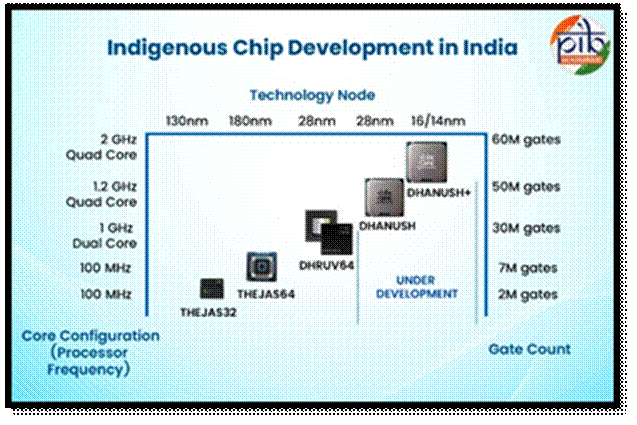
What is DHRUV64?
- Type: General-purpose microprocessor
- Architecture: 64-bit, dual-core
- Clock speed: ~1 GHz
- Developer: Centre for Development of Advanced Computing (C-DAC)
- Parent Ministry: MeitY
- Instruction Set: RISC-V (open standard)
- Role: Acts as the “brain” of electronic systems, capable of running operating systems and embedded applications.
Why Microprocessors Matter Strategically
- Microprocessors sit at the base layer of:
- Telecom networks
- Industrial control systems
- Automotive electronics
- Defence and space systems
- Control over processor design + toolchain + update pathways implies:
- Digital sovereignty
- Cybersecurity assurance
- Supply-chain resilience during sanctions or export controls
- India is a major consumer but a minor designer/manufacturer of processors.
What Do DHRUV64’s Specifications Mean?
Capability Assessment
- 64-bit design:
- Enables modern operating systems and contemporary software stacks.
- 1 GHz, dual-core:
- Modest by consumer standards
- Adequate for:
- Telecom base stations
- Routers
- Industrial automation
- Automotive modules
- Not designed for:
- High-end smartphones
- AI-heavy consumer computing (no GPU/AI accelerators disclosed)
Comparative Perspective
- Global top-tier processors:
- Multiple cores
- Higher clock speeds
- Integrated GPUs and AI blocks
- DHRUV64 prioritises:
- Reliability
- Determinism
- Hardware–software co-design
- Suitable for mission-critical but non-consumer workloads.
India’s Indigenous Processor Ecosystem
DHRUV64 is not standalone, but part of a broader pipeline:
| Processor | Institution | Use Case |
| SHAKTI | IIT Madras | Strategic & commercial systems |
| AJIT | IIT Bombay | Control systems |
| VIKRAM | ISRO–SCL | Space applications |
| THEJAS64 (2025) | C-DAC | Industrial & strategic |
| DHRUV64 | C-DAC | Platform-level processor |
DIR-V Programme (Digital India RISC-V)
What is RISC-V?
- An open instruction set architecture (ISA).
- No licensing fees for the ISA itself.
- Modular and extensible design.
Why Governments Prefer RISC-V
- Avoids dependence on proprietary ISAs (e.g., ARM, x86).
- Enables:
- Strategic autonomy
- Domestic innovation
- Custom security features
DIR-V Objectives
- Build a portfolio of RISC-V processors for:
- Industry
- Defence
- Consumer electronics
- DHRUV64 is the third DIR-V chip after:
- THEJAS32 (fabricated in Malaysia)
- THEJAS64 (fabricated at SCL Mohali)
Key Gaps & Unanswered Questions (Critical Analysis)
1. Performance Transparency
- No benchmarks disclosed:
- IPC, SPEC scores
- Cache sizes
- Memory controller features
- Performance per watt
2. Fabrication Ambiguity
- Foundry and process node not disclosed.
- Raises concerns about:
- Supply-chain sovereignty
- Yield and reliability
- Long-term availability (critical for telecom/auto sectors)
3. Meaning of “Fully Indigenous”
- Ambiguous claim:
- Indigenous ISA? (No — RISC-V is open, not Indian-origin)
- Indigenous core microarchitecture?
- Indigenous SoC integration?
- Indigenous fabrication?
- Indigenous toolchain?
- “Indigenous” may currently apply mainly to design ownership, not the entire value chain.
4. Ecosystem Readiness
- No clarity on:
- Developer boards
- OS support (Linux, RTOS, etc.)
- Security certifications
- Government anchor procurement
- Without an ecosystem, processors fail commercially.
5. Roadmap Uncertainty
- Next processors announced:
- DHANUSH: 1.2 GHz, quad-core, ~28 nm
- DHANUSH+: 2 GHz, quad-core, ~14/16 nm (reported)
- No timelines or fabrication commitments disclosed.
Supporting Policy Ecosystem
Key Government Schemes
- Chips to Startup Programme
- ₹250 crore over 5 years
- Focus: training, prototyping, startups
- Design Linked Incentive (DLI) Scheme
- Encourages domestic chip design firms
- INUP-i2i
- Access to nanofabrication facilities
Manufacturing Push
- India Semiconductor Mission (ISM):
- 10 projects approved
- 6 States
- Investment: ₹1.6 lakh crore
Strategic Significance
1. Technological Sovereignty
- Reduces reliance on foreign-controlled architectures.
- Critical during geopolitical disruptions.
2. Defence & Strategic Autonomy
- Indigenous processors essential for:
- Secure communications
- Weapon systems
- Space missions
3. Platform Approach
- DHRUV64 positioned as:
- A testbed for startups, academia, and industry
- Lower-cost prototyping without foreign chips
- Success depends on:
- Software stacks
- Reference designs
- OEM adoption
Way Forward
- Publish transparent technical documentation.
- Ensure:
- Anchor procurement by government agencies
- Strong software & OS ecosystem
- Clear fabrication roadmap within India
- Move from one-off chips to SoC families.
- Align processor design with:
- Telecom standards
- Automotive safety norms
- Defence certifications
India faces its greatest strategic challenge in Bangladesh since 1971
Why is it in News?
- 2025: Report of the Parliamentary Standing Committee on External Affairs (Chair: Shashi Tharoor).
- Assesses India–Bangladesh relations over the past two turbulent years.
- Trigger:
- Fall of Sheikh Hasina–led Awami League government (5 August 2024).
- Political churn, youth-led movements, Islamist resurgence.
- Growing Chinese and Pakistani influence in Bangladesh.
- Report warns of India potentially losing strategic space in Dhaka without timely recalibration.
Relevance
GS II – International Relations
- India–Bangladesh bilateral relations
- Neighbourhood First Policy
- Political transitions in neighbouring countries
GS II – Foreign Policy & Diplomacy
- Managing strategic influence amid China–Pakistan outreach
- Diplomatic recalibration and institutional engagement
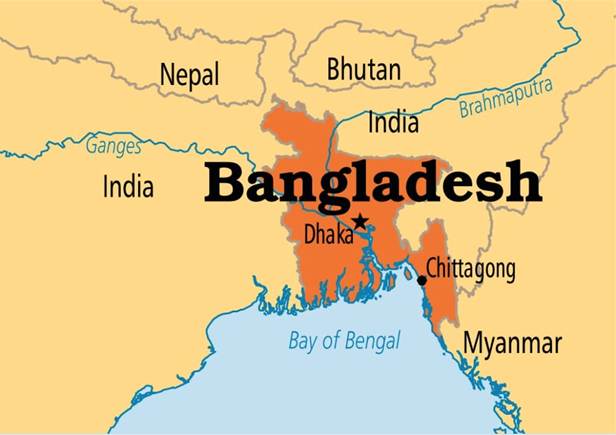
Core Assertion of the Report
- India’s greatest strategic challenge in Bangladesh since 1971.
- Contrast drawn:
- 1971: Existential, humanitarian crisis; birth of a new nation.
- Today: Subtler but possibly graver challenge:
- Generational political shift
- Reorientation of strategic alignments
- Risk of India becoming irrelevant, not threatened by war.
Background: India–Bangladesh Relations (Context)
- Traditionally strong pillars:
- Liberation War legacy (1971)
- Close ties with Awami League
- Cooperation on:
- Counter-terrorism
- Border management
- Connectivity
- River waters
- India’s Bangladesh policy heavily leader-centric, anchored around Sheikh Hasina.
What Has Changed?
1. Political Transition
- Collapse of Awami League dominance.
- Rise of:
- Youth-led nationalism
- Anti-incumbency narratives
- India perceived as:
- Over-aligned with one political party
- Insensitive to generational aspirations.
2. Generational Discontinuity
- Younger Bangladeshi population:
- Less emotionally tied to 1971 legacy.
- More assertive about sovereignty.
- India’s historic goodwill no longer automatic.
3. Resurgence of Islamists
- Re-entry of Islamist groups into mainstream politics.
- Raises concerns for:
- Internal security
- Cross-border extremism
- Minority rights in Bangladesh.
4. Strategic Inroads by China & Pakistan
- China:
- Infrastructure, ports, power, digital systems.
- Defence supplies and economic leverage.
- Pakistan:
- Intelligence and ideological outreach.
- Bangladesh increasingly hedging between India and rivals.
The Hasina Asylum Issue
India’s Decision
- India provided shelter to Sheikh Hasina after her ouster.
- Parliamentary panel:
- Endorses humanitarian and moral rationale.
- Warns against political misuse of Indian soil.
Diplomatic Sensitivities
- Bangladesh authorities accuse Hasina and associates of:
- Inciting unrest.
- Hasina:
- Issuing statements via personal communication devices.
- Indian position (as stated by Foreign Secretary Vikram Misri):
- India does not provide a political platform.
- No official facilitation of political activity from Indian territory.
Strategic Risks for India
1. Loss of Strategic Space
- India risks being sidelined in:
- Security cooperation
- Infrastructure influence
- Norm-setting in the region.
2. Border & Internal Security
- Porous border + political instability:
- Risks of radicalisation
- Smuggling
- Insurgent revival.
3. Neighbourhood First Policy at Stake
- Bangladesh is:
- India’s most critical eastern neighbour.
- Gateway to Northeast India and Act East Policy.
- Erosion here undermines India’s regional credibility.
Committee’s Warning
- Risk is not war, but irrelevance.
- Strategic loss through:
- Inattention
- Overdependence on past alignments
- Failure to engage emerging political forces.
What Recalibration Means for India ?
1. De-hyphenate from One-Party Dependence
- Engage:
- Opposition parties
- Civil society
- Youth groups
- Shift from leader-centric to institutional engagement.
2. Narrative Reset
- Move beyond 1971-centric diplomacy.
- Address:
- Economic aspirations
- Employment
- Climate vulnerability
- Digital economy cooperation.
3. Strategic Competition Management
- Offer credible alternatives to Chinese financing:
- Quality infrastructure
- Transparent development projects
- Strengthen people-to-people ties:
- Education
- Health
- Skill development.
4. Clear Red Lines on Security
- Zero tolerance on:
- Anti-India terror activities
- Radical networks.
- Quiet but firm security cooperation.
Retired judges don’t want to sit as junior ad hoc judges: CJI
Why is it in News?
- December 2025: Chief Justice of India (CJI) Surya Kant disclosed that retired High Court judges are reluctant to return as ad hoc judges mainly due to institutional and personal discomfort—being “embarrassed” to sit as junior judges with younger serving judges.
- Comes after the Supreme Court (January 2025) activated Article 224A to tackle massive criminal case pendency in High Courts.
- Despite the ruling, many High Courts have not proposed names, leading to poor uptake.
Relevance
GS II – Polity & Constitution
- Judiciary and constitutional provisions (Article 224A)
- Separation of powers
- Judicial independence and accountability
GS II – Governance
- Pendency of cases and access to justice
- Institutional reforms in higher judiciary
Scale of the Problem (Data)
- Pending criminal cases in High Courts: 18,98,833 (25 HCs).
- Cases pending >1 year: 68.27% (≈ 12,96,374).
- Sanctioned HC judge strength: 1,122.
- Vacancies (as of 15 Dec 2025): 298 (~26.6%).
- Worst-affected HCs noted: Allahabad, Punjab & Haryana, Patna.
Constitutional Basics: Article 224A
- Provision: Appointment of retired High Court judges as ad hoc judges.
- Authority:
- Initiated by Chief Justice of the High Court.
- Requires consent of the retired judge.
- President appoints after consultation.
- Purpose: Temporary augmentation to clear arrears, especially criminal appeals.
- Status: Not a substitute for regular appointments; a stop-gap measure.
Supreme Court’s Intervention
- January 2025 judgment (building on April 2021 ruling):
- Reactivated Article 224A.
- Urged HCs to use ad hoc judges selectively for criminal backlogs.
- Emphasised structured deployment and time-bound mandates.
Why Is the Uptake Poor?
1. Hierarchy & Bench Dynamics
- Criminal appeals typically heard by Division Benches.
- Retired judges feel discomfort sitting as junior members under younger judges.
- Serving judges question sitting with a retired judge heading the Bench.
- Result: Mutual hesitation disrupts bench formation.
2. Institutional Culture
- Strong seniority norms in Indian judiciary.
- Lack of clear protocols on bench composition involving ad hoc judges.
- Perceived dilution of institutional authority.
3. Administrative Inertia
- Several HCs have not forwarded names to the Supreme Court.
- Absence of:
- Incentive structures
- Clear tenure/role clarity
- Dedicated case allocation mechanisms.
Critical Assessment of Article 224A as a Solution
Strengths
- Quick augmentation without long appointment cycles.
- Utilises experienced judicial capital.
- Focused relief for criminal appeals.
Limitations
- Not scalable without cultural acceptance.
- Risks creating a parallel, temporary judiciary.
- Does not address root causes:
- Chronic vacancies
- Appointment delays
- Procedural inefficiencies.
Structural Causes of High Court Pendency
- Persistent vacancies due to:
- Delayed collegium recommendations
- Executive–judiciary friction
- Rising criminalisation and complex litigation.
- Limited judge-to-population ratio.
- Inadequate case management and listing practices.
Way Forward
1. Normalize Article 224A Usage
- Clear guidelines on:
- Bench composition
- Seniority protocol
- Role clarity for ad hoc judges
- Fixed-term, outcome-linked assignments.
2. Fix the Core Deficit
- Fill sanctioned vacancies on priority.
- Time-bound appointment processes.
- Consider raising sanctioned strength in high-load HCs.
3. Procedural & Managerial Reforms
- Dedicated criminal appeal benches.
- Enhanced case-flow management.
- Technology-driven listing and prioritisation.
4. Alternative Capacity Measures
- Strengthen evening courts / special benches.
- Expand judicial clerkship and research support.
- Promote plea bargaining and ADR where appropriate.
IDF Diabetes Atlas 2025
Why is it in News?
- 2025: 11th edition of the International Diabetes Federation (IDF) Diabetes Atlas released.
- Key findings published in The Lancet Diabetes & Endocrinology (2025).
- Projects a sharp global rise in diabetes prevalence by 2050, with middle-income countries bearing the heaviest burden.
Relevance
GS II – Social Justice & Health
- Public health challenges
- Non-communicable diseases (NCDs)
- Universal Health Coverage
GS III – Human Capital & Development
- Productivity loss due to lifestyle diseases
- Demographic transition and health burden
What is the IDF Diabetes Atlas?
- Flagship epidemiological assessment by the International Diabetes Federation.
- Estimates:
- Prevalence
- Trends
- Projections of diabetes (ages 20–79).
- Used by:
- WHO
- National health policymakers
- Global health financing agencies.
Key Global Findings (Data-driven)
1. Scale of the Epidemic
- 2024:
- People living with diabetes: ~580 million adults
- Prevalence: 11.11% of global adult population
- 2050 (Projected):
- Affected population: ~850–900 million adults
- Prevalence: 12.96%
➡ Diabetes growth is structural, not cyclical.
2. Income-Level Distribution
- Middle-income countries:
- Highest prevalence and fastest growth.
- Reflects:
- Rapid urbanisation
- Lifestyle transition
- Nutrition shift without commensurate healthcare access.
3. Urban–Rural Divide
- 2024:
- Urban: ~400 million
- Rural: ~189 million
- 2050 (Projected):
- Urban: ~655 million
- Rural: ~198 million
- Indicates:
- Diabetes increasingly an urbanisation-linked disease.
- Rural burden stagnates but does not decline.
Country-wise Diabetes Load (Top 10 Focus)
2024 Rankings
- China: ~148 million
- India: ~90 million
- United States
- Pakistan
2050 Projections
- China and India retain top two positions.
- Pakistan projected to rise to 3rd, overtaking the US.
➡ South and East Asia emerge as the global diabetes epicentre.
Why Is Diabetes Rising?
1. Lifestyle Transition
- Sedentary work
- Reduced physical activity
- Ultra-processed food consumption
2. Urbanisation without Health Planning
- Poor walkability
- Stressful urban living
- Inadequate preventive health systems
3. Demographic & Metabolic Factors
- Population ageing
- Early-life malnutrition → adult metabolic disorders
- Genetic susceptibility (notably South Asians)
India-Specific Implications
Epidemiological Transition
- Shift from communicable to non-communicable diseases (NCDs).
- Diabetes now:
- A leading cause of cardiovascular disease
- Major driver of kidney failure and blindness.
Health System Stress
- Long-term care costs
- Productivity losses
- Increased out-of-pocket expenditure
Policy & Governance Significance
Global Health
- Diabetes threatens:
- SDG 3 (Good Health & Well-being)
- Universal Health Coverage goals
- Requires preventive-first approach.
India’s Policy Landscape
- National Programme for Prevention and Control of Cancer, Diabetes, Cardiovascular Diseases & Stroke (NPCDCS).
- Ayushman Bharat:
- HWCs for early screening
- PM-JAY for tertiary care
- Gap remains in:
- Urban public health
- Lifestyle modification at scale.
Expert Warning
- Diabetes epidemic has continued unchecked since 2000.
- Stronger action needed to:
- Slow progression
- Delay onset
- Reduce complications
Way Forward
1. Population-Level Prevention
- Fiscal tools:
- Sugar-sweetened beverage taxation
- Urban planning:
- Active mobility infrastructure
- Food labelling and marketing regulations
2. Early Detection & Management
- Universal screening after 30 years.
- Integration with primary healthcare.
- Digital health monitoring.
3. Focus on High-Burden Countries
- Targeted financing for middle-income countries.
- South Asia–centric strategies.
Securities Market Code Bill, 2025
Why is it in News?
- Finance Minister Nirmala Sitharaman tabled the Securities Market Code Bill, 2025 in the Lok Sabha.
- Referred to the Standing Committee on Finance.
- Implements a reform announced in Union Budget 2021–22 to modernise India’s securities market regulation.
Relevance
GS III – Economy
- Capital markets and financial regulation
- Investor protection and market efficiency
- Ease of doing business
GS II – Polity & Governance
- Regulatory institutions (SEBI)
- Parliamentary oversight and delegated legislation
- Separation of powers concerns
What is the Securities Market Code Bill, 2025?
- A consolidation and rationalisation law for securities markets.
- Seeks to unify three major legislations:
- Securities Contracts (Regulation) Act, 1956
- SEBI Act, 1992
- Depositories Act, 1996
- Objective:
- Provide a single, coherent regulatory framework
- Enhance investor protection
- Enable capital mobilisation at scale
- Reduce regulatory fragmentation
Rationale for the Bill
- Existing framework:
- Multiple overlapping laws
- Procedural complexity
- Inconsistent enforcement provisions
- Global context:
- Need for agile capital markets
- Alignment with modern regulatory best practices
- Policy logic:
- Ease of doing business + effective deterrence
Key Provisions of the Bill
1. Consolidation of Securities Laws
- Replaces three separate Acts with one unified Code.
- Benefits:
- Legal clarity
- Reduced compliance duplication
- Faster adjudication and enforcement
2. Expansion of SEBI Board
- SEBI strength increased:
- From 9 members → 15 members
- Composition:
- Chairperson
- 2 Central Government nominees (ex-officio)
- 1 RBI nominee (ex-officio)
- 11 other members
- At least 5 whole-time members
- Current situation:
- Only 3 whole-time members
- Objective:
- Strengthen institutional capacity
- Improve sectoral expertise and oversight
3. Conflict of Interest Disclosure
- Mandatory disclosure of:
- Direct or indirect interests by SEBI Board members.
- Intended outcome:
- Institutional integrity
- Transparency in decision-making
- Reduced regulatory capture risk
4. Decriminalisation of Minor Violations
- Shifts “minor, procedural, technical” violations:
- From criminal prosecution → civil penalties
- Criminal liability retained only for serious market abuse:
- Insider trading
- Trading on material non-public information
- Rationale:
- Faster enforcement
- Reduced compliance burden
- Business-friendly regulatory environment
5. Civil Penalties Framework
- Introduces civil penalties for:
- Unlawful gains or losses
- Aligns punishment with:
- Proportionality principle
- Economic harm caused
6. Limitation on Inspections
- No inspection allowed if:
- 8 years have passed since the date of contravention.
- Purpose:
- Legal certainty
- Protection from indefinite regulatory exposure
- Concern:
- Potential weakening of long-term enforcement in complex frauds
Expert Assessment
- Legal experts view changes as:
- “Minor, procedural, and technical”
- Aimed at balancing:
- Speedy adjudication
- Effective deterrence
Political & Constitutional Concerns Raised
Opposition’s Objections
- Raised by:
- DMK MP Arun Nehru
- Congress MP Manish Tewari
- Argument:
- Excessive powers concentrated in SEBI
- Violates the principle of separation of powers
- Risk of over-centralised regulatory authority
Government’s Response
- Finance Minister:
- Defended referral to Standing Committee
- Opened scope for parliamentary scrutiny and refinement
Critical Analysis
Strengths
- Simplifies securities regulation.
- Improves regulatory efficiency.
- Reduces fear of criminalisation for genuine compliance lapses.
- Strengthens SEBI’s institutional capacity.
Concerns
- Over-centralisation of power in SEBI.
- Eight-year inspection bar may:
- Hinder investigation of long-running market manipulation.
- Increased SEBI strength without:
- Parallel accountability mechanisms.
Broader Significance
Economic
- Supports:
- Capital market deepening
- Startup and MSME fund-raising
- Long-term infrastructure financing
Governance
- Reflects shift from:
- Punitive regulation → trust-based compliance
- Tests balance between:
- Regulatory autonomy
- Parliamentary oversight
Bharat Stage–VI (BS-VI) Emission Norms
Why is it in News?
- Delhi–NCR intensified enforcement against older, non-BS-VI private vehicles amid severe winter air pollution.
- Clarification issued that vehicles bought/registered after April 1, 2020 are BS-VI compliant, while older vehicles face:
- Entry restrictions
- Fines
- Deregistration or scrappage-linked action
- Public confusion over how to identify BS-VI vehicles triggered policy and enforcement debates.
Relevance
GS III – Environment & Ecology , Science & Techology
- Air pollution and mitigation strategies
- Vehicular emissions and urban air quality
- Climate co-benefits (black carbon reduction)
What are Bharat Stage (BS) Emission Norms?
- Bharat Stage norms are India’s vehicle emission standards.
- Aim:
- Regulate pollutants from internal combustion engines.
- Pattern:
- Broadly aligned with European (Euro) standards.
- Progression:
- BS-I → BS-II → BS-III → BS-IV → BS-VI
- India skipped BS-V to fast-track pollution control.
What is BS-VI?
- BS-VI implemented nationwide from 1 April 2020.
- Applies to:
- Petrol vehicles
- Diesel vehicles
- Two-wheelers, cars, commercial vehicles
- Covers:
- Vehicle engine standards
- Fuel quality standards
How to Identify a BS-VI Vehicle?
- Registration Certificate (RC):
- Emission norm mentioned as BS-VI.
- Fuel/engine label:
- Often marked by manufacturer.
- VAHAN portal / mParivahan app:
- Official verification.
- Key rule:
- Registered on or after 1 April 2020 → BS-VI compliant
- Vehicles registered before April 2020 → not BS-VI, even if upgraded later.
What Changed from BS-IV to BS-VI?
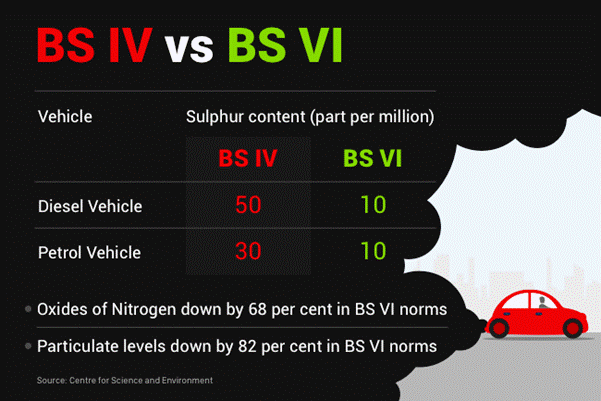
1. Emission Limits (Diesel Cars)
- Nitrogen Oxides (NOx):
- Reduced by ~68%
- Particulate Matter (PM):
- Reduced by ~82%
2. Emission Limits (Petrol Cars)
- Significant reduction in:
- NOx
- Hydrocarbons
3. Fuel Quality
- Sulphur content:
- BS-IV: 50 ppm
- BS-VI: 10 ppm
- Enables:
- Advanced emission-control systems
- Longer engine life
- Cleaner exhaust
4. Advanced Technologies
- Diesel vehicles:
- Diesel Particulate Filter (DPF)
- Selective Catalytic Reduction (SCR)
- Petrol vehicles:
- Improved catalytic converters
- Mandatory On-Board Diagnostics (OBD).
Why Are Older Vehicles More Polluting?
- Lack advanced emission-control systems.
- Higher emissions of:
- NOx
- PM2.5 and PM10
- Diesel vehicles particularly harmful:
- Fine particulates penetrate lungs and bloodstream.
- Urban impact:
- Vehicles contribute disproportionately to winter smog due to:
- Temperature inversion
- Low wind speeds
- Vehicles contribute disproportionately to winter smog due to:
Why Does Delhi–NCR Enforce Stricter Rules?
- Delhi introduced tighter emission norms earlier than the rest of India.
- Context:
- Extremely high vehicular density
- Unfavourable meteorology
- Judicial backing:
- Supreme Court–mandated measures
- GRAP (Graded Response Action Plan)
- Data cited by authorities:
- ~37% of vehicles in NCR are highly polluting, mostly older models.
Health & Environmental Rationale
Health Impact
- Vehicular pollution linked to:
- Asthma
- Chronic bronchitis
- Cardiovascular diseases
- PM2.5 classified as carcinogenic by WHO.
Environmental Impact
- Formation of:
- Urban smog
- Ground-level ozone
- Long-term climate co-benefits:
- Lower black carbon emissions.
Economic & Social Implications
Positive
- Cleaner air
- Reduced public health expenditure
- Push towards:
- Cleaner fuels
- Electric vehicles
Challenges
- Costlier BS-VI vehicles.
- Maintenance issues:
- DPF clogging in low-speed urban driving.
- Impact on lower-income vehicle owners.
Policy Linkages
- National Clean Air Programme (NCAP)
- Vehicle Scrappage Policy
- FAME scheme (EV push)
- GRAP for Delhi–NCR
Critical Issues & Concerns
- Enforcement-heavy approach:
- Risks social backlash.
- Air pollution is multi-source:
- Construction dust
- Biomass burning
- Industrial emissions
- BS-VI alone cannot solve urban air pollution.
Way Forward
- Combine BS-VI enforcement with:
- Public transport expansion
- EV adoption
- Urban planning reforms
- Scrappage incentives over punitive bans.
- Fuel quality monitoring nationwide.
- Address non-vehicular pollution sources.
India–Oman CEPA (Comprehensive Economic Partnership Agreement)
Why is it in News?
- December 2025: India and Oman signed a Comprehensive Economic Partnership Agreement (CEPA) in Muscat.
- Marks:
- India’s second CEPA in West Asia after UAE
- A strategic response to:
- Rising global trade protectionism (US tariffs, EU CBAM-type measures)
- India’s need to de-risk supply chains away from China
Basics: What is a CEPA?
- A deep, comprehensive trade agreement, broader than a Free Trade Agreement (FTA).
- Covers:
- Trade in goods
- Trade in services
- Investment
- Mobility of professionals
- Customs cooperation, standards, dispute settlement
- India’s existing CEPAs:
- UAE, Australia (ECTA), Japan, South Korea, now Oman
Key Provisions of India–Oman CEPA
1. Market Access – Goods
Oman → India
- 98.08% of tariff lines made duty-free
- Covers 99.38% of India’s exports to Oman
- One of the most liberal tariff concessions Oman has offered globally
India → Oman
- Liberalisation of 77.79% of tariff lines
- Covers 94.81% of India’s imports from Oman
2. Trade in Services (High Relevance for India)
- Enhanced market access for Indian service providers in:
- IT & IT-enabled services
- Engineering & consultancy
- Healthcare
- Education & training
- Mobility provisions:
- Easier movement of Indian professionals
- Recognition of qualifications through Mutual Recognition Agreements (MRAs) (to be operationalised)
- Sector-specific gains:
- Nursing quotas in some categories raised from 20% to 50%
3. Investment & Business Facilitation
- Predictable and transparent investment regime
- Protection against arbitrary regulatory measures
- Encourages:
- Indian investment in Omani ports, logistics, hydrocarbons, renewables
- Omani sovereign investment in Indian infrastructure and manufacturing
India–Oman Trade Snapshot (Data-driven)
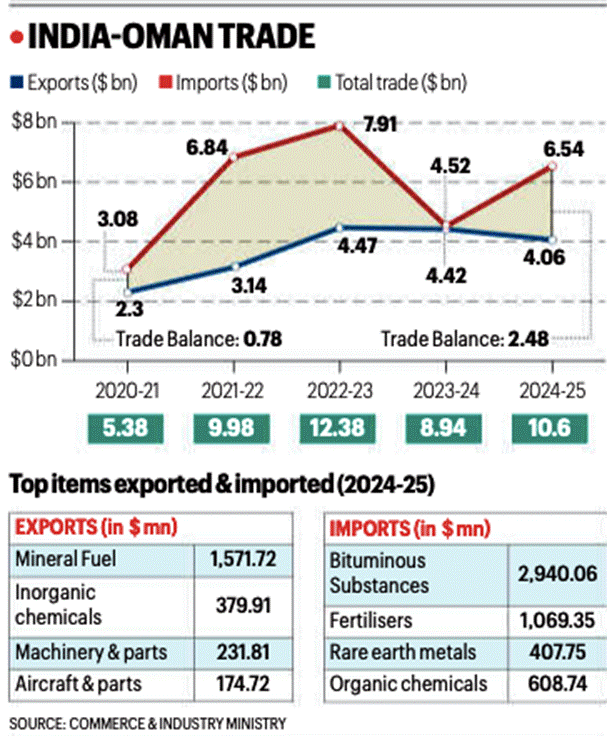
- Total bilateral trade (2024–25): ~USD 10.6 billion
- India’s exports to Oman:
- USD 4.06 billion
- 0.93% of India’s total exports
- India’s imports from Oman:
- USD 6.5 billion
- 0.91% of India’s total imports
- India runs a trade deficit, largely due to energy imports
- CEPA aims to narrow the deficit through export expansion
Composition of Trade (2024–25)
India’s Key Exports
- Machinery & mechanical appliances
- Inorganic and organic chemicals
- Aircraft parts
- Plastics, textiles, jewellery
- Mineral fuels (re-exports)
➡ Export basket is manufacturing-intensive, aligned with Make in India
India’s Key Imports
- Crude oil & LNG-related products
- Bituminous substances
- Fertilisers
- Iron ore and minerals
Strategic Significance for India
1. Economic Significance
- Boosts exports of:
- Engineering goods
- Pharmaceuticals
- Automobiles & auto components
- Textiles and food products
- Reduces tariff disadvantage vis-à-vis:
- China
- ASEAN exporters
- Facilitates India’s integration into Gulf and global value chains
2. Strategic & Geopolitical Significance
- Oman’s geostrategic location:
- At the mouth of the Strait of Hormuz
- Gateway to West Asia, East Africa, and Europe
- Strengthens India’s:
- West Asia outreach
- Maritime security interests
- Complements India’s engagement with:
- GCC
- I2U2
- Indo-Pacific trade diversification
3. Energy Security Dimension
- Oman is a key supplier of:
- Crude oil
- LNG
- CEPA deepens long-term energy partnerships
- New cooperation avenues:
- Green hydrogen
- Petrochemicals
- Renewables and energy storage
- Energy transition technologies
4. Labour & Diaspora Dimension
- Large Indian workforce in Oman
- CEPA improves:
- Job security
- Professional mobility
- Services export earnings
- Supports India’s human capital export strategy
Why Oman Matters in India’s West Asia Strategy ?
1. Trade & Logistics Hub
- Ports such as Duqm, Sohar, Salalah:
- Less congested alternatives to Gulf hubs
- Gateways to Africa and Mediterranean markets
- Supports India’s hub-and-spoke trade model
2. Supply Chain De-risking
- Oman offers:
- Political stability
- Neutral foreign policy
- Strong maritime connectivity
- Helps India reduce dependence on:
- China-centric value chains
- Protectionist Western markets
3. West Asia Reset
- Shifts India’s engagement from:
- Energy-only and diaspora-centric ties
- Towards:
- Trade–investment–technology partnership
- Complements UAE CEPA:
- UAE as financial/re-export hub
- Oman as logistics and gateway hub
- Together, anchor India’s western maritime arc
Concerns & Challenges
- Trade volumes still modest relative to potential
- Persistent trade imbalance
- Risks for Indian MSMEs:
- Limited awareness
- Compliance and certification costs
- Non-tariff barriers
- Services gains depend on:
- Effective implementation of mobility provisions
Way Forward
- Establish CEPA utilisation cells for exporters and MSMEs
- Fast-track:
- Mutual Recognition Agreements (MRAs)
- Skill and qualification recognition
- Use Oman as:
- A platform, not merely a destination market
- Integrate CEPA with:
- Make in India
- PM Gati Shakti
- India–Middle East–Europe Economic Corridor (IMEC)


