
Why is it in News?
- Delhi–NCR intensified enforcement against older, non-BS-VI private vehicles amid severe winter air pollution.
- Clarification issued that vehicles bought/registered after April 1, 2020 are BS-VI compliant, while older vehicles face:
- Entry restrictions
- Fines
- Deregistration or scrappage-linked action
- Public confusion over how to identify BS-VI vehicles triggered policy and enforcement debates.
Relevance
GS III – Environment & Ecology , Science & Techology
- Air pollution and mitigation strategies
- Vehicular emissions and urban air quality
- Climate co-benefits (black carbon reduction)
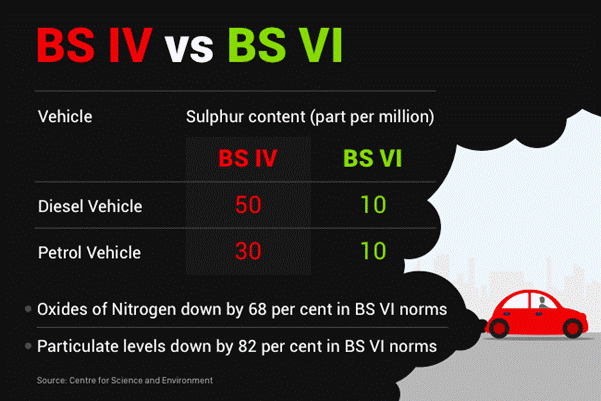
What are Bharat Stage (BS) Emission Norms?
- Bharat Stage norms are India’s vehicle emission standards.
- Aim:
- Regulate pollutants from internal combustion engines.
- Pattern:
- Broadly aligned with European (Euro) standards.
- Progression:
- BS-I → BS-II → BS-III → BS-IV → BS-VI
- India skipped BS-V to fast-track pollution control.
What is BS-VI?
- BS-VI implemented nationwide from 1 April 2020.
- Applies to:
- Petrol vehicles
- Diesel vehicles
- Two-wheelers, cars, commercial vehicles
- Covers:
- Vehicle engine standards
- Fuel quality standards
How to Identify a BS-VI Vehicle?
- Registration Certificate (RC):
- Emission norm mentioned as BS-VI.
- Fuel/engine label:
- Often marked by manufacturer.
- VAHAN portal / mParivahan app:
- Official verification.
- Key rule:
- Registered on or after 1 April 2020 → BS-VI compliant
- Vehicles registered before April 2020 → not BS-VI, even if upgraded later.
What Changed from BS-IV to BS-VI?
1. Emission Limits (Diesel Cars)
- Nitrogen Oxides (NOx):
- Reduced by ~68%
- Particulate Matter (PM):
- Reduced by ~82%
2. Emission Limits (Petrol Cars)
- Significant reduction in:
- NOx
- Hydrocarbons
3. Fuel Quality
- Sulphur content:
- BS-IV: 50 ppm
- BS-VI: 10 ppm
- Enables:
- Advanced emission-control systems
- Longer engine life
- Cleaner exhaust
4. Advanced Technologies
- Diesel vehicles:
- Diesel Particulate Filter (DPF)
- Selective Catalytic Reduction (SCR)
- Petrol vehicles:
- Improved catalytic converters
- Mandatory On-Board Diagnostics (OBD).
Why Are Older Vehicles More Polluting?
- Lack advanced emission-control systems.
- Higher emissions of:
- NOx
- PM2.5 and PM10
- Diesel vehicles particularly harmful:
- Fine particulates penetrate lungs and bloodstream.
- Urban impact:
- Vehicles contribute disproportionately to winter smog due to:
- Temperature inversion
- Low wind speeds
- Vehicles contribute disproportionately to winter smog due to:
Why Does Delhi–NCR Enforce Stricter Rules?
- Delhi introduced tighter emission norms earlier than the rest of India.
- Context:
- Extremely high vehicular density
- Unfavourable meteorology
- Judicial backing:
- Supreme Court–mandated measures
- GRAP (Graded Response Action Plan)
- Data cited by authorities:
- ~37% of vehicles in NCR are highly polluting, mostly older models.
Health & Environmental Rationale
Health Impact
- Vehicular pollution linked to:
- Asthma
- Chronic bronchitis
- Cardiovascular diseases
- PM2.5 classified as carcinogenic by WHO.
Environmental Impact
- Formation of:
- Urban smog
- Ground-level ozone
- Long-term climate co-benefits:
- Lower black carbon emissions.
Economic & Social Implications
Positive
- Cleaner air
- Reduced public health expenditure
- Push towards:
- Cleaner fuels
- Electric vehicles
Challenges
- Costlier BS-VI vehicles.
- Maintenance issues:
- DPF clogging in low-speed urban driving.
- Impact on lower-income vehicle owners.
Policy Linkages
- National Clean Air Programme (NCAP)
- Vehicle Scrappage Policy
- FAME scheme (EV push)
- GRAP for Delhi–NCR
Critical Issues & Concerns
- Enforcement-heavy approach:
- Risks social backlash.
- Air pollution is multi-source:
- Construction dust
- Biomass burning
- Industrial emissions
- BS-VI alone cannot solve urban air pollution.
Way Forward
- Combine BS-VI enforcement with:
- Public transport expansion
- EV adoption
- Urban planning reforms
- Scrappage incentives over punitive bans.
- Fuel quality monitoring nationwide.
- Address non-vehicular pollution sources.


