
Why in News ?
- New peer-reviewed research (published in Nature Climate Change, Oct 2024) shows the Southern Ocean has absorbed more carbon dioxide since the early 2000s, contradicting long-standing climate model projections.
- Highlights limits of climate models, importance of observations, and risks of abrupt future shifts in the global carbon cycle.
Relevance
GS III – Environment & Climate Change
- Global carbon cycle.
- Oceanic carbon sinks.
- Climate feedback mechanisms.
- Non-linear climate responses.
GS I – Geography (Physical)
- Ocean circulation systems.
- Stratification, upwelling, westerlies.
- Southern Ocean’s role in global climate regulation.
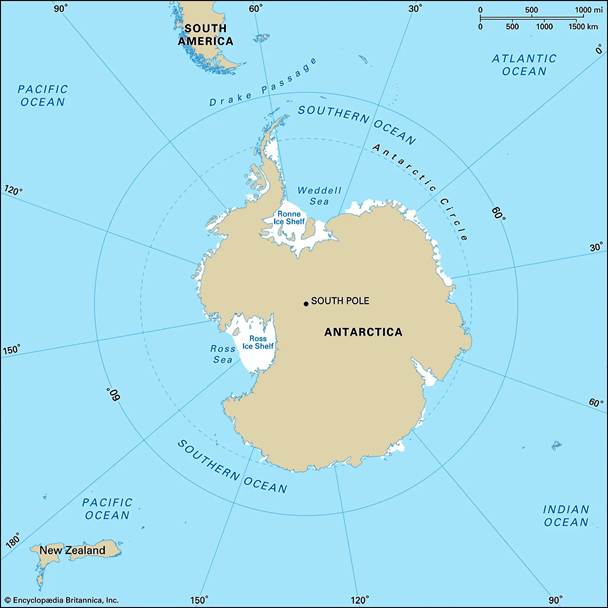
Why the Southern Ocean Matters?
- Covers ~25–30% of global ocean area.
- Absorbs ~40% of oceanic uptake of anthropogenic CO₂.
- Acts as a global climate regulator by:
- Absorbing excess heat.
- Functioning as a major carbon sink.
Inference: Small physical changes here have disproportionately large global climate impacts.
How the Southern Ocean Carbon Sink Works ?
- Cold, relatively fresh surface waters form a “lid”.
- Beneath lies warmer, saltier, carbon-rich deep water.
- Strong stratification limits vertical mixing → carbon remains trapped below surface → less CO₂ escapes to atmosphere.
What Climate Models Predicted (Pre-2020 Consensus) ?
- Rising greenhouse gases → stronger & poleward-shifting westerly winds.
- This would intensify Southern Ocean Meridional Overturning Circulation (MOC).
- Result:
- More upwelling of deep, carbon-rich water.
- Increased CO₂ outgassing.
- Weakening of Southern Ocean carbon sink.
What Observations Actually Show (The “Anomaly”)?
Confirmed Model Predictions
- Circumpolar Deep Water has risen ~40 metres since the 1990s.
- Subsurface CO₂ pressure increased by ~10 microatmospheres.
- Stronger upwelling is real.
Unexpected Outcome
- Despite this, net CO₂ absorption increased, not decreased.
- Southern Ocean remained a strong carbon sink.
What Models Missed: The Key Mechanism?
Freshwater-Driven Stratification
- Increased:
- Antarctic ice melt.
- Precipitation.
- Result:
- Fresher (lighter) surface waters.
- Enhanced stratification.
- Effect:
- Carbon-rich waters trapped 100–200 m below surface.
- Prevented contact with atmosphere → no CO₂ release.
Conclusion: A surface freshwater “mask” temporarily counteracted deep upwelling effects.
Why This Is Temporary (High-Risk Insight)?
- Observations since early 2010s show:
- Stratified layer thinning.
- Surface salinity rising again in parts of the Southern Ocean.
- Strong winds can:
- Penetrate weakened stratification.
- Mix deep, carbon-rich waters upward.
- Result:
- Delayed but abrupt weakening of the carbon sink possible.
- Potential for sudden CO₂ release, not gradual.
Why Models Struggle Here (Scientific Limits)?
- Competing processes:
- Upwelling (vertical transport).
- Stratification (vertical blockage).
- Governed by multi-scale physics:
- Eddies (few km wide).
- Ice-shelf cavities (tens–hundreds of km).
- Sparse year-round observations in Southern Ocean.
Inference: Model uncertainty ≠ model failure; reflects data and scale constraints.
Broader Climate Governance Implications
- Reinforces need for:
- Continuous ocean observations (floats, moorings, satellites).
- Stronger investment in Southern Ocean monitoring.
- Warns policymakers against:
- Assuming long-term ocean buffering.
- Raises stakes for:
- Carbon budget calculations.
- Net-zero timelines.
- Climate tipping point assessments.
Conclusion
- Climate systems can show non-linear responses.
- Temporary resilience can mask deeper vulnerabilities.
- Policy must integrate:
- Models (future risks).
- Observations (current reality).
- Southern Ocean exemplifies “delayed feedback risk” in climate change.


