
Why is it in News?
- Recent analysis based on India’s latest Time Use Survey (2024) highlights a structural time poverty faced by women, raising concerns that the AI-driven future of work may deepen gender inequality.
- As India pushes AI-led growth through initiatives like the India AI Mission, evidence shows women lack time, access, and flexibility required to upskill for AI-era jobs.
- Aligns with broader debates on:
- Automation risks
- Right to disconnect
- Gender budgeting
- India’s Viksit Bharat @2047 vision.
Relevance
- GS I – Society
- Gender roles and unpaid care work
- Time poverty and gender inequality
- GS II – Governance
- Gender budgeting
- Social infrastructure (childcare, transport, water, energy)
Women’s Workload & Time Poverty
- Labour force participation (women): ~40% (2024).
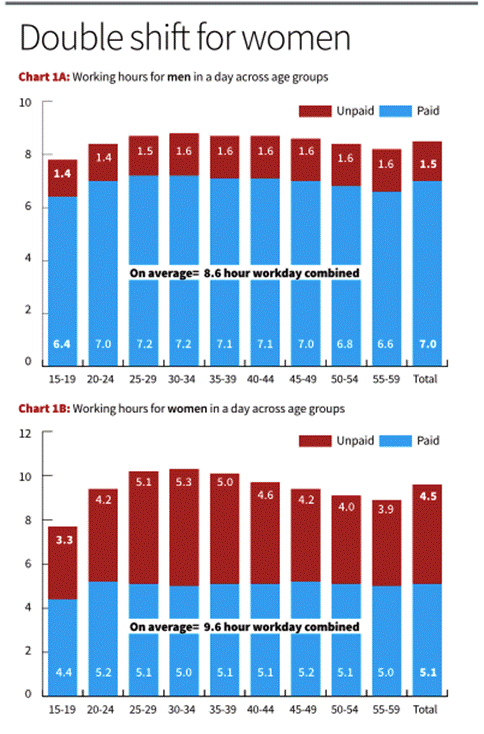
- Average daily work (paid + unpaid):
- Women: ~9.6 hours/day
- Peaks at 70–80 hours/week for ages 25–39.
- Key driver:
- ~40% of women outside the labour force cite household & caregiving responsibilities.
- Nature of work increase:
- Over 80% of recent rise in women’s workforce participation comes from:
- Unpaid family work
- Low-paid self-employment
- Informal, low-productivity jobs.
- Over 80% of recent rise in women’s workforce participation comes from:
Gender Gap in Paid vs Unpaid Work
Across the Life Cycle
- Men:
- Total work: 54–60 hours/week
- Unpaid work: minimal and stable across ages.
- Women:
- Total work exceeds men at almost all ages.
- 25–39 age group:
- Women spend 2× more time on unpaid caregiving than men.
- Childcare is the largest component.
- Even in later life:
- Men’s unpaid work rises marginally (elderly care),
- Structural inequality at home persists across income, occupation, and age.
AI-Specific Risks for Women
1. Higher Automation Exposure
- Women overrepresented in:
- Routine, clerical, low-skill service jobs
- Informal and home-based work
- These roles are more automation-prone under AI adoption.
2. Algorithmic Bias
- AI-driven productivity metrics:
- Ignore caregiving interruptions
- Penalise time constraints
- Reward uninterrupted, long-hour availability
- Care work remains invisible to algorithms.
3. Upskilling Time Deficit
- Women spend ~10 hours less per week than men on:
- Learning
- Skill enhancement
- Self-development
- Gap widens to 11–12 hours/week in prime working years.
- Result:
- Limited transition from low-skill to high-value AI-linked jobs.
Health & Well-being Costs
- Women sleep 2–2.5 hours less per week than men during peak working years.
- Time adjustment happens at the cost of:
- Rest
- Mental health
- Physical well-being
- Long-term impact:
- Lower productivity
- Higher burnout
- Reduced career longevity.
Policy & Governance Solutions Highlighted
1. Time-Centric Policy Design
- Shift from job-counting to outcome-based employment metrics.
- Explicit use of time-use data in:
- Labour policy
- Skill missions
- AI governance.
2. Gender Budgeting as an Enabler
- Integrate time-use indicators into gender budgeting.
- Prioritise sustained spending on:
- Affordable childcare
- Elderly care services
- Piped water
- Clean cooking energy
- Safe public transport.
3. AI-Era Upskilling for Women
- Design lifelong, flexible, modular skilling:
- Local delivery
- Hybrid / online formats
- Low time-intensity learning
- Scale targeted programmes:
- India AI Mission
- AI Careers for Women
- Focus on:
- Digital literacy
- Applied AI tools
- Locally relevant vocational tech skills.
Conclusion
- AI will not automatically empower women; without time-sensitive policy design, it may entrench inequality.
- Until women’s time is valued, freed, and integrated into growth strategy, India’s AI ambitions and Viksit Bharat @2047 vision will remain constrained by:
- Invisible labour
- Time poverty
- Underutilised human capital.


