
Content
- Veer Bal Diwas
- Your Money, Your Right
Veer Bal Diwas
Why in News ?
- Veer Bal Diwas 2025 observed on 26 December across India to commemorate the martyrdom of Sahibzada Zorawar Singh Ji & Sahibzada Fateh Singh Ji.
- A national-level programme was organised at Bharat Mandapam, addressed by the Prime Minister, highlighting youth leadership, bravery, talent and civic values.
Relevance
- GS-1 | Indian Culture & Heritage
- Remembrance of Sikh historical tradition, martyrdom narratives, religious-cultural symbolism.
- Role of commemorative practices in sustaining civilisational memory & identity.
- GS-2 | Governance, Welfare & Education
- State-led value-based civic initiatives, youth engagement, school-level programmes, national integration.
- Commemoration as an instrument of social mobilisation & participatory governance.
Part 1 — Veer Bal Diwas
Historical Context
- Marks the martyrdom (1704) of the two youngest Sahibzadas of Guru Gobind Singh Ji at Sirhind (Fatehgarh Sahib, Punjab).
- Youngest martyrs in Sikh history — Sahibzada Zorawar Singh Ji (≈9 yrs) and Sahibzada Fateh Singh Ji (≈7 yrs), the two younger sons of Guru Gobind Singh Ji.
- Captured at Sirhind (1704 CE) along with their grandmother Mata Gujri Ji after separation during the Mughal pursuit following the evacuation of Anandpur Sahib.
- Offered safety in exchange for conversion to Islam by Wazir Khan; both refused to abandon their faith despite extreme pressure.
- Executed by being bricked alive (later suffocated and killed) at Sirhind/Fatehgarh Sahib, Punjab — symbolising steadfast courage and moral conviction.
- Their martyrdom is remembered as a defining act of faith, dignity and resistance against coercion in Indian–Sikh tradition.
- The site of martyrdom is commemorated at Gurdwara Fatehgarh Sahib, a major pilgrimage and remembrance centre.
- The President of India conferred the Pradhan Mantri Rashtriya Bal Puraskar 2025 on 20 children from 18 States/UTs at Vigyan Bhawan, New Delhi.
- They were executed for refusing to renounce their faith — symbolising courage, sacrifice, moral conviction.
Objectives
- Institutionalise remembrance of Sikh heritage & bravery.
- Inspire youth through values of truth, courage, resilience, faith, duty.
- Promote values-based education & national integration.
Observance — Institutional Mechanism
- Activities across schools & institutions:
- Debates, essays, storytelling, quizzes.
- Cultural events, youth marches, community outreach.
- Kirtan & remembrance programmes in Gurudwaras.
- Central theme — link historical sacrifice with civic responsibility.
Significance (Governance, Culture, Society)
- Strengthens civilisational memory & ethical citizenship.
- Reinforces plural heritage & cultural nationalism.
- Encourages youth role-modelling through historical exemplars.
- Aligns with Viksit Bharat @ 2047 → Character-centric nation-building.
Critical Perspectives
- Avoids religious exclusivism by framing sacrifice as universal moral heritage.
- Need for:
- Integration into school curricula, not just commemorative events.
- Documentation of regional heroic traditions nationwide.
- Avoid tokenism → ensure value transmission through pedagogy.
Part 2 — Pradhan Mantri Rashtriya Bal Puraskar (PMRBP)
About the Award
- National-level child achievement award for ages 5–18.
- Categories:
- Bravery
- Social Service
- Environment
- Sports
- Art & Culture
- Science & Technology
Eligibility & Process
- Indian citizens, achievement within last 2 years.
- Selection by MWCD-constituted Committee with domain experts.
- Max 25 awards (relaxable in exceptional cases).
- Medal + Certificate; rarely posthumous.
2025 Highlights (Data Points)
- 20 awardees | 18 States & UTs.
- Themes reflected:
- Bravery beyond self-interest
- Grassroots innovation
- Inclusive talent (divyang achievers)
- Sports excellence, global platforms
- Social contribution & resilience from marginal regions
Governance Significance
- Encourages youth leadership & innovation culture.
- Builds aspirational narratives, positive social role models.
- Supports child-centric policy ecosystem (talent, welfare, inclusion).
Reform Needs
- Tracking long-term career support to awardees.
- Greater rural & marginalised outreach in nominations.
- Institutional mentoring & scholarships beyond recognition.
- Transparent impact-assessment framework.
Conclusion
- Veer Bal Diwas transforms a historical act of supreme courage into a living civic lesson, reinforcing values of faith, resilience, and moral integrity among India’s youth.
- It serves as a bridge between cultural memory and contemporary nation-building, nurturing ethical citizenship, unity, and value-based education.
- By combining remembrance with youth-centric initiatives and national recognition programmes, it institutionalises inspiration and strengthens India’s character-driven developmental ethos.
Your Money, Your Right
Why in News ?
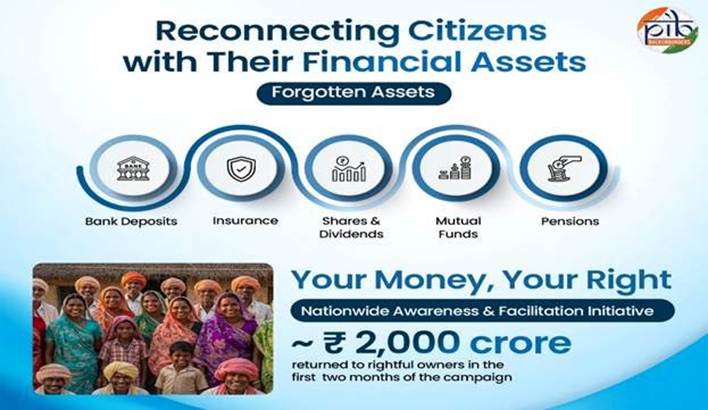
- The Government rolled out the nationwide awareness & facilitation campaign “आपकी पूंजी, आपका अधिकार – Your Money, Your Right” (Oct–Dec 2025) to help citizens trace and reclaim unclaimed financial assets.
- Implemented across 668 districts, combining digital portals + ground-level facilitation camps.
- Nearly ₹2,000 crore returned to rightful owners through coordinated action by DFS, RBI, IRDAI, SEBI, PFRDA, IEPFA and financial institutions.
Relevance
- GS-2 | Governance, Service Delivery, Institutional Coordination
- Inter-regulator convergence (RBI-IRDAI-SEBI-PFRDA-IEPFA), 3A framework, citizen-centric outreach.
- District-level implementation, financial grievance redressal, last-mile facilitation.
- GS-3 | Economy — Financial Inclusion, Savings, Household Resilience
- Reclaiming dormant assets → strengthens household finance, consumption security, trust in formal system.
- Data hygiene, KYC reforms, digital public infrastructure for financial access.
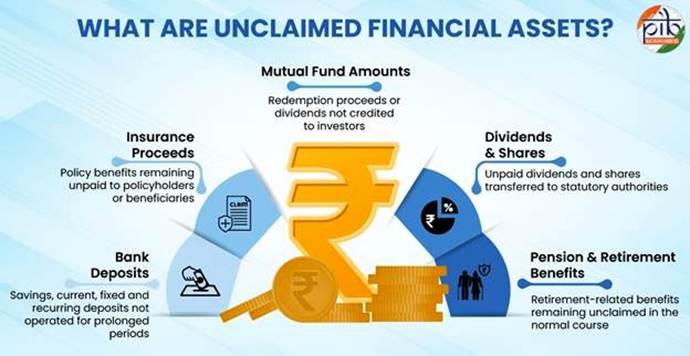
Concept — What are Unclaimed Financial Assets ?
- Savings that remain unclaimed / inoperative for prolonged periods due to:
- migration, death of account holder, missing nomination
- change in address/contact/bank account
- outdated records, lack of family awareness
- Includes:
- Bank deposits (inactive ≥10 years → transferred to DEA Fund)
- Insurance proceeds (≥10 yrs → Senior Citizens’ Welfare Fund)
- Mutual fund dividends /redemption dues
- Unclaimed dividends & shares (≥7 yrs → IEPFA)
- Pension / retirement benefits
Rationale — Why Unclaimed Assets Matter ?
- Household level: lost access to savings needed for health, education, emergencies.
- System level: weakens trust & participation in formal finance.
- Governance lens: recovery strengthens financial inclusion, citizen ownership, transparency.
Architecture of the Initiative ?
- Nodal: Department of Financial Services, Ministry of Finance.
- Regulators involved: RBI, IRDAI, SEBI, IEPFA, PFRDA.
- 3A Framework: Awareness • Accessibility • Action.
- Twin strategy:
- Digital discovery platforms
- District facilitation camps + helpdesks + kiosks via SLBCs & insurance committees.
Key Digital Platforms
- UDGAM (RBI) — search unclaimed bank deposits; claim via respective bank; no time limit.
- Bima Bharosa (IRDAI) — trace unclaimed insurance proceeds; up to 25 yrs post-transfer to SCWF.
- MITRA / MF Central (SEBI–MF ecosystem) — trace unclaimed / inactive mutual fund folios.
- IEPFA Portal — reclaim unclaimed dividends, shares, deposits; no claim time-bar.
(Preventive emphasis: nomination, updated KYC/bank details, DigiLocker records, PAN–Aadhaar linkage.)
Scale — Indicative Stock of Unclaimed Assets
- Bank deposits: ~₹78,000 crore
- Insurance proceeds: ~₹14,000 crore
- Mutual funds: ~₹3,000 crore
- Unclaimed dividends: ~₹9,000 crore
(Shows magnitude of citizen wealth locked within the system.)
Implementation Outcomes (Oct–Dec 2025 Drive)
- 668 districts covered; on-ground claim facilitation + on-the-spot settlements in many cases.
- ~₹2,000 crore restored to households.
- Higher awareness on nomination, documentation, record-keeping → better financial planning.
Governance Significance
- Reconnects citizens with rightful ownership of savings.
- Strengthens credibility of financial institutions & inclusion architecture.
- Improves data hygiene, beneficiary targeting, estate & succession clarity.
- Advances citizen-first service delivery through regulator–state coordination.
Critical Issues
- Fragmented awareness among rural/elderly households.
- Legacy accounts with paper-based KYC, missing heirs, legal disputes.
- Procedural frictions: attestation, succession proof, cross-institution coordination.
- Need for uniform timelines, standard claim documentation, and multilingual support.
Way Forward
- Single-window integrated claim interface across sectors.
- Auto-alerts to nominees / heirs on inactivity & maturity dues.
- Default nomination mandate + periodic KYC nudges.
- Proactive outreach for widows, migrants, senior citizens.
- Annual district audits of dormant assets with disclosure dashboards.
- Financial literacy + succession planning as part of inclusion programmes.


