
Why in News ?
- The Union Finance Ministry has issued notifications to implement a new taxation regime on tobacco products from 1 February 2026 under the Central Excise (Amendment) Act, 2025.
- Key elements include:
- Revival and revision of excise duty on cigarettes (earlier reduced to a nominal level under GST).
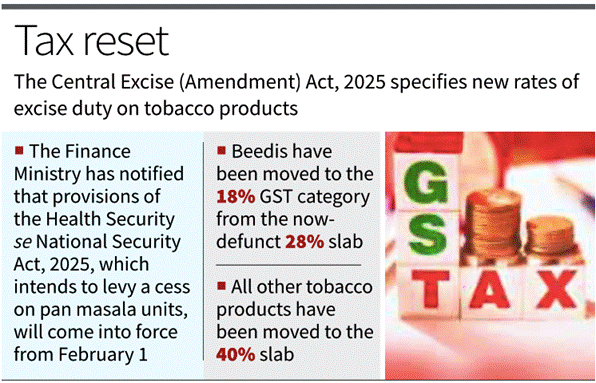
- Enforcement of a cess on pan masala units under the Health Security and National Security Act, 2025.
- End of the GST Compensation Cess from 1 February.
- Revision of GST rates on tobacco products — beedis shifted to 18% (from the earlier 28% slab); other tobacco products moved to a 40% slab.
- The Ministry flagged that cigarette affordability has not declined in the past decade, contrary to global public-health guidance recommending annual real price increases through higher specific excise duties.
Relevance
- GS-3 (Economy)
- Taxation, GST architecture, cess vs tax, fiscal federalism, sin-tax economics, price elasticity.
- GS-2 (Health & Governance)
- Public health policy, NCDs, regulation of harmful products, Centre–State coordination.
Conceptual Foundations
- Indirect Taxes on Tobacco (Pre-GST vs Post-GST)
- Pre-GST: Central excise + State VAT + surcharges.
- Post-GST (2017): GST (12/18/28% slabs), plus GST Compensation Cess; central excise continued only on cigarettes (but reduced to a nominal level).
- Types of Tobacco Taxes
- Specific excise → fixed per unit (effective for health policy; raises price uniformly).
- Ad valorem tax → % of price (can be evaded via down-trading to cheaper brands).
- GST Compensation Cess (2017–2022, later extended)
- Purpose: compensate States for revenue losses due to GST implementation.
- Funded partly by cess on sin/luxury goods (incl. tobacco).
- Economic Rationale for “Sin Taxes”
- Correct negative externalities (health costs, productivity loss).
- Recommended by WHO-FCTC: regular increases in real prices; prefer specific excise.
- Price Elasticity of Demand for Tobacco
- Low but not zero; higher among youth & low-income users → taxation is an effective control tool.
What Has Changed — Policy Moves from 1 Feb 2025
- Excise Duty on Cigarettes Raised/Restored from nominal levels to a meaningful specific levy.
- Cess on Pan Masala Units brought into force under the 2025 Act.
- GST Compensation Cess Ends from 1 February.
- Re-structuring of GST Rates on Tobacco
- Beedis: moved to 18% category (from the now-defunct 28% slab).
- Other tobacco products: shifted to 40% slab.
- Policy Logic Cited by Government
- Cigarettes have become more affordable relative to income growth.
- Aim is to align with global public-health benchmarks mandating periodic excise hikes.
Implications — Economy, Health, Governance
- Public Health
- Likely reduction in initiation and consumption over time, especially among youth.
- Supports NCD control, lowers long-term healthcare burden.
- Revenue & Fiscal Federalism
- Higher excise may boost Union revenues; cessation of compensation cess changes Centre–State fiscal dynamics.
- States may seek alternative revenue sources post-cess.
- Equity & Behavioural Effects
- Taxes are regressive in incidence but progressive in health gains (larger benefits for poorer households).
- Industry & Supply Chain
- Possible down-trading to cheaper/illicit products; need strong track-and-trace enforcement.
- Beedi sector largely informal → compliance and monitoring challenges.
- Trade & Compliance
- Risk of illicit cross-border trade → requires customs vigilance and FCTC-aligned controls.
Analytical Perspectives
- Does tobacco taxation balance revenue and health objectives?
- Compare specific vs ad valorem models; global lessons (WHO-FCTC, Thailand, Philippines).
- Post-GST cess withdrawal and States’ revenue space
- Options: buoyancy via GST expansion vs targeted sin-tax rationalisation.
- Beedi sector paradox
- High consumption, low taxation, informal labour → policy trade-offs (health vs livelihoods).
Prelims-Ready Pointers
- Excise duty on cigarettes continues outside GST (Union power).
- Compensation Cess → designed to offset States’ GST revenue losses; ends from 1 Feb 2025.
- From 1 Feb 2025:
- Beedis → 18% GST category.
- Other tobacco products → 40% GST slab.
- Specific excise is considered more effective for tobacco control than ad valorem taxes.
Way Forward
- Periodic, inflation-indexed specific excise increases.
- Track-and-trace systems to curb illicit trade.
- Differential taxation aligned to harm continuum (discourage smoked forms strongly).
- Health-earmarked revenues for NCD prevention and cessation programmes.
- Support measures for workers/farmers in tobacco & beedi value chains during transition.


