
Content
- Rah-Veer: Save a Life Without Fear
- Design Linked Incentive Scheme
Rah-Veer: Save a Life Without Fear
Why in News ?
- The Ministry of Road Transport & Highways (MoRTH) is highlighting the Rah-Veer (Good Samaritan) protections and reward scheme, reinforcing public awareness that bystanders helping road-accident victims are legally protected .
- Linked to India’s broader road-safety strategy under the Motor Vehicles (Amendment) Act, 2019 and the Good Samaritan Rules, 2020.
Relevance
- GS-II (Health): Golden Hour emergency-care governance; cuts preventable deaths and disability.
- GS-III (Public Safety / Disaster Management): Community-led first response; Safe-Systems / Vision Zero approach.

Basics — Concept & Rationale
- Golden Hour: First hour after a serious injury when timely medical care can prevent death or disability.
- Problem Addressed: Bystanders often hesitate to help due to fear of police, court procedures, hospital liabilities, or payment demands.
- Policy Logic: Encourage lifesaving intervention by removing legal, procedural, and financial risks for helpers.
Legal Architecture
- Statutory Basis: Section 134A, Motor Vehicles (Amendment) Act, 2019.
- Operational Rules: Good Samaritan (Protection from Civil and Criminal Liability) Rules, 2020.
- Judicial Foundation: Supreme Court directions in SaveLIFE Foundation v. Union of India (2016) — made Good Samaritan guidelines binding nationwide.
Good Samaritan — Rights & Protections
- No civil or criminal liability when acting in good faith.
- Right to anonymity — no mandatory disclosure of name/address.
- No detention or harassment by police or hospital authorities.
- If volunteering as witness — statement can be recorded only once, at a convenient time/place (including video-conference).
- Hospital acknowledgement must be issued on request.
- No obligation to stay back after admission of the victim.
- No payment liability — hospitals cannot demand treatment costs from the helper.
- No compulsion to file FIR or give evidence unless the person voluntarily agrees.
Obligations on Authorities / Institutions
- Hospitals (public & private) must:
- Provide immediate emergency care without pre-payment.
- Issue simple acknowledgement to the Good Samaritan.
- Not detain the helper for procedural formalities.
- Police must:
- Avoid unnecessary questioning or repeated summons.
- Treat Good Samaritans with dignity and privacy safeguards.
- State Governments / MoRTH:
- Conduct awareness programmes and institutional compliance audits.
Rah-Veer Reward & Recognition Scheme
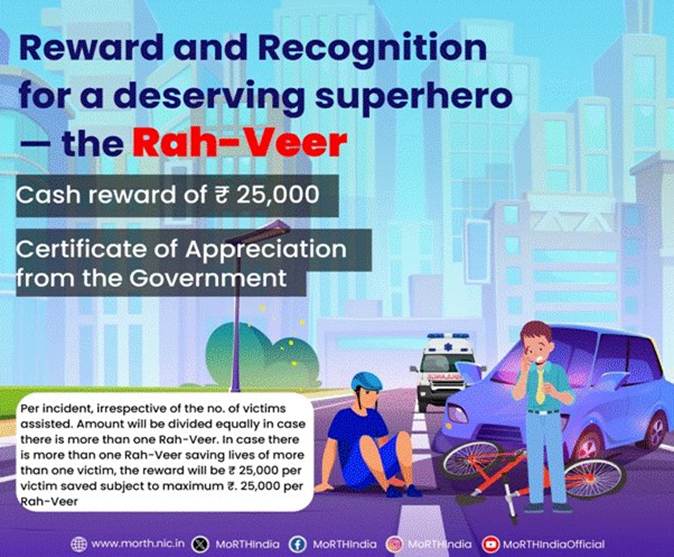
- ₹25,000 reward + Certificate of Appreciation for helping a crash victim reach medical care within the Golden Hour.
- Eligibility up to five recognitions per person per year (repeat acts of assistance).
- Objective: build a culture of empathy, courage, and community responsibility on roads.
Data & Context
- India records one of the highest global road-crash fatalities.
- Economic loss from road accidents estimated at ~3% of GDP (as noted in studies cited by MoRTH / IIT-Delhi).
- A significant share of preventable deaths occurs due to delays in first response during the Golden Hour — bystander hesitation is a major factor.
Impact Pathways — Why the Policy Matters ?
- Reduces Golden-Hour mortality by encouraging early evacuation.
- Builds trust between citizens, hospitals, and law-enforcement.
- Shifts policy focus from punitive perception to public-spirited participation.
- Supports Vision Zero / Safe-Systems approach in road safety.
Implementation Gaps & Challenges
- Low public awareness → fear still persists in many regions.
- Variable compliance by private hospitals & local police.
- Lack of standardised claim processing for rewards in some states.
- Need for training of frontline officials and routine audits.
Way Forward
- Nationwide awareness campaigns in schools, highways, transport hubs.
- Emergency responder training for citizens (basic first-aid modules).
- Digital reward & acknowledgement portal for transparency.
- Integration with 112 emergency response and ambulance networks.
- Periodic compliance monitoring & penalties for violations by institutions.
Prelims Pointers
- Section under MV Act: 134A.
- Rules notified: 2020.
- Liability status: Protected from civil & criminal liability when acting in good faith.
- Supreme Court basis: SaveLIFE Foundation case (2016).
- Reward under Rah-Veer scheme: ₹25,000 + certificate.
Design Linked Incentive Scheme
Why in News ?
- The Government of India highlighted progress under MeitY’s Design Linked Incentive (DLI) Scheme — a pillar of the Semicon India Programme — aimed at building a self-reliant fabless semiconductor design ecosystem.
- The update reports rapid scaling of DLI-supported chip-design projects, talent creation, patents, tape-outs, and private-investment leverage.
Relevance
- GS-III (S&T & Indigenisation): Strategic chip-design capability, IP ownership, RISC-V/SoC innovation; design-to-deployment ecosystem.
- GS-III (Economy & MSMEs): Startup/MSME up-gradation, investment leverage, and high-value manufacturing linkages (design ≈ major share of value addition).
Basics — Semiconductor Value Chain & Policy Logic
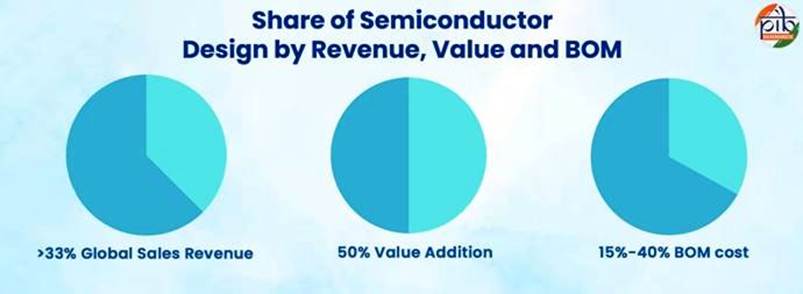
- Chip design = main value creator
- Contributes up to 50% of value addition
- Accounts for 20–50% of BOM cost
- Drives 30–35% of global semiconductor sales via the fabless segment
- Fabless model = high-value, low-capex
- Value lies in design + IP, not fabrication alone.
- Strategic rationale for India
- Reduce import dependence on core technologies
- Retain IP ownership
- Attract downstream manufacturing & assembly
- Strengthen technology sovereignty & resilience
Scheme Architecture — Core Facts
- Implementing Ministry: MeitY
- Nodal Agency: C-DAC under the India Semiconductor Mission (ISM)
- Umbrella Programme: Semicon India Programme (₹76,000 crore outlay)
- Coverage: ICs, chipsets, SoCs, systems, IP cores, semiconductor-linked designs
- Lifecycle support: Design → prototyping → validation → deployment
Eligibility
- Startups & MSMEs → incentives + design-infrastructure support
- Other domestic companies → deployment-linked financial incentives
- Definitions aligned to:
- MSME notification (1 June 2020)
- DPIIT Startup notification (19 Feb 2019)
- FDI Policy, 2017 (domestic ownership norms)
Financial Incentives
- Product Design Linked Incentive (PDLI)
- Up to 50% reimbursement of eligible expenditure
- Cap: ₹15 crore per application
- Deployment Linked Incentive (DLI)
- 6% → 4% of net sales turnover for 5 years
- Cap: ₹30 crore per application
- Minimum cumulative net sales (Y1–Y5):
- ₹1 crore → startups/MSMEs
- ₹5 crore → other domestic firms
- Design must be successfully deployed in products
Design-Infrastructure Support
- National EDA Tool Grid — remote access to advanced design tools
- IP Core Repository — reusable IPs for SoC design
- MPW prototyping support — shared-lot chip fabrication
- Post-silicon validation — testing & silicon bring-up support
Measured Outcomes & Data Highlights
- 24 DLI-supported chip-design projects in strategic sectors
- 16 tape-outs, 6 fabricated ASIC chips
- 10 patents filed
- 140+ reusable IP cores developed
- 1,000+ specialised engineers engaged / trained
- >3× private investment leveraged
- EDA Grid Usage: 54,03,005 hours by 95 startups
- ChipIN Centre reach:
- ~1 lakh engineers & students
- 400+ organisations
- 305 academic institutions (C2S Programme)
- 95 startups
Key Institutional Pillars
- Semicon India Programme (SIM) — investment & design ecosystem support
- Chips to Startup (C2S) — target 85,000 semiconductor-ready manpower
- Microprocessor Development Programme — indigenous VEGA, SHAKTI, AJIT families
- C-DAC, IIT-Madras, IIT-Bombay — open-source architecture leadership
Strategic Impact Pathways
- Anchors India in high-value chip-design/IP segment
- Reduces exposure to geopolitical & supply-chain shocks
- Enables assured access to technologies for defence, telecom, AI, mobility
- Drives technology autonomy + export-ready fabless capability
Representative Success Stories
- Vervesemi — motor-control ICs for appliances, drones, EVs; 110+ IPs, 10 patents
- InCore — indigenous RISC-V processor IPs; silicon-proven across 180–16 nm
- Netrasemi — India’s first indigenous AI SoC @ 12 nm for surveillance & robotics
- Aheesa Digital — VEGA-based GPON broadband SoC (Vihaan)
- AAGYAVISION — advanced radar-on-chip for safety & 6G-sensor networks
Challenges & Implementation Gaps
- Talent pipeline needs deep-specialization scaling
- Transition from prototype → volume manufacturing still evolving
- Need for stronger market linkages & downstream fabrication access
- IP commercialisation & export readiness require policy continuity
Way Forward — Policy Priorities
- Expand EDA + MPW capacity & subsidised access
- Incentivise RISC-V, edge-AI, telecom & automotive SoCs
- Strengthen design-to-manufacturing coordination with ISM fabs
- Deepen VC + industry co-funding & global partnerships
- Create national semiconductor IP marketplace and standards stack
Prelims Pointers
- Scheme type: Fabless chip-design incentive
- Ministry / Nodal: MeitY / C-DAC
- Outlay umbrella: Semicon India ₹76,000 crore
- PDLI cap: ₹15 crore | DLI cap: ₹30 crore
- Incentive band: 6% → 4% of net sales (5 years)
- Focus: ICs, SoCs, chipsets, IP cores, semiconductor-linked designs


