
Why in News?
- Recent Aravalli judgment revived debate on environmental governance, mining, and climate commitments.
- Over 10 years since India’s climate pledges under the Paris Agreement, prompting evaluation of delivery vs outcomes.
- Updated data on emissions intensity, renewable capacity, and forest carbon sinks (ISFR 2023, CEA projections).
- Relevance to India’s 2070 Net Zero credibility.
Relevance
- GS-3 | Environment & Climate Change
- Paris Agreement commitments, emissions intensity vs absolute emissions
- Renewable energy transition, coal dependence, storage bottlenecks
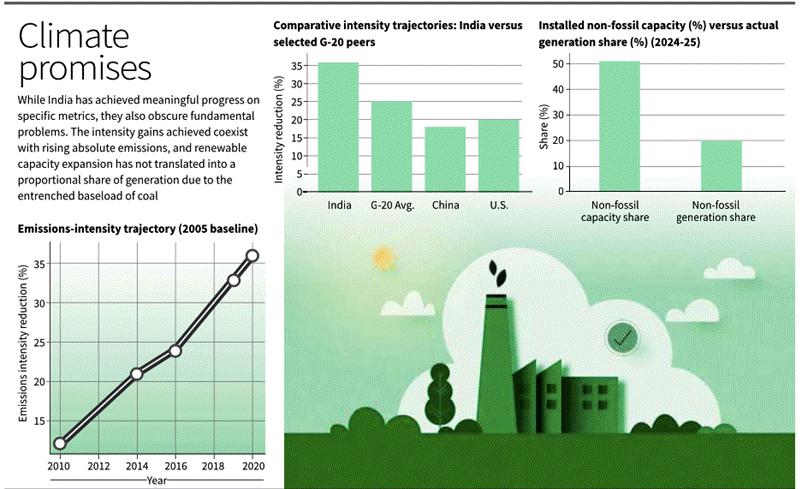
India’s Climate Commitments (Paris, 2015)
- Reduce emissions intensity of GDP by 33–35% from 2005 levels by 2030.
- Achieve 40% non-fossil power capacity by 2030 (later raised to ~50%).
- Install 175 GW renewables by 2022.
- Create 2.5–3 billion tonnes CO₂e forest carbon sink by 2030.
- Principle: Common but Differentiated Responsibilities (CBDR).
Emissions Intensity: Success with Caveats
- Achievement:
- Emissions intensity reduced by ~36% by 2020 (2005 baseline).
- Target met a decade early.
- Drivers:
- Rapid non-fossil capacity expansion (solar, wind, hydro, nuclear).
- Structural shift towards services & digital economy.
- Efficiency schemes: PAT, UJALA → measurable energy savings.
- Limitation:
- Absolute emissions remain high (~2,959 MtCO₂e in 2020).
- India is the 3rd largest absolute emitter globally.
- Conceptual Issue:
- Partial decoupling: GDP growth > emissions growth.
- Intensity ↓, but emissions ↑ in cement, steel, transport.
Renewable Energy: Capacity–Generation Mismatch
- Headline Success:
- Non-fossil capacity rose from ~29.5% (2015) to ~51.4% (June 2025).
- Solar: ~3 GW (2014) → ~111 GW (2025).
- Ground Reality:
- Renewables contribute only ~22% of electricity generation (2024–25).
- Coal (~240–253 GW) still provides >70% of electricity.
- Reasons:
- Low capacity factors of solar/wind.
- Intermittency and grid integration limits.
- Delays in land acquisition and transmission.
- Targets Missed:
- 175 GW by 2022 not achieved.
- 500 GW by 2030 feasible but execution-heavy.
Storage Deficit: Core Bottleneck
- CEA projection (2029–30): 336 GWh storage needed.
- Actual operational storage (Sept 2025): ~500 MWh.
- Without storage:
- Renewables cannot replace coal baseload.
- Grid stability risks increase.
Forest Carbon Sink: Numbers vs Ecology
- Official Claim:
- Total forest carbon stock: 30.43 billion tonnes CO₂e.
- Additional sink since 2005: ~2.29 billion tonnes.
- Target likely met numerically by 2030.
- Data Issues:
- “Forest cover” includes:
- Plantations, eucalyptus, tea, mango orchards.
- Any land >1 ha with >10% canopy.
- Natural forests vs plantations not differentiated.
- “Forest cover” includes:
- Governance Gaps:
- CAMPA funds (~₹95,000 crore) under-utilised (e.g., Delhi ~23% usage).
- Green India Mission (Revised, 2025) equates plantations with regeneration.
- Climate Stress:
- Warming and water stress reduce actual carbon assimilation despite “greening” signals.
Structural Contradictions Highlighted
- Intensity gains coexist with rising absolute emissions.
- Renewable capacity growth masks coal-centric generation reality.
- Forest targets met administratively, not ecologically.
- Coal phase-down roadmap remains opaque.
The Road Ahead
- Battery & pumped storage scale-up at mission mode.
- Transparent coal transition timetable aligned with 2070 net zero.
- Industrial decarbonisation (steel, cement, transport).
- Forest governance reform: quality, biodiversity, survivability metrics.
- Data transparency: sector-wise, region-wise emissions tracking.
- Stronger Centre–State coordination on grids and land.


