
Content
- 10–20 Minute Delivery Model & Gig Workers
- ISRO and the Next Big Challenge
- Madhav Gadgil’s Enduring Legacy in the Nilgiris Biosphere Reserve
- Why Folic Acid Awareness is Key to Preventing Spina Bifida
- Monument Conservation Opens to the Private Sector
- AI-Based Citizen Participation in Budgeting
10–20 Minute Delivery Model & Gig Workers
Why in News?
- On 31 December, over 1 lakh gig and platform workers went on strike across India.
- Memorandum submitted to Union Labour Minister Mansukh Mandaviya demanding:
- Immediate withdrawal of 10–20 minute delivery models.
- Priority to worker safety, income stability, and accountability of platforms.
- Renewed debate on:
- Adequacy of four Labour Codes in protecting gig workers.
- Regulation of algorithm-driven work systems.
- Contextual relevance due to:
- Rapid expansion of quick commerce.
- Projections by NITI Aayog that 2.35 crore workers will be part of the gig economy by 2029–30.
Relevance
GS II (Governance & Social Justice)
- Labour reforms and adequacy of Labour Codes.
- Social security coverage of gig and platform workers.
- Role of State in regulating new forms of work.
- Worker safety, dignity of labour, and grievance redressal mechanisms.
GS III (Economy, Technology & Employment)
- Gig economy and platform capitalism.
- Impact of AI and algorithms on labour markets.
- Employment generation vs job precarity.
- Urban logistics, quick commerce, and informalisation of work.
What is the 10–20 Minute Delivery Model?
- Ultra-fast delivery promise driven by competitive business strategy, not essential consumer demand.
- Initiated by private platforms; replicated to avoid market loss.
- Relies on:
- Dense urban logistics.
- Algorithmic task allocation.
- High-pressure human labour rather than pure technological efficiency.
Key Concerns with the 10–20 Minute Delivery Model
1. Worker Safety & Human Cost
- Time compression leads to:
- Rash driving, traffic violations, accident risks.
- Physical exhaustion and mental stress.
- Speed is extracted from workers, not created by technology.
2. Algorithmic Control & Precarity
- Work allocation, incentives, ratings, and deactivations controlled by opaque algorithms.
- Risks:
- Sudden ID blocking without explanation.
- Income volatility and psychological stress.
- No statutory right to explanation, appeal, or grievance redressal.
3. Unequal Risk Allocation
- Tech infrastructure and marketing costs treated as fixed.
- Labour treated as the only adjustable variable.
- Workers effectively subsidise platform growth through risk-bearing.
Economic Context: Why Platforms Defend the Model ?
- Quick commerce growth trajectory:
- ~₹50,000 crore market (2025).
- Expected to reach ₹1–1.5 lakh crore in next 2 years.
- Industry CAGR ~28%.
- Online grocery market projected growth: 40–50%.
- Generates rapid, low-entry-barrier employment in an economy with:
- ~20 million new workforce entrants annually.
- Only ~2 million formal jobs created per year.
Are the Labour Codes Adequate for Gig Workers?
Structural Limitations
- Gig workers explicitly excluded from employee status.
- No entitlement to:
- Minimum wages.
- Regulated working hours.
- Paid leave, overtime, or collective bargaining.
Social Security Provisions: Weak & Non-Mandatory
- Social Security Code mentions:
- Accident insurance, maternity benefits, welfare schemes.
- Issues:
- Non-binding nature.
- No guaranteed funding ratios.
- Registration on e-SHRAM offers identification, not assured benefits.
Algorithmic Blind Spot
- No regulation of:
- Automated penalties.
- Task allocation logic.
- Deactivation decisions.
- Absence of transparency or accountability mechanisms.
Debate: Protection vs Platform Viability
Platform-Side Argument
- Over-regulation may:
- Reduce flexibility.
- Increase costs.
- Shrink gig opportunities.
- High attrition suggests workers value flexibility.
- Fear of “killing the golden goose” in a fast-growing employment segment.
Worker-Centric Argument
- Evidence shows ~80% of gig workers are full-time.
- For millions, gig work is primary livelihood, not supplemental income.
- Core demands are basic, not radical:
- Predictable minimum earnings.
- Safety cover.
- Protection from arbitrary deactivation.
- Data and algorithmic transparency.
Impact of AI on Gig Work: Future Risks
- AI likely to:
- Intensify surveillance and control.
- Enable faster, cheaper worker replacement.
- Reduce human discretion and dialogue.
- Workers risk becoming:
- More disposable.
- One algorithm update away from income loss.
Way Forward: Regulatory Balance
- Avoid binary of “consumer convenience vs worker welfare”.
- Key policy directions:
- Minimum floor income and insurance mandates.
- Algorithmic transparency and explainability norms.
- Independent grievance redressal mechanisms.
- Shared responsibility where control implies obligation.
- Parallel focus on:
- Expanding labour-intensive manufacturing to absorb workforce surplus.
ISRO and the next big challenge
Why in News?
- Over the last decade, Indian Space Research Organisation (ISRO) has delivered high-complexity, high-credibility missions:
- Chandrayaan-3 soft lunar landing (23 Aug 2023).
- Aditya-L1 placed in halo orbit at Sun–Earth L1 (6 Jan 2024).
- NISAR launched with NASA (July 2025).
- Parallel preparation for Gaganyaan, Chandrayaan-4, and Next-Generation Launch Vehicle (NGLV).
- Post-2020 liberalisation of India’s space sector has exposed gaps in governance, execution capacity, and competitiveness.
Relevance
GS III (Science & Technology)
- Space technology and applications.
- Transition from mission-based success to institutional capacity building.
- Heavy-lift launch vehicles, reusability, and space competitiveness.
ISRO’s Recent Performance: What Has Changed?
1. Launch Reliability
- Polar Satellite Launch Vehicle (PSLV):
- Normalised multi-satellite, multi-orbit missions.
- Reliable, cost-effective access to space → operational maturity.
2. Capability Leap
- Shift from Earth-centric missions to:
- Lunar surface operations.
- Solar physics.
- Human spaceflight preparation.
3. International Credibility
- NISAR marks:
- Billion-dollar, equal partnership mission.
- Entry into elite group executing advanced Earth-observation systems.
Implication
- Success has raised the bar: future evaluation is about routine excellence, not isolated achievements.
Core Challenges Ahead
1. Execution Capacity & Mission Bottlenecks
Parallel Mission Load
- Human spaceflight.
- Advanced science missions.
- Satellite replenishment.
- Development of NGLV (beyond medium-lift Geosynchronous Satellite Launch Vehicle).
Symptoms of Strain
- Only 5 launches in 2025 (vs projected 8).
- Delays linked to:
- Big-ticket programme prioritisation.
- Limited annual launch cadence.
Structural Issue
- ISRO remains:
- Designer + integrator + operator.
- Creates a single institutional bottleneck.
Systemic Risk
- One anomaly → cascading delays across unrelated missions.
What is Needed ?
- Expanded integration and testing capacity.
- Robust industrial supply chains (structures, avionics).
- Clear separation of:
- R&D vehicles vs operational vehicles.
- Workflows that absorb setbacks without system-wide paralysis.
2. Governance Gap in a Liberalised Space Sector
Post-2020 Institutional Architecture
- IN-SPACe: authorisation & promotion.
- New Space India Limited: commercialisation.
Critical Gap
- Absence of a comprehensive national space law.
Consequences
- Legal ambiguity on:
- Authorisation powers.
- Liability and insurance.
- Dispute resolution.
- ISRO pulled in as:
- Default regulator.
- Technical certifier.
- Commercial failures risk being socialised onto ISRO.
Why a Space Law Matters ?
- Provides statutory authority to IN-SPACe and NSIL.
- Insulates ISRO from routine regulatory/commercial tasks.
- Ensures continuity across political and administrative cycles.
3. Competitiveness as an Ecosystem Problem
Global Trends
- High-frequency launches.
- Partially reusable launch vehicles.
- Rapid satellite manufacturing cycles.
India’s Strategic Response
- NGLV targeting:
- Reusability.
- ~30-tonne payload to Low Earth Orbit.
Core Constraint
- Competitiveness is no longer purely technological.
- Requires:
- Advanced manufacturing.
- Production depth.
- High qualification throughput.
- Large, patient capital.
Financial Stress
- Space-sector investment fell sharply in 2024.
- Hardware-heavy, long-gestation projects deter private finance.
Policy Response
- IN-SPACe’s Technology Adoption Fund:
- Bridge prototype → scalable product.
- Reduce import dependence.
Strategic Insight: From Feats to Systems
- Past: Individual mission brilliance.
- Future: Sustained, institutionalised performance.
- Decisive factors:
- Engineering capacity.
- Legal clarity.
- Industrial depth.
- Financial maturity — evolving together.
Madhav Gadgil’s Enduring Legacy in the Nilgiris Biosphere Reserve
Why in News?
- Madhav Gadgil, one of India’s most influential ecologists, passed away recently.
- Renewed national attention on:
- His foundational role in the Nilgiris Biosphere Reserve (NBR).
- His philosophy of people-centric, landscape-level conservation.
- Relevance for contemporary debates on:
- Western Ghats conservation.
- Community participation vs top-down environmental regulation.
- Sustainable livelihoods in biodiversity-rich regions.
Relevance
GS I (Geography & Environment)
- Western Ghats as a global biodiversity hotspot.
- Biosphere Reserves and landscape ecology.
GS III (Environment & Ecology)
- Conservation models: people-centric vs exclusionary.
- Ecologically Sensitive Areas (ESAs).
- Human–wildlife coexistence and corridor-based conservation.
Who Was Madhav Gadgil?
- Pioneer of ecological science and conservation biology in India.
- Founder of the Centre for Ecological Sciences (CES) at Indian Institute of Science, Bengaluru.
- Architect of participatory environmental governance in India.
- Chairperson of the Western Ghats Ecology Expert Panel (WGEEP).
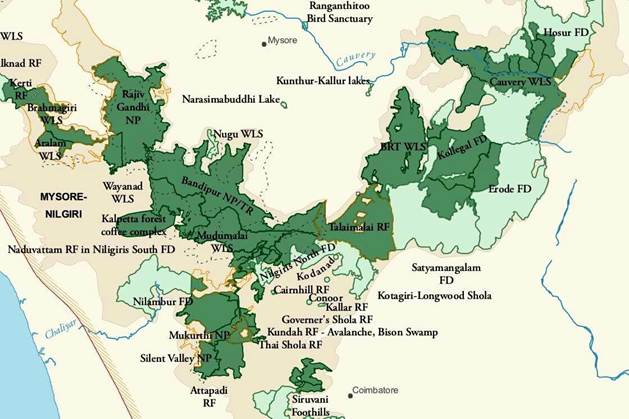
Contribution to the Nilgiris Biosphere Reserve (NBR)
1. Conceptualising India’s First Biosphere Reserve
- Authored the NBR concept document.
- Enabled designation of NBR as:
- India’s first Biosphere Reserve.
- Part of UNESCO’s Man and the Biosphere Programme (MAB).
- Integrated conservation with human use rather than exclusionary protection.
2. Landscape-Level Conservation Approach
- Moved beyond fragmented, species-specific protection.
- Emphasised:
- Ecological connectivity across forests, grasslands, and human settlements.
- Conservation at landscape and regional scales.
- Insight emerged from:
- Field studies on Asian elephants, highlighting the need for corridor-based conservation.
3. People-Centric Conservation Philosophy
- Advocated:
- Local communities as stakeholders, not threats.
- Protection of biodiversity-dependent livelihoods.
- Rejected fortress-style conservation.
- Influenced later debates on:
- Eco-sensitive zones.
- Community forest rights.
Institutional & Academic Legacy
1. Building Ecological Institutions
- Established CES at IISc as:
- India’s premier ecology research hub.
- A cradle for interdisciplinary ecological science.
- Trained generations of ecologists, conservationists, and policy thinkers.
2. Western Ghats Network Programme
- Connected:
- Universities and researchers from Gujarat to Tamil Nadu.
- Created a pan-Western Ghats research ecosystem.
- Democratized ecological knowledge across regions and institutions.
Policy Impact Beyond the Nilgiris
Western Ghats Ecology Expert Panel (WGEEP)
- Chaired by Gadgil.
- Recommended:
- Zoning of Western Ghats into Ecologically Sensitive Areas (ESAs).
- Decentralised, participatory decision-making.
- Though politically contested, it:
- Set the intellectual benchmark for future Western Ghats governance.
Why Gadgil’s Legacy Matters Today ?
- Climate change, habitat fragmentation, and infrastructure pressures are intensifying in the Western Ghats.
- Gadgil’s framework offers:
- A scientifically grounded yet socially just conservation model.
- An alternative to purely technocratic or exclusionary approaches.
- His work underlines that:
- Long-term conservation success depends on local legitimacy and ecological realism.
Nilgiris Biosphere Reserve
- India’s first Biosphere Reserve (declared in 1986); part of UNESCO’s Man and the Biosphere (MAB) Programme.
- Located at the tri-junction of Tamil Nadu, Kerala, and Karnataka in the Western Ghats.
- Covers diverse ecosystems: tropical evergreen forests, moist deciduous forests, shola–grassland complexes.
- Landscape-level conservation model integrating forests, wildlife habitats, and human settlements.
Folic Acid Awareness & Prevention of Spina Bifida
Why in News?
- Renewed public health concern following reporting on Spina Bifida, India’s most common birth defect, and the persistently low awareness about its prevention.
- Expert calls for:
- National awareness campaigns.
- Food fortification with folic acid.
- India continues to record one of the highest global prevalence rates, despite three decades of scientific evidence on prevention.
Relevance
GS II (Social Justice & Health)
- Preventive healthcare and maternal nutrition.
- Public health awareness failures.
- Role of State in reducing avoidable disabilities.
GS III (Human Resource Development)
- Nutrition, micronutrient deficiency, and long-term productivity.
- Cost-effectiveness of prevention vs treatment.
What is Spina Bifida?
- A neural tube defect (NTD) where the spinal cord fails to develop properly in early pregnancy.
- Occurs very early in gestation (within first 28 days).
- Leads to irreversible neurological damage.
Magnitude of the Problem in India
- >25,000 children born annually with Spina Bifida.
- Prevalence: ~4 per 1,000 births (much higher than global best practices).
- India among countries with highest disease burden globally.
- >75% of affected children lack access to comprehensive medical care.
Clinical & Social Impact
- Physical disability:
- Ranges from mild foot weakness to complete paralysis below the hips.
- Many children wheelchair-dependent from early childhood.
- Associated conditions:
- Hydrocephalus (excess fluid in brain).
- Urinary & bowel incontinence.
- Orthopaedic deformities (club foot).
- Cognitive function:
- No intellectual impairment — children can lead productive lives if treated.
- Socio-economic burden:
- Long-term medical costs.
- Caregiver burden.
- Loss of household income and dignity.
Why Folic Acid is Critical ?
- Folic acid (Vitamin B9) intake:
- Before conception and during early pregnancy.
- Can prevent >70% of Spina Bifida cases.
- Evidence established since 1991:
- Medical Research Council (MRC) Vitamin Study (published in The Lancet).
- Cost-effective:
- ₹1 spent on prevention saves >₹100 in treatment and rehabilitation.
India’s Policy & Awareness Gap
- No large-scale national awareness campaign.
- Limited counselling on pre-conception nutrition, especially for:
- Rural women.
- Unplanned pregnancies.
- Absence of:
- Mandatory food fortification with folic acid.
- Systematic education via primary healthcare systems.
- Represents public health negligence, given known preventability.
Global Best Practices
- 68 countries mandate folic acid fortification in staple foods.
- Outcomes:
- Reduced Spina Bifida prevalence to <1 per 1,000 births.
- Combined approach:
- Mass awareness campaigns.
- Mandatory fortification laws.
Emerging Research & Indian Context
- Exploration of universally consumed food vehicles:
- Salt.
- Tea.
- Preliminary Indian trial:
- Tea fortification with folate and vitamin B12.
- Published in BMJ Nutrition, Prevention & Health.
- Objective:
- Address both neural tube defects and anaemia-related neurological issues.
Expert & Institutional Advocacy
- Strong advocacy by public health experts including:
- Emory University-based Center for Spina Bifida Prevention.
- Calls for:
- Primary prevention over curative focus.
- Integration of folic acid awareness into maternal health programmes.
Way Forward
- Launch nationwide awareness campaign on:
- Pre-conception folic acid intake.
- Early antenatal nutrition.
- Introduce mandatory food fortification with folic acid and vitamin B12.
- Strengthen:
- Primary healthcare counselling.
- Referral and rehabilitation systems for affected children.
- Align with goals of:
- Reducing under-five mortality.
- Preventing avoidable disabilities and stillbirths.
Monument Conservation Opens to Private Sector
Why in News?
- The Ministry of Culture has decided to open conservation and restoration of centrally protected monuments to private agencies.
- This marks a major shift as Archaeological Survey of India (ASI) will no longer be the sole implementing authority.
- Over 200 private heritage conservation agencies are being empanelled following a Request for Proposals (RFP).
- The move formally ends ASI’s exclusive mandate in monument conservation.
Relevance
GS I (Indian Culture & Heritage)
- Conservation of monuments and heritage management.
- Role of ASI and centrally protected monuments.
GS II (Governance)
- Changing role of the State: implementer → regulator.
- Public–Private Partnerships (PPP) in public goods.
- Accountability and regulatory oversight.

What is the New Conservation Framework?
- Private sector participation allowed in:
- Conservation.
- Restoration.
- Preservation of centrally protected monuments.
- Work will be carried out:
- Under ASI supervision.
- Following approved conservation plans and standards.
- Ministry will:
- Vet and empanel agencies through an internal committee.
- Monitor execution and compliance.
How Will the System Work?
- Detailed Project Reports (DPRs):
- Prepared by expert conservation architects.
- Execution:
- Can be done by:
- PSU corporations.
- Municipal bodies.
- Private heritage firms.
- Can be done by:
- Funding mechanism:
- Use of National Culture Fund (NCF).
- Encourages CSR-based funding.
- ASI’s role shifts to:
- Approval of plans.
- Oversight and quality control.
- Ensuring adherence to conservation norms.
Rationale Behind the Move
- Capacity constraints of ASI:
- Conservation work for nearly 3,700 monuments handled largely by ASI staff.
- Slow pace of conservation:
- Limited manpower and institutional bandwidth.
- Need to build a broader ecosystem:
- Create a national talent pool of conservation professionals.
- Utilise private expertise:
- Many private agencies possess advanced conservation skills and experience.
Key Institutional Changes
- ASI transitions from:
- Implementer → Regulator & Supervisor.
- Conservation becomes:
- More decentralised.
- Potentially faster and scalable.
- Marks shift from a state-monopoly model to a PPP-style framework.
Illustrative Case
- Ranthambore Fort:
- Among monuments where NCF is seeking private support for conservation.
- Indicates application to high-value, iconic heritage sites.
Concerns & Criticisms
- Risk of commercialisation:
- Profit motives may dilute conservation ethics.
- Past experience:
- Corporates struggled with heritage timelines and compliance.
- Quality control challenges:
- Need to prevent cosmetic or tourism-oriented alterations.
- Accountability gaps:
- Clear liability needed in case of damage or non-compliance.
Safeguards Built into the Model
- ASI retains:
- Final approval authority.
- Monitoring and enforcement powers.
- Mandatory adherence to:
- Conservation charters.
- Scientific restoration norms.
- No transfer of:
- Ownership.
- Monument management rights.
Global Parallels
- United Kingdom:
- Churches Conservation Trust.
- United States:
- Strong role of private funding and foundations.
- Germany & Netherlands:
- Historic foundations managing heritage assets.
- India aligning with international best practices under regulatory oversight.
AI-Based Citizen Participation in Budgeting
Why in News?
- Haryana government has launched an AI-based Voice Feedback Portal to gather citizen inputs for Budget 2026–27.
- Objective: Formulate a “People’s Budget” through direct public participation.
- Claimed as the first-ever use of Artificial Intelligence for budget consultation within India’s administrative and democratic framework.
- Initiative launched at the instance of Nayab Singh Saini, Chief Minister of Haryana.
Relevance
GS II (Governance & Democracy)
- Participatory democracy and citizen engagement.
- Budget-making as a democratic exercise.
- Role of States as laboratories of governance reform.
GS III (Technology & E-Governance)
- Use of AI in public administration.
- Data-driven policymaking.
- Digital inclusion and exclusion risks.
What is the Initiative?
- An AI-enabled chatbot and voice-based platform allowing citizens to:
- Submit budget-related suggestions.
- Share priorities and grievances.
- Inputs collected live and analysed using AI tools.
- Aims to support data-driven budget formulation.
Institutional Framework
- Implemented through Swarna Jayanti Haryana Institute for Fiscal Management.
- Role:
- Design and operationalise AI-based consultation.
- Aggregate and analyse citizen feedback for policymakers.
Key Features
- Voice-based access:
- Reduces digital literacy barriers.
- Enables participation beyond text-based portals.
- AI-driven analysis:
- Categorisation of suggestions.
- Identification of recurring themes and priorities.
- Real-time feedback loop:
- Faster collation compared to traditional consultations.
Why It Matters?
- Deepening participatory democracy:
- Moves beyond token consultations.
- Gives citizens a direct voice in fiscal decision-making.
- Administrative innovation:
- Demonstrates use of AI in core governance functions.
- Inclusive governance:
- Potential to include rural, semi-literate, and marginalised populations.
Governance Significance
- Marks a shift from:
- Elite-driven budgeting → citizen-informed budgeting.
- Aligns with:
- Digital governance.
- Evidence-based policymaking.
- Sets a precedent for other States and possibly the Union government.
Challenges & Concerns
- Representativeness:
- Risk of over-representation of digitally active groups.
- Data governance:
- Privacy, consent, and ethical use of citizen data.
- Policy translation gap:
- No statutory obligation to incorporate suggestions.
- Algorithmic transparency:
- Need clarity on how AI prioritises and filters inputs.
Way Forward
- Combine AI consultations with:
- Offline public hearings.
- Gram Sabha-level discussions.
- Ensure:
- Transparency on how feedback influences budget allocations.
- Clear data protection safeguards.
- Institutionalise citizen consultation as a regular budgetary process, not a one-off experiment.


