
Why in News?
- Madhav Gadgil, one of India’s most influential ecologists, passed away recently.
- Renewed national attention on:
- His foundational role in the Nilgiris Biosphere Reserve (NBR).
- His philosophy of people-centric, landscape-level conservation.
- Relevance for contemporary debates on:
- Western Ghats conservation.
- Community participation vs top-down environmental regulation.
- Sustainable livelihoods in biodiversity-rich regions.
Relevance
GS I (Geography & Environment)
- Western Ghats as a global biodiversity hotspot.
- Biosphere Reserves and landscape ecology.
GS III (Environment & Ecology)
- Conservation models: people-centric vs exclusionary.
- Ecologically Sensitive Areas (ESAs).
- Human–wildlife coexistence and corridor-based conservation.
Who Was Madhav Gadgil?
- Pioneer of ecological science and conservation biology in India.
- Founder of the Centre for Ecological Sciences (CES) at Indian Institute of Science, Bengaluru.
- Architect of participatory environmental governance in India.
- Chairperson of the Western Ghats Ecology Expert Panel (WGEEP).
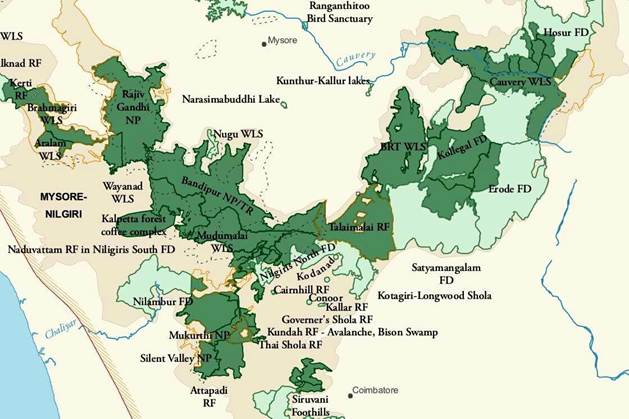
Contribution to the Nilgiris Biosphere Reserve (NBR)
1. Conceptualising India’s First Biosphere Reserve
- Authored the NBR concept document.
- Enabled designation of NBR as:
- India’s first Biosphere Reserve.
- Part of UNESCO’s Man and the Biosphere Programme (MAB).
- Integrated conservation with human use rather than exclusionary protection.
2. Landscape-Level Conservation Approach
- Moved beyond fragmented, species-specific protection.
- Emphasised:
- Ecological connectivity across forests, grasslands, and human settlements.
- Conservation at landscape and regional scales.
- Insight emerged from:
- Field studies on Asian elephants, highlighting the need for corridor-based conservation.
3. People-Centric Conservation Philosophy
- Advocated:
- Local communities as stakeholders, not threats.
- Protection of biodiversity-dependent livelihoods.
- Rejected fortress-style conservation.
- Influenced later debates on:
- Eco-sensitive zones.
- Community forest rights.
Institutional & Academic Legacy
1. Building Ecological Institutions
- Established CES at IISc as:
- India’s premier ecology research hub.
- A cradle for interdisciplinary ecological science.
- Trained generations of ecologists, conservationists, and policy thinkers.
2. Western Ghats Network Programme
- Connected:
- Universities and researchers from Gujarat to Tamil Nadu.
- Created a pan-Western Ghats research ecosystem.
- Democratized ecological knowledge across regions and institutions.
Policy Impact Beyond the Nilgiris
Western Ghats Ecology Expert Panel (WGEEP)
- Chaired by Gadgil.
- Recommended:
- Zoning of Western Ghats into Ecologically Sensitive Areas (ESAs).
- Decentralised, participatory decision-making.
- Though politically contested, it:
- Set the intellectual benchmark for future Western Ghats governance.
Why Gadgil’s Legacy Matters Today ?
- Climate change, habitat fragmentation, and infrastructure pressures are intensifying in the Western Ghats.
- Gadgil’s framework offers:
- A scientifically grounded yet socially just conservation model.
- An alternative to purely technocratic or exclusionary approaches.
- His work underlines that:
- Long-term conservation success depends on local legitimacy and ecological realism.
Nilgiris Biosphere Reserve
- India’s first Biosphere Reserve (declared in 1986); part of UNESCO’s Man and the Biosphere (MAB) Programme.
- Located at the tri-junction of Tamil Nadu, Kerala, and Karnataka in the Western Ghats.
- Covers diverse ecosystems: tropical evergreen forests, moist deciduous forests, shola–grassland complexes.
- Landscape-level conservation model integrating forests, wildlife habitats, and human settlements.


