
Content
- Why Article 6 is a powerful tool for India ?
- Equality isn’t the Enemy of Growth; High Inequality Erodes Social Trust
Why Article 6 is a powerful tool for India ?
Why in News ?
- Article 6 carbon markets made fully operational at COP29 → marks shift from rule-making to implementation.
- 89 cooperation arrangements under Article 6.2 across 58 Parties → rapid expansion of bilateral/plurilateral carbon trade.
- Adoption of Paris Agreement Crediting Mechanism (PACM) under Article 6.4 → formal transition from Clean Development Mechanism.
- August 2025: India signs Joint Crediting Mechanism (JCM) → operationalises Article 6.2 with Japan.
Relevance
- GS Paper I (Geography – Environment)
- Climate change mitigation mechanisms
- Energy transition & decarbonisation pathways
- GS Paper II (Governance & International Relations)
- Global climate governance (Paris Agreement)
- India–Japan strategic cooperation
- International institutions & rule-based order
Practice Question
- “Article 6 of the Paris Agreement represents a shift from climate ambition to climate implementation.” Examine how India can leverage Article 6 to achieve growth-compatible decarbonisation.(250 Words)
What is Article 6?
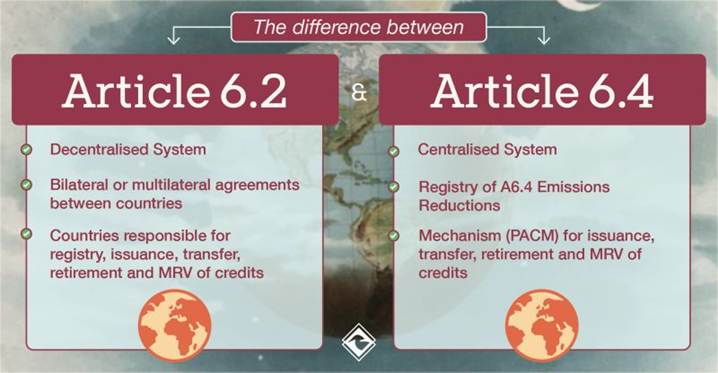
- Article 6.2:
- Bilateral / plurilateral transfer of ITMOs (Internationally Transferred Mitigation Outcomes).
- Requires corresponding adjustments to prevent double counting.
- Article 6.4:
- Centralised UN-supervised crediting mechanism (successor to CDM).
- Emphasis on additionality, environmental integrity, transparency.
- Article 6.8:
- Non-market approaches (capacity building, tech cooperation).
Constitutional Dimension
- Article 48A & 51A(g): Environmental protection → constitutional basis for climate action.
- International law alignment:
- India exercising CBDR-RC within Paris framework.
- Domestic legal gap:
- No dedicated Carbon Markets Act yet; reliance on executive rules under Energy Conservation Act (amended).
Governance & Institutional Architecture
- Designated National Authority (DNA) for Article 6 appointed.
- Pending clarity on:
- Rules for Letters of Authorisation (LoA).
- Application of corresponding adjustments.
- Interplay with Indian Carbon Market (ICM).
- Need for Cabinet-level Steering Committee for inter-ministerial coordination (Power, MNRE, Steel, Civil Aviation, MoEFCC).
Economic & Developmental Significance for India
- Climate finance mobilisation:
- Bridges India’s climate finance gap (India needs ~$170 bn/year till 2030 – various estimates).
- Technology transfer:
- Offshore wind, green hydrogen, CCUS, SAF, fuel cells.
- Industrial competitiveness:
- Prepares Indian exports for CBAM-like carbon border measures.
- Growth-compatible decarbonisation:
- Aligns with India’s developmental state model, not growth sacrifice.
Strategic Significance of India’s Article 6 Participation
- From credit-selling to transformation tool:
- Focus on industrial & technological leapfrogging, not low-cost offsets alone.
- Bilateral diplomacy:
- Deepens strategic partnerships beyond trade and defence.
- Resilient trade relationships:
- Carbon-constrained global economy → carbon credentials become trade currency.
India’s Identified Priority Activities (13 sectors)
High-end, future-facing sectors:
- Renewable energy + storage
- Offshore wind, solar thermal
- Green hydrogen, compressed bio-gas
- Fuel-cell mobility
- Advanced energy efficiency
- Sustainable Aviation Fuel (SAF)
- CCUS in cement & steel
- Marine & emerging energy technologies
Overview:
- Shift away from legacy CDM-style projects (small renewables).
- Direct alignment with Net Zero 2070 and deep decarbonisation pathways.
Environmental & Climate Impact
- Coal-heavy energy mix reality:
- Article 6 enables energy diversification without abrupt transition shocks.
- Hard-to-abate sectors addressed:
- Steel, cement, aviation → otherwise outside scope of conventional mitigation.
- Carbon removals potential:
- Biochar, Enhanced Rock Weathering → long-term negative emissions.
Data & Evidence
- 89 Article 6.2 cooperation arrangements across 58 Parties.
- Voluntary carbon projects in India:
- AFOLU projects take ~1,600 days to register vs <400 days in rest of Asia (CEEW).
- Global demand for carbon removals projected to rise sharply post-2030 (IPCC AR6 pathways).
Key Challenges
Institutional & Regulatory
- Absence of detailed Article 6 operational rules.
- Risk of policy uncertainty deterring investors.
Administrative
- Multi-layered project approvals.
- Land-intensive projects → federal & local coordination bottlenecks.
Market Design Risks
- Poor-quality credits → reputational risk.
- Weak MRV could undermine environmental integrity.
Equity & Ethics
- Risk of enclave decarbonisation without local co-benefits.
- Community consent & benefit-sharing concerns.
Way Forward
- Enact a Carbon Markets Framework Law:
- Legal certainty, dispute resolution, investor confidence.
- Single-window clearance system for Article 6 projects.
- Clear LoA & corresponding adjustment rules.
- Integrate Indian Carbon Market with Article 6 cautiously.
- Develop carbon removals ecosystem (R&D + standards).
- Lead South–South cooperation:
- Shared MRV platforms, pooled finance, technical assistance.
- Align with SDGs 7, 9, 12, 13 and principles of Just Transition.
Prelims Pointers
- Article 6 ≠ carbon tax.
- Article 6.2 = bilateral ITMOs; 6.4 = UN-supervised crediting.
- JCM is Article 6.2, not 6.4.
- Corresponding adjustment prevents double counting, not double claiming.
Equality isn’t the Enemy of Growth; High Inequality Erodes Social Trust
Core Argument
- Growth without distributive justice weakens social trust, democratic legitimacy, and long-term economic sustainability.
Conceptual Clarity
- Equality ≠ absolute sameness
- Refers to fair access, capability enhancement, and dignity, not uniform outcomes.
- Inequality problem:
- When it becomes structural, persistent, and politically entrenched, it harms growth and democracy.
Relevance
- GS Paper I (Indian Society)
- Inequality, social cohesion, trust deficit
- GS Paper II (Polity & Governance)
- Democratic legitimacy
- Role of the state in welfare
- Constitutional values
Practice Question
- Why is high inequality considered detrimental to long-term economic growth?Explain with reference to demand, human capital, and innovation.(250 Words)
Economic Dimension
- Inequality is not growth-neutral:
- Extreme concentration of wealth → lower aggregate demand.
- Rich save more; poor consume more → inequality depresses demand-led growth.
- Human capital distortion:
- Unequal access to education, health, nutrition → suboptimal workforce productivity.
- Misallocation of talent:
- High inequality limits intergenerational mobility → innovation suffers.
- Empirical insight:
- IMF & World Bank studies: high inequality shortens growth spells and raises volatility.
Social Dimension
- Erosion of social trust:
- Visible disparities undermine belief in fairness of institutions.
- Perception of rigged systems:
- Wealth → political influence → policy capture.
- Psychological impact:
- Inequality fuels resentment, alienation, and social fragmentation.
- Outcome:
- Rise of populism, identity politics, and social unrest.
Governance & Democratic Dimension
- Democracy depends on legitimacy:
- Citizens must believe outcomes are not pre-determined by wealth.
- Inequality weakens democratic consent:
- Policy debates shift from evidence to resentment.
- Elite capture:
- Regulatory frameworks, taxation, subsidies skewed towards affluent interests.
- Result:
- Decline in trust in state capacity and democratic institutions.
Ethical & Constitutional Dimension
- Constitutional morality:
- Articles 14, 15, 38, 39(b)-(c) mandate reduction of inequalities.
- Ethical economy:
- Growth that excludes large sections violates principles of justice, dignity, and fraternity.
- Equality as enabling condition:
- Not anti-growth, but pro-growth in the long run.
Political Economy Insight
- False binary exposed:
- Growth vs equality is a misleading dichotomy.
- Real danger:
- Inequality reshapes politics by:
- Turning policy into distributional conflict.
- Weakening institutional credibility.
- Inequality reshapes politics by:
- Historical lesson:
- Stable high-growth societies invested early in broad-based welfare and opportunity.
Indian Context
- India’s growth paradox:
- High GDP growth with:
- Persistent wealth concentration.
- Unequal access to quality public services.
- High GDP growth with:
- Visible fault lines:
- Education quality gaps.
- Health expenditure burden on poor.
- Informal sector precarity.
- Risk:
- Growth loses social legitimacy → reform fatigue and resistance.
Challenges
- Policy focus skewed towards headline growth:
- Distribution treated as secondary.
- Weak redistributive capacity:
- Limited tax progressivity.
- Implementation gaps:
- Welfare leakage, uneven state capacity.
- Narrative problem:
- Equality framed as populism, not productivity-enhancing.
Way Forward
- Reframe equality as growth enabler:
- Focus on capability-based equality.
- Strengthen public goods:
- Health, education, nutrition as productivity investments.
- Progressive but efficient taxation:
- Wealth and inheritance debates grounded in data.
- Institutional neutrality:
- Reduce policy capture; ensure rule-based governance.
- Inclusive growth narrative:
- Growth + fairness as complementary, not competing goals.
Prelims Pointers
- Equality in Indian Constitution includes substantive equality, not just formal.
- Inequality affects social trust, not merely income distribution.
- IMF links inequality with shorter growth durations.


