
Content
- End of 10-Minute Delivery: Gig Workers’ Safety vs Platform Capitalism
- Source Code Disclosure Debate: Cybersecurity vs Digital Rights
- Urbanisation of Small Towns: India’s Silent Urban Transition
- Passive Euthanasia and the Right to Die with Dignity: Supreme Court Jurisprudence
- Shaksgam Valley: Sovereignty, Illegality and the China–Pakistan Axis
- Why Buddhism Went Global and Jainism Did Not: Doctrine, Patronage and Diffusion
End of 10-Minute Delivery — Gig Workers’ Safety vs Platform Capitalism
Why in News ?
- Major delivery platforms (Blinkit, Zepto, Zomato, Swiggy) decided to remove 10-minute delivery branding after intervention by the Union Labour Minister.
- Triggered by:
- One-day strike by gig/platform workers (Dec 31).
- Demands citing accidents, health stress, and unsafe working conditions.
- Marks a policy-relevant moment in India’s evolving gig economy governance.
Relevance
- GS I (Society)
- Changing nature of work, informalisation, urban labour precarity
- Platform economy & “invisible urban workers”
- GS II (Social Justice & Governance)
- Labour welfare, unorganised sector, State intervention
- Code on Social Security, 2020; labour as Concurrent List
Vulnerable Workforce Category
- Gig workers fall under informal, unorganised, and non-standard employment.
- Characteristics:
- No fixed employer–employee relationship.
- Absence of minimum wages, social security, paid leave.
- Algorithmic control without human accountability.
10-minute delivery intensified precarity and risk, deepening social injustice.
Changing Nature of Work
- Shift from traditional employment → platform-mediated work.
- Speed-based service models:
- Normalise hyper-productivity culture.
- Transfer business risk (time pressure, road safety) to workers.
Social Impact
- Accident-prone urban delivery ecosystem.
- Health issues:
- Stress, fatigue, unsafe driving.
- Creates a class of “invisible urban workers” sustaining middle-class convenience.
Constitutional Ethos
- Article 21: Right to life → includes right to safe and dignified working conditions.
- Article 23: Prohibition of forced labour → economic compulsion + unsafe mandates raise ethical concerns.
- Directive Principles:
- Article 39(e): Health and strength of workers must not be abused.
- Article 42: Just and humane conditions of work.
10-minute delivery model arguably conflicted with constitutional morality.
Governance & State Intervention
- Labour Minister’s intervention shows:
- Soft regulation through persuasion, not coercion.
- Recognition that branding and algorithms shape work intensity.
- Shift from:
- “Consumer-first convenience”
- to “worker-first safety framing”.
Gig Economy Regulation: Static Linkage
Existing Framework
- Code on Social Security, 2020:
- Recognises gig & platform workers.
- Enables social security schemes (insurance, maternity, old age).
- Gaps:
- Codes not fully operational.
- No regulation of algorithmic management, delivery timelines, or work intensity.
Ethical Dimension
- Utilitarian consumer logic: Faster delivery = better service.
- Rights-based ethics: Worker safety > marginal consumer convenience.
- Corporate ethics issue:
- Is speed-driven branding ethical if it externalises risk onto workers?
Government action reflects ethics of care and dignity of labour.
Economic & Urban Governance Angle
- Hyper-speed delivery:
- Encourages unsafe driving → public safety issue.
- Externalises costs (accidents, healthcare) to society.
- Sustainable platform economy requires:
- Balancing efficiency with human costs.
Significance of the Decision
- Symbolic but important:
- Removes normative pressure of “10 minutes”.
- Acknowledges worker voices & collective action.
- Signals:
- Beginning of labour-sensitive platform governance.
- Precedent for regulating algorithm-driven work practices.
Challenges
- Removal of branding ≠ end of implicit performance pressure.
- Warehousing logic may still incentivise speed.
- Weak collective bargaining power of gig workers.
- Absence of enforceable workplace safety standards for platforms.
Way Forward
Regulatory
- Notify and operationalise Social Security Code provisions for gig workers.
- Define reasonable delivery timelines as part of labour standards.
- Mandate accident insurance & health coverage funded by platforms.
Institutional
- Establish Gig Workers Welfare Boards at State level.
- Enable platform worker unions/associations.
Technological Governance
- Audit algorithms for:
- Work intensity
- Penalty systems
- Incentive structures
- Transparency in ratings & delivery metrics.
Social Justice Lens
- Recognise gig workers as workers, not mere service providers.
- Shift discourse from convenience to dignity of labour.
Prelims Pointers
- Gig workers are recognised under Code on Social Security, 2020.
- They are part of unorganised workforce, not regular employees.
- Labour is a Concurrent List subject.
Source Code Disclosure Debate — Cybersecurity vs Digital Rights
Why in News ?
- Reports (Reuters) suggested the Indian government was considering mandating smartphone manufacturers to:
- Disclose source code to third-party testing agencies.
- Notify the government before rolling out major software updates.
- Government has officially denied any finalised demand, stating discussions are exploratory.
- Triggered concerns over cybersecurity, privacy, transparency, and regulatory overreach.
Relevance
- GS II (Polity & Governance)
- Right to Privacy (Art. 21), proportionality doctrine (Puttaswamy)
- Transparency, stakeholder consultation
- GS III (Internal Security & S&T)
- Cybersecurity, critical digital infrastructure
- Supply-chain risks, state-sponsored cyber threats
What is Source Code?
- The core human-readable instructions that define how software functions.
- Includes:
- Algorithms
- Security architecture
- System design logic
- Kept confidential because:
- Commercial IP protection
- Cybersecurity (prevents attackers from identifying vulnerabilities).
Why Source Code Disclosure Is Risky ?
- Security-by-obscurity vs Security-by-design:
- Full disclosure increases attack surface.
- Risks include:
- Easier identification of zero-day vulnerabilities.
- Supply-chain attacks via testing agencies.
- Potential state or non-state cyber exploitation.
- Smartphones = critical digital infrastructure:
- Banking, Aadhaar, health, communications.
Paradox: A measure meant to enhance security may weaken systemic cyber resilience.
Internal Security Dimension
- Smartphones are gateways to:
- Personal data
- Critical communications
- Location and biometric-linked services
- Any compromise affects:
- Individual security
- National cyber posture
- India already faces:
- Rising cybercrime
- State-sponsored cyber threats
Source code exposure magnifies internal security vulnerabilities.
Governance & Regulatory Dimension
Existing Regulatory Framework
- Indian Telegraph (Amendment) Rules, 2017
- MTCTE (Mandatory Testing & Certification of Telecom Equipment):
- Includes Indian Telecom Security Assurance Requirements (ITSAR).
- Telecommunications Act, 2023:
- Shifted regulatory approach.
- Smartphones already undergo:
- BIS certification for India.
Institutional Overlap
- Earlier: DoT → MTCTE & ITSARs.
- Now: MeitY assumes lead role.
- Raises issues of:
- Regulatory clarity
- Jurisdictional overlap
Polity & Constitutional Dimension
Article 21 – Right to Privacy
- Source code access could:
- Enable mass surveillance (directly or indirectly).
- Undermine data security guarantees.
- Puttaswamy judgment (2017):
- Any intrusion must satisfy:
- Legality
- Necessity
- Proportionality
- Procedural safeguards
- Any intrusion must satisfy:
Blanket source code access fails proportionality test.
Transparency & Democratic Governance
Civil Society Concerns
- Internet Freedom Foundation (IFF) flagged:
- Closed-door consultations.
- Lack of public disclosure of draft ITSARs.
- Governance issue:
- Stakeholder consultation ≠ Big Tech consultation alone.
- Democratic regulation requires public scrutiny.
Comparative Global Practice
- China:
- Heavy state control, but even China does not mandate Apple to share full source code.
- EU / US:
- Focus on:
- Security audits
- Vulnerability disclosure programmes
- Standards-based compliance
- Not source code handover.
- Focus on:
India’s reported approach would be globally atypical.
Technology & Innovation Impact
- Risks:
- Discouraging foreign investment.
- Undermining India’s image as a trusted digital market.
- Potential chilling effect on:
- Innovation
- Startup ecosystem
- Global supply chains.
Ethical Dimension
Competing Ethical Claims
- State ethics: Protect citizens from insecure devices.
- Rights ethics: Protect users from overreach & surveillance.
- Corporate ethics: Duty to protect users’ data and systems.
Ethical governance demands least intrusive means.
Way Forward
Regulatory Design
- Prefer:
- Black-box security audits
- Penetration testing
- Bug bounty programmes
- Avoid:
- Blanket source code access.
Institutional
- Clear division of roles:
- DoT vs MeitY vs CERT-In.
- Strengthen:
- CERT-In
- National cyber testing labs.
Governance
- Publish draft ITSARs.
- Open public consultation.
- Parliamentary oversight of digital security norms.
Rights Protection
- Embed privacy-by-design and security-by-design.
- Align with Digital Personal Data Protection Act principles.
Challenges
- Balancing:
- National security
- Cyber resilience
- Privacy & trust
- Rapid technological change outpacing regulation.
- Capacity constraints in indigenous testing infrastructure.
Prelims Pointers
- Source code ≠ executable code.
- Smartphones already certified by BIS.
- MTCTE stems from Indian Telegraph Rules, 2017.
- Privacy is a fundamental right under Article 21.
Urbanisation of Small Towns — India’s Silent Urban Transition
Why in News ?
- India’s urban debate remains metro-centric, while the most significant urbanisation is occurring in small towns (population <1 lakh).
- Of ~9,000 census/statutory towns, only ~500 are large cities.
- Editorial argues that small-town urbanisation is a structural outcome of capitalist development under stress, not a benign decentralisation.
Relevance
- GS I (Society & Urbanisation)
- Urbanisation patterns, migration, informal labour
- Urbanisation without industrialisation
- GS II (Governance & Local Government)
- Municipal capacity, decentralisation vs devolution
- Metro-centric bias in AMRUT
Core Argument
- India is witnessing urbanisation without urban prosperity.
- Small towns are not “alternatives” to metros; they are new frontiers absorbing surplus labour and capital displaced from over-saturated cities, often under weaker regulation and governance.
Nature of India’s Urban Transition
- From Metropolisation (1970s–1990s):
- Large cities as centres of industry, state investment, labour absorption.
- “Spatial fixes” for capitalism.
- To Small-Town Urbanisation (Present):
- Driven by:
- High land costs in metros
- Infrastructure saturation
- Rising cost of living
- Small towns emerge as:
- Logistics hubs
- Agro-processing centres
- Warehousing & construction economies
- Service & consumption markets
- Driven by:
Social Composition
- Migrant workers pushed out of metros.
- Rural youth with declining agrarian options.
- Dominance of informal labour:
- Contract-less construction workers
- Women in home-based piecework
- Youth in platform/gig work without security
Urbanisation of rural poverty, not inclusive urban growth.
Municipal Weakness
- Small-town municipalities:
- Understaffed
- Underfunded
- Low technical capacity
- Planning deficits:
- Outsourced to consultants
- Minimal local participation
- Procedural rather than deliberative governance
Policy Bias
- Metro-centric urban missions:
- AMRUT (even expanded) largely excludes small towns from meaningful investments.
- Infrastructure design (water, sewerage) tailored to large cities.
- Consequences:
- Tanker economies
- Groundwater over-extraction
- Ecological stress
Decentralisation without devolution.
Economic Dimension
- Small towns as:
- Low-cost accumulation zones (cheap land, pliable labour).
- Sites for informal capitalism.
- New power hierarchies:
- Real estate brokers
- Local contractors
- Micro-financiers
- Political intermediaries
Capital relocates, but labour precarity persists.
Infrastructure Stress
- Fragmented schemes instead of integrated systems.
- Absence of long-term urban services planning.
Environmental Dimension
- Unregulated groundwater extraction.
- Absence of sewage and solid waste systems.
- Ecological degradation without institutional safeguards.
Social Justice Angle
Who Loses?
- Informal workers without:
- Job security
- Social protection
- Collective bargaining
- Women workers concentrated in low-paid, invisible labour.
- Migrants lacking urban entitlements.
Structural Injustice
- Benefits of urbanisation accrue to:
- Local elites
- Land intermediaries
- Platform corporations
- Costs borne by:
- Workers
- Urban poor
- Local ecology
Unequal urban citizenship in small towns.
Ethical & Political Economy Perspective
- Urban growth without dignity violates:
- Justice
- Equity
- Human-centred development
- Planning reduced to technocracy, not democracy.
Way Forward
1. Political Recognition
- Acknowledge small towns as India’s primary urban frontier, not peripheral spaces.
2. Reimagined Planning
- Town-specific plans integrating:
- Housing
- Livelihoods
- Transport
- Ecology
- Avoid replication of metro templates.
3. Empowered Local Governments
- Fiscal devolution to municipalities.
- Transparent budgeting.
- Capacity-building of local cadres.
4. Labour & Social Justice
- Space for:
- Workers’ collectives
- Cooperatives
- Women’s groups
- Extend urban social protection to migrants and informal workers.
5. Discipline Capital & Platforms
- Regulate:
- Platform economies
- Digital infrastructures
- Ensure:
- Labour rights
- Local value retention
- Data accountability
Prelims Pointers
- Majority of India’s towns are small towns (<1 lakh population).
- Urbanisation ≠ industrialisation or formalisation.
- AMRUT primarily targets larger urban centres.
Takeaway
- India’s future urban crisis will not be written in its megacities, but in its small towns—where capital has moved faster than planning, governance, and social justice.
Passive Euthanasia, Right to Life & Supreme Court Jurisprudence
Core Issue
- Family of a man in a persistent vegetative state (PVS) met Supreme Court of India judges seeking permission for euthanasia.
- The patient has been in a vegetative state for over 13 years.
- Judges sought views of primary and secondary medical boards on whether continuation of treatment is in the patient’s best interest.
Relevance
- GS II (Polity & Constitution)
- Article 21, judicial interpretation of dignity
- Supreme Court role in rights expansion
- GS IV (Ethics)
- Autonomy vs sanctity of life
- Medical ethics: beneficence, non-maleficence
What is Euthanasia?
- Euthanasia: Intentional act/omission to end life to relieve suffering.
- Types:
- Active Euthanasia: Direct act to cause death (e.g., lethal injection) → Illegal in India.
- Passive Euthanasia: Withdrawal/withholding of life-sustaining treatment → Legal under conditions.
- Assisted Suicide: Providing means to commit suicide → Illegal.
Article 21 – Right to Life
- Interpreted as Right to live with dignity, not mere animal existence.
- Includes:
- Right to privacy
- Bodily autonomy
- Right to refuse medical treatment
Key question: Does dignity extend to the end of life?
SC answer: Yes, in limited circumstances.
Supreme Court Jurisprudence
1. Aruna Shanbaug Case
- First legal recognition of passive euthanasia in India.
- Allowed withdrawal of life support for patients in PVS.
- Required:
- Approval of High Court.
- Medical opinion.
- Laid foundation but procedure was cumbersome.
2. Common Cause v. Union of India
- Landmark Constitution Bench judgment.
- Held:
- Passive euthanasia is legal.
- Living Will / Advance Directive recognised.
- Established:
- Right to die with dignity as part of Article 21.
- Replaced HC approval with medical boards.
Legal Framework for Passive Euthanasia
Who can decide?
- Competent patient → Through Living Will / Advance Directive.
- Incompetent patient (PVS/coma) → Family + Doctors + Medical Boards.
Safeguards:
- Opinion of:
- Primary Medical Board.
- Secondary Medical Board.
- Certification that:
- Treatment is futile.
- Continuation not in best interest of patient.
- No criminal liability if procedure followed.
Medical Boards – Role Explained
- Primary Board: Treating doctors, hospital specialists.
- Secondary Board: Independent experts, acts as safeguard.
- Purpose:
- Prevent misuse.
- Ensure decision is medical, not emotional or economic.
Ethical Dimension
Competing Ethical Principles
- Autonomy: Respecting patient’s will/dignity.
- Beneficence: Acting in patient’s best interest.
- Non-maleficence: Avoiding prolonged suffering.
- Sanctity of life vs Quality of life debate.
Indian approach: Middle path – no active killing, but dignity-preserving withdrawal.
Social & Governance Concerns
- Fear of misuse against:
- Elderly
- Disabled
- Economically dependent patients
- Indian society:
- Strong family involvement.
- Limited palliative care infrastructure.
- Hence emphasis on procedural safeguards.
Relevance of Current Case
- Tests implementation of SC guidelines in real-life scenarios.
- Shows shift from judicial approval to medical ethics-based governance.
- Reinforces:
- Family’s role.
- Medical board centrality.
- Highlights growing acceptance of end-of-life dignity.
International Context
- Many countries allow:
- Passive euthanasia (UK, India).
- Some allow active euthanasia (Netherlands, Belgium).
- India follows conservative, dignity-based model.
Challenges
- Low awareness of Living Wills.
- Hospital-level hesitation due to fear of litigation.
- Uneven capacity of medical boards across States.
- Emotional burden on families.
Way Forward
- Standardise hospital protocols for end-of-life care.
- Public awareness on Advance Directives.
- Strengthen palliative care services.
- Periodic training of doctors on legal safeguards.
- Ethical committees at hospital level.
India’s Assertion, Pakistan’s Cession — How China Took Shaksgam Valley
Core Issue
- India has reiterated its sovereignty claim over Shaksgam Valley, after China referred to infrastructure activity in the region.
- The issue revives debates around the 1963 China–Pakistan Boundary Agreement, legality of territorial cession, and implications for India’s territorial integrity.
Relevance
- GS I (Geography)
- Strategic location: Karakoram, Siachen region
- GS II (International Relations)
- Sovereignty, boundary agreements, international law
- India–China–Pakistan relations
Location & Geography
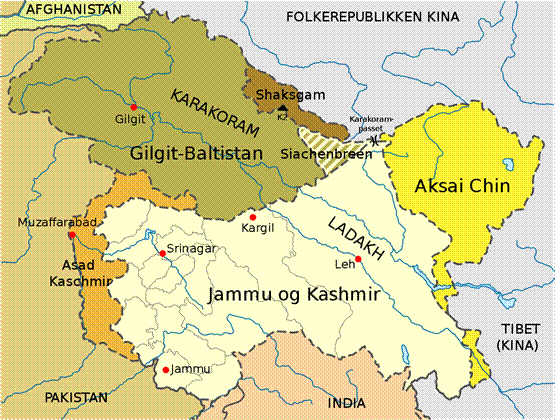
- Shaksgam Valley (Trans-Karakoram Tract):
- Lies north of the Shaksgam River, north of the Siachen Glacier.
- Part of the larger Ladakh region of J&K claimed by India.
- Area: ~5,000 sq km.
- Strategically located between Xinjiang (China) and PoK (Pakistan-occupied Kashmir).
Historical Background
- Pre-1963:
- Region historically linked to Jammu & Kashmir; never legally ceded by India.
- China began asserting control post-1962 India–China war.
- 1963 Boundary Agreement:
- Signed between China and Pakistan.
- Pakistan illegally ceded ~5,180 sq km of Indian-claimed territory to China.
- India not a party → Agreement void ab initio under international law (no third-party territorial transfer).
India’s Official Position
- Reiterated by Ministry of External Affairs:
- Shaksgam Valley is Indian territory.
- 1963 agreement has no legal validity.
- China’s presence is based on illegal occupation facilitated by Pakistan.
- Consistent stance since 1960s, including Parliamentary statements by Jawaharlal Nehru.
China’s Position
- Claims Shaksgam based on 1963 agreement with Pakistan.
- Built infrastructure linking Xinjiang–Tibet through the area.
- Treats region as settled boundary, despite India’s objections.
Pakistan’s Role
- Pakistan lacks locus standi to cede territory of J&K (disputed under UNSC resolutions).
- Pattern of territorial concessions to China for strategic & economic support.
- Weakens its own Kashmir position internationally.
Strategic & Security Dimension
- Shaksgam Valley forms a critical Sino-Pak strategic link.
- Enhances China–Pakistan military coordination near Siachen–Ladakh sector.
- Raises concerns for India’s northern front security.
CPEC Angle
- Region’s proximity to China–Pakistan Economic Corridor:
- Alternative routes connecting Xinjiang to Gwadar.
- Part of China’s strategy to reduce dependence on Malacca Strait.
- India’s objection:
- CPEC passes through Indian-claimed PoK → violation of sovereignty.
International Law Perspective
- Principle violated: Nemo dat quod non habet (no one can give what they don’t own).
- Boundary agreements involving disputed territories lack legitimacy without consent of all claimants.
- Reinforces India’s argument against third-party legitimisation of PoK.
Political & Diplomatic Dimension
- India maintained claims despite pressures during Cold War era, including from John F. Kennedy to compromise on Kashmir talks.
- Demonstrates continuity in India’s territorial claims irrespective of regime or global alignments.
Implications for India
- Territorial Integrity: Sets precedent against legitimising illegal occupations.
- India–China Relations: Adds another layer to boundary disputes (LAC, Aksai Chin).
- India–Pakistan Relations: Highlights Pakistan’s inconsistent Kashmir stance.
- Strategic Autonomy: Reinforces India’s refusal to accept faits accomplis.
Challenges
- De facto Chinese control since 1960s → difficult on-ground reversal.
- Growing China–Pakistan strategic convergence.
- Limited international awareness of Shaksgam issue compared to Aksai Chin.
Way Forward
- Persistent diplomatic articulation of India’s legal position.
- Integrate Shaksgam issue within broader boundary negotiations with China.
- Highlight illegality of 1963 agreement in international forums.
- Strengthen infrastructure & security posture in eastern Ladakh.
- Strategic communication distinguishing PoK, Aksai Chin, Shaksgam in public discourse.
Why Buddhism Went Global and Jainism Did Not ?
Context
- Article explains divergent historical trajectories of Buddhism and Jainism, despite:
- Common origin in Śramaṇa tradition
- Similar period of emergence (6th century BCE)
- Shared opposition to Vedic ritualism
- Core question: Why did Buddhism become a world religion, while Jainism remained largely India-centric?
Relevance
- GS I (Ancient History & Culture)
- Śramaṇa tradition, heterodox philosophies
- Role of doctrine, patronage, trade routes
Indian Thought: Two Broad Traditions
- Brahmanical tradition
- Authority of Vedas
- Emphasis on ritual, sacrifice, social order
- Śramaṇa tradition
- Rejection of Vedic authority
- Emphasis on renunciation (tyāga), moksha
- Included Buddhism, Jainism, Ajivikas
Both Buddhism and Jainism belong to the Śramaṇa stream
Buddhism (Middle Path)
- Rejects extremes of:
- Self-indulgence
- Severe asceticism
- Key doctrines:
- Four Noble Truths
- Eightfold Path
- Impermanence (anicca), non-self (anatta)
- Flexible ethics → adaptable across cultures
Jainism (Ascetic Rigour)
- Core doctrines:
- Ahimsa (absolute non-violence)
- Anekantavada (multiplicity of truths)
- Aparigraha (non-possession)
- Strict code:
- Mahavratas for monks
- Extreme ascetic practices
Doctrinal rigidity vs flexibility is central to divergent spread
Role of Royal Patronage
Buddhism
- Received imperial backing from:
- Ashoka
- Kanishka
- Effects:
- State-sponsored missions
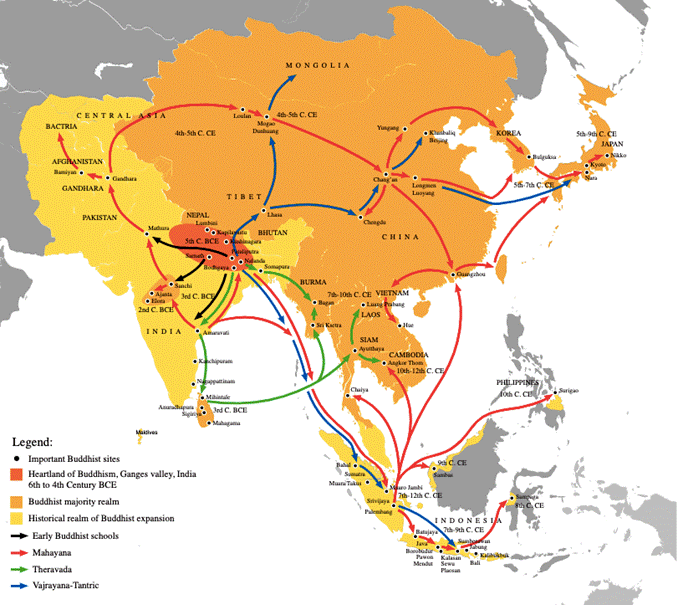
- Monasteries (viharas) along trade routes
- Diplomatic-cum-religious outreach to:
- Central Asia
- Sri Lanka
- Southeast Asia
Jainism
- Patronage from:
- Chandragupta Maurya
- Kharavela
- Later regional rulers
- Limitations:
- Patronage remained regional
- No organised missionary state support
Empire-backed Buddhism vs regionally-supported Jainism
Approach
Buddhism
- Actively proselytising
- Monks:
- Travelled widely
- Interacted with local cultures
- Adapted practices without diluting core tenets
- Monastic code (Vinaya) allowed:
- Flexibility in food
- Cultural accommodation
Jainism
- Non-proselytising
- Jain monks:
- Travel on foot only
- Avoid interaction with other belief systems
- Strong inward focus → community preservation, not expansion
Outreach vs inward preservation
Social Accessibility
Buddhism
- Simple ethical code
- Use of local languages (Pali, Prakrit)
- Open to:
- Women (bhikkhunis)
- Lower social groups
- Compatible with urbanisation & trade networks
Jainism
- Highly demanding ascetic ideals
- Monastic life difficult to replicate outside Indian socio-cultural context
- Better suited to:
- Mercantile communities
- Urban elites within India
Historical Turning Point (~1200 CE)
Buddhism in India
- Decline due to:
- Loss of royal patronage
- Revival of Brahmanism
- Turkish invasions (monastic destruction)
- But: Buddhism already global → survived abroad
Jainism in India
- Continued to flourish within India
- Strong community institutions
- No equivalent global footprint
Geographical diversification ensured Buddhism’s survival
Ethical Philosophy & Global Reception
Buddhism
- Universal ethics:
- Compassion
- Moderation
- Mindfulness
- Easily integrated with foreign belief systems
Jainism
- Anekantavada promotes tolerance
- But doctrinal position:
- Truth is multi-faceted
- No need to convert others
- Mahavira’s teaching (Sutrakritanga):
- Respect other ideologies, do not impose
Ethical universalism vs ethical exclusivity
Summary
| Dimension | Buddhism | Jainism |
| Asceticism | Moderate | Extreme |
| Patronage | Imperial | Regional |
| Missionary zeal | Strong | Absent |
| Cultural adaptability | High | Low |
| Global spread | Extensive | Limited |
| Survival outside India | Yes | No |


