
Core Issue
- India has reiterated its sovereignty claim over Shaksgam Valley, after China referred to infrastructure activity in the region.
- The issue revives debates around the 1963 China–Pakistan Boundary Agreement, legality of territorial cession, and implications for India’s territorial integrity.
Relevance
- GS I (Geography)
- Strategic location: Karakoram, Siachen region
- GS II (International Relations)
- Sovereignty, boundary agreements, international law
- India–China–Pakistan relations
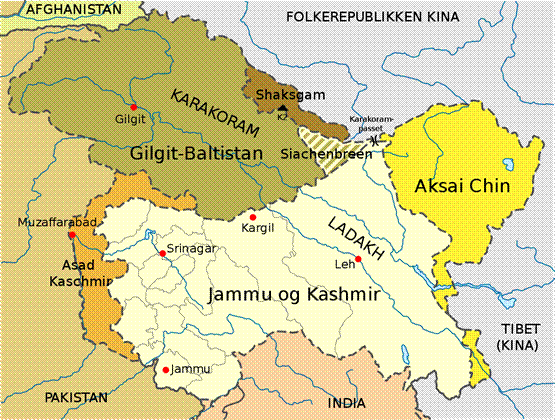
Location & Geography
- Shaksgam Valley (Trans-Karakoram Tract):
- Lies north of the Shaksgam River, north of the Siachen Glacier.
- Part of the larger Ladakh region of J&K claimed by India.
- Area: ~5,000 sq km.
- Strategically located between Xinjiang (China) and PoK (Pakistan-occupied Kashmir).
Historical Background
- Pre-1963:
- Region historically linked to Jammu & Kashmir; never legally ceded by India.
- China began asserting control post-1962 India–China war.
- 1963 Boundary Agreement:
- Signed between China and Pakistan.
- Pakistan illegally ceded ~5,180 sq km of Indian-claimed territory to China.
- India not a party → Agreement void ab initio under international law (no third-party territorial transfer).
India’s Official Position
- Reiterated by Ministry of External Affairs:
- Shaksgam Valley is Indian territory.
- 1963 agreement has no legal validity.
- China’s presence is based on illegal occupation facilitated by Pakistan.
- Consistent stance since 1960s, including Parliamentary statements by Jawaharlal Nehru.
China’s Position
- Claims Shaksgam based on 1963 agreement with Pakistan.
- Built infrastructure linking Xinjiang–Tibet through the area.
- Treats region as settled boundary, despite India’s objections.
Pakistan’s Role
- Pakistan lacks locus standi to cede territory of J&K (disputed under UNSC resolutions).
- Pattern of territorial concessions to China for strategic & economic support.
- Weakens its own Kashmir position internationally.
Strategic & Security Dimension
- Shaksgam Valley forms a critical Sino-Pak strategic link.
- Enhances China–Pakistan military coordination near Siachen–Ladakh sector.
- Raises concerns for India’s northern front security.
CPEC Angle
- Region’s proximity to China–Pakistan Economic Corridor:
- Alternative routes connecting Xinjiang to Gwadar.
- Part of China’s strategy to reduce dependence on Malacca Strait.
- India’s objection:
- CPEC passes through Indian-claimed PoK → violation of sovereignty.
International Law Perspective
- Principle violated: Nemo dat quod non habet (no one can give what they don’t own).
- Boundary agreements involving disputed territories lack legitimacy without consent of all claimants.
- Reinforces India’s argument against third-party legitimisation of PoK.
Political & Diplomatic Dimension
- India maintained claims despite pressures during Cold War era, including from John F. Kennedy to compromise on Kashmir talks.
- Demonstrates continuity in India’s territorial claims irrespective of regime or global alignments.
Implications for India
- Territorial Integrity: Sets precedent against legitimising illegal occupations.
- India–China Relations: Adds another layer to boundary disputes (LAC, Aksai Chin).
- India–Pakistan Relations: Highlights Pakistan’s inconsistent Kashmir stance.
- Strategic Autonomy: Reinforces India’s refusal to accept faits accomplis.
Challenges
- De facto Chinese control since 1960s → difficult on-ground reversal.
- Growing China–Pakistan strategic convergence.
- Limited international awareness of Shaksgam issue compared to Aksai Chin.
Way Forward
- Persistent diplomatic articulation of India’s legal position.
- Integrate Shaksgam issue within broader boundary negotiations with China.
- Highlight illegality of 1963 agreement in international forums.
- Strengthen infrastructure & security posture in eastern Ladakh.
- Strategic communication distinguishing PoK, Aksai Chin, Shaksgam in public discourse.


