
Why in News ?
- 230 fish species recorded in the Ganga River, the highest in ~50 years.
- Over 3,000 gharials documented across the Ganges basin.
- Findings from nationwide scientific assessments led by ICAR institutes and wildlife agencies.
Relevance
- GS III – Environment & Ecology
- River ecology, freshwater biodiversity, flagship species conservation.
- Outcomes of Namami Gange; e-flow norms.
- GS II – Governance
- Basin-level, inter-State coordination.
Fish Diversity (Freshwater Biodiversity)
- Survey agency: ICAR-CIFRI.
- Coverage:
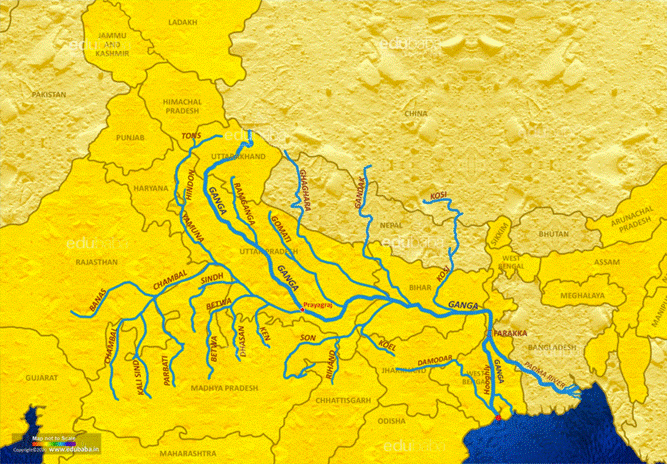
- 2,525 km of the Ganga mainstem.
- 67 tributaries + 6 floodplain wetlands.
- Trend:
- 1822: 271 species
- 1974: 150 species
- 2004: 104 species
- 2023: 230 species (strong recovery signal).
- High-diversity sites:
- Farakka (109 spp.)
- Buxar (85)
- Baharampore (76)
- Low-diversity sites:
- Diamond Harbour (38)
- Gadkhali (32)
Gharial Status (Flagship Indicator Species)
- Assessment led by Wildlife Institute of India with partners.
- Basin-wide count: >3,000 gharials.
- Strongholds:
- Chambal River (≈2,097 individuals).
- Other rivers (Gandak, Ghaghara, Son, Ganga):
- Much lower encounter rates (~0.02 per km surveyed).
- Context:
- Gharial = Critically Endangered; recovery indicates improved riverine conditions in select stretches.
What Explains the Recovery?
Governance & Policy Drivers
- Namami Gange Mission:
- Improved sewage treatment capacity.
- Reduced industrial effluents.
- River habitat interventions:
- Wetland restoration.
- Environmental flow (e-flow) norms.
- Fisheries management:
- Ranching & restocking by ICAR-CIFRI (e.g., ~47 lakh fish juveniles released since 2010; ~6,031 tagged).
Environmental Significance
- Fish diversity = proxy for:
- Water quality
- Habitat connectivity
- Flow regimes.
- Gharials = apex, flow-dependent species:
- Require deep, sandy banks and clean water.
- Signals partial success of river rejuvenation, though spatially uneven.
Governance & Federal Dimensions
- Multi-agency coordination:
- ICAR, State fisheries departments, SPCBs, wildlife agencies.
- River basin approach:
- Tributaries and wetlands critical—not just the main river.
- Need for inter-State coordination across the Ganga basin.
Economic & Livelihood Angle
- Inland fisheries:
- Support nutrition and livelihoods.
- Biodiversity recovery can raise sustainable yields.
- Eco-tourism potential:
- Gharial and dolphin habitats (with safeguards).
Challenges
- Spatial disparity:
- Recovery concentrated in few stretches; delta & lower reaches lag.
- Anthropogenic pressures persist:
- Sand mining, barrages, fishing bycatch.
- Flow fragmentation:
- Dams/barrages affect migratory species and gharials.
- Data continuity:
- Need for long-term, standardised monitoring.
Way Forward
- Scale basin-wide habitat restoration (tributaries + floodplains).
- Strengthen e-flow enforcement and fish passages at barrages.
- Expand community-based fisheries management.
- Protect gharial nesting sites; reduce bycatch with gear modifications.
- Integrate biodiversity metrics into Namami Gange performance dashboards.
Prelims Pointers
- Highest fish species count in Ganga in ~50 years: 230.
- Apex research body for inland fisheries: ICAR-CIFRI.
- Gharial status: Critically Endangered.
- Gharial stronghold: Chambal River.
- Fish diversity hotspots vary significantly along the river.


