
Why in News ?
- INS Kaudinya successfully completed a historic voyage to Muscat (Oman).
- The journey recreated ancient Indian Ocean trade routes using a hand-stitched wooden ship, based on traditional shipbuilding techniques.
- The expedition commemorates India’s maritime heritage and civilisational links with West Asia, especially Oman.
Relevance
- GS II – International Relations
- Maritime diplomacy; India–Oman ties.
- Soft power; Indian Ocean Region engagement.
- GS III – Security
- Maritime awareness; SAGAR doctrine.
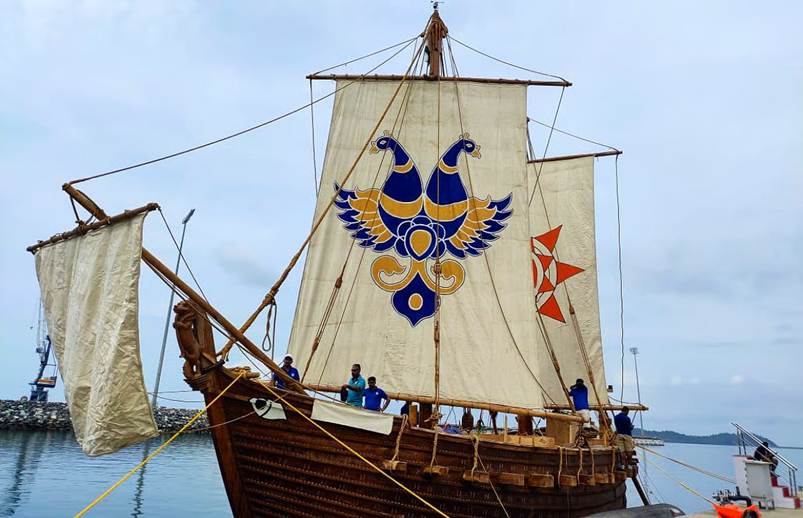
What is INS Kaudinya?
- A traditional hand-stitched wooden vessel, inspired by ancient Indian shipbuilding.
- Built without modern metal fastenings:
- Wooden planks stitched together using traditional methods.
- Operated as a seagoing vessel, not merely a ceremonial replica.
- Named after Kaudinya, an ancient Indian mariner associated with early Indian Ocean trade and cultural diffusion.
Historical & Civilisational Significance
Ancient Indian Ocean Trade
- India maintained robust maritime trade with:
- Oman
- Arabia
- East Africa
- Southeast Asia
- Traded goods included:
- Spices
- Textiles
- Beads
- Metalware
- Indian merchants and sailors were key carriers of:
- Commerce
- Culture
- Ideas
Muscat’s Importance
- Muscat was a critical node in:
- Indian Ocean trade networks.
- Reflects centuries-old India–Oman maritime linkages.
Strategic & Geopolitical Relevance
Maritime Diplomacy
- Voyage reinforces India’s soft power through civilisational diplomacy.
- Strengthens ties with:
- Oman
- West Asia
- Complements India’s:
- Indo-Pacific vision
- SAGAR doctrine (Security and Growth for All in the Region).
Cultural Diplomacy
- Demonstrates India as a historical maritime civilisation, not only a continental power.
- Aligns with:
- Vasudhaiva Kutumbakam
- People-to-people connect initiatives.
Technological & Knowledge Dimension
Indigenous Knowledge Systems
- Validates:
- Traditional shipbuilding
- Indigenous maritime engineering
- Shows:
- Ancient Indian ships were deep-sea capable, not limited to coastal navigation.
- Reinforces the importance of:
- Documenting and reviving traditional technologies.
Security & Naval Dimension
- Highlights:
- Indian Navy’s role beyond combat—heritage, diplomacy, outreach.
- Enhances:
- Maritime awareness
- Oceanic domain familiarity.
- Symbolically supports:
- India’s role as a net security provider in the Indian Ocean Region (IOR).
Cultural & Educational Value
- Encourages:
- Public interest in maritime history.
- Academic research on Indian Ocean studies.
- Counters narratives that:
- Underplay India’s seafaring past.
Challenges & Critiques
- Symbolic initiatives must be:
- Backed by academic research.
- Integrated into school curricula & museums.
- Risk of:
- Remaining a one-off event without sustained follow-up.
Way Forward
Coastal community engagement.
Institutionalise maritime heritage diplomacy through:
- Regular heritage voyages.
Joint research with IOR countries.
Integrate findings into:
- NCERT curricula.
Maritime museums & digital archives.
Link heritage initiatives with:
- Contemporary Indo-Pacific strategy.


