
Content
- NITI Aayog Report: “Achieving Efficiencies in MSME Sector through Convergence of Schemes”
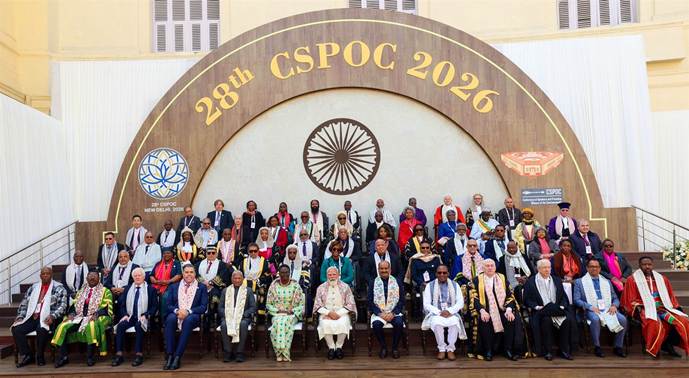
- 28th Conference of Speakers and Presiding Officers of the Commonwealth (CSPOC)
NITI Aayog Report: “Achieving Efficiencies in MSME Sector through Convergence of Schemes”
Why in News ?
- NITI Aayog released a comprehensive roadmap to streamline MSME schemes through convergence, improve outreach, and enhance outcomes.
- Launched by Dr. Arvind Virmani (Member) and B.V.R. Subrahmanyam (CEO), NITI Aayog.
Relevance
- GS II: Governance reforms, inter-ministerial coordination, service delivery, digital public infrastructure
- GS III: MSMEs, industrial policy, employment, innovation, skill development
Context & Problem Diagnosis
- Ministry of MSME administers 18 schemes across credit, skills, marketing, innovation, tech upgradation, infrastructure.
- Issues identified
- Overlapping objectives across ministries → duplication & inefficiencies
- Fragmented implementation → low last-mile outreach
- Multiple portals & compliances → high transaction costs for MSMEs
- Rationale: Convergence can improve input–output–outcome translation, reduce confusion, and enhance impact.
Strategic Framework for Convergence
1. Information Convergence
- Integrate government-generated data (Centre + States).
- Enable evidence-based policymaking, real-time monitoring, and governance coordination.
- Reduce asymmetry between scheme design and beneficiary needs.
2. Process Convergence
- Align / merge schemes with similar objectives & components.
- Unify workflows, common guidelines, and shared implementation platforms.
- Foster Centre–State–Ministry collaboration to create a cohesive MSME ecosystem.
Key Recommendations
A. Centralized Digital Portal for MSMEs
- AI-powered single-window platform integrating:
- Scheme discovery & application
- Compliance & approvals
- Finance, skilling, and market intelligence
- Features: AI chatbots, dashboards, mobile access, real-time support.
- Global best practices adapted to Indian DPI ecosystem.
B. Convergence of Cluster Development Schemes
- Merge SFURTI with MSE-CDP.
- Design
- Dedicated sub-scheme for traditional industries
- Unified governance under MSE-CDP
- Consolidated funding with earmarked resources
- Objective: Preserve crafts & endangered traditional industries while improving scale and efficiency.
C. Convergence of Skill Development Programmes
- Rationalise into a three-tier structure:
- Entrepreneurship & business skills
- MSME technical skills
- Rural & women artisan training
- Merge overlapping schemes; retain targeted inclusion-focused programmes.
- Improve coordination among training institutions.
D. Marketing Assistance Wing
- Establish a dedicated Marketing Wing:
- Domestic: National exhibitions, trade fairs, buyer–seller meets
- International: Overseas trade fairs, B2B events, global buyer linkage
- Aim: Structured, predictable market access for MSMEs.
E. Innovation & Incubation
- Integrate ASPIRE into MSME Innovative as a special category for agro-rural enterprises.
- Existing ASPIRE funds continue; future MSME Innovative budgets earmark a share.
- Broaden access to advanced incubation without excluding rural focus.
Schemes to Remain Independent
- PMEGP – scale, employment intensity
- PM Vishwakarma – craft-based livelihoods
- Targeted initiatives safeguarded:
- National SC/ST Hub
- Promotion of MSMEs in North Eastern Region (NER)
Governance & Administrative Angle
- Strengths
- Moves from scheme proliferation → outcome orientation
- Emphasises whole-of-government approach
- Challenges / Gaps
- Inter-ministerial turf issues
- Capacity constraints at district level
- Transition risks during scheme merger
- Mitigation
- Phased convergence
- Joint workshops & shared capacity-building
- Continuous outcome tracking
Economic & Social Impact
- Lower compliance costs → formalisation & productivity gains
- Better credit–skill–market linkage → employment generation
- Targeted safeguards ensure equity (SC/ST, women, NER, artisans)
Tech & Data Dimension
- AI-driven portal aligns with Digital Public Infrastructure (DPI) vision.
- Data integration enhances policy feedback loops and reduces leakages.
Way Forward
- Pilot convergence in select sectors/clusters before national rollout.
- Legally mandate inter-ministerial data sharing protocols.
- Outcome-linked budgeting & third-party evaluation.
- Align with SDGs 8 (Decent Work) and 9 (Industry, Innovation).
28th Conference of Speakers and Presiding Officers of the Commonwealth (CSPOC)
Why in News ?
- Narendra Modi inaugurated the 28th CSPOC at Samvidhan Sadan, New Delhi (15 Jan 2026).
- Lok Sabha Speaker Om Birla delivered the inaugural address, focusing on Ethical AI, Social Media Governance, Parliamentary Reforms, and Democratic Credibility.
Relevance
- GS II
- Parliamentary institutions, democratic governance
- Ethics in public institutions
- Role of technology in democracy
What is CSPOC ?
- Conference of Speakers and Presiding Officers of the Commonwealth
- Platform of Speakers & Presiding Officers of Commonwealth Parliaments.
- Participants:
- 53 national parliaments of sovereign states
- 14 semi-autonomous legislatures
- 28th edition:
- 61 Presiding Officers (45 Speakers, 16 Deputy Speakers)
- From 42 countries + 4 semi-autonomous parliaments
Key Themes & Takeaways
Artificial Intelligence & Democracy
- AI and digital tools:
- Enhance efficiency, transparency, accessibility of legislatures
- Enable paperless parliaments, real-time data & research support
- Risks highlighted:
- Misinformation
- Algorithmic bias
- Cybercrime
- Social polarisation
- Normative Position
- Need for Ethical AI:
- Human oversight
- Transparency
- Accountability
- Democratic control
- Need for Ethical AI:
Social Media & Parliamentary Credibility
- Social media:
- Strengthens citizen engagement
- Improves outreach of parliamentarians
- Challenges:
- Fake news
- Deepfakes
- Erosion of institutional trust
- Call for:
- Credible, transparent & accountable social media frameworks
- Balance between free speech & democratic integrity
Collective Responsibility of Legislatures
- Legislatures worldwide face common challenges:
- Declining public trust
- Disruptions inside parliaments
- Digital misinformation
- CSPOC seen as a forum for:
- Collective wisdom
- Shared solutions
- Exchange of best practices
India’s Parliamentary Experience
A. Digital & Institutional Reforms
- Increasing use of AI & digital platforms in:
- Parliament of India
- State Legislatures
- Movement towards:
- Paperless functioning
- Unified digital parliamentary platforms
B. Legislative Reforms
- Repeal of obsolete and redundant laws
- Enactment of:
- Welfare-oriented legislations
- Aspirational, people-centric laws
- Outcome:
- Faster progress towards Developed India (Viksit Bharat) and Atmanirbhar Bharat
C. Democratic Strengthening
- 70+ years of parliamentary democracy:
- Robust electoral system
- Inclusive participation
- Welfare-based policy orientation
- Result:
- Sustained public faith in democratic institutions
Global & Diplomatic Dimension
- India portrayed as:
- “Mother of Democracy”
- Source of direction, stability and inspiration
- Parliamentary diplomacy:
- Strengthens India’s soft power
- Reinforces democratic norms in Global South
Conference Agenda
- AI in Parliament: Innovation vs Oversight
- Social media & impact on parliamentarians
- Enhancing citizen participation beyond voting
- Security, health & wellbeing of MPs and staff
- Role of Presiding Officers in:
- Impartiality
- Fairness
- Institutional dignity
Institutional & Ethical Angle
Challenges / Gaps
- Absence of global standards on Ethical AI for legislatures
- Regulatory lag vs technological speed
- Social media misuse affecting parliamentary decorum
Governance Concerns
- Maintaining neutrality of Presiding Officers
- Ensuring parliamentary debates are not driven by digital outrage
Way Forward
- Develop Parliamentary AI Ethics Framework (India-led global initiative).
- Strengthen digital literacy of MPs & legislative staff.
- Institutionalise fact-checking & AI audit mechanisms within parliaments.
- Global cooperation via CSPOC, Inter-Parliamentary Union and Commonwealth Parliamentary Association.
- Citizen engagement models beyond elections:
- Digital consultations
- Parliamentary outreach programmes
Prelims Pointers
- CSPOC ≠ IPU (different parliamentary forums).
- CSPOC includes semi-autonomous legislatures.
- 28th CSPOC hosted by Parliament of India.
- Key focus areas: AI, Social Media, Parliamentary Ethics.


