
Content
- One Station One Product (OSOP): Celebrating Regional Identity Through Indian Railways
- India–AI Impact Summit 2026: Welfare for All, Happiness of All
One Station One Product (OSOP): Celebrating Regional Identity Through Indian Railways
Background
- One Station One Product (OSOP) is an Indian Railways initiative launched in 2022 to promote indigenous products by integrating local craftsmanship with the national railway transport and market infrastructure.
- The scheme aligns with broader national priorities such as Vocal for Local and Atmanirbhar Bharat, using public infrastructure to enable decentralised, market-led, inclusive economic development.
Relevance
- GS I (Culture & Society): Preserves and promotes regional crafts, indigenous food traditions, and living cultural heritage through everyday public spaces like railway stations.
- GS II (Governance & Social Justice): Illustrates innovative, inclusive governance by using public infrastructure for livelihood creation and empowering women-led SHGs and marginal artisans.
- GS III (Economy & Infrastructure): Strengthens MSMEs and non-farm rural employment through infrastructure-led, market-based local economic development.
Current Status and Scale
Coverage and Physical Outreach
- As of 19 January 2026, OSOP has been implemented across 2,002 railway stations, with 2,326 dedicated outlets operating within station premises across diverse geographical and cultural regions.
Beneficiary Reach
- Since its launch in 2022, OSOP has generated direct livelihood opportunities for more than 1.32 lakh artisans, weavers, self-help groups, and small producers nationwide.
Objectives of the OSOP Scheme
Economic Objectives
- OSOP aims to provide assured, high-footfall market access to local producers, reducing dependency on intermediaries and improving income realisation for informal and micro-enterprises.
Social Objectives
- The initiative promotes inclusive growth by integrating women-led SHGs, rural artisans, and marginal producers into formal market spaces traditionally inaccessible to them.
Cultural Objectives
- OSOP seeks to preserve and revitalise traditional crafts, indigenous food items, and regional specialities that were facing declining demand due to industrial standardisation.
Key Features of the Scheme
Station–Product Mapping
- Each railway station is mapped to a unique local product representing regional identity, including handlooms, handicrafts, GI-tagged goods, agro-products, spices, and traditional sweets.
Implementation Mechanism
- Implementation is decentralised through railway divisions in coordination with state governments, MSME departments, KVIC, cooperatives, and local self-help group networks.
Economic Significance
Livelihood Generation
- OSOP creates stable non-farm employment opportunities, particularly in rural and semi-urban areas, contributing to income diversification and resilience against agricultural income volatility.
MSME and Local Economy Strengthening
- The scheme strengthens local value chains by encouraging micro-producers to scale production, improve quality, and gradually integrate into formal MSME and regional supply ecosystems.
Social and Cultural Impact
Revival of Traditional Crafts
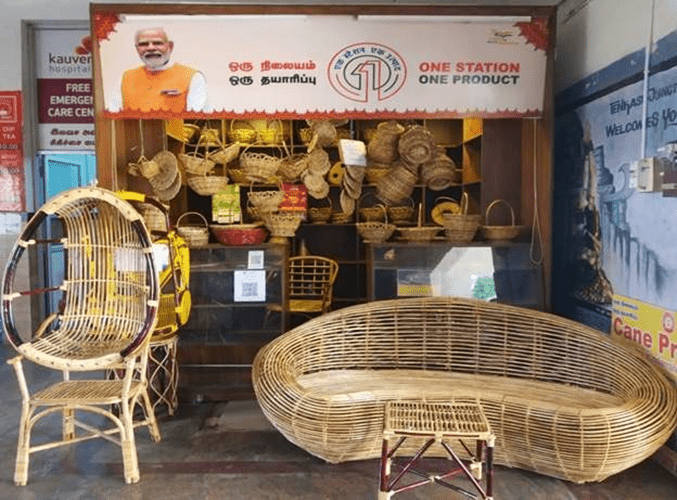
- OSOP has enabled revival of region-specific crafts such as bamboo and cane work in the Northeast, handlooms, pottery, indigenous foods, and artisanal household products.
Cultural Integration and Passenger Experience
- Railway stations function as cultural interfaces, exposing millions of passengers daily to India’s micro-cultural diversity and transforming transit spaces into experiential cultural marketplaces.
Gender and Community Empowerment
- Significant participation of women artisans and SHGs enhances economic agency, strengthens collective entrepreneurship, and reinforces dignity of labour in traditional and informal occupations.
Governance and Administrative Dimensions
Innovative Use of Public Infrastructure
- OSOP exemplifies governance innovation by repurposing existing railway infrastructure as economic platforms, maximising public asset utility without significant additional fiscal expenditure.
Cooperative Federalism
- Effective implementation reflects Centre–State convergence, with local administrations identifying products and beneficiaries while Indian Railways provides national-level logistical and market connectivity.
Alignment with Constitutional and Global Goals
Constitutional Values
- OSOP advances Article 38 and Article 39 objectives by promoting equitable livelihood opportunities, decentralised economic participation, and social justice through market-based empowerment.
Sustainable Development Goals
- The initiative contributes to SDG 8 on decent work, SDG 9 on inclusive industrialisation, and SDG 11 on sustainable, culturally resilient communities.
Challenges and Gaps
Operational and Quality Challenges
- Variations in product quality, packaging, branding, and pricing across stations reduce consumer trust and limit the ability of OSOP products to command premium market value.
Structural and Capacity Constraints
- Small artisans often face production scalability constraints, supply inconsistency, and raw material limitations, particularly during peak travel seasons and festive demand surges.
Digital and Market Integration Gaps
- Limited integration with digital platforms, e-commerce ecosystems, and national branding frameworks restricts OSOP’s long-term market expansion beyond physical station outlets.
Way Forward
Quality, Branding, and Certification
- Introducing GI tagging, standardised branding templates, and quality certification mechanisms can enhance credibility, price realisation, and national recognition of OSOP products.
Digital Expansion and Market Linkages
- Integrating OSOP with railway applications, ONDC, QR-based product catalogues, and digital payments can expand consumer reach beyond station footfall.
Capacity Building and Sustainability
- Collaboration with institutions like NIFT, NID, and KVIC can support design upgradation, packaging innovation, and sustainable cluster-based production planning.
India–AI Impact Summit 2026: Welfare for All, Happiness of All
Context
- Artificial Intelligence has emerged as a critical enabler of India’s development strategy, supporting inclusive growth, governance reform, and public service delivery aligned with the long-term vision of Viksit Bharat@2047.
- Building on a development-centric AI approach, India–AI Impact Summit 2026 positions AI as a public good, translating global AI discourse into practical outcomes relevant to developing and Global South economies.
Relevance
- GS II (Governance & International Relations): Positions India as a Global South leader in development-oriented, ethical AI governance and multilateral cooperation.
- GS III (Science, Technology & Economy): Accelerates productivity, innovation, and technological self-reliance through AI adoption across priority economic sectors.
Key Facts and Current Status
Summit Overview
- India–AI Impact Summit 2026 will be held from 16–20 February 2026 at Bharat Mandapam, New Delhi, making it the first global AI summit hosted in the Global South.
Scale and Participation
- The Summit includes policy dialogues, research forums, industry engagement, and public outreach, with over 400 exhibitors, seven thematic pavilions, and expected participation of 1.5 lakh visitors.
Foundational Vision of the Summit
Three Sutras (Guiding Principles)
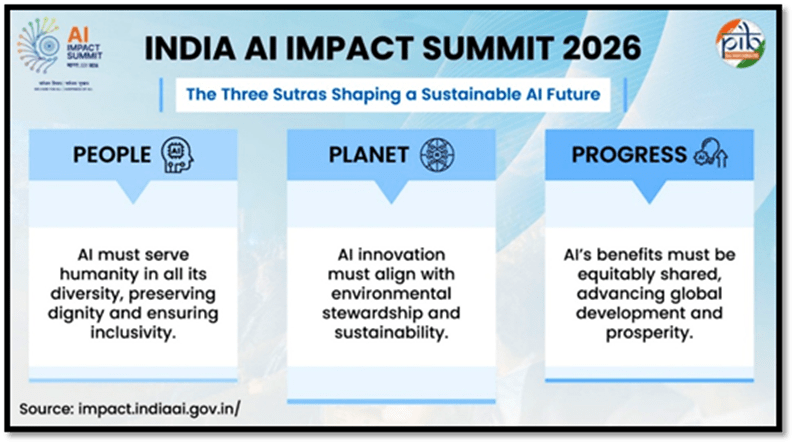
- The Summit is anchored on three foundational Sutras—People, Planet, and Progress—emphasising inclusive human development, environmental sustainability, and productivity-led economic and governance transformation through AI.
Development-Oriented AI Philosophy
- India’s approach focuses on people-centric and impact-oriented AI, prioritising real-world developmental outcomes over purely commercial or geopolitical competition-driven AI frameworks.
Significance of Artificial Intelligence for India
AI for People
- AI enhances citizen empowerment by expanding healthcare access, personalising education, strengthening financial security, and enabling multilingual digital inclusion across India’s diverse linguistic and cultural landscape.
AI for Planet
- AI enables sustainable practices through precision agriculture, crop prediction, climate monitoring, and resource optimisation, supporting environmentally responsible growth while addressing climate and ecological vulnerabilities.
AI for Progress
- AI strengthens governance efficiency through judicial translation, smart service delivery, mobility optimisation, and data-driven decision-making, improving everyday administrative outcomes for both rural and urban citizens.
Sectoral Applications of AI
AI in Healthcare
- AI improves healthcare outcomes through remote diagnostics, telemedicine, medical image analysis, disease outbreak prediction, and affordable drug discovery, particularly benefiting rural and underserved populations.
AI in Agriculture and Rural Economy
- AI-driven advisories on weather, pests, irrigation, and pricing empower farmers, while drones, satellite imagery, and tools like Kisan E-Mitra enhance productivity and income resilience.
AI in Education and Learning
- AI enables personalised and inclusive education through adaptive learning platforms, real-time feedback, multilingual content delivery, and initiatives like DIKSHA, bridging access gaps across regions.
AI in Finance and Commerce
- AI strengthens financial inclusion through fraud detection, alternative credit scoring for unbanked populations, banking chatbots, and personalised financial products enhancing trust in digital transactions.
AI in Governance and Public Services
- AI improves governance transparency and efficiency by supporting judicial translations, smart city management, faster scheme processing, and data-driven public service delivery mechanisms.
Global Collaboration Framework: Sutras and Chakras
Seven Chakras of Multilateral Cooperation
- Summit deliberations are structured around seven Chakras, representing priority domains for international cooperation to deliver inclusive, sustainable, and development-oriented AI outcomes.
Human Capital
- Focuses on equitable AI skilling and reskilling ecosystems, strengthening workforce readiness for AI-led economic transitions aligned with India’s demographic and development priorities.
Inclusion for Social Empowerment
- Emphasises scalable AI solutions for last-mile service delivery, enabling inclusive participation of marginalised communities in digital and governance ecosystems.
Safe and Trusted AI
- Seeks to operationalise global responsible AI principles into interoperable governance frameworks, strengthening public trust while enabling innovation-friendly regulatory environments.
Resilience, Innovation, and Efficiency
- Addresses environmental and resource challenges of large-scale AI systems, promoting sustainable AI adoption and preventing widening of global and domestic AI divides.
Science
- Focuses on accelerating scientific discovery through AI while addressing inequities in access to data, compute, and research capacity across countries.
Democratising AI Resources
- Envisions equitable access to AI compute, datasets, and foundational tools for startups, researchers, and public institutions, enabling fair participation in global AI value chains.
AI for Economic Growth and Social Good
- Highlights high-impact AI use cases that simultaneously drive economic productivity and address societal challenges, positioning AI as a dual engine of growth and welfare.
AI Impact Events at the Summit
Pre-Summit and Regional Engagements
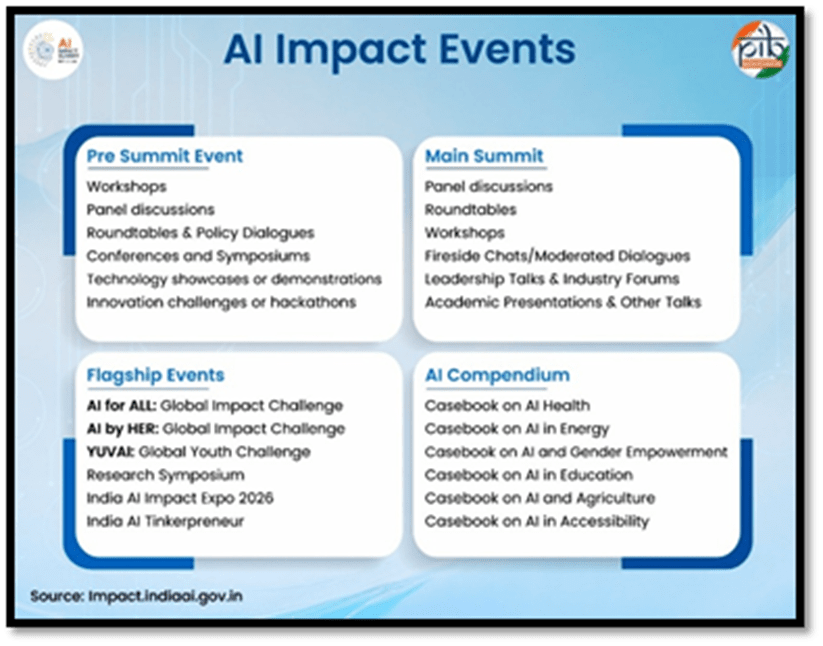
- Pre-Summit consultations and eight Regional AI Conferences across Indian states identify region-specific AI use cases, capacity gaps, and policy inputs informing Summit outcomes.
Main Summit and Knowledge Outputs
- Main Summit sessions across seven Chakras examine global use cases, policy experiences, and development strategies, supported by over 700 international proposals received.
AI Compendium
- The AI Compendium, released on 17 February 2026, documents real-world AI applications across priority sectors, serving as a long-term reference for practitioners and policymakers.
Flagship Initiatives and Challenges
AI for ALL: Global Impact Challenge
- Identifies scalable AI solutions with large public impact, implemented with Startup India and Bhashini, offering awards up to ₹2.5 crore.
AI by HER: Global Impact Challenge
- Promotes women-led AI innovation through NITI Aayog’s Women Entrepreneurship Platform, supporting solutions addressing large-scale public challenges with awards up to ₹2.5 crore.
YUVAi: Global Youth Challenge
- Encourages youth aged 13–21 to develop AI solutions for real-world problems, implemented with MyBharat and NIELIT, with prizes worth ₹85 lakh.
Institutional Framework Supporting the Summit
Ministry of Electronics and Information Technology (MeitY)
- MeitY provides overall policy direction, inter-ministerial coordination, and integration of Summit outcomes with national digital governance and AI regulatory frameworks.
IndiaAI Mission
- IndiaAI Mission shapes Summit themes on compute infrastructure, datasets, indigenous models, skilling, and startups, advancing safe, inclusive, and trusted AI adoption.
Software Technology Parks of India (STPI)
- STPI supports startups and MSMEs through incubation, infrastructure, and global linkages, enabling broad-based participation and strengthening India’s AI-driven digital economy.
Digital India Initiative
- Digital India provides the foundational platform for large-scale AI adoption, ensuring alignment with citizen-centric governance, accessibility, transparency, and trusted digital public infrastructure.
Expected Outcomes of the Summit
- The Summit is expected to strengthen AI governance frameworks, assess regional preparedness, promote workforce transition, and foster sustained partnerships across government, academia, startups, and industry.


