
Content
- India–EU Free Trade Agreement (FTA)
- International Data Privacy Day (28 January)
India–EU Free Trade Agreement (FTA)
Why in News ?
- Concluded at the 16th India–EU Summit on 27 January 2026, the FTA marks culmination of negotiations relaunched in 2022, reflecting strong political commitment to rules-based trade.
- Announced jointly by Prime Minister Narendra Modi and European Commission President Ursula von der Leyen, signalling elevation of India–EU relations from transactional trade to strategic economic partnership.
Relevance
- GS 2 (International Relations):
Deepening India–EU strategic partnership, trade diplomacy, mobility of professionals, and institutional cooperation with a major global bloc in a multipolar and rules-based international order. - GS 3 (Economy, Agriculture, Environment, S&T):
Export competitiveness, value-chain integration, Make in India, agricultural market access, CBAM-linked climate trade norms, and cooperation in clean tech, AI, semiconductors, and digital trade.
Strategic Significance of India–EU FTA
Global Economic Weight
- India, the world’s 4th largest economy, and the EU, the 2nd largest, together account for nearly 25% of global GDP and about one-third of global trade.
- Integration of two large, diverse, and complementary economies enhances supply-chain resilience, reduces overdependence on single geographies, and strengthens multipolar global trade architecture.
Trusted Partnership Narrative
- The FTA positions India and the EU as trusted partners committed to openness, predictability, sustainability, and inclusive growth amid rising protectionism and geopolitical fragmentation.
Trade and Investment Impact
Goods Trade Expansion
- In 2024–25, India–EU goods trade stood at INR 11.5 lakh crore, with Indian exports of INR 6.41 lakh crore poised for accelerated growth under preferential market access.
- Over 99% of Indian exports by trade value receive preferential entry into the EU, representing India’s deepest goods market access commitment in any FTA to date.
Labour-Intensive Sectors Boost
- Nearly USD 33 billion exports from textiles, apparel, leather, marine products, gems and jewellery will see EU tariffs up to 10% eliminated on entry into force.
- Enhanced competitiveness directly benefits MSMEs, women workers, artisans, and informal-sector employment, aligning trade liberalisation with inclusive growth and social equity objectives.
Sector-Specific Provisions
Agriculture and Processed Foods
- Tea, coffee, spices, fruits, vegetables, and processed foods gain favourable access, improving farmer incomes, rural value chains, and India’s credibility as a reliable agri-exporter.
- Sensitive sectors such as dairy, cereals, poultry, soymeal, and select fruits remain fully protected, balancing export promotion with food security and livelihood concerns.
Automobiles and Manufacturing
- Carefully calibrated, quota-based auto liberalisation allows EU manufacturers limited access while preserving domestic industry space and reinforcing Make in India manufacturing ecosystems.
- Reciprocal EU market access opens long-term export opportunities for India-made automobiles, auto components, and engineering goods within European value chains.
Services, Mobility, and Human Capital
Services Market Access
- EU grants predictable access across 144 subsectors, including IT/ITeS, professional services, education, and R&D, strengthening India’s position as a global services powerhouse.
- India’s commitments in 102 EU-priority subsectors facilitate technology inflows, investment, and high-value services integration without compromising domestic regulatory autonomy.
Mobility Framework
- The FTA establishes a facilitative framework for business visitors, intra-corporate transferees, contractual service suppliers, and independent professionals across 37 and 17 subsectors respectively.
- Provisions include entry and work rights for dependents, student mobility frameworks, post-study opportunities, and pathways towards future social security agreements.
Sustainability, Technology, and Regulations
CBAM and Climate Cooperation
- Forward-looking CBAM provisions secure MFN assurances, technical cooperation on carbon pricing, recognition of verifiers, and financial support to help Indian exporters meet climate norms.
- Constructive engagement mitigates risks of green protectionism while aligning trade expansion with India’s climate commitments and low-carbon industrial transition.
Digital, IPR, and Emerging Technologies
- The FTA reinforces TRIPS-consistent IPR protection, affirms the Doha Declaration, and recognises India’s Traditional Knowledge Digital Library, preventing biopiracy and misappropriation.
- Cooperation in artificial intelligence, clean technologies, semiconductors, and digital trade supports India’s innovation ecosystem and long-term technological self-reliance.
Governance and Institutional Design
- Provisions cover customs facilitation, SPS and TBT disciplines, SME cooperation, digital trade, and regulatory transparency, reducing non-tariff barriers that often constrain Indian exporters.
- Embedded review, consultation, and response mechanisms ensure adaptability to evolving technologies, regulatory complexities, and future economic shocks.
Challenges and Criticisms
- Compliance with stringent EU standards on environment, labour, and data may strain MSMEs without adequate domestic capacity-building and financial support mechanisms.
- CBAM-related reporting and verification costs could initially disadvantage carbon-intensive Indian exports despite cooperation assurances.
Way Forward
- Strengthen MSME readiness through standards infrastructure, skilling, digital compliance tools, and export finance aligned with FTA opportunities.
- Leverage the FTA to integrate deeper into EU value chains, attract quality investment, and advance India’s Viksit Bharat 2047 vision through trade-led growth.
International Data Privacy Day (28 January)
Why in News ?
- International Data Privacy Day, observed on 28 January, commemorates Convention 108 (2006) and reinforces India’s commitment to citizen-centric, secure, and accountable digital governance.
- PIB Delhi highlighted India’s evolving data protection framework, anchored in the DPDP Act, 2023 and DPDP Rules, 2025, alongside enhanced cybersecurity investments in Budget 2025–26.
Relevance
- GS 2 (Polity & Governance):
Operationalisation of the Right to Privacy through the DPDP Act, 2023 and DPDP Rules, 2025, strengthening citizen rights, institutional accountability, and digital governance trust.
Significance of Data Privacy in Digital Governance
Democratic and Governance Imperative
- Data privacy safeguards individual autonomy, informational self-determination, and dignity, transforming privacy from a technical issue into a core democratic and constitutional governance principle.
- Robust privacy frameworks enhance trust in government-led digital platforms, ensuring legitimacy, accountability, and sustained citizen participation in large-scale digital public service delivery.
Enabler of Responsible Innovation
- Strong data protection regimes allow ethical, secure, and lawful data use, enabling innovation while preventing misuse, profiling harms, surveillance excesses, and systemic cyber vulnerabilities.
India’s Expanding Digital Footprint
Scale of Digital Public Infrastructure (DPI)
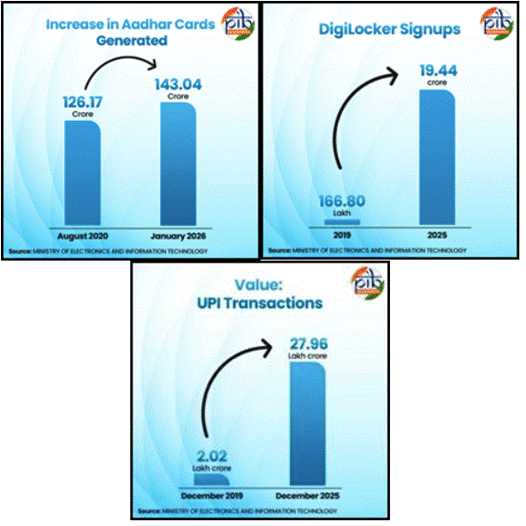
- India’s DPI, including Aadhaar, UPI, DigiLocker, MyGov, and eSanjeevani, operates at population scale, making data a critical public resource requiring strong privacy-by-design safeguards.
- MyGov hosts over 6 crore users, while eSanjeevani has delivered more than 44 crore telemedicine consultations, underscoring inclusion alongside heightened data protection responsibilities.
Connectivity and Digital Inclusion
- India is the world’s 3rd-largest digitalised economy, supported by over 101.7 crore broadband subscribers and ultra-low mobile data costs of around USD 0.10 per GB.
- Citizens spend nearly 1,000 minutes online on average, embedding digital platforms into identity, payments, healthcare, education, and grievance redressal, amplifying privacy and cybersecurity risks.
Privacy and Cybersecurity Imperative
- Exponential growth in digital interactions has increased volumes of sensitive personal data, intensifying exposure to cyber frauds, breaches, identity theft, and data misuse.
- Recognising these risks, Budget 2025–26 allocated ₹782 crore for cybersecurity projects to safeguard digital public infrastructure and national cyber resilience.
Legal and Institutional Framework for Data Protection
Information Technology Act, 2000
- The IT Act provides the foundational legal framework for e-governance, electronic records, digital signatures, and cybersecurity, enabling secure digital transactions and online public services.
- Key provisions and institutions like CERT-In, adjudicatory bodies, and Sections 69A and 70B support content regulation, national security, and cyber incident response mechanisms.
IT Intermediary Guidelines Rules, 2021
- The Rules mandate due diligence, time-bound grievance redressal, and accountability for intermediaries, including social media platforms, marketplaces, search engines, and telecom service providers.
- By defining intermediary obligations, the Rules aim to create a safer, transparent, and trusted online environment without stifling innovation or free expression.
Digital Personal Data Protection (DPDP) Act, 2023
Core Philosophy and Scope
- Enacted in August 2023, the DPDP Act governs digital personal data processing, including digitised offline data, balancing privacy protection with innovation, service delivery, and economic growth.
- The Act follows a SARAL approach—Simple, Accessible, Rational, Actionable—ensuring clarity, ease of compliance, and practical enforceability for citizens and organisations.
Institutional Architecture
- The Data Protection Board of India oversees compliance, investigates breaches, and enforces corrective actions, strengthening institutional accountability and public trust in digital governance.
- Citizens are recognised as Data Principals, while entities determining data use are designated Data Fiduciaries, clearly defining rights, duties, and liability structures.
Rights of Citizens under DPDP Act
- Citizens have rights to give or refuse consent, access information, correct, update, and erase personal data, ensuring meaningful control over personal digital footprints.
- Mandatory breach intimation, grievance redressal within ninety days, and nomination rights enhance transparency, accountability, and continuity of data rights.
- Special protections exist for children and persons with disabilities, requiring verifiable guardian consent except for essential services like healthcare, education, and real-time safety.
DPDP Rules, 2025
- Notified in November 2025, the Rules operationalise the Act by detailing compliance mechanisms, citizen interfaces, fiduciary obligations, and enforcement procedures.
- Together, the Act and Rules establish a clear, balanced, and future-ready data governance regime that protects privacy while enabling responsible innovation and digital growth.
Additional National Cybersecurity Measures
Institutional Coordination
- CERT-In functions as the national nodal agency for cyber incident prevention and response, proactively securing India’s communications and information infrastructure.
- The Indian Cyber Crime Coordination Centre (I4C) enables national-level prevention, detection, and investigation of cybercrime, especially crimes against women and children.
Citizen-Centric Protection Systems
- Platforms like the National Cyber Crime Reporting Portal and helpline 1930 enable rapid reporting of cyber frauds, safeguarding personal and financial data at scale.
- The Cyber Fraud Mitigation Centre enables real-time coordination among banks, telecom providers, and law enforcement to block compromised accounts and digital identifiers.
Capacity Building and Awareness
- Initiatives like CyTrain, Cyber Commando Programme, ISEA, CSPAI, and Cyber Swachhta Kendra strengthen skilled manpower, AI security readiness, and citizen cyber hygiene.
Challenges and Gaps
- Ensuring compliance readiness among MSMEs and small digital platforms remains challenging due to costs, technical capacity constraints, and evolving regulatory expectations.
- Rapid technological change in AI, big data, and cross-border data flows demands continuous regulatory adaptation without undermining innovation or ease of doing digital business.
Way Forward
- Embed privacy-by-design across all digital public platforms, strengthen regulatory capacity, and enhance coordination between data protection and cybersecurity institutions.
- Expand citizen awareness, invest in indigenous cybersecurity technologies, and align India’s data governance with global best practices while preserving digital sovereignty.


