
Why in News ?
- Urban India’s rising solid waste burden, landfill crises, and policy push under Solid Waste Management Rules 2016 (amended) have renewed focus on Waste-to-Energy (WtE) as a waste-processing and energy-recovery solution.
Relevance
GS-3 – Environment / Ecology
- Solid waste management
- Pollution control
- Circular economy
- Renewable energy debates
GS-2 – Governance (Local Bodies)
- Urban Local Bodies’ role
- Environmental regulation
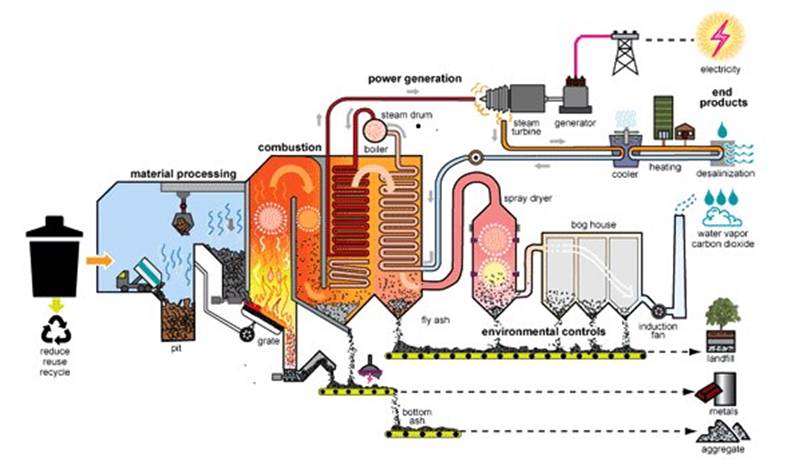
Waste-to-Energy – Basics
Definition
- Waste-to-Energy (WtE) converts non-recyclable solid waste into usable energy—electricity, heat, or fuel through thermal, chemical, or biological processes, reducing landfill volumes while recovering embedded energy from waste streams.
Major Technologies
- Incineration burns waste at high temperatures for steam-electricity generation; gasification/pyrolysis convert waste into syngas with limited oxygen; anaerobic digestion uses microbes to produce biogas from organic waste.
Policy & Regulatory Framework
Solid Waste Management Rules
- SWM Rules 2016 mandate source segregation, scientific processing, and RDF promotion, positioning WtE as a residual-waste treatment option after recycling and composting to reduce landfill dependency.
Institutional Ecosystem
- MoHUA, CPCB, State Pollution Control Boards, ULBs regulate and monitor WtE plants, setting emission norms, environmental clearances, and compliance standards for air pollutants and ash disposal.
Rationale for WtE Push
Urbanisation & Waste Surge
- India generates ~1.5–1.7 lakh tonnes of MSW daily, projected to rise with urbanisation and consumption; WtE offers volume reduction and partial energy recovery from otherwise landfilled waste.
Land Scarcity
- Megacities face landfill saturation and land constraints; WtE can reduce waste volume up to ~80–90%, extending landfill life and easing urban land-use pressures.
Climate Link
- Diverting waste from dumpsites reduces methane emissions, a potent greenhouse gas; controlled combustion with safeguards can be climatically preferable to open dumping and burning.
Constitutional / Legal Dimension
- Supports Article 48A environmental protection and Article 21 right to clean environment, while invoking polluter pays and precautionary principles recognised in Indian environmental jurisprudence.
Governance / Administrative Dimension
- Effective WtE requires strict segregation at source, reliable feedstock quality, long-term municipal contracts, and credible monitoring capacity, often weak across Urban Local Bodies with fiscal and technical constraints.
Economic Dimension
- WtE plants are capital-intensive with high operating costs; financial viability depends on tipping fees, power tariffs, and assured waste supply agreements, raising concerns over long-term fiscal sustainability.
Environmental Dimension
- Poorly managed WtE emits dioxins, furans, particulate matter, heavy metals; safe operation demands advanced flue-gas treatment, continuous emission monitoring, and scientific ash disposal.
Social / Ethical Dimension
- Informal waste pickers risk livelihood loss if recyclable streams divert to incineration; inclusive policy must integrate them into segregation, recycling value chains, and formal waste management systems.
Technology Dimension
- Indian waste has high moisture and low calorific value due to organic content, reducing incineration efficiency; technological adaptation and better segregation are critical for optimal plant performance.
Data & Evidence
- India has 20+ WtE plants and over 100 biogas facilities operational; several plants historically faced shutdowns due to poor segregation, community opposition, and emission concerns.
- Studies show recycling often saves more energy and emissions than incineration, supporting the waste hierarchy prioritising reduce–reuse–recycle before recovery.
Challenges / Gaps
- Mixed waste collection undermines calorific value and raises pollution risks, making many WtE projects technologically and environmentally suboptimal.
- Community resistance arises from health concerns, siting issues, and trust deficits regarding emission compliance and monitoring transparency.
- Overemphasis on WtE may create perverse incentives to burn recyclables, discouraging circular-economy practices like composting and material recovery.
Way Forward
- Enforce strict source segregation and decentralised composting for wet waste, reserving WtE only for non-recyclable, high-calorific residual fractions consistent with waste-hierarchy principles.
- Strengthen real-time emission monitoring, public disclosure, and third-party audits to build trust and ensure environmental compliance.
- Integrate informal workers into formal systems through MRFs, cooperatives, and social security, ensuring just transition.
- Promote circular economy policies, EPR, and waste reduction to address root causes rather than relying solely on end-of-pipe solutions.
Data & Facts
- India generates ~55–60 million tonnes MSW annually, projected to double by 2030.
- ~70–75% waste remains unsegregated in many cities.
- Methane from landfills has 28x higher warming potential than CO₂ (IPCC).
- EU waste hierarchy prioritises: Reduce → Reuse → Recycle → Recover → Dispose.
- Sweden imports waste for energy due to advanced segregation and WtE systems.


