
Why in News ?
Recent Scientific Concern
- Recent field studies and satellite observations show accelerated thinning, grounding-line retreat, and ice-shelf fracturing, raising fears of irreversible instability and renewed focus on Antarctica’s contribution to future global sea-level rise.
Relevance
GS 1 (Geography) — Core
- Glaciers, cryosphere, sea-level rise
- Physical geography of Antarctica
- Climate–ocean interactions
GS 3 (Environment) — Core
- Climate change impacts
- Global warming and sea-level rise
- Coastal vulnerability and disaster risk
Basics & Core Keywords
What is a Glacier ?
- A glacier is a long-lasting mass of compressed snow and ice flowing under gravity, acting as a freshwater reservoir and climate indicator, sensitive to temperature, snowfall, and oceanic conditions.
What is Thwaites Glacier ?
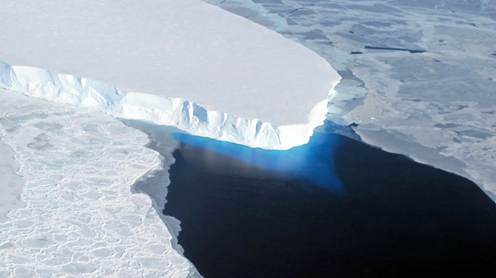
- Thwaites Glacier is a massive outlet glacier in West Antarctica draining into the Amundsen Sea, comparable in area to a large country, and critically important for global sea-level regulation.
Why “Doomsday Glacier” ?
- Nicknamed “Doomsday Glacier” because potential collapse could trigger substantial sea-level rise and destabilise neighbouring ice basins, amplifying global coastal risks far beyond Antarctica.
Physical Geography & Glaciology
Marine Ice Sheet Setting
- Thwaites rests on bedrock sloping downward inland below sea level, a configuration called marine ice-sheet instability, making retreat self-reinforcing once warm water reaches grounding zones.
Grounding Line
- The grounding line is where glacier ice detaches from bedrock and begins floating; its inland retreat indicates weakening structural stability and greater vulnerability to ocean-driven melting.
Ice Shelf Buttressing
- Thwaites’ floating ice shelf acts as a buttress, slowing inland ice flow; thinning or breakup reduces resistance, allowing faster glacier discharge into the ocean.
Climate & Ocean Interactions
Ocean-Driven Melting
- Relatively warm Circumpolar Deep Water intrudes beneath the ice shelf, melting it from below, thinning critical support structures and accelerating grounding-line retreat.
Atmospheric Warming
- Rising air temperatures influence surface melt and ice dynamics, though ocean heat currently plays the dominant role in destabilising West Antarctic outlet glaciers.
Data & Evidence
Current Contribution
- Thwaites alone contributes roughly 4% of present global sea-level rise, making it one of the single largest glacial contributors worldwide.
Potential Sea-Level Rise
- Complete collapse over centuries could raise global mean sea level by ~0.5 metre, while also destabilising adjacent West Antarctic ice, adding several additional metres over longer timescales.
Observed Changes
- Satellite records show rapid thinning, faster ice flow, and grounding-line retreat over recent decades, indicating ongoing dynamic imbalance rather than stable conditions.
Global Implications
Coastal Vulnerability
- Even modest sea-level rise increases coastal flooding, erosion, salinisation, and storm-surge damage, threatening megacities, ports, and delta regions globally.
Small Island States
- Low-lying island nations face existential risks, with higher adaptation costs, displacement pressures, and loss of freshwater lenses due to saltwater intrusion.
Economic Impact
- Sea-level rise raises costs for coastal infrastructure, insurance, disaster management, and climate adaptation, affecting both developed and developing economies.
Governance & Policy Dimension
Climate Mitigation Link
- Thwaites’ fate is strongly tied to global warming trajectories, making deep emissions cuts under Paris Agreement central to slowing long-term ice-sheet loss.
Scientific Cooperation
- International collaborations like large Antarctic research missions improve modelling, monitoring, and early-warning capacity for ice-sheet instability.
Challenges & Uncertainties
Timescale Uncertainty
- Exact timelines for major retreat remain uncertain, complicating policy planning, but risk-based approaches justify early adaptation and mitigation investments.
Complex Ice Dynamics
- Ice–ocean interactions, subglacial topography, and feedback loops create modelling challenges, requiring continuous observation and refinement.
Way Forward
Rapid Emission Reductions
- Limiting warming to well below 2°C reduces long-term Antarctic mass loss risks and associated sea-level rise.
Coastal Adaptation
- Strengthen coastal zoning, resilient infrastructure, mangrove restoration, and managed retreat strategies to reduce vulnerability.
Polar Research Investment
- Expand satellite monitoring, ocean sensors, and ice-penetrating radar to improve predictive capability.
Value Addition
- Antarctica stores ~70% of the world’s freshwater.
- Antarctic Ice Sheet holds enough ice to raise sea level by ~58 metres if fully melted.
- Global mean sea level already rose ~20 cm since 1900 (IPCC).
- Sea level is rising at ~3.3 mm/year currently, double the 20th-century rate.
- Mumbai, Kolkata, Chennai among top 20 global cities at coastal flood risk by 2050 (C40/World Bank studies).
- India has 7,500 km coastline, making it highly vulnerable.


