
Content
- Tamil Brahmi inscriptions discovered in Egypt shed light on ancient trade links
- India gets first ‘musical path’; Mumbai’s Coastal Road plays ‘Jai Ho’ for motorists
- Have States gained from the 16th Finance Commission?
- Vande Mataram to be played before National Anthem: govt
- There are 765 dolphins of six species along Odisha’s coast, latest census reveals
- Nature’s renewal has slowed down despite rising temperatures: Study
Tamil Brahmi inscriptions discovered in Egypt shed light on ancient trade links
Source : The Hindu
Why in News?
2024–25 Discovery in Egypt
- Researchers identified ~30 Indian inscriptions (Tamil Brahmi, Prakrit, Sanskrit) in Valley of the Kings tombs, dated 1st–3rd century CE, indicating direct Indian presence in elite Egyptian funerary spaces.
- Study by Charlotte Schmid (EFEO, Paris) and Ingo Strauch (Lausanne) documented inscriptions across six Theban Necropolis tombs, expanding evidence beyond Red Sea ports into the Nile valley.
Relevance
GS I — History & Culture
- Ancient Indian maritime trade, Indo–Roman trade, Sangam age economy, early globalisation
- Cultural diffusion, epigraphy, Indian Ocean trade networks
- Correlation between literature (Sangam) and archaeology
Practice Question
- “Recent discoveries of Tamil Brahmi inscriptions in Egypt reframe our understanding of ancient Indian trade networks.” Discuss how archaeological evidence complements literary sources in reconstructing India’s early maritime history. (250 Words)
Historical Context
Tamil Brahmi Script
- Tamil Brahmi (c. 3rd century BCE onward) is earliest Tamil writing system, used in trade, donations, and memorial inscriptions across Tamilakam, Sri Lanka, and Indian Ocean networks.
- Script reflects early literacy, mercantile culture, and mobility of South Indian traders, monks, and artisans in transregional exchange systems.
Indo–Roman Trade Background
- 1st–3rd century CE marked peak Indo–Roman maritime trade, linking Tamilakam’s Malabar and Coromandel coasts with Roman Egypt via monsoon-driven routes.
- Classical sources like Periplus of the Erythraean Sea and Pliny the Elder note Indian exports—pepper, pearls, ivory, textiles—flowing to Roman markets.
Key Findings
Nature of Inscriptions
- Visitors carved names and short graffiti inside tomb corridors, following established multilingual graffiti traditions dominated by Greek inscriptions documented since 1926.
- Indian names appear alongside Greek, showing participation in shared commemorative practices by foreign visitors to royal necropolis sites.
Repeated Name — Cikai Korran
- Name “Cikai Korran” appears 8 times across 5 tombs, sometimes at ~4 metres height, suggesting deliberate, visible self-marking by literate visitors.
- “Korran” linked to Tamil root korram (victory/slaying), associated with Chera warrior culture and goddess Korravai, indicating cultural identity retention abroad.
Corroborative Parallels
- Name elements appear in Berenike sherd (1995) and Pugalur Tamil Brahmi inscriptions (2nd–3rd century CE), aligning Egyptian finds with known Chera-era onomastics.
- Other names like Kopan, Catan, Kiran match Tamil Nadu epigraphic records, strengthening attribution to Tamilakam visitors.
Trade & Cultural Implications
Beyond Port Trade
- Evidence shows Indians travelled beyond Red Sea ports (e.g., Berenike) into Egypt’s cultural heartland, indicating deeper socio-cultural interactions, not mere commercial docking.
- Suggests merchant mobility along Nile corridors tied to trade logistics, diplomacy, or pilgrimage-like curiosity.
Diaspora Footprints
- Graffiti functioned as identity markers, similar to modern travel inscriptions, revealing presence of an early Indian mercantile diaspora in Roman domains.
- Reinforces idea of Indian Ocean as a connected commercial-cultural zone.
Wider Historical Significance
Early Globalisation Evidence
- Demonstrates people-to-people mobility, linguistic plurality, and cultural exchange in antiquity, predating modern globalisation by two millennia.
- Highlights Tamilakam as an active node in Afro–Eurasian trade circuits.
Reframing Tamil History
- Moves narrative from regional to transcontinental connectivity, validating Sangam references to Yavanas (Westerners) and maritime wealth.
- Supports archaeological-economic reading of Sangam literature.
Challenges & Cautions
Attribution Limits
- Graffiti are brief and lack occupational details; linking individuals to specific trade guilds or missions requires cautious interpretation.
- Epigraphy must be corroborated with material culture.
Preservation Bias
- Survival of inscriptions depends on tomb conservation; absence elsewhere may reflect erosion, not absence of Indians.
- Archaeological record remains partial.
Way Forward
Interdisciplinary Research
- Combine epigraphy, archaeobotany, numismatics, and maritime archaeology to map Indo–Mediterranean networks more precisely. Multi-proxy methods improve historical reconstruction.
Indian Ocean Studies
- Strengthen research on monsoon navigation, port archaeology, and trade diasporas to contextualise findings within broader oceanic history.Enhances global history scholarship.
India gets first ‘musical path’; Mumbai’s Coastal Road plays ‘Jai Ho’ for motorists
Source : The Hindu
Why in News?
India’s First Musical Road (2026)
- Mumbai Coastal Road launched India’s first ‘musical path’, where calibrated rumble strips play ‘Jai Ho’ when driven at 60–80 kmph, showcasing innovation in road engineering and behavioural nudges.
- Implemented by BMC on the Nariman Point–Worli stretch, making India the 5th country globally after Hungary, Japan, South Korea, and UAE to adopt musical roads.
Relevance
GS III — Science & Tech / Infrastructure
- Urban mobility innovation, behavioural nudges in public policy
- Road safety engineering, Intelligent Transport Systems (ITS)
- Application of physics in civic infrastructure
Practice Question
- “Behavioural nudges are emerging as effective public policy tools.”Examine the role of behavioural insights in improving urban governance and public safety, citing examples. (250 Words)
Basics
What is a Musical Road?
- A musical road uses precisely spaced rumble strips that generate musical notes through tyre friction and vibration, producing melodies when vehicles maintain designated speeds.
- Works on physics of vibration frequency and acoustic resonance, converting mechanical motion into audible musical patterns.
Rumble Strips — Purpose
- Traditionally used for speed calming, lane discipline, and driver alerts, rumble strips improve road safety by creating tactile and auditory feedback.
- Musical adaptation adds behavioural incentives.
Technology & Design
Engineering Principle
- Groove depth, width, and spacing determine pitch and rhythm; consistent speed ensures correct melody sequence.
- Small deviations distort tune, nudging drivers toward steady speeds.
Hungarian Technology Base
- Concept derived from Hungarian road-safety innovation, adapted locally by BMC for Indian traffic conditions and road materials.
- Demonstrates tech transfer in urban infrastructure.
Governance & Policy Relevance
Behavioural Public Policy
- Musical roads apply nudge theory, encouraging voluntary speed compliance without coercive enforcement or penalties. Aligns with behavioural economics in governance.
Urban Mobility Innovation
- Reflects shift toward smart mobility solutions, integrating safety, user experience, and technology in city infrastructure. Supports sustainable urban transport planning.
Road Safety Significance
Speed Management
- Designed for optimal listening at 60–80 kmph, indirectly discouraging overspeeding and promoting uniform traffic flow. Complementary to signage and enforcement.
Driver Engagement
- Interactive infrastructure can reduce monotony on long stretches, potentially lowering fatigue-related accidents.Psychological engagement aids safety.
Challenges
Noise Concerns
- Repeated musical output may create noise pollution for nearby residents if deployed in dense urban areas. Requires zoning prudence.
Limited Impact Scope
- Effectiveness depends on driver awareness and compliance; reckless drivers may ignore intended speed ranges. Not a standalone solution.
Way Forward
Pilot-Based Expansion
- Deploy on expressways, accident-prone corridors, and tourist routes, evaluating behavioural outcomes before scaling.
- Evidence-based rollout preferred.
Integration with ITS
- Combine with Intelligent Transport Systems (ITS), speed sensors, and signage for holistic traffic management.
- Enhances impact.
Have States gained from the 16th FC?- Explained
Source : The Hindu
Why in News?
16th Finance Commission Report (2026–31)
- 16th Finance Commission (Chairman: Dr. Arvind Panagariya) submitted report for 2026–31, and Union government accepted devolution recommendations, reviving debates on fiscal federalism, equity, and efficiency.
- Introduced State GDP contribution as a new horizontal devolution criterion, signalling gradual shift toward recognising growth and efficiency alongside equity.
Relevance
GS II — Polity
- Fiscal federalism, Centre–State relations
- Constitutional bodies (Art 280, 270)
- Equity vs efficiency debate
GS III — Economy
- Tax devolution, divisible pool, cess & surcharge issue
- Political economy of resource distribution
Practice Question
- “Finance Commissions must balance equity and efficiency in fiscal transfers.” Discuss in the context of recent Finance Commission recommendations. (250 Words)
Constitutional Basis
Finance Commission — Article 280
- Article 280 mandates a Finance Commission every five years to recommend tax devolution, grants-in-aid, and measures to strengthen fiscal federalism.
- Acts as key constitutional body for Centre–State fiscal balance.
Tax Devolution — Article 270
- Article 270 governs distribution of net tax proceeds between Centre and States through the divisible pool.
- Operationalises fiscal sharing framework.
What Taxes are Shared?
Included in Divisible Pool
- Shared taxes include corporation tax, personal income tax, CGST, and Centre’s share of IGST, forming bulk of sharable revenues. Core revenue-sharing sources.
Excluded Taxes
- Cess and surcharge are excluded from divisible pool; Centre retains full proceeds.
- For 2025–26, divisible pool ~81% of gross tax revenue after such exclusions.
Evolution of Vertical Devolution
Pre-14th FC
- Till 13th FC, vertical share was 32%, with large tied transfers under Centrally Sponsored Schemes (CSS) carrying conditionalities. Limited State autonomy.
14th FC Shift
- 14th FC raised devolution to 42% and reduced CSS conditional transfers, strengthening fiscal autonomy and cooperative federalism. Landmark decentralisation.
Why 41% in 15th FC?
- 15th FC reduced to 41% due to Jammu & Kashmir reorganisation, where Union Territories do not receive State share. Technical adjustment.
Demands by Industrialised States
Efficiency Recognition
- States like Maharashtra, Gujarat, Tamil Nadu, Karnataka, Telangana sought weight for GDP contribution, arguing contribution to national growth deserves fiscal recognition. Push for efficiency.
Income Distance Debate
- Many developed States opposed excessive weight to income distance, claiming it penalises better performers and disincentivises reforms. Equity–efficiency tension.
What 16th FC Recommended?
Vertical Devolution
- Retained 41% share, citing States’ existing tax share, CSS transfers routed to States, and Centre’s needs for defence and infrastructure spending. Status quo maintained.
Cess & Surcharge
- FC held it neither permissible nor desirable to cap or include cess/surcharge in divisible pool under current constitutional scheme. Preserves Union flexibility.
Horizontal Devolution Approach
Guiding Principles
- Emphasised gradual changes in State shares and due recognition to efficiency and growth contribution. Avoids fiscal shocks.
New GDP Criterion
- Added State GDP contribution as criterion with moderate weight, creating directional shift without drastic redistribution. Efficiency signal.
Distribution Impact
- Southern and western States’ shares marginally increased, while big northern/central States saw slight decline. Balanced recalibration.
Key Observations by 16th FC
For the Centre
- Recommended progressive reduction in reliance on cess and surcharge for transparency and fairness. Encourages clean tax sharing.
For States
- Urged targeted subsidies, power-sector reforms, and fiscal discipline to manage deficits and debt sustainably. Promotes fiscal prudence.
PSU Reforms
- Called for public sector enterprise reforms at both Union and State levels to improve efficiency and fiscal health. Structural strengthening.
Governance Significance
Fiscal Federalism
- Reflects balance between equity (redistribution) and efficiency (growth incentives) in India’s cooperative federal framework.
Political Economy
- Devolution debates shape Centre–State relations, regional equity, and development politics.
Vande Mataram to be played before National Anthem: govt
Source : The Hindu
Why in News?
MHA Guidelines
- Union Home Ministry (MHA) issued fresh instructions stating Vande Mataram should precede Jana Gana Mana when both are played, clarifying protocol, decorum, and occasions for singing/playing.
- Guidelines uploaded February 6, 2026, without formal announcement, but triggered debate on symbolism, constitutional status, and protocol hierarchy between National Song and National Anthem.
Relevance
GS II — Polity
- National symbols, constitutional morality
- Fundamental Duties (Art 51A)
- Legal vs moral obligations
GS I — Culture
- Freedom movement symbolism
- Nation-building and identity politics
Practice Question
- “National symbols play a role in nation-building but can also raise questions of inclusivity.” Discuss with reference to constitutional values. (250 Words)
Historical & Cultural Background
Origin of Vande Mataram
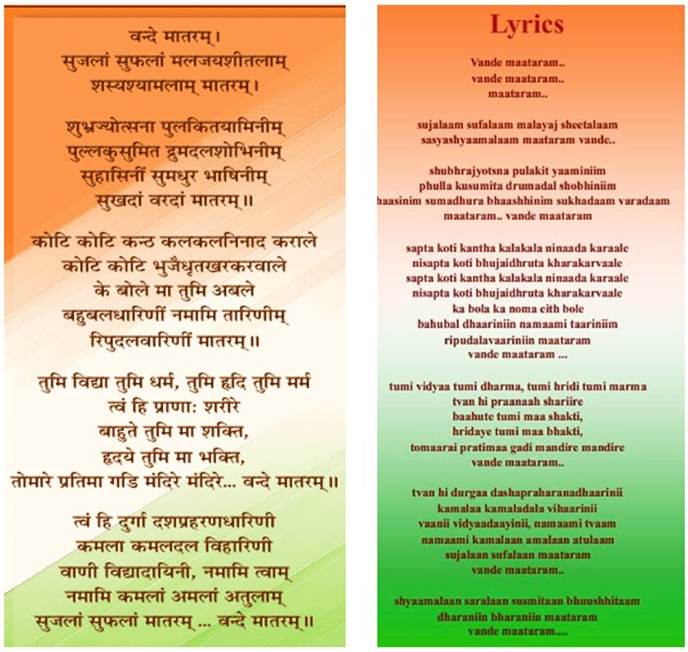
- Vande Mataram, composed by Bankim Chandra Chatterjee in Anandamath (1882), became a rallying cry in the freedom movement, symbolising devotion to the motherland. Strong nationalist association.
Constituent Assembly Position
- In 1950, Constituent Assembly accorded Jana Gana Mana as National Anthem and recognised Vande Mataram as National Song with equal respect but distinct constitutional status. Political compromise.
Constitutional & Legal Status
National Anthem
- Article 51A(a) makes respect for National Anthem a Fundamental Duty; Prevention of Insults to National Honour Act, 1971 enforces legal protection.Legally enforceable.
National Song
- No specific constitutional or statutory provision mandates National Song; its status is cultural-symbolic, though officially recognised. Moral respect expected.
Key Provisions in Guidelines
Order of Playing
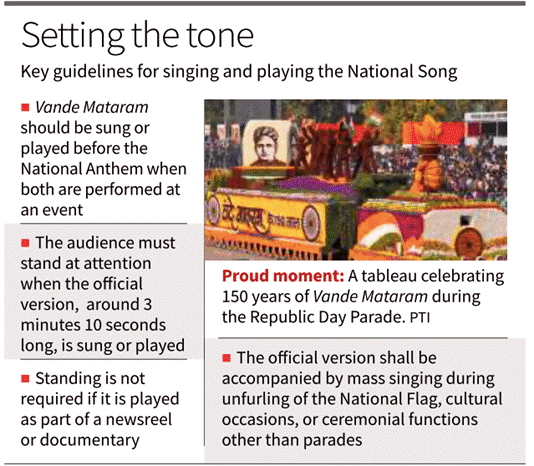
- When both played, National Song precedes National Anthem, reinforcing ceremonial sequencing but not altering constitutional hierarchy. Protocol clarity.
Standing Protocol
- Audience must stand to attention when official version (~3.1 minutes) is sung or played, except during film/newsreel where standing may disrupt proceedings. Practical decorum.
Ceremonial Occasions
- Played on arrival/departure of President or Governor, flag unfurling, cultural and ceremonial functions, and other government-notified occasions. State functions focus.
Band & Choir Use
- Band performances preceded by drum roll; mass singing allowed with trained choirs ensuring coordination and dignity. Structured presentation.
Schools
- Schools may begin day with community singing of Vande Mataram, promoting civic values and patriotic education. Civic culture.
Governance & Policy Significance
Symbolic Nation-Building
- Reflects role of national symbols in fostering collective identity, patriotism, and cultural unity. Soft power domestically.
Centre–State Coordination
- Protocols guide uniform practices across States, reducing ambiguity in official ceremonies. Administrative standardisation.
Debates & Sensitivities
Pluralism Concerns
- Some communities historically expressed discomfort with certain verses; debate centres on balancing cultural symbolism with inclusivity. Diversity management.
Legal vs Moral Duty
- Unlike Anthem, National Song observance is not legally enforceable, raising questions on voluntary patriotism vs mandated symbolism. Constitutional nuance.
Way Forward
Sensitivity & Inclusion
- Promote respectful observance while ensuring pluralistic accommodation and avoiding coercive nationalism. Harmony focus.
Civic Education
- Increase awareness on history and protocol of national symbols, strengthening informed patriotism. Knowledge-based respect.
There are 765 dolphins of six species along Odisha’s coast, latest census reveals
Source : Down to Earth
Why in News?
Record Dolphin Count
- Odisha recorded 765 dolphins in 2026, highest in five years, marking an increase of 55 individuals from previous year, credited to conservation, habitat protection, and community participation.
- Census conducted 20 January 2026 by Odisha Forest Department, showcasing India’s only annual marine dolphin monitoring programme at state scale.
Relevance
GS III — Environment
- Marine biodiversity conservation
- Schedule I species protection
- Ramsar wetlands (Chilika)
- Community-based conservation models
Practice Question
- “Scientific monitoring is crucial for wildlife conservation.” Evaluate the role of periodic biodiversity assessments in conservation policy. (250 Words)

Species Composition
Species-wise Numbers
- Humpback dolphins: 497, Irrawaddy: 208, Bottlenose: 55, Spinner: 3, Finless porpoise: 2, reflecting species diversity along Odisha’s coast and estuaries. Humpbacks dominate coastal waters.
Trend Over Time
- Dolphin numbers rose from 544 (2020–21) to 765 (2026), indicating gradual recovery despite marine ecosystem pressures. Suggests conservation gains.
Irrawaddy Dolphin Focus
Status & Protection
- Irrawaddy dolphin listed under Schedule I, Wildlife Protection Act 1972 and IUCN Endangered, receiving highest legal protection.Flagship conservation species.
Chilika Stronghold
- 159 Irrawaddy dolphins in Chilika, Asia’s largest brackish lagoon and a Ramsar site, making it the world’s largest single-site population. Global significance.
Distribution Beyond Chilika
- Sightings in Balasore (15), Berhampur (13), Puri (12), Rajnagar mangroves (9) show range expansion along Odisha coast. Habitat connectivity important.
Conservation Framework
Protected Areas
- Gahirmatha Marine Sanctuary hosts 474 Humpback dolphins, also famous for Olive Ridley turtle rookeries. Multi-species conservation zone.
Monitoring System
- Dolphin estimation began in Chilika (2008), expanded coastwide in 2015, using boat and shore transects for scientific accuracy. Long-term dataset.
Capacity Building
- Training on species identification and survey methods builds institutional expertise among frontline staff. Strengthens governance.
Governance Significance
Model for Marine Conservation
- Odisha’s annual census seen as a national model for evidence-based marine biodiversity management. Data-driven policy.
Community Participation
- Local fisher engagement reduces conflict and supports habitat stewardship. Co-management success.
Challenges
Habitat Stress
- Prawn gheries, nylon fishing nets, and boat traffic degrade habitats and increase bycatch risks. Major threats.
Slow Breeding
- Irrawaddy dolphins have low reproductive rates, limiting rapid population growth. Recovery takes time.
Stagnation in Chilika
- Population stable at 159 for two years, indicating carrying-capacity or disturbance issues. Needs habitat regulation.
Way Forward
Habitat Regulation
- Control illegal aquaculture, destructive fishing gear, and pollution in lagoon and coastal zones.Reduce stressors.
Technology Use
- Employ acoustic monitoring, satellite tagging, and GIS mapping for precise tracking.Improves science.
Community Incentives
- Promote eco-tourism and compensation schemes to align livelihoods with conservation. Sustainable approach.
Nature’s renewal has slowed down despite rising temperatures: Study
Source : Down to Earth
Why in News?
Nature Communications Study
- Study from Queen Mary University London, published February 3, 2026, finds species turnover has slowed in many ecosystems over the past century despite accelerating climate change.
- Challenges assumption that warming automatically speeds biodiversity reshuffling.
Relevance
GS III — Environment & Ecology
- Biodiversity loss, ecosystem resilience
- Climate change vs habitat degradation
- Ecological regime shifts
Practice Question
- “Climate change is not the only driver of biodiversity change.”Analyse the role of anthropogenic pressures in altering ecosystem dynamics. (250 Words)
Basics
What is Species Turnover?
- Species turnover is the rate at which species disappear and are replaced within ecological communities over time, reflecting ecosystem dynamism, resilience, and adaptive capacity. Core biodiversity indicator.
Why Turnover Matters ?
- Continuous turnover allows ecosystems to adapt to climate shifts, disturbances, and invasions, maintaining functional diversity and stability. Supports resilience.
Key Findings
Overall Trend
- Turnover decelerated in significantly more ecosystems than it accelerated, with rates typically declining by ~one-third over the last century. Indicates global pattern.
Dataset Scope
- Analysis used BioTIME database, covering land, freshwater, and marine biodiversity surveys over decades. Large-scale evidence.
Community Patterns
- Slowdown observed in birds, benthic, and mixed communities; fish showed inconsistent signals due to fisheries management distortions. Human pressure factor.
Ecological Interpretation
Not Climate-Driven
- Short-term species changes often driven by internal ecosystem dynamics, not directly by climate change. Counters common narrative.
Shrinking Species Pools
- Environmental degradation reduces regional species pools, limiting new colonisers and slowing community reshuffling. Biodiversity erosion link.
Causes of Deceleration
Anthropogenic Pressures
- Habitat destruction, pollution, fragmentation, and overexploitation reduce biodiversity reservoirs necessary for natural turnover. Human footprint dominant.
Fisheries Impact
- Exploited fish communities show distorted turnover patterns due to harvesting and management interventions. Alters natural dynamics.
Implications for Ecosystems
Reduced Resilience
- Lower turnover reduces ecosystems’ ability to self-repair and adapt, increasing vulnerability to climate variability. Weakens buffers.
Regime Shift Risk
- Stagnant communities face higher chances of abrupt ecological regime shifts, such as coral collapse or forest dieback. Tipping-point concern.
Conceptual Insight
“Self-Repairing Engine” Analogy
- Nature works like a self-repairing engine replacing species over time; slowdown suggests this mechanism is weakening. Powerful exam metaphor.
Governance & Policy Relevance
Conservation Focus
- Emphasises restoring habitat quality and connectivity, not just climate mitigation, to sustain biodiversity dynamics. Policy shift needed.
Monitoring Importance
- Long-term biodiversity datasets crucial for evidence-based conservation planning. Science-led governance.
Way Forward
Habitat Restoration
- Expand protected areas, corridors, and wetland restoration to rebuild species pools. Enhances colonisation.
Pollution & Fragmentation Control
- Reduce chemical pollution and land-use fragmentation to maintain ecological connectivity. Supports turnover.
Sustainable Resource Use
- Strengthen fisheries and wildlife regulations to reduce overexploitation pressures. Balance use and conservation.


