
Basics and static context
What counts as pothole-related accidents ?
- Pothole-related accidents are crashes where road surface defects directly cause loss of control, recorded in police FIRs and compiled by MoRTH in its annual Road Accidents in India reports.
- They fall under infrastructure-related causes, alongside poor signage and road design; globally, WHO notes road infrastructure quality significantly influences crash risks, especially for two-wheelers and pedestrians.
Scale of the problem in India
- India records about 1.7 lakh road deaths annually (2024), the highest in the world; even small shares from potholes translate into thousands of preventable deaths.
- India has the second-largest road network (~63 lakh km), including ~1.46 lakh km of National Highways, making maintenance a massive governance and fiscal challenge.
Relevance
- GS III (Infrastructure): Road safety, public infrastructure management.
- GS II (Governance): Accountability of agencies, urban governance.
Practice question
- Road accidents in India are as much a governance failure as a transport issue. Discuss with reference to pothole deaths.(250 Words)
Why in news ?
Sharp rise in fatalities
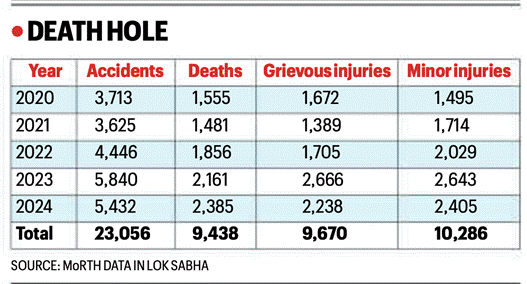
- Lok Sabha data show pothole deaths rose from 1,555 (2020) to 2,385 (2024) — a 53% jump, signalling worsening road maintenance outcomes despite rising infrastructure spending.
- Total pothole-linked deaths over 2020–24 reached 9,438, averaging nearly 5 deaths daily, highlighting that potholes are not minor defects but serious safety hazards.
Data and trends
Accident and injury pattern
- Pothole accidents increased from 3,713 (2020) to 5,432 (2024); grievous injuries also remained high, showing that many victims survive with long-term disabilities.
- Minor injuries crossed 10,000 cases in five years, indicating a broader safety burden beyond fatalities, including healthcare costs and productivity losses.
State-wise concentration
- Uttar Pradesh contributes the largest share of deaths, consistent with its overall high road fatality numbers and vast road network.
- MP, Punjab, Tamil Nadu, Assam together account for over 80% of pothole deaths, showing regional clustering linked to traffic density and maintenance gaps.
Governance and policy dimension
Maintenance vs construction bias
- India’s road policy has prioritised new highway construction, but maintenance budgets and monitoring often lag, leading to rapid deterioration, especially after monsoons.
- Contracts sometimes focus on asset creation, not lifecycle upkeep; performance-based maintenance is less uniformly enforced across states and urban local bodies.
Accountability issues
- Multiple agencies (NHAI, PWDs, municipalities) share responsibility, causing diffused accountability when pothole deaths occur.
- Though courts have occasionally held authorities liable, routine criminal or financial accountability for negligence remains rare.
Economic and social implications
Economic costs
- Road crashes cost India an estimated ~3–5% of GDP annually (various government and World Bank estimates); pothole crashes add to repair costs, medical bills and productivity losses.
- Logistics delays from poor road quality raise transport costs, indirectly affecting inflation and competitiveness.
Social justice angle
- Victims are often two-wheeler riders and lower-income commuters, who are more exposed and less protected than car occupants.
- Families of victims face sudden income shocks, linking road safety with poverty and social protection concerns.
Environmental and urban angle
Urban flooding and potholes
- Poor drainage and waterlogging accelerate pothole formation; cities with clogged stormwater systems see roads degrade quickly after heavy rains.
- Climate change–linked extreme rainfall events can worsen this cycle, raising maintenance demands.
Challenges and way forward
Structural challenges
- Reactive “patchwork repairs” dominate over scientific resurfacing, leading to recurring potholes within a single season.
- Weak data integration between police, transport and road agencies limits targeted interventions on blackspots.
Reform priorities
- Adopt performance-based maintenance contracts with penalties for defects, as used in some highway PPP models.
- Use geo-tagging, citizen-reporting apps and third-party audits to monitor road quality; some cities already pilot such digital grievance systems.
- Integrate road safety with Safe System Approach (safer roads, vehicles, speeds, users, post-crash care) recommended by WHO.


