
Content
- Union Budget 2026-27: Rural Transformation through Decentralization
- Transforming Healthcare Delivery Through Artificial Intelligence
Union Budget 2026-27: Rural Transformation through Decentralization
Why is it in News?
- Union Budget 2026–27 scales rural development outlay to ₹2.73 lakh crore, marking 211% rise since 2016–17, institutionalising decentralised, women-led, tech-enabled rural transformation as central to inclusive growth strategy.
- PIB release emphasises shift from welfare delivery to community partnerships, higher fiscal devolution, SHG-led livelihoods, and legal employment guarantees, projecting rural India as growth engine.
Relevance
- GS II (Polity & Governance): 73rd Amendment, PRIs, fiscal devolution, social audits, rights-based welfare.
- GS II (Social Justice): SHGs, PVTGs (PM-JANMAN), gender empowerment, poverty reduction.
- GS III (Economy): Rural capex, livelihoods, infrastructure multipliers, agri–nonfarm transition.
Practice Question
- “Decentralised, women-led and tech-enabled rural governance is key to inclusive growth.” Examine in the context of Union Budget 2026–27. (250 words)
Constitutional / Legal Dimensions
Decentralisation Framework
- 73rd Constitutional Amendment (1992) constitutionalised Panchayati Raj, mandating Gram Sabhas, reservations, State Finance Commissions, Eleventh Schedule subjects, forming legal base for participatory planning, social audits, and accountability.
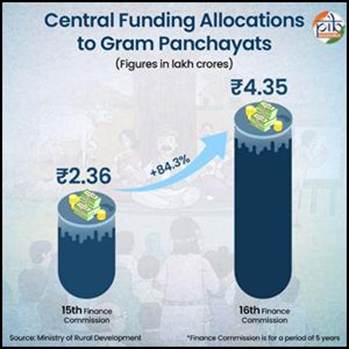
- Fiscal devolution rises from ₹2.36 lakh crore (15th FC) to ₹4.35 lakh crore (16th FC), strengthening subsidiarity principle, local autonomy, and constitutionally backed grassroots democracy.
Rights-Based Welfare Architecture
- Viksit Bharat Rozgar and Ajeevika Mission (Gramin) Act, 2025 provides legal 125-day employment guarantee, delay compensation, and climate-resilient works, deepening justiciable socio-economic rights.
- Forest Rights Act, 2006 ensures tenurial justice; over 2.5 million forest titles distributed, recognising community forest rights and correcting historical tribal marginalisation.
Governance / Administrative Dimensions
Institutional Deepening
- Revamped RGSA (₹5,911 crore) strengthens PRI capacity via training, e-governance, and planning support, addressing Second ARC concerns on weak decentralised administration and elite capture.
- Model Youth Gram Sabha builds civic awareness among students, nurturing leadership, participatory culture, and democratic accountability aligned with constitutional values and local self-governance ethos.
Digital Governance
- Aadhaar-enabled DBT, geo-tagging, e-payments reduce leakages and delays; near-universal electronic wage transfers enhance transparency and fiscal accountability in rural schemes.
- SVAMITVA scheme covers 3.28 lakh villages, issuing 2.76 crore property cards, formalising assets and enabling credit access, reflecting Hernando de Soto’s property–capital linkage thesis.
Economic Dimensions
Public Investment-Led Growth
- Rural allocation rises from ₹87,765 crore (2016–17) to ₹2.73 lakh crore (2026–27), signalling Keynesian demand stimulus, infrastructure creation, and multiplier effects in rural markets.
- PMGSY achieving 99.6% connectivity reduces transaction costs and boosts school access, healthcare reach, and non-farm jobs, supported by World Bank impact assessments.
Livelihood Diversification
- DAY-NRLM mobilises 10.05 crore women into 90.09 lakh SHGs, building social capital, credit networks, and micro-enterprises aligned with Amartya Sen’s capability approach.
- DDU-GKY trained 17.92 lakh youth with 11.64 lakh placements, gradually shifting labour from low-productivity agriculture to wage employment.
Social / Ethical Dimensions
Equity and Inclusion
- Multidimensional Poverty falls to 11.28% (2022–23) from 55.3% (2005–06), showing progress in nutrition, schooling, and living standards beyond income poverty.
- PM-JANMAN targets 28,700 PVTG habitations, reflecting substantive equality and equity-based policy design for historically marginalised communities.
Gender Empowerment
- Bank Sakhis (1.49 lakh), Krishi Sakhis, Drone Didis expand women’s agency in finance and technology, countering feminisation-of-agriculture vulnerabilities.
- SHGs’ Panchsutra–Dashsutra framework integrates credit, nutrition, governance, and livelihoods, embedding dignity and collective empowerment.
Environmental / Tech / Sustainability Dimensions
Natural Resource Governance
- Employment programmes prioritise water conservation, land development, drought-proofing, linking rural jobs with climate adaptation and ecological regeneration.
- 4,105 Van Dhan Vikas Kendras benefit ~12 lakh individuals, promoting sustainable minor forest produce value chains and biodiversity-friendly livelihoods.
WASH and Human Development
- Jal Jeevan Mission raises tap coverage from 17% to ~100%, reducing disease burden and unpaid care work, especially for women.
- ODF Plus villages (5.68 lakh) ensure solid and liquid waste management, shifting focus from toilet construction to sustainability.
Data & Evidence
- Social protection coverage expands from 22% (2016) to 64.3% (2025); Social Sector Expenditure CAGR 12%, education 11%, health 8%.
- Infant Mortality Rate drops from 40 (2013) to 25 (2023); Maternal mortality declines 86% since 1990, reflecting WASH-health synergy.
- PLFS 2025: 58.5% rural workers in agriculture, 63.2% self-employed, showing structural constraints and need for diversification.
Challenges
- States lag in devolving 3Fs—functions, funds, functionaries, limiting genuine PRI autonomy, as flagged by CAG and Second ARC.
- Capacity gaps among Panchayats cause uneven planning and fund utilisation, risking elite capture.
- SHG credit deepening sometimes leads to debt without enterprise viability; NABARD studies show uneven income graduation.
- Digital exclusion persists due to connectivity gaps, digital illiteracy, and Aadhaar authentication failures among vulnerable groups.
Way Forward
- Ensure clear activity mapping and 3F devolution, with predictable untied grants and incentives for local revenue mobilisation.
- Move toward outcome-based SDG-aligned metrics, social audits, and real-time dashboards for accountability.
- Promote rural industrial clusters, green jobs, agro-processing, digital services for labour absorption.
- Converge SHGs–FPOs–MSMEs for scale, branding, and market linkages.
- Mainstream climate-resilient infrastructure, renewable energy, and nature-based solutions in rural planning.
Transforming Healthcare Delivery Through Artificial Intelligence
Why is it in News?
- PIB highlights rapid scale-up of AI-enabled diagnostics, telemedicine, and surveillance, positioning AI as a pillar for Universal Health Coverage (UHC) and affordable healthcare delivery.
- IndiaAI Mission (₹10,371.92 crore) and upcoming Global South AI Summit 2026 signal strategic push to make India a leader in AI-driven public health governance and digital health innovation.
Relevance
- GS II (Governance): UHC, digital health governance, ABDM, privacy.
- GS II (Social Justice): Equity in access, rural healthcare, vulnerable groups.
- GS III (S&T/Economy): AI innovation, startups, cost efficiency.
Practice Question
- “AI can be a force multiplier for Universal Health Coverage, but raises ethical and governance concerns.” Discuss with examples. (250 words)
Constitutional / Legal Dimensions
Right to Health Orientation
- Though Right to Health is not explicit, Article 21 (Right to Life) judicially includes health; AI-enabled access strengthens state capacity to realise this socio-economic obligation.
- Directive Principles (Articles 38, 39, 47) mandate improving public health and reducing inequalities; AI supports evidence-based targeting, early diagnosis, and efficient allocation of scarce medical resources.
Data Governance & Ethics
- ICMR Ethical Guidelines (2023) and MeitY AI Governance norms mandate privacy-by-design, informed consent, and secure data exchange, aligning AI-health deployment with constitutional privacy under Puttaswamy judgment (2017).
- ABDM digital architecture institutionalises interoperable, consent-based data sharing, legally balancing innovation with informational self-determination and preventing unregulated commercial exploitation of health data.
Governance / Administrative Dimensions
State Capacity Augmentation
- AI bridges specialist shortages, enabling frontline workers to conduct high-quality screening, reflecting “technology as force multiplier” in public administration and strengthening last-mile service delivery.
- Integration across TB, NCDs, nutrition, and surveillance creates whole-of-government health intelligence, improving coordination, early response, and programmatic convergence across ministries and states.
Digital Public Infrastructure
- Ayushman Bharat Digital Mission (ABDM) with 799 million ABHA IDs, 410,000 facilities, and 670,000 professionals forms backbone for scalable AI deployment and continuity of care.
- Federated Learning Platform (NHA–IIT Kanpur) enables AI model validation without centralising sensitive data, enhancing innovation while preserving data sovereignty.
Economic Dimensions
Efficiency & Cost Reduction
- AI reduces diagnostic costs, unnecessary referrals, and hospital burden; e.g., Qure.ai improves TB detection by 30%, lowering long-term treatment expenditure and productivity losses.
- Telemedicine (282 million eSanjeevani consultations) cuts travel, wage loss, and out-of-pocket expenditure, crucial as India still has high OOPE share in total health spending.
Health-Tech Ecosystem
- India’s AI-health startups attract global capital (e.g., Qure.ai $125M funding), promoting domestic innovation, high-skill jobs, and exportable digital health solutions.
- Public AI missions crowd-in private innovation, reflecting public–private complementarity in sunrise sectors like digital health and medical AI.
Social / Ethical Dimensions
Equity & Inclusion
- AI tools democratise specialist expertise in rural areas, reducing urban bias in healthcare access and aligning with SDG 3 (Good Health and Well-being).
- Targeted AI use in TB, malnutrition, and maternal care benefits vulnerable populations, operationalising inclusive development and leaving-no-one-behind principle.
Ethical Concerns
- Algorithmic bias risk persists if datasets underrepresent certain regions, genders, or ethnicities, potentially reinforcing diagnostic inequalities.
- Over-reliance on AI may weaken clinical judgement; ethical model requires human-in-the-loop rather than full automation.
Environmental / Tech Dimensions
One Health & Surveillance
- Media Disease Surveillance (4,500+ alerts) uses AI text-mining for early outbreak detection, strengthening One Health approach and biosecurity preparedness.
- AI-enabled water and sanitation monitoring (e.g., 65+ crore litres water recovered) links environmental health with public health outcomes.
Frontier Technologies
- Ayurgenomics + AI integrates traditional knowledge with genomics, recognised by WHO (2025) as global model, showcasing culturally contextual innovation.
- AI wearables and IoT devices enable continuous monitoring, shifting healthcare from episodic treatment to preventive, data-driven care.
Data & Evidence
- 27% decline in adverse TB outcomes after AI-based predictive analytics under National TB Elimination Programme.
- 12–16% rise in TB case detection due to AI-supported screening and radiology tools.
- 7,100 patients screened under MadhuNetrAI; 20,000+ newborns monitored via NemoCare Raksha.
- 130,000+ ICU patients supported by AI-enabled remote monitoring; 40% reduction in documentation time.
Challenges
- Digital divide limits AI benefits in low-connectivity and low-literacy regions, risking urban-centric AI healthcare growth.
- Data security risks increase with large-scale digitisation; health data breaches can undermine trust.
- Fragmented regulatory framework; India lacks a dedicated AI-in-health law clarifying liability and accountability.
- Capacity gaps among health workers to interpret AI outputs may reduce effectiveness.
Way Forward
- Create sector-specific AI Health Regulation covering liability, validation standards, and patient safety norms.
- Invest in digital literacy and connectivity to avoid AI-driven health inequalities.
- Promote indigenous datasets to reduce algorithmic bias and enhance contextual accuracy.
- Institutionalise human oversight, ethical audits, and transparent algorithms.
- Align AI-health roadmap with National Digital Health Mission and SDG targets.
AI Initiatives in Public Healthcare
Disease Control & Clinical Screening
TB Management
- AI Adverse Outcome Prediction uses predictive analytics to flag high-risk TB patients early, enabling targeted care; nationwide deployment reports 27% decline in adverse outcomes.
- DeepCXR (AI chest X-ray tool) automates TB triage by detecting nodules/cavities; deployed in 8 States/UTs, free for government use, addressing acute radiologist shortages.
Non-Communicable Diseases
- MadhuNetrAI (Diabetic Retinopathy) enables non-specialists to capture retinal images, with AI grading severity; 7,100 patients screened across 38 facilities, India’s first AI community DR program (2025).
- Ocellux AI retina device (prototype) provides portable, affordable screening for DR, glaucoma, AMD, expanding early detection in primary-care settings.
Cancer Care
- Imaging Biobank (20,000+ profiles) by NITI Aayog builds radiology–pathology dataset for AI research, improving early cancer detection accuracy and indigenous algorithm development.
- MafPro AI device (prototype) offers radiation-free, non-invasive cancer staging and metastasis detection, reducing dependence on expensive imaging modalities.
Telemedicine & Clinical Decision Support
- eSanjeevani CDSS provides AI-based differential diagnosis; 282 million consultations (2023–25), with 12 million supported by AI recommendations, reducing diagnostic delays.
- Doctor-led AI personal health assistants (prototype stage) promise 24×7 preventive guidance, wearable integration, and early disease alerts, shifting focus toward preventive healthcare.
Traditional Medicine & Integrative Health
- Ayurgenomics + Ayush Grid combines genomics and Ayurveda using AI to identify disease markers by Prakriti types; WHO recognised (2025) as global integrative model.
Health System Governance
Fraud & Integrity
- AB-PMJAY AI Anti-Fraud System uses ML to detect suspicious claims in real time, shifting from reactive audits to proactive integrity management, improving fiscal prudence.
Surveillance & One Health
- Media Disease Surveillance (MDS) scans digital media for symptom clusters; issued 4,500+ outbreak alerts since 2022, strengthening early-warning systems.
Foundational AI Ecosystem (Safety & Standards)
- Centres of Excellence (AIIMS Delhi, PGIMER, AIIMS Rishikesh, IISc–TANUH) drive indigenous AI R&D, reducing import dependence and contextualising solutions.
- National Federated Learning Platform (NHA–IIT Kanpur) validates AI models using distributed ABDM data, preserving privacy and enabling scalable innovation.
- Ethical Oversight under ICMR (2023) and MeitY AI guidelines ensures privacy-by-design, accountability, and secure data sharing.
- SAHI (Strategy for AI in Healthcare for India) under preparation to provide sector-specific roadmap after multi-stakeholder consultations.
AI for Nutrition & Social Welfare
- AI food-quality monitoring in Maharashtra Ashram schools analysed 2,100+ meal parameters, exposed menu deviations, and improved nutrition compliance, addressing 27% malnutrition prevalence.
Digital Health Diplomacy
- Regional Open Digital Health Summit 2025 with WHO-SEARO, UNICEF, SEAR nations positioned India as leader in open digital health standards and AI governance.
IndiaAI Mission – Healthcare Pipeline
- IndiaAI Application Development Initiative promotes scalable AI solutions for national challenges; healthcare among priority sectors.
- Key solutions: NIDAAN (AI TB detection, 30+ CXR findings), AI radiology cloud platforms, AI musculoskeletal wearables, VoxelBox neuro-informatics, and AI retinal screening tools.
Private Sector Innovations
- CareNX maternal platform supported 5 lakh+ mothers, reducing OOPE and improving antenatal monitoring.
- NemoCare Raksha wearable monitored 20,000+ newborns, enabling one nurse to track 40–50 infants simultaneously.
- Cloudphysician Smart ICU impacted 1.3 lakh+ patients across 280 hospitals, cutting documentation time by 40%.
- 3Nethra AI screening deployed in 75+ countries, screened 3M+ people, reducing unnecessary referrals by 70%.
- Qure.ai serves 15M patients annually across 1,000+ sites, improves TB detection by 30%, and secured $125M funding.
- Thermalytix AI breast screening screened 75,000+ women, offering non-contact, radiation-free early detection.
ABDM-Enabled AI Ecosystem
- 799 million ABHA IDs, 410,000 facilities, 670,000 professionals, and 671 million records linked—forming world’s largest digital health ecosystem.
- AI apps like Eka Doc, Sunoh.AI, Eka Scribe, Plus91, EkaCare enable AI-driven triaging, documentation, and smart summaries at national scale.


