
Content
- CJI’s office received 8,630 complaints against judges from 2016 to 2025: Minister
- DGCA fines Air India ₹1 crore for operating aircraft on expired certificate
- How terrorist and hate groups use gaming platforms to recruit children
- India is set to get two new telescopes and upgrade one in Ladakh: How it will be a game-changer for astronomy
- No-confidence motion against Om Birla: What is the process for removal of the Lok Sabha Speaker?
- India assumes command of multinational training task force CTF-154
- When giants get trapped: How Kerala’s fishers are learning to save the world’s largest fish
CJI’s office received 8,630 complaints against judges from 2016 to 2025: Minister
Source : The Hindu
Why is it in News?
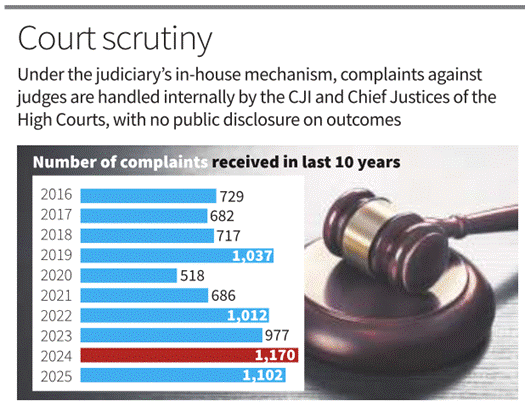
- Union Law Minister informed Lok Sabha that 8,360 complaints were received against sitting judges of the Supreme Court and High Courts during 2016–2025, indicating sustained citizen engagement with judicial grievance channels.
- Annual complaints crossed 1,000 in 2019 (1,037), 2022 (1,012), 2024 (1,170), and 2025 (1,102), coinciding with expansion of CPGRAMS digital grievance portal and rising public awareness about judicial conduct.
Relevance
- GS2 – Polity & Governance
- Judicial independence vs accountability; Basic Structure doctrine.
- In-house mechanism, impeachment process, need for credible oversight.
- Transparency, citizen grievance redress (CPGRAMS), rule of law.
Practice Question
- “Judicial independence must be balanced with judicial accountability.” Examine in the context of India’s complaint-handling mechanisms against judges.
Judicial Accountability in India
Security of Tenure
- Supreme Court and High Court judges enjoy strong tenure security under Articles 124 and 217, preventing arbitrary removal and safeguarding decisional independence from executive or legislative pressure.
- Example: Even during politically sensitive rulings like NJAC case (2015), judges remained insulated from retaliation due to constitutional tenure protection.
Removal Process
- Judges can be removed only by special majority of Parliament, requiring majority of total membership and two-thirds of members present and voting, making removal extremely rare.
- Example: Justice V. Ramaswami (1993) impeachment failed despite inquiry finding misconduct, showing political difficulty of removal.
What is the In-House Mechanism?
Nature and Origin
- Created by judiciary in 1999 after allegations against Justice V. Ramaswami, the in-house procedure provides internal inquiry without constitutional or statutory basis, relying on peer review by senior judges.
Who Handles Complaints?
- Complaints against Supreme Court judges are examined by the Chief Justice of India and senior SC judges, while High Court complaints are handled by respective Chief Justices.
- Example: Past complaints against sitting judges were examined internally without invoking impeachment, reflecting preference for internal correction.
Confidentiality Feature
- Proceedings and outcomes remain confidential to protect judicial reputation and independence, but this also limits public knowledge of corrective actions taken.
- Contrast: In the UK Judicial Conduct Investigations Office, annual reports publicly list disciplinary actions, increasing transparency.
Data Trends (2016–2025)
Volume of Complaints
- 8,360 complaints in a decade averages over 800 annually, showing consistent grievance reporting rather than isolated spikes, suggesting institutionalised complaint culture.
- Yearly data: 729 (2016), 682 (2017), 717 (2018), 1,037 (2019), 518 (2020 pandemic dip), 686 (2021), 1,012 (2022), 977 (2023), 1,170 (2024), 1,102 (2025).
Interpretation
- Increase linked to digital access (CPGRAMS), rising litigation awareness, and media coverage of judicial ethics debates, not necessarily proportional increase in proven misconduct.
- Example: Similar global trend where complaint volumes rise with transparency mechanisms, as seen in UK and Canada judicial councils.
Governance & Institutional Dimensions
Judicial Independence vs Accountability
- Judicial independence is part of Basic Structure (Kesavananda Bharati, 1973), ensuring courts can review executive and legislative actions without fear.
- However, accountability ensures legitimacy; without credible oversight, independence may be perceived as insulation from scrutiny.
Current Gap
- No independent statutory body exists for judicial complaints; system relies on in-house ethics and rare impeachment, creating gap for handling mid-level misconduct.
- Example: Minor ethical lapses often handled informally, lacking structured disciplinary spectrum.
Legal & Reform Context
Judicial Standards and Accountability Bill, 2010
- Proposed mandatory asset disclosure and complaint scrutiny panels but lapsed due to concerns over judicial independence and political misuse.
Law Commission View
- 214th Law Commission Report (2008) recommended National Judicial Council to examine complaints, balancing independence with credible accountability.
Comparative Perspective
International Models
- UK: Judicial Conduct Investigations Office publishes disciplinary outcomes annually, including warnings and removals.
- USA: Judicial Councils handle complaints under Judicial Conduct and Disability Act, allowing graded responses.
Key Challenges
- Opacity : Confidential inquiries create perception of secrecy, potentially weakening public trust despite intention to protect judicial dignity.
- High Removal Threshold : Impeachment’s political nature makes it impractical for most misconduct cases, leaving limited formal accountability tools.
- Risk of Frivolous Complaints : Politically motivated or vexatious complaints can be used to intimidate judges, especially in high-profile constitutional cases.
Way Forward
- Balanced Reform : Establish independent but judiciary-dominated complaints authority with statutory backing, ensuring autonomy and structured inquiry process.
- Graded Penalties : Introduce advisories, reprimands, temporary withdrawal of judicial work, and mandatory disclosures as intermediate accountability measures.
- Transparency : Publish anonymised annual reports on complaint numbers and broad outcomes, similar to global best practices, enhancing credibility without sensationalism.
DGCA Fines Air India ₹1 Crore for Operating Aircraft on Expired Certificate
Source : The Hindu
Why is it in News?
- DGCA fined Air India ₹1 crore for operating an Airbus A320 with expired Airworthiness Review Certificate (ARC), categorised as a Level-I safety lapse, the most serious violation in aviation compliance.
- Aircraft reportedly flew eight commercial sectors in November without valid ARC, raising concerns about airline compliance systems, safety culture, and regulatory surveillance in a fast-growing aviation market.
Relevance
- GS3 – Economy (Aviation), Science & Tech, Internal Security
- Aviation safety regulation, ICAO compliance, Safety Management Systems.
- Regulatory capacity vs rapid market growth; MRO ecosystem.
Practice Questions
- Discuss the role of DGCA and ICAO frameworks in ensuring aviation safety in a rapidly expanding aviation market like India.(250 Words)
Airworthiness Review Certificate (ARC)
Meaning and Purpose
- ARC certifies that an aircraft complies with prescribed maintenance standards and remains airworthy; without ARC, aircraft is legally unfit for commercial operations under aviation rules.
- Validity typically one year, renewed after detailed technical inspection and maintenance record verification by authorised personnel or regulator-approved organisations.
Importance
- Ensures structural safety, system reliability, and regulatory compliance; protects passenger safety and airline liability exposure.
- Example: Globally, lapses in airworthiness documentation have led to grounding of fleets, such as Boeing 737 MAX grounding (2019) after certification and design scrutiny.
Other Key Aviation Certificates
Certificate of Airworthiness (CoA)
- Issued when aircraft is initially registered and deemed safe to fly; ARC ensures its continued validity.
Air Operator Certificate (AOC)
- Mandatory licence for airlines to conduct commercial operations; DGCA grants AOC after evaluating safety systems, crew training, and maintenance capabilities.
Pilot & Crew Licensing
- DGCA issues licences for pilots, engineers, and cabin crew ensuring qualification, medical fitness, and simulator training compliance.
Maintenance Release Certificate
- Certifies maintenance work completion before aircraft returns to service; issued by certified engineers or MRO organisations.
DGCA (Directorate General of Civil Aviation)
Legal Status
- DGCA is India’s primary civil aviation safety regulator under Ministry of Civil Aviation, exercising powers under Aircraft Act, 1934 and Aircraft Rules, 1937.
Functions
- Regulates air safety, aircraft certification, crew licensing, accident prevention, and airline audits.
- Conducts surveillance, ramp inspections, and safety audits, and can impose fines, suspend licences, or ground aircraft for violations.
International Role
- Coordinates with ICAO (International Civil Aviation Organization), ensuring India’s compliance with global safety standards.
- India’s ICAO Effective Implementation score ~85%+, above world average, reflecting relatively strong safety oversight.
Aviation Safety Ecosystem
Safety Management System (SMS)
- ICAO-mandated framework requiring airlines to identify, assess, and mitigate operational risks systematically.
- Encourages reporting culture and predictive risk management rather than reactive action after incidents.
Aircraft Accident Investigation Bureau (AAIB)
- Independent body under MoCA investigating accidents and serious incidents; focuses on root causes, not punishment.
MRO (Maintenance, Repair, Overhaul) Sector
- India promoting domestic MRO under UDAN and aviation reforms, as maintenance quality directly affects certification validity and safety.
Indian Aviation Growth Context
- India is 3rd largest domestic aviation market globally, with passenger traffic crossing 150 million annually pre-COVID and strong rebound post-pandemic.
- Fleet expansion by Air India and IndiGo (hundreds of aircraft orders) increases regulatory oversight complexity.
Key Issues Highlighted
- Compliance Culture : Rapid expansion sometimes outpaces internal compliance systems; documentation lapses often linked to human error rather than mechanical faults.
- Regulatory Capacity : DGCA faces manpower and technical resource constraints compared to scale of aviation growth, necessitating digital and institutional strengthening.
- Reputational Risk : Safety lapses can affect bilateral aviation agreements, insurance costs, and passenger confidence, especially for airlines expanding internationally.
Way Forward
- Digital Compliance Systems : Automated certificate expiry alerts, AI-based maintenance logs, and real-time DGCA-airline compliance dashboards can reduce human error.
- Strengthening DGCA : Enhance staffing, training, and technological tools for predictive audits and surveillance.
- Safety Culture : Promote “just culture” encouraging voluntary reporting of mistakes without fear, aligning with ICAO best practices.
How Terrorist & Hate Groups Use Gaming Platforms to Recruit Children
Source : The Indian Express
Why is it in News?
- Recent investigations and UN-linked research highlight that extremist and hate groups increasingly use gaming platforms like Roblox, Discord, and multiplayer chat spaces to reach minors, raising child-safety and national security concerns.
- Studies indicate online radicalisation is rising sharply, with extremist ecosystems exploiting gaming communities, encrypted chats, and youth loneliness to build early ideological influence among children.
Relevance
- GS3 – Internal Security & Cybersecurity
- Online radicalisation, lone-wolf threats, platform governance.
- UAPA, IT Rules, child safety (POCSO), encrypted ecosystems.
Practice Questions
- Examine how online ecosystems, including gaming platforms, are reshaping radicalisation pathways among youth. Suggest a prevention-centric strategy.(250 Words)
What is Online Radicalisation?
Definition : Meaning
- Online radicalisation is the process by which individuals, especially youth, are exposed to extremist ideologies via digital platforms, gradually normalising hate, violence, or anti-state narratives.
- It often begins with memes, humour, or gaming interactions, then shifts to private chats, ideological grooming, and closed extremist communities.
Why Children Are Vulnerable ?
Psychological Factors
- Adolescents seek identity, belonging, and recognition; extremist recruiters exploit these needs by offering community, status, and a “cause,” especially to socially isolated youth.
- UN research links vulnerability to loneliness, marginalisation, and lack of offline support systems, not merely ideology.
How Gaming Platforms Are Misused ?
Communication Tools : In-Game Chats & Private Servers
- Multiplayer games allow real-time chat, voice communication, and private servers, enabling recruiters to build trust gradually and move conversations off-platform to encrypted apps.
Gamification of Extremism : Simulation & Role-Play
- Some games simulate conflict or violence; extremists misuse these to normalise narratives around “heroic struggle,” sometimes recreating real attacks symbolically inside game maps.
Community Migration
From Games to Encrypted Apps
- Recruiters often shift children from public gaming chats to Discord, Telegram, or closed forums, where monitoring is weaker and ideological grooming deepens.
Global Evidence & Trends
Data Indicators
- UN-linked counter-terror research notes a multi-fold rise in online investigations since 2021, with gaming spaces emerging as a recurring vector.
- Some Western security agencies report teenagers among the youngest terrorism-related arrestees, partly linked to online radical networks.
Case Patterns
- Lone-actor and small-cell radicalisation increasingly show online origins, where exposure precedes real-world intent, though causation varies case by case.
Legal & Regulatory Framework
UAPA (1967)
- India’s primary anti-terror law criminalises support, recruitment, and propaganda for terrorist organisations, including digital facilitation.
IT Act, 2000 & Rules
- Enables takedown of unlawful content and mandates due diligence by intermediaries; social media and gaming platforms fall under intermediary obligations.
POCSO & Child Protection Laws
- Protect minors from online exploitation and grooming, relevant when radicalisation involves manipulation of children.
Governance & Cybersecurity Dimensions
Platform Responsibility
- Global firms use AI moderation, parental controls, and reporting tools, but scale and encryption create monitoring challenges.
Digital Literacy Gap
- Many parents and teachers lack awareness of gaming ecosystems, making early detection of grooming or radical content difficult.
Security Implications
Internal Security
- Online radicalisation can translate into lone-wolf threats, hate crimes, or support networks, complicating traditional intelligence models.
Soft Power & Social Cohesion
- Spread of hate narratives undermines social harmony and democratic values, aligning with goals of extremist propaganda.
Way Forward
Prevention over Policing : Invest in digital literacy, critical thinking education, and parental awareness to build resilience among youth.
Tech-Policy Collaboration : Stronger cooperation between governments and platforms on early warning systems, while respecting privacy and free-speech norms.
Community-Based Counter-Narratives : Promote positive online communities and credible voices to counter extremist messaging.
India is set to get two new telescopes and upgrade one in Ladakh.
Source : The Indian Express
Why is it in News?
- Union Budget 2026 sanctioned two major telescopes — National Large Solar Telescope (NLST) and National Large Optical–Near Infrared Telescope (NLOT) — plus upgrade of Himalayan Chandra Telescope (HCT), signalling big push to astronomy.
- Ladakh’s Hanle Dark Sky Reserve (India’s first, notified 2022) and high-altitude conditions make it globally competitive for precision astronomy, boosting India’s scientific leadership and Global South research capacity.
Relevance
- GS3 – Science & Technology
- Observational astronomy, space weather, exoplanet research.
- Big-science infrastructure, R&D ecosystem, multi-messenger astronomy.
Practice Question
- How can large scientific infrastructure projects like next-gen telescopes contribute to strategic autonomy and innovation ecosystems?(250 Words)

How Astronomical Telescopes Work ?
Electromagnetic Spectrum Principle
- Telescopes collect electromagnetic radiation (optical, infrared, radio, X-ray); different wavelengths reveal different cosmic phenomena like stars, planets, or solar magnetic activity.
- Not all wavelengths reach Earth due to atmospheric absorption, hence mix of ground-based (optical/IR/radio) and space-based (X-ray/UV) observatories is essential.
Aperture Matters
Why Size is Crucial ?
- Larger aperture = more light-gathering power and higher resolution; enables detection of faint and distant objects, including exoplanets and early galaxies.
- Example: 10-metre-class telescopes can detect objects billions of light-years away, aiding cosmology.
National Large Solar Telescope (NLST)
Technical Features : Specifications
- 2-metre aperture solar telescope at Merak near Pangong Tso; operates in visible and near-infrared bands, ideal for studying solar surface and chromosphere.
Scientific Importance
Solar Physics & Space Weather
- Studies solar magnetism, sunspots, solar flares, coronal mass ejections (CMEs) which directly influence satellite safety, GPS accuracy, and power grids.
- Space-weather events can damage satellites; e.g., strong storms have historically disrupted communications and navigation systems.
Strategic Value
- Will become India’s 3rd solar observatory (after Kodaikanal–1899, Udaipur–1975), complementing ISRO’s Aditya-L1 (2023), India’s first space-based solar mission.
- Strengthens India’s heliophysics capability and disaster preparedness for solar storms.
National Large Optical–Near Infrared Telescope (NLOT)
Technical Features : Scale & Design
- 13.7-metre segmented mirror telescope with 90 hexagonal segments, placing it among the world’s largest optical-IR telescopes once operational.
Why Ladakh is Ideal ?
Site Advantage
- Hanle’s 4,000+ m altitude, dry air, low light pollution, and ~250–300 clear nights/year reduce atmospheric distortion and diffraction.
Scientific Payoff
Frontier Research
- Enables research on exoplanets, galaxy evolution, supernovae, and early-universe signals, helping trace cosmic origins.
- Infrared capability helps observe dust-obscured regions and distant redshifted galaxies.
Global Positioning
- India leverages experience from Thirty Meter Telescope (TMT) collaboration; India supplies 80 mirror segments and critical alignment systems.
- Enhances India’s standing in global big-science collaborations.
Upgraded Himalayan Chandra Telescope (HCT)
Upgrade Features : New Capability
- Upgraded from 2 m to 3.7 m segmented mirror, improving resolution and sensitivity in optical-infrared astronomy.
Scientific Role
- Strong in transient astronomy (supernovae, gamma-ray bursts), crucial for time-sensitive cosmic events.
- Complements LIGO-India (gravitational waves) and Square Kilometre Array (radio astronomy) for multi-messenger astronomy.
Institutional & Policy Dimensions
• Science & Technology Policy : Aligns with National Education Policy (research push) and India’s aim to raise GERD (Gross Expenditure on R&D) beyond ~0.7% of GDP.
- Global South Leadership : Provides advanced facilities in Asia, reducing dependence on Western observatories where telescope time is limited and competitive.
Economic & Strategic Spillovers
Technology & Industry
- High-precision optics, sensors, and control systems spur deep-tech manufacturing and skill development.
Soft Power
- Positions India as science leader; astronomy collaborations often build long-term diplomatic and academic ties.
Environmental Dimension
Dark Sky Conservation
- Hanle Dark Sky Reserve protects nocturnal ecology and promotes astro-tourism, blending conservation with science.
Challenges
- High capital and maintenance costs; large telescopes often cost hundreds of millions of dollars globally.
- Harsh Ladakh climate and logistics can affect construction timelines.
Way Forward
- Ensure stable funding, international collaboration, and integration with universities.
- Promote citizen science and astro-tourism to build public engagement.
No Confidence motion against Om Birla: What happens now? What is the process for removal of Lok Sabha speaker?
Source : The Indian Express
Why is it in News?
- Opposition parties have moved a no-confidence (removal) motion against the Lok Sabha Speaker, reviving debate on constitutional safeguards, neutrality of the Chair, and procedural thresholds for removal.
- Such motions are rare in parliamentary history; only three earlier attempts (1954, 1966, 1987) were initiated, and none resulted in removal, underscoring high institutional thresholds.
Relevance
- GS2 – Polity
- Articles 93–94, Rules 200–203, effective majority.
- Neutrality of the Chair, Money Bill certification, anti-defection.
- Conventions vs codified rules in parliamentary democracy.
Practice Question
- Critically analyse the constitutional design for removal of the Lok Sabha Speaker. Does it adequately protect neutrality while ensuring accountability?(250 Words)
Office of the Lok Sabha Speaker
Constitutional Status : Articles Involved
- Article 93 mandates election of Speaker and Deputy Speaker of Lok Sabha, making the office a constitutional necessity for House functioning.
- Article 94 provides for vacation, resignation, and removal; ensures continuity and stability of the presiding office.
Role & Importance
Neutral Arbiter
- Speaker presides over debates, maintains order, certifies Money Bills (Article 110), and decides on disqualification under Tenth Schedule (anti-defection law).
- Example: Speaker’s Money Bill certification has shaped major laws like Aadhaar Act, showing constitutional weight of the office.
Can a Speaker Be Removed?
Yes — Under Article 94(c)
- Speaker/Deputy Speaker can be removed by resolution passed by majority of all the then members of Lok Sabha (effective majority, not just present and voting).
- With Lok Sabha strength of 543, effective majority generally means more than 50% of current total membership.
Procedure for Removal
Notice Requirement : 14-Day Rule
- Written notice must be given to the Secretary-General of Lok Sabha, with minimum 14 days’ notice, preventing sudden or politically impulsive removal attempts.
Admissibility Stage
Support Threshold
- Motion is taken up only if at least 50 Members rise in support, ensuring seriousness and preventing frivolous motions.
- This acts as a preliminary filter before full debate.
Discussion & Voting
Time-Bound Consideration
- If admitted, resolution must be scheduled within 10 days, ensuring timely disposal.
- Debate is restricted strictly to charges; mover’s speech capped at 15 minutes, maintaining procedural discipline.
Voting Rules
- Speaker’s Position : Speaker can participate in debate and vote in first instance, but cannot exercise casting vote in case of tie, preserving fairness.
- Continuity After Dissolution : Even if Lok Sabha is dissolved, Speaker continues till just before first meeting of new House, ensuring institutional continuity.
Historical Precedents
Past Motions
- 1954: Against G.V. Mavalankar (India’s first LS Speaker).
- 1966: Against Hukam Singh.
- 1987: Against Balram Jakhar.
- None succeeded, highlighting strong convention of protecting Speaker’s office.
Rules Governing Motion
Rules 200–203, Lok Sabha Rules
- Resolution must be specific, precise, and free from defamatory or argumentative language.
- Ensures motion remains procedural, not rhetorical.
Governance & Constitutional Dimensions
Doctrine of Neutrality
- Westminster model expects Speaker to act above party lines; in UK, Speaker resigns party affiliation upon election.
- In India, though party membership continues, neutrality is a constitutional convention.
Checks & Balances
- High threshold protects Speaker from frequent political attacks, ensuring stability of parliamentary proceedings.
Comparative Perspective
- In many parliamentary democracies, removal of presiding officer is rare and politically sensitive, reflecting need for procedural stability.
Key Issues
- Politicisation Risk : Frequent motions may undermine authority of the Chair and disrupt legislative functioning.
- Perception of Bias : Controversies around recognition of opposition, debate time, or Money Bill certification can trigger removal attempts.
Way Forward
- Strengthen Conventions : Reinforce neutrality norms and all-party consultations to reduce conflict.
- Institutional Reforms : Consider evolving convention where Speaker distances from party roles after election.
‘Reflects commitment to collaborative maritime security’: India assumes command of multinational training task force CTF 154
Source : The Indian Express
Why is it in News?
- Indian Navy assumed command of Combined Task Force (CTF)-154 under the Combined Maritime Forces (CMF) at Manama, Bahrain—India’s first leadership of this training-focused multinational task force.
- Move signals India’s growing role as a “Preferred Security Partner” and commitment to a rules-based maritime order across critical sea lanes in the Western Indian Ocean and Middle East.
Relevance
- GS2 – International Relations
- Maritime diplomacy, rules-based order, coalition leadership.
- SAGAR, Act East–West Asia linkages.
- GS3 – Security
- Sea Lines of Communication (SLOCs), piracy, trafficking, HADR.
- MDA, interoperability, energy security (oil/LNG flows).
Practice Question
- Assess how multinational maritime task forces enhance collective security in the Indian Ocean Region. What is India’s strategic calculus?(250 Words)
Combined Maritime Forces (CMF)
Nature & Scale
- CMF is the world’s largest multinational naval partnership, headquartered in Bahrain, with ~46–47 member nations, operating across ~3.2 million sq miles of international waters.
- Works with US NAVCENT/US Fifth Fleet; focuses on maritime security, stability, and freedom of navigation in key chokepoints and SLOCs (Sea Lines of Communication).
Why the Region Matters ?
Geostrategic Value
- Covers Arabian Sea, Gulf of Oman, Red Sea approaches, and links to Strait of Hormuz and Bab-el-Mandeb—arteries for global energy and container trade.
- ~80–90% of global trade by volume moves by sea; Gulf routes carry a large share of global oil/LNG flows, making security here economically critical.
What is CTF-154?
Training & Capacity Building
- Established May 2023, CTF-154 focuses on multinational training rather than patrols—building partner capacity against piracy, trafficking, and irregular migration.
- Training pillars: Maritime Domain Awareness (MDA), Law of the Sea, Maritime Interdiction, Search & Rescue, Leadership—core to professionalising regional navies.
How It Operates ?
Accessible Training Model
- Conducts ashore and afloat courses, enabling participation even without ships/aircraft—broadening inclusion of smaller littoral states.
- Runs MSET events and exercises (e.g., Compass Rose, Readiness series) to standardise procedures and interoperability.
India’s Role & Significance
Diplomatic & Operational Credibility
- Command by an Indian Commodore reflects trust in India’s operational experience and neutrality, enhancing India’s profile in coalition leadership.
- Aligns with India’s SAGAR (Security and Growth for All in the Region) vision and Act East–West Asia linkages.
Capacity Building Footprint
From Net Security Provider to Trainer
- India already conducts EEZ surveillance, HADR, anti-piracy escorts (since 2008 in Gulf of Aden) and coastal radar networking with IOR states; CTF-154 adds structured training diplomacy.
Other CMF Task Forces
- CTF-150: Maritime Security (counter-terror, trafficking).
- CTF-151: Counter-Piracy.
- CTF-152: Arabian Gulf maritime security.
- CTF-153: Red Sea maritime security.
- CTF-154: Training & capacity building.
Security & Economic Payoffs
Trade & Energy Security : Safer SLOCs reduce insurance premiums, delays, and supply shocks; crucial as India imports ~85% of its crude oil, much transiting West Asian routes.
Interoperability & Standards : Common SOPs improve joint responses to piracy spikes, trafficking, and SAR, reducing incident response time and coordination failures.
Challenges
Geopolitical Sensitivities : Balancing coalition roles amid great-power competition and regional tensions requires calibrated diplomacy.
- Resource & Continuity : Sustained training commitments need funding, platforms, and trained instructors to maintain quality and frequency.
Way Forward
- Deepen Training Diplomacy : Expand Indian-led modules on MDA fusion, legal finish (evidence handling), and SAR, leveraging Indian Coast Guard–Navy synergy.
- Integrate Tech : Use satellite AIS, LRIT, coastal radar chains, and data fusion centres (IFC-IOR) for real-time MDA sharing.
- HADR Linkages : Pair security training with HADR exercises to build goodwill and rapid response capacity in cyclone-prone littorals.
When giants get trapped: How Kerala’s fishers are learning to save the world’s largest fish
Source : Down to Earth
Why is it in News?
- Three whale sharks were rescued and released in a single day (Jan 2026) near Thiruvananthapuram by local fishers with support from Wildlife Trust of India (WTI), a rare multi-rescue event.
- Kerala fishers have now helped save 54 whale sharks, reflecting a behavioural shift from accidental killing to active conservation through awareness and compensation support.
Relevance
- GS3 – Environment & Biodiversity
- IUCN Endangered species, Schedule I protection, CITES/CMS.
- Bycatch, sustainable fisheries, Blue Economy.
Practice Question
- Evaluate community-led conservation models in reducing bycatch and protecting marine megafauna. What policy support is needed?(250 Words)
Whale Shark
Species Facts
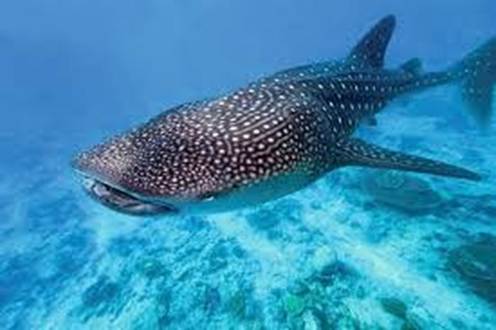
- Whale shark (Rhincodon typus) is the largest fish in the world, reaching 18–20 metres and weighing 20+ tonnes, yet feeds mainly on plankton and fish eggs (filter feeder).
- Listed as Endangered on IUCN Red List due to population decline from fishing, bycatch, and vessel strikes.
Unique Identification
- Each whale shark has a unique white-spot pattern, like a fingerprint, enabling scientists to track individuals across oceans using photo-ID databases.
Distribution & Migration
Indian Context
- Found along Arabian Sea coast, especially Oct–March, following plankton blooms in warm coastal waters; often come within a few hundred metres of shore.
- India is part of their Indo-Pacific migratory corridor, linking East Africa, Arabian Sea, and Southeast Asia.
Why Do They Get Trapped?
Shore-Seine (Kambavala) Fishing
- Traditional nets form long curved walls in shallow waters; effective for sardines but indiscriminate, unable to exclude large megafauna like whale sharks.
- When trapped, sharks face gill entanglement, stress, and suffocation, especially as tides recede.
Bycatch Problem
- Globally, bycatch is among the top threats to marine megafauna; FAO notes millions of tonnes of non-target species are caught annually.
Conservation Framework
Legal Protection in India
- Whale shark is protected under Schedule I of Wildlife (Protection) Act, 1972, giving it the highest legal protection (same as tiger, elephant).
- Hunting or trade is illegal; protection strengthened since early 2000s after decline along Gujarat coast.
Global Protection
- Listed under CITES Appendix II (regulated international trade).
- CMS (Convention on Migratory Species) also recognises whale sharks as migratory species needing international cooperation.
Community Conservation Model
WTI–Kerala Forest Dept Initiative (Since 2017)
- Focus on training fishers, rapid response, and compensation for damaged nets, addressing economic concerns of fishing communities.
- Behavioural change evident: fishers now call for rescue instead of concealment, showing success of participatory conservation.
Gujarat Success Story
- Along Gujarat coast, 1,000+ whale sharks rescued and released over two decades under Pan-India Whale Shark Conservation Programme.
- Cultural campaigns reframed whale shark as “Vhali (beloved) daughter,” reducing hunting.
Ecological Importance
Role in Marine Ecosystem : As filter feeders, whale sharks help regulate plankton populations, indirectly supporting marine food webs and ocean health.
Indicator Species : Presence indicates productive, plankton-rich waters, often linked to healthy marine ecosystems.
Governance & Policy Dimensions
Blue Economy Link : Sustainable fisheries and marine biodiversity conservation are pillars of India’s Blue Economy vision.
Co-Management Approach : Involving communities aligns with CBD principle of participatory conservation and SDG 14 (Life Below Water).
Challenges
- Net damage causes direct livelihood losses, making fishers hesitant without compensation.
- Limited awareness in some regions; many incidents still unreported.
- Climate change may alter plankton patterns, affecting shark migration routes.
Way Forward
- Expand compensation and insurance schemes for bycatch-related net loss.
- Promote bycatch-reducing gear innovations and early-warning networks.
- Strengthen citizen science and photo-ID tracking for research.


