
Content
- Death Sentences in India: Fewer Confirmations, Higher Acquittals
- Ambiguities in the U.S.–India Trade Deal
- Bio-based Chemicals and Enzymes: India’s Bioeconomy Push
- India Adds 50,000+ MW Power Capacity: Renewable Surge
- AI Impact Summit 2026: India & Global AI Governance
- LHS 1903 Planetary System Discovery
- RBI Plan to Compensate Victims of Digital Fraud
Death Sentences in India: Fewer Confirmations, Higher Acquittals
Source : The Hindu
A. Issue in Brief
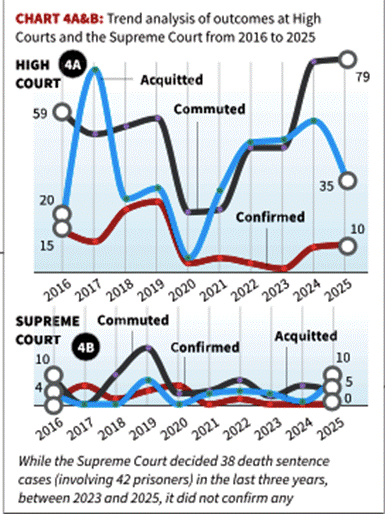
- As of 31 Dec 2025, 574 prisoners (550 men, 24 women) on death row — 43.5% rise since 2016, indicating growing imposition at trial stage despite low final confirmation.
- ~45% death row prisoners for murder; ~37% for murder with sexual offences, showing concentration in aggravated violent crimes.
- NALSAR Death Penalty Report (2025) notes rising removal from death row since 2020 due to appellate courts’ reluctance to confirm capital punishment.
- Only 8.31% death sentences upheld by High Courts; Supreme Court confirmed none in last 3 years, showing systemic dilution at higher judiciary.
- Signals concerns on evidence quality, procedural fairness, and rights protection at trial level.
Relevance
- GS-II (Polity & Governance)
- Judiciary, criminal justice system, due process
- Role of higher judiciary in protecting fundamental rights
- Legal aid and access to justice
B. Static Background
Constitutional & Legal Basis
- Article 21 permits deprivation of life by “procedure established by law” → constitutional basis for death penalty.
- Bachan Singh vs State of Punjab (1980): Introduced “rarest of rare” doctrine, making death penalty an exception.
- Machhi Singh vs State of Punjab (1983): Elaborated aggravating vs mitigating factors framework.
- Death penalty provided under IPC/BNSS for offences like terrorism, waging war, rape-murder, etc.
C. Key Dimensions
Judicial Trends
- 1,310 death sentences (last decade) by Sessions Courts → high trial-level imposition.
- Out of 842 cases reviewed, only 70 confirmed by HCs → strong appellate correction.
- 34.65% HC decisions led to acquittals, indicating serious trial-stage errors.
- Highest acquittal rates:
- Patna HC – 78.31%
- Karnataka HC – 50.46%
- Jharkhand HC – 46.97%
Criminal Justice System Insight
- Pattern suggests over-reliance on capital punishment at trial stage, followed by appellate reversals.
- Reflects investigation gaps, weak legal aid, coerced confessions, and forensic limitations.
D. Critical Analysis
Structural Concerns
- High acquittal rates imply possible wrongful convictions, undermining fairness in irreversible punishment.
- Trial courts may award death penalty under public pressure in heinous crimes, later corrected by higher courts.
- Long death row incarceration creates “death row phenomenon” — psychological torture recognised in jurisprudence.
Rights Perspective
- Global human rights discourse increasingly views death penalty as violative of right to life and dignity.
- Law Commission 262nd Report (2015) recommended abolition except for terrorism-related offences.
Deterrence Debate
- Empirical studies globally show no conclusive proof that death penalty deters crime more than life imprisonment.
- NCRB data show crime trends not directly correlated with capital punishment frequency.
E. Way Forward
- Strengthen forensic infrastructure and investigation quality to reduce wrongful convictions.
- Mandatory mitigation investigation reports before awarding death penalty (as SC suggested in recent rulings).
- Improve legal aid quality at trial stage; many death row prisoners are socio-economically vulnerable.
- Consider legislative re-evaluation of death penalty scope in line with Law Commission suggestions.
- Promote victim-centric justice models focusing on restitution and speedy trials rather than symbolic severity.
F. Exam Orientation
Prelims Pointers
- Death penalty constitutional under Article 21.
- “Rarest of rare” doctrine – Bachan Singh (1980).
- Law Commission 262nd Report recommended partial abolition.
- Supreme Court confirmation required for execution.
Mains Practice Question (15M)
- “The declining confirmation of death sentences by higher courts indicates deeper structural issues in India’s criminal justice system.”Critically examine in light of recent death penalty statistics.
Ambiguities in the U.S.–India Trade Deal
Source : The Hindu
A. Issue in Brief
- India and U.S. moved toward an interim trade deal (2025–26) after prolonged tariff tensions; comes when bilateral trade already crossed ~$190–200 billion (FY24, USTR/GoI data), making U.S. India’s largest trading partner.
- U.S. imposed 25% tariff hikes on select imports and an additional 25% tariff threat linked to Russian oil purchases, blending trade policy with geopolitical leverage.
- U.S. cuts tariffs to 18% on Indian goods; India reportedly indicated ~$500 billion purchase intentions over 5 years in energy, defence, and tech, aimed at narrowing the U.S. trade deficit and stabilising ties.
- Domestic debate intensified due to possible concessions on agriculture, GM foods, and NTBs, raising farmer-income and food-security concerns.
Relevance
- GS-II (International Relations)
- India–U.S. bilateral relations
- Trade diplomacy and strategic autonomy
- Geoeconomics and foreign policy
B. Static Background
Trajectory of India–U.S. Trade
- Bilateral goods & services trade:
- ~$120 bn (2016) → ~$191 bn (2023–24)
- Target often discussed: $500 bn by 2030 (joint ambition statements).
- U.S. accounts for ~18% of India’s exports (largest single-country destination), especially in IT services, pharma, gems & jewellery, engineering goods.
- India runs a goods trade surplus (~$30–35 bn) with the U.S., a recurring U.S. concern.
Disputes
- GSP withdrawal (2019) affected ~$6 bn of Indian exports.
- Section 232 (steel/aluminium) and 301 tariffs created friction.
- Multiple disputes filed at WTO (e.g., ICT products, steel tariffs).
C. Key Dimensions
1) Tariffs & Market Access
- U.S. average applied tariffs:
- ~3–4% overall, but higher on specific sectors (textiles, footwear, agri).
- India’s average tariffs:
- ~17–18% (WTO data); higher in agriculture (30–40%+ in some lines).
- Interim deal discussions focus on:
- Lower Indian duties on nuts, apples, medical devices, select agri.
- Better U.S. access for Indian textiles, leather, and engineering goods.
Example: Earlier tariff cuts on U.S. almonds and apples were used as confidence-building measures.
2) Agriculture Sensitivity
- Agriculture supports ~45% of India’s workforce but contributes ~15–16% of GDP → high livelihood sensitivity.
- U.S. provides large farm support:
- $20–30 bn annually in farm subsidies (OECD estimates vary by year).
- Creates price competitiveness against Indian smallholders.
- India’s red lines:
- Dairy, cereals, pulses, edible oils, and GM foods.
Example: India kept dairy largely out of RCEP, showing consistent defensive stance.
3) Energy & Strategic Trade
- U.S. already among India’s top LNG suppliers:
- U.S. share in India’s LNG imports rose from ~5% (2017) to ~15%+ in some recent years.
- Russian oil:
- Share in India’s crude imports jumped from <2% (pre-2022) to ~35–40% in 2023–24 due to discounts.
- Linking tariffs to Russian oil purchases introduces geoeconomics into trade, potentially constraining India’s diversification strategy.
4) Non-Tariff Barriers (NTBs) & GM Foods
- U.S. repeatedly flags India’s SPS measures and lengthy approvals as NTBs.
- India restricts GM food imports citing:
- Biosafety
- Environmental risks
- Farmer dependency on patented seeds
Example: GM mustard debate in India shows domestic sensitivity to biotech crops.
D. Critical Analysis
Opportunities
- Improved access to U.S. market benefits:
- Textiles & apparel (~$10 bn+ exports to U.S.)
- Pharmaceuticals (U.S. takes ~30–35% of India’s pharma exports)
- Energy deals diversify supply and support India’s role as a major energy consumer economy.
- Trade cooperation complements strategic ties in QUAD, iCET, semiconductor and defence tech cooperation.
Risks
- Import surges can depress prices for MSP-backed crops:
- Example: edible oil import liberalisation earlier hurt domestic oilseed farmers.
- Policy space erosion:
- FTAs may constrain future use of tariffs for infant industry protection.
- Strategic autonomy:
- Trade conditionalities on energy sourcing blur line between commerce and geopolitics.
- Asymmetric bargaining:
- U.S. GDP ~$27 trillion vs India ~$4 trillion → power imbalance in negotiations.
E. Way Forward
- Use tariff-rate quotas (TRQs) for sensitive agri products.
- Strengthen domestic competitiveness via logistics, storage, and value chains rather than only tariffs.
- Institutionalise stakeholder consultations with states & farmer bodies before commitments.
- Diversify export destinations to avoid overdependence on a single market.
- Separate trade diplomacy from geopolitical pressure points to preserve autonomy.
F. Exam Orientation
Prelims Pointers
- U.S. = India’s largest trading partner.
- GSP withdrawal – 2019.
- WTO terms: AoA, SPS, TBT often tested.
- Section 232/301 = U.S. unilateral trade tools.
Mains Practice Question (15M)
- “India’s trade negotiations increasingly reflect a balance between export ambition, farmer protection, and strategic autonomy.”Examine in the context of recent India–U.S. trade developments.
Bio-based Chemicals and Enzymes: India’s Bioeconomy Push
Source : The Hindu
A. Issue in Brief
- Bio-based chemicals are produced from renewable biomass (sugarcane, corn, agri-residue) using fermentation or enzymatic processes, offering lower carbon footprint vs petrochemicals.
- India has prioritised the sector under Department of Biotechnology’s BioE3 Policy (2024) — Biotechnology for Economy, Environment, Employment.
- India still imports key intermediates; e.g., ~$480 million acetic acid imports in 2023, showing petrochemical dependence and opportunity for bio-alternatives.
- Global push for net-zero and circular bioeconomy is driving demand for green chemicals, sustainable fuels, and industrial enzymes.
Relevance
- GS-III (Science & Technology)
- Biotechnology, industrial bioprocessing
- Innovation-led growth sectors
- GS-III (Environment)
- Circular economy
- Low-carbon industrial transition
- Waste-to-wealth
B. Static Background
What are Bio-based Chemicals?
- Industrial chemicals derived from biomass instead of fossil fuels, including:
- Organic acids (lactic, acetic)
- Bio-alcohols (ethanol, butanol)
- Bioplastics & solvents
- Used in plastics, cosmetics, pharma, textiles, packaging.
What are Enzymes?
- Biological catalysts enabling reactions at lower temperature & pressure, reducing energy use by 10–30% in some industrial processes (IEA estimates for bioprocessing).
- Key sectors:
- Detergents
- Food processing
- Pharmaceuticals
- Biofuels
Policy Framework
- BioE3 Policy (2024):
- Focus on bio-manufacturing and green growth.
- Links with Atmanirbhar Bharat and Net Zero 2070 goals.
- Related initiatives:
- National Biofuel Policy
- PLI schemes in chemicals & specialty materials
- SATAT for bio-CNG
C. Key Dimensions
1) Economic Potential
- Global bio-based chemicals market:
- Estimated $110–120 billion, projected to grow at ~10–12% CAGR (industry estimates).
- Enzyme market:
- Global size $12–15 billion, dominated by Novozymes (Denmark) and DSM (Netherlands).
- India’s enzyme market:
- Consolidated; top players hold >75% share.
2) Resource Advantage
- India produces 500+ million tonnes of agri-residue annually, much underutilised or burned.
- Strong sugar industry:
- India among top 2 global sugar producers, enabling ethanol and biochemicals.
3) Industrial Base
- Major Indian players:
- Praj Industries – biofuels & biochemicals.
- Godavari Biorefineries – bio-based chemicals & ethanol.
- Advanced Enzyme Technologies, Rossari Biotech – industrial enzymes.
4) Environmental Gains
- Bio-based chemicals can reduce lifecycle emissions by 30–80% vs petrochemicals (EU bioeconomy studies).
- Support circular economy and waste-to-wealth models.
D. Critical Analysis
Opportunities
- Reduces import dependence on petrochemicals.
- Creates new markets for farmers via biomass value chains.
- Aligns with global ESG investment flows toward green manufacturing.
Risks / Constraints
- Cost disadvantage vs fossil-based chemicals when crude prices are low.
- Limited bioprocessing infrastructure:
- Few bio-foundries, pilot plants, scale-up facilities.
- Technology gaps:
- Advanced enzymes and fermentation tech often imported.
- Market adoption:
- Downstream industries reluctant without price parity.
E. Way Forward
- Scale shared bio-manufacturing infrastructure (bio-foundries, pilot plants).
- Offer green procurement incentives for bio-based products.
- Support R&D-industry linkages via DBT and BIRAC.
- Develop standards & certification for bio-based products.
- Integrate with carbon markets and green finance.
F. Exam Orientation
Prelims Pointers
- BioE3 Policy – DBT initiative.
- Enzymes reduce energy need in industry.
- Bio-based chemicals derive from biomass, not fossil fuels.
- India major agri-residue producer.
Mains Practice Question (15M)
“Bio-based chemicals and enzymes can transform India’s industrial ecosystem from fossil-dependent to bio-economy driven.”Discuss opportunities and challenges.
India Adds 50,000+ MW Power Capacity: Renewable Surge
Source : The Hindu
A. Issue in Brief
- India added 52,537 MW generation capacity in FY 2025–26 (till Jan 31) — highest-ever annual addition, surpassing previous record 34,054 MW (FY 2024–25).
- Addition equals ~11% increase over last year’s base capacity, indicating accelerated infrastructure build-out.
- 39,657 MW (≈75%) of new capacity from renewables, led by 34,955 MW solar and 4,613 MW wind.
- India’s total installed capacity now at 5,20,510.95 MW (≈520.5 GW), reflecting rapid energy-sector expansion.
Relevance
- GS-III (Infrastructure & Energy)
- Power sector, renewable transition
- Grid stability and storage
- GS-III (Environment)
- Climate commitments (Panchamrit)
- Decarbonisation pathway
B. Static Background
India’s Power Mix – Structural Context
- Current installed capacity share:
- Renewables (incl. large hydro): ~50.5% (2,63,189 MW)
- Fossil fuels: ~48% (2,48,541 MW)
- Nuclear: ~1.6% (8,780 MW)
- India is the 3rd-largest electricity producer and consumer globally (IEA).
- Electricity demand growing ~6–7% annually due to urbanisation, EVs, cooling demand, and industrial growth.
Policy Framework Driving Growth
- National Electricity Plan (CEA) projects ~900 GW capacity by 2032 to meet demand and climate goals.
- Panchamrit commitments (COP26):
- 500 GW non-fossil capacity by 2030
- 50% energy from renewables
- Net Zero by 2070
- Key schemes:
- PLI for solar modules
- Green Energy Corridor
- PM Surya Ghar Rooftop Solar
- ISTS charge waivers for renewables
C. Key Dimensions
1) Solar Dominance
- 34,955 MW solar added in one year:
- Nearly equals total solar capacity addition of many countries annually.
- India already among top 5 global solar markets.
- Falling solar tariffs:
- Utility-scale tariffs reached ₹2–2.5/unit range in recent bids, improving competitiveness.
2) Wind Sector
- 4,613 MW wind addition shows revival after slow years.
- Offshore wind policy and hybrid projects (solar-wind-storage) gaining traction.
3) Energy Transition Signal
- Renewables now largest share in installed capacity, a structural shift from coal dominance a decade ago.
- In 2014:
- Renewables share was ~30% or less (including hydro).
- Coal dominated >60%.
4) Grid & Storage Implications
- Higher RE penetration requires:
- Battery Energy Storage Systems (BESS)
- Pumped hydro
- Smart grids
- CEA estimates India may need ~27 GW storage by 2030.
D. Critical Analysis
Opportunities
- Reduces fossil import bill:
- India imports ~85% of crude oil and significant coal.
- Supports climate diplomacy credibility.
- Creates green jobs:
- Solar & wind sectors labour-intensive in installation phase.
Challenges
- Installed capacity ≠ actual generation:
- Coal still provides ~70% of actual electricity generation due to higher PLFs.
- Land acquisition and transmission bottlenecks slow RE deployment.
- DISCOM financial stress affects payment security to RE developers.
E. Way Forward
- Accelerate storage deployment for grid stability.
- Reform DISCOMs under RDSS scheme for financial viability.
- Promote domestic manufacturing of modules, cells, and batteries.
- Integrate green hydrogen with renewable growth.
- Strengthen interstate transmission for RE-rich states.
F. Exam Orientation
Prelims Pointers
- India = 3rd largest power producer globally.
- 500 GW non-fossil target by 2030.
- Renewables now >50% of installed capacity.
- Nuclear share ~1–2%.
Mains Practice Question (15M)
- “India’s rapid renewable capacity addition is transforming its energy landscape, but structural challenges remain.”Examine.
AI Impact Summit 2026: India & Global AI Governance
Source : The Hindu
A. Issue in Brief
- AI Impact Summit 2026 hosted by India at Bharat Mandapam (Feb 16–20) — first time the global AI summit is hosted in a Global South country, signalling India’s growing AI diplomacy role.
- Participation from ~100 countries, 20+ heads of state/government, and global tech CEOs like Sundar Pichai, Sam Altman, Demis Hassabis, showing high geopolitical-tech convergence.
- Event includes India AI Impact Expo with 300+ exhibitions, 3,000+ speakers, and expected 2.5 lakh visitors, making it one of the largest AI gatherings globally.
- India positions summit around “human-centric AI” and equitable access rather than heavy regulation-first models.
Relevance
- GS-II (International Relations)
- Tech diplomacy
- Global governance of emerging tech
- India as Global South voice
- GS-III (Science & Tech)
- AI ecosystem, compute infrastructure
- DPI model and AI applications
B. Static Background
Global AI Governance Context
- Previous AI summits hosted by:
- UK (Bletchley Park, 2023)
- South Korea
- France
- Global debate split between:
- EU-style regulation-first approach (AI Act)
- U.S.-style innovation-led governance
- China’s state-driven AI model
- India advocates inclusive AI governance for Global South, aligned with its Digital Public Infrastructure (DPI) diplomacy.
India’s AI Ecosystem
- India among top 5 AI talent pools globally (Stanford AI Index, recent editions).
- MeitY-backed IndiaAI Mission (~₹10,000+ crore outlay approved in 2024) focuses on:
- Compute infrastructure
- Datasets
- Startups
- Skilling
- India has 100,000+ AI professionals and one of the world’s largest startup ecosystems.
C. Key Dimensions
1) Geopolitical Significance
- AI seen as strategic technology shaping economic and military power.
- Hosting summit boosts India’s soft power similar to:
- G20 Presidency 2023
- Voice of Global South Summits
- Engagement from Brazil, France, UAE, African and Latin American states indicates South–South tech diplomacy.
2) Economic & Innovation Impact
- Global AI market projected to reach:
- $1–1.5 trillion by 2030 (PwC/McKinsey estimates).
- AI could add ~$500 billion to India’s GDP by 2025–30 period (industry estimates).
- AI-driven productivity gains expected in:
- Health
- Agriculture
- Education
- Governance
3) Human-Centric AI Approach
- Focus on People, Planet, Progress:
- AI for climate modelling
- Smart agriculture
- Public service delivery
- Aligns with India’s DPI model:
- Aadhaar
- UPI
- CoWIN
4) Tech Diplomacy & Standards
- Early participation in AI standards can prevent rule-setting dominance by developed nations.
- Opportunity to shape global norms on ethics, data governance, and access to compute.
D. Critical Analysis
Opportunities
- Positions India as bridge between tech powers and developing world.
- Boosts domestic AI startup visibility and investment.
- Enhances India’s claim as trusted tech partner.
Concerns / Risks
- Compute gap:
- Advanced AI requires high-end GPUs; global supply concentrated in few firms.
- Data governance:
- Balancing innovation with privacy under DPDP Act 2023.
- Skill gap:
- Large talent pool but uneven advanced research capacity.
- Ethical debates and reputational risks around controversial attendees can politicise events.
E. Way Forward
- Invest in national AI compute infrastructure and semiconductor ecosystem.
- Promote open datasets for public-good AI.
- Strengthen AI skilling under Skill India Digital.
- Develop balanced AI regulation ensuring safety without stifling startups.
- Lead Global South AI coalition for equitable access.
F. Exam Orientation
Prelims Pointers
- IndiaAI Mission – MeitY initiative.
- EU AI Act = regulation-first model.
- AI summits earlier in UK, Korea, France.
- DPI model = Aadhaar, UPI, CoWIN.
Mains Practice Question (15M)
- “AI governance is emerging as a key arena of global power politics.” Discuss India’s role in shaping inclusive and human-centric AI governance.
LHS 1903 Planetary System Discovery
Source : The Hindu
A. Issue in Brief
- Astronomers identified a four-planet system around red dwarf star LHS 1903 (117 light-years away) that challenges existing planet formation theories.
- System contains 2 rocky super-Earths + 2 gaseous mini-Neptunes, but unusually the outermost planet is rocky instead of gaseous, contradicting classical models.
- Observed using ESA’s CHEOPS (Characterising Exoplanet Satellite) space telescope dedicated to exoplanet studies.
- One rocky planet has estimated surface temperature ~60°C, placing it near the inner edge of habitable conditions.
Relevance
- GS-III (Science & Technology — Space)
- Exoplanets, astronomy
- Space missions and telescopes

B. Static Background
What are Exoplanets?
- Planets outside our solar system; over 5,500 exoplanets confirmed (NASA Exoplanet Archive, recent data).
- Detection methods:
- Transit method (most common)
- Radial velocity
- Direct imaging
Planet Formation Theory
- Standard model:
- Planets form in a protoplanetary disk of gas and dust.
- Inner planets = rocky (gas evaporates due to heat).
- Outer planets = gaseous (retain hydrogen-helium).
- LHS 1903 system deviates from this expected pattern.
Red Dwarf Stars
- Make up ~70–75% of stars in Milky Way.
- Smaller, cooler, longer-lived than Sun:
- LHS 1903 is ~50% Sun’s mass
- Only ~5% Sun’s luminosity
- Habitable zones closer to the star due to low luminosity.
C. Key Dimensions
1) Scientific Significance
- Rocky outer planet suggests:
- Sequential formation rather than simultaneous.
- Gas depletion before last planet formed.
- Alternative hypothesis:
- Planet lost atmosphere due to stellar radiation or collision.
2) Habitability Angle
- Surface temperature ~60°C:
- High but potentially within extremophile tolerance.
- Habitability also depends on:
- Atmosphere
- Water presence
- Magnetic field
- Many potentially habitable exoplanets found around red dwarfs.
3) Technology & Space Science
- CHEOPS mission (launched 2019):
- ESA mission focused on characterising known exoplanets.
- Measures planet size, density, and orbit.
- Complements missions like:
- NASA’s TESS
- James Webb Space Telescope
D. Critical Analysis
Opportunities for Science
- Forces refinement of planetary formation models.
- Improves understanding of atmospheric evolution and planetary migration.
- Expands search criteria for habitable worlds.
Limitations
- Habitability inference based on temperature alone is incomplete.
- Red dwarfs emit strong stellar flares:
- Can strip atmospheres and harm life prospects.
- Distance (117 light-years) makes direct study difficult.
E. Way Forward
- Use JWST spectroscopy to detect atmospheric gases.
- Study more red dwarf systems to see if pattern repeats.
- Integrate findings into next-gen planet formation simulations.
F. Exam Orientation
Prelims Pointers
- Exoplanets = planets outside solar system.
- Red dwarfs most common stars.
- CHEOPS = ESA exoplanet mission.
- Super-Earth vs mini-Neptune distinction.
Mains Practice Question (10–15M)
- “Recent exoplanet discoveries are reshaping our understanding of planetary formation and habitability.”Discuss with examples.
RBI Plan to Compensate Victims of Digital Fraud
Source : The Indian Express
A. Issue in Brief
- RBI proposed a framework (Feb 2025) to compensate victims of digital payment frauds, especially UPI-related scams, addressing rising consumer vulnerability in India’s fast-growing digital economy.
- Proposal follows surge in complaints: National Cybercrime Reporting Portal recorded ~25 lakh cyber complaints in 2024, many linked to financial fraud.
- RBI aims to shift from purely customer-liability model to a shared-responsibility and faster-redress system.
- Reflects need to sustain trust in India’s Digital Public Infrastructure (UPI, AEPS, cards, wallets).
Relevance
- GS-II (Governance)
- Consumer protection
- Role of RBI as regulator
- Ombudsman and grievance redressal
- GS-III (Economy & Internal Security)
- Digital economy & fintech risks
- Cyber fraud and financial security
B. Static Background
Digital Payments Growth Context
- India is world leader in real-time payments:
- UPI processed 100+ billion transactions in 2023–24 (NPCI data).
- Monthly UPI transactions often exceed ₹15–20 lakh crore.
- Rapid scale has also expanded fraud surface area.
Existing Liability Framework
- RBI’s 2017 circular on “Customer Protection – Limiting Liability”:
- Zero liability if customer reports promptly and no negligence.
- Limited liability if delay or customer fault.
- However, delays in dispute resolution often leave victims uncompensated.
C. Key Dimensions
1) Rising UPI Fraud Trends
UPI fraud data (as per Parliamentary replies):
| Year | Fraud Cases | Amount |
| 2021–22 | ~4.07 lakh | ~₹242 crore |
| 2022–23 | ~7.25 lakh | ~₹573 crore |
| 2023–24 | ~13.42 lakh | ~₹1,087 crore |
| 2024–25 | ~12.64 lakh | ~₹981 crore |
| 2025–26* | ~10.64 lakh | ~₹805 crore |
(*till Dec 2025)
Shows 3–4x rise in cases since 2021–22.
2) RBI Proposed Compensation Structure
- Compensation cap proposed: up to ₹25 thousand per victim (or 85% of actual loss, whichever lower).
- RBI to create a dedicated fund (~20% contribution from banks).
- Banks expected to contribute ~15%+ share, ensuring industry skin-in-the-game.
- Focus on cases involving:
- OTP scams
- Social engineering
- App-based fraud
3) Consumer Protection & Trust
- Digital payments rely on network trust:
- Any fear reduces adoption, especially among elderly and rural users.
- RBI signals shift toward proactive consumer protection, not just reactive grievance handling.
4) Institutional Mechanism
- Integration with:
- NPCI dispute resolution
- Ombudsman framework
- Cybercrime portal coordination
- Faster turnaround expected compared to current bank-led investigations.
D. Critical Analysis
Opportunities
- Strengthens confidence in DPI ecosystem (UPI, Aadhaar, Jan Dhan).
- Encourages reporting rather than silent victimhood.
- Aligns with global best practices:
- UK & EU frameworks ensure faster fraud refunds.
Concerns / Risks
- Moral hazard:
- Users may lower vigilance expecting refunds.
- Fraud ecosystem increasingly sophisticated:
- Deepfakes, spoofed calls, phishing-as-a-service.
- Burden on banks:
- Rising fraud losses could affect profitability.
- Enforcement gap:
- Low conviction rates in cyber fraud cases.
E. Way Forward
- Strengthen real-time fraud detection using AI/ML.
- Nationwide digital literacy campaigns under Digital India.
- Mandatory cooling period for high-risk transactions.
- Stronger KYC norms for mule accounts.
- Faster coordination between banks and law enforcement.
F. Exam Orientation
Prelims Pointers
- UPI = NPCI-run real-time payment system.
- RBI Ombudsman handles digital payment complaints.
- India leads world in real-time digital payments volume.
- Customer liability rules from RBI 2017 circular.
Mains Practice Question (15M)
- “Rapid digitisation of finance must be accompanied by robust consumer protection.”Discuss in context of rising digital payment frauds in India.


