
Content
- India’s Strengthened Sports Ecosystem
- VoicERA Launched on BHASHINI National Infrastructure at India AI Impact Summit 2026
India’s Strengthened Sports Ecosystem
A. Issue in Brief
- Khelo India was originally launched in 2017–18 as a central sector scheme to promote grassroots sports participation and excellence across India through infrastructure support, competitions, and talent identification.
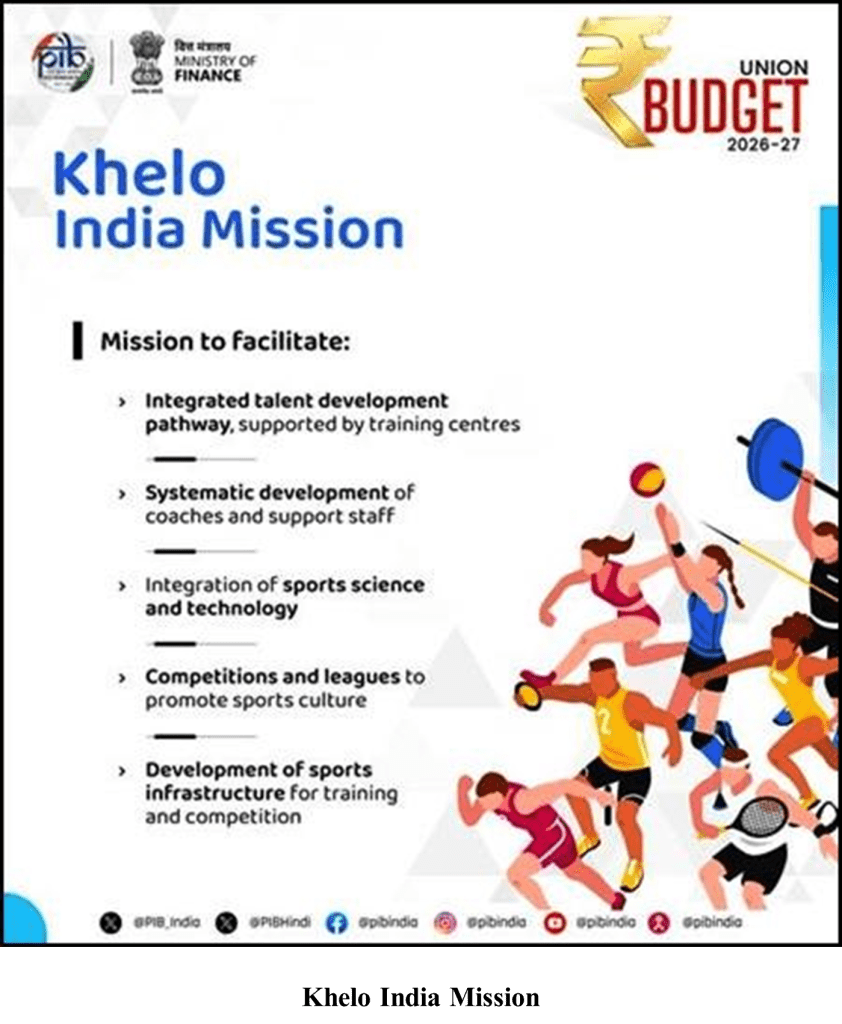
- Union Budget 2026–27 does not newly launch Khelo India but upgrades it into a Khelo India Mission, signalling a decade-long, outcome-driven, mission-mode transformation of India’s sports ecosystem.
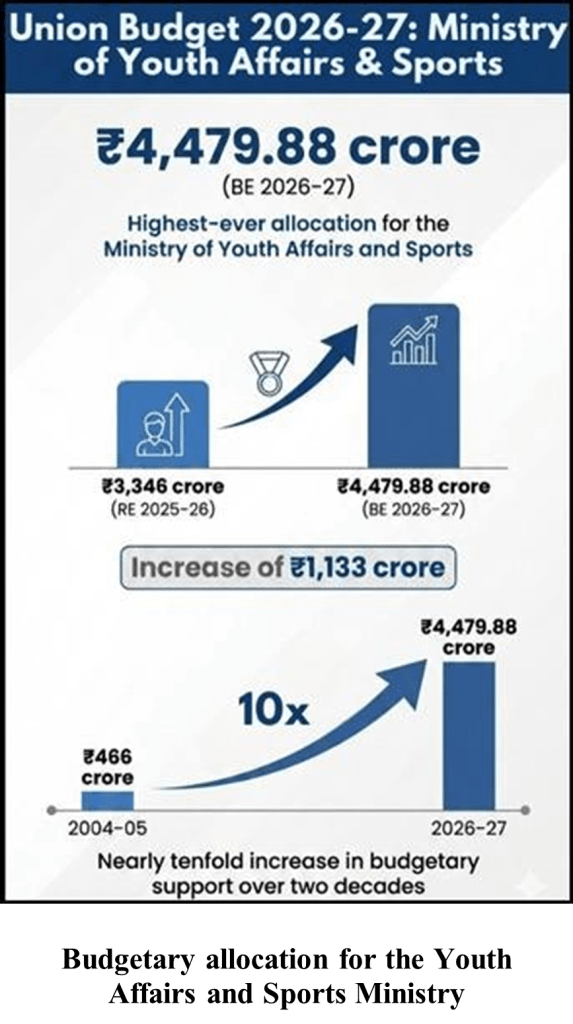
- The Ministry of Youth Affairs and Sports received its highest-ever allocation of ₹4,479.88 crore, demonstrating sustained fiscal prioritisation of youth empowerment and sporting excellence.
- The Budget provides ₹924.35 crore for Khelo India (2026–27) and announces a ₹500 crore Sports Goods Manufacturing Initiative, integrating sports into economic and industrial strategy.
- National vision: India among the Top 10 sporting nations by 2036 and Top 5 by 2047, aligning sports development with the Viksit Bharat roadmap.
Relevance
GS 1 (Society):
- Youth empowerment, social mobility through sports.
- Gender inclusion in competitive participation.
- Sports as instrument of national identity and social cohesion.
GS 3 (Economy):
- Sports economy expansion (₹500 crore manufacturing initiative).
- Employment generation in sports science, coaching, analytics.
- Export potential in sports goods clusters.
B. Constitutional / Legal Dimensions
- Article 21 (Right to Life) encompasses health and dignity; systematic sports promotion supports preventive healthcare, mental well-being, and holistic human development.
- Article 47 (DPSP) mandates improvement of public health; expanding sports participation operationalises this directive through structured fitness and youth engagement frameworks.
- Sports fall under Entry 33, State List, yet Union-led funding through centrally sponsored frameworks reflects cooperative federalism and national standard-setting.
- Anti-doping compliance aligns with the World Anti-Doping Agency, ensuring fairness and safeguarding India’s international sporting credibility.
- Olympic governance reforms operate within norms of the International Olympic Committee, integrating domestic regulatory standards with global expectations.
C. Governance / Institutional Shift
- Transition from scheme-based implementation (2016–2026) to a mission-mode framework (2026 onwards) reflects emphasis on long-term planning, measurable outcomes, and institutional accountability.
- Financial scaling shows policy continuity: ₹1,756 crore (2017–20), ₹3,790.50 crore (2021–26), and ₹924.35 crore (2026–27) under Khelo India.
- The Mission seeks to create a seamless talent pipeline, linking grassroots competitions, scientific training, elite academies, and international exposure to minimise talent attrition.
- Emphasis on performance metrics, infrastructure benchmarking, and federated coordination indicates a shift toward evidence-based sports governance.
D. Economic Dimensions
- The global sports industry exceeds $500 billion, encompassing manufacturing, broadcasting, infrastructure, analytics, and event management, offering significant export and employment potential.
- The ₹500 crore manufacturing initiative aims to enhance domestic equipment production, strengthen R&D, and integrate MSMEs into global sports supply chains.
- Sports infrastructure expansion stimulates allied sectors including construction, tourism, sports medicine, media rights, and analytics, generating multiplier effects across the economy.
- Skill development in coaching, physiotherapy, sports science, and performance analytics aligns sports policy with Skill India and demographic dividend utilisation strategies.
E. Social / Ethical Dimensions
- Sports participation fosters discipline, teamwork, resilience, and leadership, strengthening social capital and reinforcing national identity through collective achievement.
- Focus on women’s participation and inclusive access promotes gender equality and aligns with constitutional principles of non-discrimination.
- Mass sports engagement reduces incidence of non-communicable diseases (NCDs), contributing to long-term public health savings and productivity enhancement.
- Transparent federation governance and strict anti-doping enforcement uphold ethical integrity and sustain public trust in competitive sports systems.
F. Infrastructure & Technology
- Development of grassroots sports complexes in rural and semi-urban areas addresses spatial inequities and broadens the athletic talent base.
- Integration of sports science, biomechanics, AI-based performance tracking, and injury analytics enhances global competitiveness and career longevity of athletes.
- Digital talent identification systems enable data-driven scouting and monitoring, improving coordination between schools, academies, and federations.
- Public–Private Partnerships (PPP) in stadium and academy development accelerate infrastructure creation while maintaining financial sustainability.
G. Challenges / Gaps
- Persistent governance deficits and politicisation within sports federations undermine transparency, athlete welfare, and institutional efficiency.
- Urban–rural disparities in infrastructure limit equitable access to high-quality training facilities and professional coaching.
- Inadequate athlete social security mechanisms contribute to economic insecurity and early career dropouts.
- Doping violations, if poorly addressed, risk reputational damage and potential international sanctions.
H. Way Forward
- Establish an independent National Sports Development Authority for governance reform, financial auditing, and performance monitoring of federations.
- Institutionalise comprehensive athlete welfare frameworks, including insurance, pension, education continuity, and post-retirement career planning.
- Develop sports manufacturing clusters with export facilitation and innovation grants to strengthen global competitiveness.
- Integrate structured sports education under NEP 2020, universalising early talent identification and physical literacy.
- Strengthen NADA’s enforcement capacity to maintain zero-tolerance doping standards aligned with global norms.
Exam Orientation
Prelims Pointers
- Khelo India launched: 2016–17; upgraded to Khelo India Mission (2026–27).
- Ministry allocation (2026–27): ₹4,479.88 crore.
- Khelo India allocation (2026–27): ₹924.35 crore.
- Sports Goods Manufacturing Initiative: ₹500 crore.
- Sports fall under State List (Entry 33).
Practice Question
- “Examine how the transition from the Khelo India Scheme (2016–17) to the Khelo India Mission (2026–27) reflects a structural shift in India’s sports governance and assess its economic and social implications.”(250 Words)
VoicERA Launched on BHASHINI National Infrastructure at India AI Impact Summit 2026
A. Issue in Brief
- VoicERA, an open-source, end-to-end Voice AI stack, was launched at the India AI Impact Summit 2026, marking expansion of India’s Digital Public Infrastructure (DPI) ecosystem into conversational AI.
- Developed by the Digital India BHASHINI Division (DIBD) under Digital India Corporation (DIC), Ministry of Electronics and IT (MeitY), reinforcing sovereign AI capabilities.
- Deployed on BHASHINI National Language Infrastructure, creating a national execution layer for multilingual Voice and Language AI at population scale.
- Designed as open, pluggable, interoperable, cloud-deployable, and on-premise ready, reducing duplication of effort and eliminating vendor lock-in.
Relevance
GS 3 (Science & Tech):
- Indigenous Voice AI stack (sovereign AI capability).
- Open-source architecture; reduced vendor lock-in.
- Data protection alignment (DPDP Act, 2023).
GS 3 (Economy):
- Startup ecosystem boost via shared APIs.
- DPI export potential to Global South.
B. Constitutional / Legal Dimensions
- Article 14 (Equality before Law) supports equitable digital access; multilingual voice interfaces enhance inclusion across India’s linguistic diversity.
- Article 19(1)(a) strengthens citizen expression; voice-based governance enables communication with the State in native languages.
- Article 21 (Right to Life & Dignity) operationalised through accessible digital services for low-literacy and digitally excluded populations.
- Alignment with the Digital Personal Data Protection Act, 2023 ensures lawful voice data processing, consent management, and accountability safeguards.
- Advances sovereign digital capability under Digital India Mission, reducing reliance on proprietary foreign AI platforms.
C. Governance / Institutional Architecture
- BHASHINI functions as India’s National Language Infrastructure, supporting translation, speech recognition, and cross-lingual communication services.
- Integration of VoicERA expands BHASHINI from translation-focused infrastructure to a real-time speech, conversational AI, and multilingual telephony platform.
- Collaboration with EkStep Foundation, COSS, IIIT Bengaluru, and AI4Bharat reflects a public–private–academic innovation model.
- Enables rapid onboarding of departments for citizen services, including agriculture advisories, grievance redressal, education support, livelihood services, and scheme discovery.
D. Digital Public Infrastructure (DPI) Perspective
- Positions Voice AI as a Digital Public Good, analogous to Aadhaar (identity) and UPI (payments) within India’s DPI stack.
- Open architecture ensures interoperability, scalability, and cost efficiency, preventing monopolistic technology dependence.
- Cloud and on-premise deployment enhances cybersecurity control and adaptability across Union and State governments.
- Supports multilingual telephony systems at population scale, directly addressing the digital divide.
E. Economic / Innovation Dimensions
- Strengthens sovereign AI ecosystem, fostering indigenous innovation in speech recognition, NLP, and conversational technologies.
- Enables startups and MSMEs to build solutions using shared APIs, lowering entry barriers in voice-enabled governance markets.
- Facilitates AI-driven expansion in sectors such as agri-tech, ed-tech, fintech, and telemedicine, enhancing productivity and service delivery.
- Positions India as a Global South leader in inclusive AI governance, with potential DPI export opportunities.
F. Social / Inclusion Dimensions
- Voice interfaces enhance access for low-literacy populations, persons with disabilities, and rural citizens, strengthening inclusive governance.
- Multilingual conversational AI promotes linguistic diversity and cultural inclusion within national digital systems.
- Voice-enabled grievance and feedback systems deepen participatory governance and citizen-state trust.
- Reduces transaction costs for welfare access in aspirational districts and remote regions.
G. Technology / Security Dimensions
- Modular voice stack separates speech recognition, natural language understanding, and speech synthesis, enabling flexible upgrades and security audits.
- Open-source architecture enhances auditability, transparency, and algorithmic accountability in public AI systems.
- Secure deployment frameworks align with national cybersecurity priorities, minimising risks of data misuse or unauthorised access.
- Real-time conversational systems enable scalable deployment of AI-powered public services across geographies.
H. Challenges / Risks
- Large-scale voice data collection raises privacy and consent management concerns, necessitating strict compliance with data protection standards.
- Risk of algorithmic bias in dialect and accent recognition may affect equitable service delivery.
- Infrastructure disparities in telecom bandwidth and digital literacy may limit uniform system performance.
- Cybersecurity risks in voice authentication require robust encryption and layered security frameworks.
I. Way Forward
- Establish a National Voice AI Governance Framework for transparency, audit mechanisms, and ethical AI compliance.
- Integrate VoicERA across State portals to strengthen cooperative federal digital governance models.
- Develop comprehensive consent management and anonymisation protocols aligned with the DPDP Act, 2023.
- Expand indigenous language datasets to reduce bias and improve speech recognition accuracy.
- Leverage digital diplomacy to export the BHASHINI–VoicERA DPI model to Global South partners.
J. Exam Orientation
Prelims Pointers
- VoicERA: Open-source Voice AI stack launched at India AI Impact Summit 2026.
- Built on BHASHINI National Language Infrastructure under MeitY.
- Designed as interoperable, cloud-deployable, on-premise ready architecture.
- Part of India’s expanding Digital Public Infrastructure (DPI) ecosystem.
Practice Question
- “Evaluate how the integration of VoicERA with BHASHINI advances India’s Digital Public Infrastructure, strengthens sovereign AI capability, and promotes inclusive digital governance.”(250 Words)


