
Content
- India and Brazil sign MoU to strengthen and secure steel supply chain
- Sarvam AI Powering a Made-in-India AI Revolution
India and Brazil sign MoU to strengthen and secure steel supply chain
A. Issue in Brief
- India and Brazil signed a Memorandum of Understanding (MoU) to strengthen and secure the steel supply chain, focusing on mining cooperation, mineral processing, recycling technologies, automation, and AI-driven geoscientific exploration, thereby institutionalising long-term strategic mineral partnership.
- The MoU was exchanged in the presence of Narendra Modi and Luiz Inácio Lula da Silva, signalling high-level political backing and elevating mineral diplomacy within the broader India–Brazil strategic partnership framework.
- India currently has 218 million tonnes (MT) steelmaking capacity and aims to reach 300 MT by 2030 under the National Steel Policy, 2017, making assured access to iron ore and alloying minerals structurally critical.
- Brazil is a leading global producer of iron ore and holds substantial reserves of manganese, nickel, and niobium, key inputs for high-strength and stainless steel production.
Relevance:
GS I (Geography – World Resources & Industrial Location)
- Brazil’s vast iron ore reserves (Carajás, Minas Gerais), Atlantic coastline, and Amazon–Highlands physiography make it a key global mineral hub influencing industrial supply chains and India’s resource geography strategy.
GS II (International Relations)
- Mineral diplomacy strengthening India–Brazil strategic partnership within BRICS and advancing supply-chain diversification for strategic autonomy.
GS III (Economy & Infrastructure)
- Raw material security critical for achieving 300 MT steel capacity under National Steel Policy and sustaining infrastructure-led growth.
B. Static Background
Steel Sector – India
- The National Steel Policy (2017) targets 300 MT capacity by 2030–31 and enhanced domestic consumption, reflecting steel’s centrality to infrastructure expansion, manufacturing growth, and defence indigenisation.
- Steel is part of the Eight Core Industries, linking directly with IIP performance and major schemes such as PM Gati Shakti, housing, railways modernisation, and renewable energy deployment.
Brazil’s Mineral Strength
- Brazil is the world’s 2nd largest exporters of high-grade iron ore, and a dominant holder of global niobium reserves, critical for producing lightweight, high-strength alloy steels.
- Its mineral portfolio complements India’s demand for alloy inputs such as manganese (strengthening agent) and nickel (corrosion resistance).
Strategic Context
- Critical mineral security has gained urgency amid supply chain disruptions and concentration of mineral processing capacities in limited geographies.
- Both countries are members of BRICS, reinforcing the Global South cooperation dimension in resource governance.
C. Key Dimensions
| Strategic Gains | Key Challenges |
| Diversifies mineral sourcing and enhances supply chain resilience, reducing vulnerability to geopolitical disruptions. | Long shipping routes and freight costs may impact price competitiveness. |
| Secures access to niobium and high-grade iron ore, crucial for advanced infrastructure and defence-grade steel. | Commodity price volatility may dilute long-term stability unless structured contracts exist. |
| Promotes AI-enabled exploration and automation, improving efficiency and reducing wastage in mining operations. | Technology transfer may remain limited without structured joint R&D frameworks. |
| Supports sustainability via recycling and beneficiation technologies, aligning with green steel transition. | Domestic regulatory and environmental clearances may slow implementation. |
Concept Flow
Rising Infrastructure Demand
→ Target 300 MT Steel Capacity
→ Need for Secure Raw Materials
→ India–Brazil MoU
→ AI + Sustainable Mining + Alloy Security
→ Industrial Resilience & Strategic Autonomy
D. Critical Analysis
Economic
- Steel demand is structurally tied to infrastructure and urbanisation; thus, mineral security directly influences India’s long-term industrial competitiveness and GDP growth trajectory.
- However, India remains import-dependent on coking coal, indicating that broader diversification beyond iron ore is required for holistic supply security.
Strategic
- Mineral supply chains are increasingly geopoliticised; diversifying toward Brazil strengthens India’s strategic autonomy and reduces excessive concentration risk in global processing hubs.
- Cooperation within BRICS enhances South–South industrial collaboration and contributes to multipolar economic architecture.
Technological
- Integration of artificial intelligence in mineral exploration can improve geological accuracy, reduce exploration risk, and lower operational costs over time.
- Recycling and beneficiation technologies support circular economy objectives and reduce environmental footprint.
Environmental
- The steel sector contributes approximately 7–8% of global CO₂ emissions, making sustainable mining and green steel production essential for climate commitments and export competitiveness (e.g., CBAM compliance).
Governance & Social
- Effective implementation requires Centre–State coordination in mining approvals and adherence to environmental safeguards under the Forest Rights Act, 2006, and related regulations.
E. Way Forward
- Conclude long-term offtake agreements with pricing safeguards to reduce exposure to global commodity volatility.
- Establish joint R&D and technology-sharing platforms to ensure genuine capacity building in AI-based exploration and sustainable mining.
- Align the partnership with India’s Green Hydrogen Mission to accelerate low-carbon steel production pathways.
- Strengthen domestic beneficiation, logistics infrastructure, and port connectivity to maximise gains from diversified mineral sourcing.
F. Exam Orientation
Prelims Pointers
- India’s steel capacity: 218 MT; target 300 MT by 2030.
- Brazil: Major producer of iron ore, manganese, nickel, niobium.
- Steel contributes ~7–8% of global CO₂ emissions.
- National Steel Policy: 2017.
Mains Practice Question
- “Discuss the strategic importance of diversifying critical mineral supply chains for India’s steel sector. Evaluate the role of the India–Brazil MoU in enhancing industrial resilience.”(250 Words)
Intro Options
- “In the era of mineral geopolitics, control over supply chains has become central to economic sovereignty.”
- “India’s ambition to achieve 300 MT steel capacity by 2030 necessitates diversified and technology-driven mineral partnerships.”
Conclusion Framework
- Resource security must translate into industrial resilience, technological upgrading, and sustainable production, ensuring that mineral diplomacy strengthens both economic growth and strategic autonomy.
Notes on Brazil
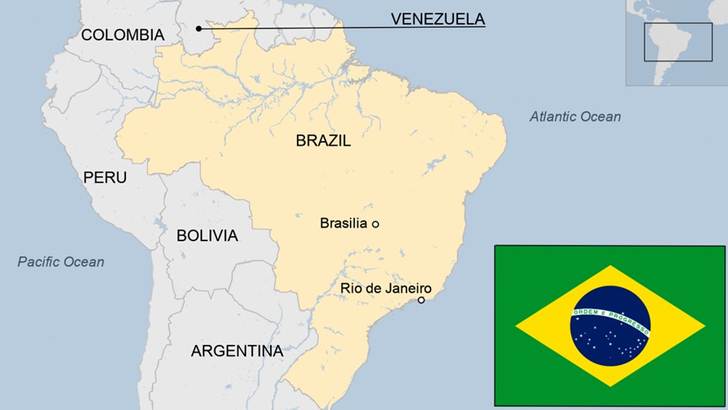
Location
- Brazil is located in eastern South America and is the largest country in South America and the fifth-largest country in the world by area.
Water Bodies Surrounding Brazil
- Brazil has an extensive eastern coastline along the Atlantic Ocean, making it strategically important for trans-Atlantic maritime trade.
- Major rivers include the Amazon River (world’s largest by discharge), São Francisco River, and Paraná River (partly forming border with Paraguay and Argentina).
Neighbouring Countries
Brazil shares borders with 10 countries:
- Venezuela, Guyana, Suriname, French Guiana (France – overseas territory), Colombia, Peru, Bolivia, Paraguay, Argentina, Uruguay
Note: Brazil does not share borders with Chile and Ecuador (important prelims trap).
Physiographic Features
- Dominated by the Amazon Basin in the north and west.
- Brazilian Highlands in the east and south.
- Significant iron ore reserves located in Minas Gerais and Carajás region.
Sarvam AI Powering a Made-in-India AI Revolution
A. Issue in Brief
- Sarvam AI is emerging as a key pillar of India’s sovereign, multilingual AI ecosystem, developing indigenous foundational models tailored to Indian languages, governance needs, and enterprise applications under the IndiaAI Mission.
- It is among 12 organisations selected under the Innovation Centre pillar of IndiaAI Mission, receiving ₹246.72 crore in financial and compute support to build large language and speech models rooted in Indian linguistic diversity.
- The initiative reflects India’s push toward technological sovereignty, digital public infrastructure (DPI) expansion, and reduced dependence on foreign AI systems, particularly in governance, citizen services, and strategic data ecosystems.
- Sarvam AI’s full-stack platform spans compute infrastructure, foundational models, enterprise applications, and edge deployment, positioning AI as a population-scale public good aligned with the vision of Viksit Bharat.
Relevance :
GS II (Governance & Polity)
- Indigenous AI integrated with Digital Public Infrastructure enhances welfare delivery while raising data protection and privacy considerations (Article 21).
GS III (Science & Technology)
- Development of sovereign foundational AI models under IndiaAI Mission advances technological self-reliance.
B. Static Background
1. IndiaAI Mission
- The IndiaAI Mission aims to create indigenous AI capacity across compute, datasets, skilling, startups, and foundational model development, ensuring India does not remain merely a consumer of global AI technologies.
- It integrates AI development with India’s Digital Public Infrastructure (DPI) ecosystem such as Aadhaar, UPI, DigiLocker, and ONDC, thereby embedding AI into governance and service delivery frameworks.
2. AI & Strategic Autonomy
- Foundational models (LLMs, speech models) act as the base layer for generative AI systems; dependence on foreign models raises concerns about data sovereignty, algorithmic bias, and regulatory vulnerability.
- Indigenous AI aligns with Atmanirbhar Bharat, ensuring local language coverage across 22 Scheduled Languages and reducing digital exclusion.
3. Digital Governance Context
- India processes billions of transactions via Aadhaar and UPI, creating massive datasets requiring secure, sovereign AI tools for analytics, fraud detection, and multilingual service delivery.
C. Key Dimensions
| Strategic Gains | Challenges / Risks |
| Strengthens technological sovereignty by developing foundational AI models within India, reducing reliance on foreign cloud and AI providers. | High compute costs and energy-intensive AI infrastructure may strain fiscal and environmental resources. |
| Promotes multilingual inclusion, covering 22 Scheduled Languages and code-mixed speech, enhancing accessibility in governance. | Ensuring accuracy across dialects and low-resource languages remains technically challenging. |
| Integrates AI into public service delivery (Aadhaar, state governance), improving efficiency and fraud detection. | Risks of algorithmic bias, privacy breaches, and surveillance concerns require strong regulatory safeguards. |
| Builds domestic innovation ecosystem across startups, academia, and industry via open-source frameworks. | Global competition in frontier AI research may limit scalability without sustained funding and talent retention. |
D. Critical Analysis
1. Constitutional & Legal
- Indigenous AI must align with data protection frameworks and constitutional safeguards under Article 21 (Right to Privacy) as affirmed in Puttaswamy judgment.
- AI integration in governance must comply with principles of natural justice, transparency, and accountability, avoiding opaque automated decision-making.
2. Governance & Administrative
- AI-enabled multilingual interfaces can improve last-mile delivery in welfare schemes, grievance redressal, and citizen communication, particularly in linguistically diverse states.
- However, institutional capacity to audit AI systems, ensure explainability, and manage cybersecurity risks remains uneven across departments.
3. Economic
- AI could significantly enhance productivity across sectors, from document processing to fraud analytics, strengthening India’s digital economy competitiveness.
- Indigenous AI ecosystems reduce outflow of capital spent on foreign AI subscriptions and cloud services, improving digital trade balance.
4. Social & Ethical
- Multilingual AI tools reduce linguistic exclusion, particularly for rural and non-English-speaking populations, advancing substantive equality.
- Ethical risks include misinformation amplification, deepfakes, and potential marginalisation if datasets underrepresent certain communities.
5. Security & Strategic
- Sovereign AI infrastructure reduces strategic vulnerability arising from foreign model dependency and potential sanctions or service withdrawal.
- AI also enhances cybersecurity, fraud detection, and national security analytics when embedded within secure government infrastructure.
6. Technological
- Sarvam AI’s models such as Bulbul (Text-to-Speech – 11 languages, 39 voices) and Saaras (Speech-to-Text – 22 Scheduled Languages) demonstrate population-scale multilingual capability.
- Edge intelligence deployment enables low-latency (<500 ms) responses, critical for real-time governance and enterprise applications.
E. Way Forward
- Develop a robust AI regulatory framework ensuring transparency, explainability, auditability, and alignment with Digital Personal Data Protection norms.
- Expand sovereign compute capacity through energy-efficient data centres and renewable-powered AI infrastructure to address environmental concerns.
- Promote public–private–academic partnerships to strengthen foundational research and prevent brain drain in frontier AI domains.
- Institutionalise independent AI ethics review boards within ministries deploying AI in public service delivery.
- Integrate AI skilling initiatives with higher education reforms to build a sustainable domestic AI talent pipeline.
F. Exam Orientation
Prelims Pointers
- IndiaAI Mission – Innovation Centre pillar.
- Financial support: ₹246.72 crore (to Sarvam AI).
- Coverage: 22 Scheduled Languages.
- Concepts: Foundational Models, AI Stack, Edge Intelligence, Sovereign Compute.
Mains Practice Question
- “Discuss the importance of developing sovereign, multilingual AI systems for India’s governance and strategic autonomy. Examine the role of indigenous foundational models in this context.”(15 Marks)
Intro Options
- “In the digital age, technological sovereignty increasingly defines national power and policy autonomy.”
- “Artificial intelligence is no longer a peripheral technology but a foundational layer of governance, economy, and security.”
Conclusion Framework
- Strategic Autonomy Lens: Sovereign AI → Secure Data → Independent Innovation → Enhanced Global Competitiveness.
- Inclusive Governance Lens: Multilingual AI → Accessible Services → Reduced Digital Divide → Substantive Equality.


