Context
- A recent study published in Communications Earth & Environment analysed deep-sea sediment records to examine the duration of Earth’s magnetic field reversals over geological timescales.
- The research indicates that some magnetic reversals may have lasted far longer than the previously assumed ~10,000 years, challenging long-standing geophysical assumptions about the behaviour of Earth’s magnetic field.
- Evidence from sediments dating back around 40 million years to the Eocene epoch suggests that certain reversals lasted 18,000 years and even up to 70,000 years.
Relevance
- Prelims – Geography / Earth Science: Concepts of geomagnetic reversals, magnetosphere and geodynamo.
- GS I – Physical Geography: Studies of magnetic reversals help understand Earth’s core dynamics and planetary evolution.
Practice Question
- Explain the mechanism behind Earth’s magnetic field and discuss the significance of geomagnetic reversals for understanding planetary processes.(250 Words)
Static Background: Earth’s Magnetic Field
Nature of the Magnetic Field
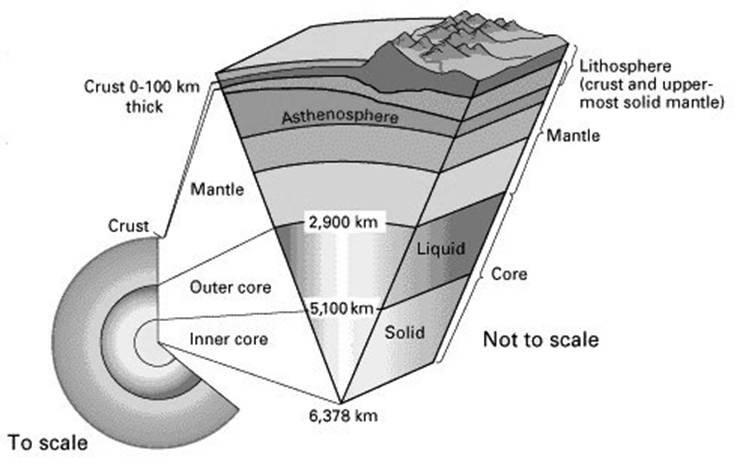
- Earth possesses a global magnetic field generated by convective motion of molten iron and nickel in the outer core, a process known as the geodynamo.
- This magnetic field forms the magnetosphere, a protective shield that deflects high-energy charged particles from the Sun and cosmic radiation.
- Without this shield, solar wind could gradually strip the atmosphere and expose life to harmful radiation.
Magnetic Pole Reversal
What is a Magnetic Reversal?
- A magnetic reversal occurs when the magnetic north and south poles switch positions, causing the polarity of the Earth’s magnetic field to invert.
- These reversals occur irregularly over geological time and are recorded in rocks, sediments and volcanic deposits.
Frequency
- Geological evidence indicates that hundreds of magnetic reversals have occurred during Earth’s history, though they do not follow a fixed periodic cycle.
- The most recent reversal, known as the Brunhes–Matuyama reversal, occurred approximately 780,000 years ago.
Earlier Scientific Understanding
- For decades, geologists believed that most magnetic reversals occurred over relatively short geological periods of about 10,000 years.
- This estimate was derived mainly from high-resolution geological records covering the last 17 million years, which represent only a small portion of Earth’s 4.5-billion-year history.
- Scientists thought this timescale reflected an inherent property of the geodynamo mechanism in the Earth’s core.
New Research Findings
Geological Data Used
- Researchers analysed deep-sea sediment cores from the North Atlantic Ocean, collected during an international ocean drilling expedition.
- The sediments examined formed around 40 million years ago during the Eocene epoch.
Magnetic Recording Mechanism
- As sediments settled on the ocean floor, tiny magnetic minerals aligned with the Earth’s magnetic field.
- When these sediments were buried, the mineral orientation was preserved, creating a permanent geological record of magnetic field direction and intensity.
Analytical Methods
- Scientists used X-ray scanning and magnetic measurements to reconstruct historical magnetic field behaviour.
- Astronomical tuning techniques, linking sediment layers to Earth’s orbital cycles, helped precisely date the magnetic transitions.
Major Discoveries
- The study identified one magnetic reversal lasting about 18,000 years, significantly longer than the conventional 10,000-year estimate.
- Another reversal lasted approximately 70,000 years, representing an exceptionally prolonged transition.
- The longer reversal showed a complex precursor phase and multiple rebound phases, indicating instability in the magnetic field before stabilising.
Role of the Geodynamo
- The Earth’s magnetic field originates from the geodynamo, produced by turbulent convection of liquid iron in the outer core.
- Numerical simulations conducted by the researchers showed that long-duration reversals are a natural but rare outcome of geodynamo dynamics.
- During reversals, the magnetic field temporarily loses much of its strength before re-establishing polarity.
Environmental Implications
Weakened Magnetic Shield
- During prolonged reversals, the weakened magnetic field allows greater penetration of solar and cosmic radiation into the atmosphere.
- This could potentially affect atmospheric chemistry and increase radiation exposure at Earth’s surface.
Influence on Climate and Life
- Prolonged magnetic instability may have influenced ancient environmental conditions and evolutionary processes, although the exact effects remain uncertain.
- Increased radiation levels could potentially affect mutation rates, biological evolution and atmospheric processes.
Importance of Sedimentary Magnetic Records
- Sedimentary rocks preserve paleomagnetic records, allowing scientists to reconstruct the history of Earth’s magnetic field.
- Ocean-floor sediments provide particularly valuable records because they accumulate continuously over millions of years.
- These records help scientists understand long-term changes in Earth’s internal dynamics and planetary magnetic behaviour.
Scientific Significance
- The findings suggest that magnetic reversals are more complex and variable than previously believed, challenging simplified models of the geodynamo.
- Extending the magnetic record further back in geological time can help refine models of Earth’s core dynamics and planetary magnetic evolution.
- Understanding reversal processes also helps scientists assess potential future changes in the Earth’s magnetic field.
Prelims Pointers
- Geodynamo: Process generating Earth’s magnetic field through convection of liquid iron in the outer core.
- Magnetosphere: Region around Earth dominated by its magnetic field that shields the planet from solar wind.
- Magnetic reversal: Event in which Earth’s magnetic north and south poles switch positions.
- Brunhes–Matuyama reversal: Last major geomagnetic reversal (~780,000 years ago).
- Eocene epoch: Geological epoch spanning roughly 56–34 million years ago.