
🐘 Elephant Conservation in India
African vs Asian differences · Project Elephant (1992) · 150 corridors · Census 2025 (22,446 elephants, first DNA-based) · Human-Elephant conflict · MIKE programme · Haathi Mere Saathi — with PYQs and current affairs.
The Synchronous All-India Elephant Estimation (SAIEE) 2021–25 was released in October 2025 — India’s first ever DNA-based elephant census, conducted by WII under MoEFCC. The estimate of 22,446 elephants appears lower than the 2017 count of 29,964. However, WII clarified: the two figures are NOT comparable — different methodologies. The DNA-based method (mark-recapture using dung DNA) is far more accurate and establishes a fresh scientific baseline. Previously, direct visual and dung-count methods tended to overcount. ★
- India — Schedule I, WPA 1972: Highest legal protection — same as tiger ★
- India — National Heritage Animal: Designated in 2010 ★
- IUCN Red List: Endangered (since 1986) ★ — population declined ≥50% over 3 generations (~60–75 years)
- CITES: Appendix I — international trade strictly prohibited ★
- CMS: Appendix I + II — listed at CMS COP13 (2020, Gandhinagar) ★
UPSC repeatedly tests the differences between Asian and African elephants. Know both species AND the two African subspecies.

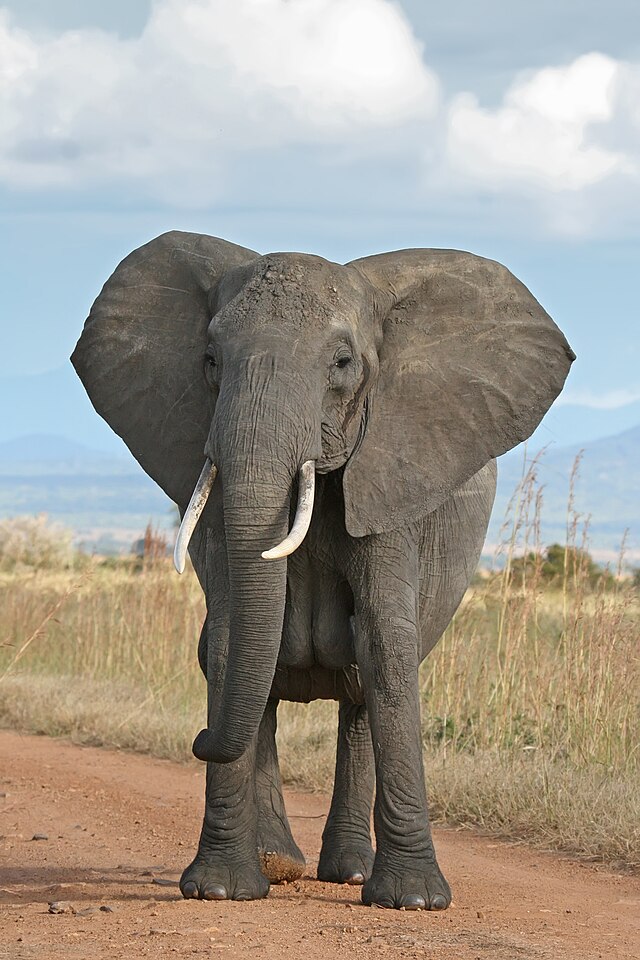
African Forest vs African Savanna Elephant ★
- African Savanna Elephant (Loxodonta africana) — larger, found in open grasslands and savannas of sub-Saharan Africa. IUCN: Endangered ★
- African Forest Elephant (Loxodonta cyclotis) — smaller, rounded ears, straighter downward-pointing tusks, found in rainforests of Central/West Africa. IUCN: Critically Endangered ★
- Previously treated as ONE species — now recognised as TWO genetically distinct species (genetic studies 2010s) ★
- Forest elephant has smaller, rounder ears, darker skin, and its tusks point downward (adapted for moving through dense forest)
- UPSC trap: African Savanna = world’s largest land animal; African Forest = smaller than Savanna but still larger than Asian ★
| Feature | Asian Elephant | African Savanna | African Forest |
|---|---|---|---|
| Scientific Name | Elephas maximus | Loxodonta africana | Loxodonta cyclotis |
| Size | Smaller (up to 3m, 5t) | Largest land animal (4m, 7t) | Medium (between Asian & Savanna) |
| Ears | Small, rounded (India-shaped) ★ | Huge, Africa-shaped ★ | Smaller, rounded |
| Back shape | Convex/arched ★ | Concave/saddle ★ | Concave |
| Trunk fingers | 1 finger ★ | 2 fingers ★ | 2 fingers |
| Tusks | Males only (rarely females) ★ | Both sexes ★ | Both sexes, downward-pointing |
| IUCN Status | Endangered ★ | Endangered ★ | Critically Endangered ★ |
| Genetic Relation | Closer to woolly mammoth ★ | Different genus | Separate species (2010s) ★ |
| India connection | National Heritage Animal; CMS App I+II; Schedule I | Listed at CMS COP13 for overall elephant ★ | — |
Launched in 1992 (19 years after Project Tiger), Project Elephant is India’s centrally sponsored scheme for elephant conservation. Unlike Project Tiger — which was an emergency response to a crisis — Project Elephant was launched proactively, before elephant numbers crashed to alarming levels.
- Launched: 1992 ★ · Under: MoEFCC (Ministry of Environment, Forest and Climate Change)
- Type: Centrally Sponsored Scheme ★ — funds flow Centre → states
- Implemented in: 16+ states with wild elephant populations
- Administered by: Project Elephant Division, MoEFCC (no separate statutory body like NTCA)
- Merged with Project Tiger from FY 2023–24 → now called “Project Tiger & Elephant” ★
- First Elephant Reserve notified: Singhbhum Elephant Reserve, Jharkhand (2001) ★
- Latest (33rd) Elephant Reserve: Terai Elephant Reserve, Uttar Pradesh (2022) ★
- Largest Elephant Reserve: Mysore Elephant Reserve, Karnataka (6,724 km²) ★
- Total Elephant Reserves: 33 notified, across 14 states, covering 80,778 km² ★
- Proposal to create NECA (National Elephant Conservation Authority), like NTCA for tigers — not yet formed ★
- Protect elephants, their habitat and migration corridors
- Address human-elephant conflict (HEC) in elephant range states
- Welfare of captive elephants — veterinary care, management, welfare standards
- Support ecological research — elephant ecology, behaviour, genetics
- Promote awareness among local communities living in elephant habitat
- Monitoring of Illegal Killing of Elephants (MIKE programme)
Synchronous All-India Elephant Estimation (SAIEE) 2021–25 — released October 2025. First ever DNA-based elephant census in India. Previously used: direct (visual) count and indirect (dung density) methods. New method: mark-recapture using DNA from dung samples — each elephant individually identified by its unique DNA. Avoids double-counting and observer bias. WII cautions: 22,446 is NOT comparable to earlier figures — this is a new monitoring baseline. ★
Census 2025 — State-wise Highlights
Census 2025 — 4 Landscape Regions
Tamil Nadu · Karnataka · Kerala
11,934 elephants — more than half of India’s total. Karnataka leads (6,013). Nilgiri Biosphere Reserve is the heart of this population.
Despite highest numbers, tiger occupancy declining in fringe areas — same pressure on elephants too.
Assam · Arunachal · Meghalaya · etc.
~4,988 elephants. Assam leads (4,159). Fragmented habitats and growing human-elephant conflict due to forest clearance in Sonitpur and Golaghat districts. ★
Uttarakhand · UP · Bihar
2,062 elephants. Uttarakhand: 1,792 (highest here). Terai Arc Landscape — transboundary corridors to Nepal are critical for this population. ★
Odisha · Jharkhand · AP · etc.
1,891 elephants. Odisha: 912 (but 54% decline noted). Jharkhand: 68% decline ★. Mining and linear infrastructure are the primary threats in this landscape. ★
Elephants are highly migratory animals with home ranges of hundreds of square kilometres. They follow ancient routes — sometimes millennia-old traditional paths — between feeding, watering, and breeding areas. When these routes are blocked by human settlements, railways, or highways, elephants are forced into conflict with people.
MoEFCC has ground-validated 150 elephant corridors across 15 elephant-range states. These are narrow stretches of forest connecting larger habitats. Some corridors are just a few hundred metres wide — a thread of green connecting two forest patches. ★
Legal protection: Corridors are notified as part of Elephant Reserves. State governments directed to take necessary steps to protect all 150 corridors. Encroachment and construction in corridors is a major ongoing challenge. ★
- Railway lines: Hundreds of elephants killed by train strikes annually. MoEF suggested ramps, underpasses, overpasses, and Intrusion Detection Systems (IDS) ★
- Electrocution: Low-hanging power lines — one of the top causes of elephant deaths in India. Capacity building workshop on electrocution risk held at WII, Dehradun (January 2024) ★
- Lemru Elephant Reserve, Chhattisgarh: Proposed to be reduced from 1,995 km² to 450 km² for coal mining — major conservation controversy ★
- Encroachment: Encroachments on corridors — especially in Kerala, Tamil Nadu, Assam — fragment routes and push elephants into cropland
- Highways & expressways: New highways bisecting traditional elephant corridors in NE India and Western Ghats
Purpose: Long-term survival of viable wild elephant populations. Provides financial and technical support to states. Covers: habitat protection, corridor notification, HEC mitigation, captive elephant welfare, research, and community awareness.
Key 2023–24 update ★: Project Tiger and Project Elephant merged into a single scheme — “Project Tiger & Elephant” — for better administrative efficiency and unified conservation planning.
A nationwide awareness campaign to mobilise public support for elephant conservation and human-elephant coexistence. Gaj = elephant in Sanskrit. Yatra = journey. Launched in 2017 and periodically revived, the campaign sends elephant ambassadors across 12 elephant range states to spread awareness, engage local communities, and collect signatures for elephant protection.
Key message: Elephants are India’s National Heritage Animals — their corridors and habitats belong to all of India, not just range states.
MIKE is a CITES Secretariat-led international programme to monitor elephant poaching trends and the effectiveness of conservation measures. In India, MIKE has been operational since 2003 in 10 elephant reserves. ★
Participating reserves submit systematic carcass data — every elephant carcass found is recorded, and cause of death analysed. This gives real-time poaching data. India’s MIKE data shows significantly lower illegal killing compared to Africa — highlighting the effectiveness of Schedule I protection + community awareness.
“Haathi Mere Saathi” (Elephant is My Friend) is an MoEFCC initiative focused on fostering coexistence between local communities and elephants. Named after the iconic 1971 Hindi film, it emphasises that elephants and humans have shared landscapes for millennia.
Key components: Community-based monitoring, forest department training, compensation mechanisms for crop damage and human deaths, and local awareness through schools and village councils. Dovetails with Gaj Yatra campaign.
Tech tools (2024): Project Suraksha app — uses GIS, satellite mapping, and camera traps to provide real-time elephant location alerts to village communities. ★
- Asian Elephant Alliance (AEA): A coalition of NGOs (including WWF, WTI, CWS, Elephant Family, IUCN) working together for Asian elephant conservation. Focuses on corridor protection, research, and advocacy. Not a government body. ★
- IUCN Asian Elephant Specialist Group (AsESG): A group of IUCN experts that regularly updates the IUCN Red List status of Asian elephants, provides technical guidance on conservation strategies, and coordinates research across all 13 Asian elephant range countries. ★
- World Elephant Day: Observed every 12 August — co-founded in 2012 by Canadian filmmaker Patricia Sims and the Elephant Reintroduction Foundation of Thailand. ★
- Project RE-HAB: KVIC’s Reducing Elephant-Human Attacks Using Bees — bee boxes placed in elephant pathways. When elephants disturb boxes, bees swarm and deter them. Low-cost, non-harmful. First used in Karnataka; extended to Assam. ★
1. Asian elephants have one “finger” at the trunk tip; African elephants have two
2. Female African elephants have tusks while female Asian elephants generally do not
3. Asian elephants have a convex (arched) back while African elephants have a concave (saddle) back
4. The African forest elephant is classified as Critically Endangered while African savanna elephant is Endangered
Statement 1: CORRECT ★ — Asian elephants have 1 trunk finger (prehensile upper lip), African elephants have 2. This is one of the most distinctive anatomical differences. Statement 2: CORRECT ★ — Both male and female African elephants grow tusks; in Asian elephants only males grow tusks (some females have small “tushes”). Statement 3: CORRECT ★ — Asian elephant back is convex/arched (highest point = mid-back); African elephant back is concave/saddle-shaped (highest point = shoulders). This is a direct UPSC PYQ distinguishing feature. Statement 4: CORRECT ★ — African Forest Elephant (Loxodonta cyclotis) = Critically Endangered; African Savanna Elephant (Loxodonta africana) = Endangered. The separation of African elephants into two species based on genetics is itself UPSC-testable.
1. It was launched in 1992, 19 years after Project Tiger
2. It is a Statutory Authority like NTCA — it has independent legal powers
3. The first elephant reserve notified in India was Singhbhum Elephant Reserve in Jharkhand
4. As of 2024, there are 33 notified elephant reserves across 14 states
Statement 1: CORRECT ★ — Project Tiger = 1973; Project Elephant = 1992. Statement 2: WRONG ★ — Project Elephant is a Centrally Sponsored Scheme administered by MoEFCC’s Project Elephant Division. It is NOT a statutory authority like NTCA. There is no “National Elephant Conservation Authority” (NECA) yet — it has been proposed but not enacted. This is a classic UPSC trap: students assume Project Elephant has an NTCA-equivalent statutory body — it does not. Statement 3: CORRECT ★ — Singhbhum Elephant Reserve, Jharkhand was the first notified (2001). Statement 4: CORRECT ★ — 33 notified elephant reserves, 14 states, 80,778 km².
1. MIKE stands for Monitoring the Illegal Killing of Elephants
2. It is administered by the IUCN Secretariat
3. MIKE has been operational in India since 2003, in 10 elephant reserves
4. MIKE collects systematic carcass data to monitor poaching trends
Statement 1: CORRECT ★ — MIKE = Monitoring the Illegal Killing of Elephants. Statement 2: WRONG ★ — MIKE is administered by the CITES Secretariat, NOT IUCN. IUCN and CITES are separate organisations. CITES regulates international wildlife trade; IUCN assesses conservation status. Statement 3: CORRECT ★ — MIKE operational in India from 2003, covering 10 elephant reserves. Statement 4: CORRECT ★ — MIKE’s primary method is systematic recording and analysis of elephant carcasses. Every elephant death is reported and cause of death determined — allowing trend analysis of illegal killing over time and across regions.
1. It estimated India’s wild elephant population at 22,446
2. It used DNA-based mark-recapture methodology for the first time in India
3. Karnataka had the highest elephant population, followed by Assam
4. The figure of 22,446 shows a decline and can be directly compared with the 2017 estimate of 29,964
Statement 1: CORRECT ★ — 22,446 estimated across 4 landscapes. Statement 2: CORRECT ★ — First ever DNA-based census for elephants in India — uses dung samples for individual identification and mark-recapture population estimation. Statement 3: CORRECT ★ — Karnataka: 6,013 (rank 1); Assam: 4,159 (rank 2); Kerala: ~3,100 (rank 3). Statement 4: WRONG ★ — This is the most critical trap in the 2025 census. WII explicitly stated the two figures are NOT comparable — completely different methodologies. The DNA method is more accurate (avoids double-counting). The 22,446 figure should be treated as a new baseline, not as evidence of a decline from 29,964. UPSC will almost certainly test this distinction.
The Indian elephant was designated as India’s National Heritage Animal in 2010 ★. This was done to give the elephant a symbolic status equivalent to the national animal (tiger) and national bird (peacock), but acknowledging the elephant’s unique cultural, religious, and ecological significance. India is the only country that has designated an elephant as a National Heritage Animal. Key facts to remember: National Animal = Tiger (1973), National Bird = Peacock, National Aquatic Animal = Gangetic Dolphin (2009), National Heritage Animal = Elephant (2010) ★. The Indian elephant is also listed under Schedule I of WPA 1972, CITES Appendix I, IUCN Endangered, and CMS Appendix I + II (listed at COP13).
1. The Asian elephant is the only living species of the genus Elephas
2. Asian elephant’s ears are smaller than those of African elephants
3. A subspecies of the Asian elephant is found in Borneo
Which of the statements given above is/are correct?
Statement 1: CORRECT ★ — The genus Elephas contains only one living species: Elephas maximus (Asian elephant). The other genus is Loxodonta (African elephants). There were many extinct Elephas species including Elephas antiquus (Straight-tusked elephant). Statement 2: CORRECT ★ — Asian elephant ears are significantly smaller than African elephant ears. African elephant ears are shaped like the continent of Africa; Asian elephant ears are rounded and shaped like the Indian subcontinent. Statement 3: CORRECT ★ — The Bornean elephant (Elephas maximus borneensis) is a subspecies of Asian elephant found in Borneo. It is the smallest Asian elephant subspecies and is Critically Endangered. Other subspecies: Indian (indicus), Sri Lankan (maximus), Sumatran (sumatranus), and Bornean (borneensis).
1. The African forest elephant is classified as Critically Endangered by IUCN
2. Both male and female African elephants have tusks
3. African forest elephants are larger than African savanna elephants
4. The African savanna elephant is the world’s largest land animal
Statement 1: CORRECT ★ — African Forest Elephant (Loxodonta cyclotis): IUCN Critically Endangered. African Savanna Elephant (Loxodonta africana): IUCN Endangered. Statement 2: CORRECT ★ — Both sexes of African elephants (both savanna and forest) develop tusks — unlike Asian elephants where typically only males have tusks. Statement 3: WRONG ★ — This is the trap. African Forest Elephant is SMALLER than the Savanna Elephant — it is adapted to moving through dense forest. The hierarchy by size: African Savanna (largest) > African Forest (medium) > Asian (smallest). Statement 4: CORRECT ★ — African Savanna Elephant (Loxodonta africana) is the world’s largest land animal — can reach 4m at shoulder height and 7+ tonnes.
Consider — They are referred to as “ecosystem engineers” because they:
1. Push over trees creating forest clearings that allow grasses to grow
2. Disperse seeds in their dung far from parent plants
3. Create waterholes by digging with tusks and feet in dry riverbeds
4. Their dung supports entire micro-ecosystems including dung beetles
All four statements correctly describe elephant roles as “ecosystem engineers” — the term used in UPSC and ecology for species that physically modify their environment in ways that create habitat for other species. Statement 1: CORRECT ★ — Elephants as creators of clearings (savannas maintained by elephants). Statement 2: CORRECT ★ — Elephants as seed dispersers — one of the most important forest regeneration services. Statement 3: CORRECT ★ — Elephants as waterhole creators — critical for other wildlife in dry season. Statement 4: CORRECT ★ — Elephant dung as a complete mini-ecosystem. Dung beetles are keystone organisms within this system — they aerate soil, recycle nutrients, and are prey for birds. All four together make elephants true “ecosystem engineers” — justifying their designation as a keystone + umbrella + flagship species simultaneously.
Mysore Elephant Reserve (Karnataka) is the largest elephant reserve in India by area: 6,724 km² ★. Karnataka also has the largest elephant population in India (6,013 per 2025 census). Key facts on all options: (a) Nilgiri ER — important reserve in Tamil Nadu, part of the Nilgiri Biosphere Reserve; (b) Kaziranga-Karbi Anglong ER — important in Assam, has significant elephant population; (d) Singhbhum ER — Jharkhand — notable as the FIRST elephant reserve notified in India (2001) ★. Standard UPSC “largest” vs “first” trap: First ER = Singhbhum (Jharkhand, 2001) ★; Largest ER = Mysore (Karnataka, 6,724 km²) ★; Latest/33rd ER = Terai ER (Uttar Pradesh, 2022) ★.
1. World Elephant Day is observed on 12 August every year
2. The Indian elephant was declared National Heritage Animal of India in 2010
3. The MIKE programme in India monitors illegal killing of elephants and is administered by CITES
4. Project Elephant was launched in the same year as Project Tiger — 1973
Statement 1: CORRECT ★ — World Elephant Day: 12 August annually. Co-founded 2012 by Patricia Sims (Canadian filmmaker) and Elephant Reintroduction Foundation of Thailand. Statement 2: CORRECT ★ — National Heritage Animal: Indian Elephant, designated 2010. Statement 3: CORRECT ★ — MIKE = Monitoring the Illegal Killing of Elephants; administered by CITES Secretariat (NOT IUCN). India: 10 reserves from 2003. Statement 4: WRONG ★ — Project Tiger launched 1973; Project Elephant launched 1992 — 19 years later. This is a standard UPSC trap designed to test whether you know each programme’s launch year precisely.
The 2017 estimate (29,964) used direct visual counts and dung density methods. These methods have known limitations — observer bias, double-counting of moving herds, and difficulty in dense forests lead to systematic overestimates.
The 2025 SAIEE used DNA-based mark-recapture for the first time. Dung samples are collected across the landscape. DNA extracted from each sample uniquely identifies individual elephants (like a fingerprint). The mark-recapture statistics give a far more precise estimate that avoids double-counting entirely.
WII explicitly stated: “given the methodological changes, it is not comparable to past figures and may be treated as a new monitoring baseline.” In other words, 22,446 ≠ decline from 29,964. It simply means we now have a more accurate number.
Think of it like switching from a visual count of stars in the night sky to using a telescope — the number you see changes because your instrument improved, not because stars disappeared. The 2025 figure will be the baseline against which future trends are measured. ★
Asian Elephants: Only MALES grow tusks (called “tuskers”). Female Asian elephants either have no tusks or have very small “tushes” that barely protrude. This means:
1. Female Asian elephants are generally not targeted for ivory — reducing their poaching risk
2. But male (tusker) Asian elephants are heavily targeted — leading to a severely skewed sex ratio in many populations. Some populations in South India now have 1 male per 100 females — far below natural ratios ★
3. Reduced number of tuskers means less genetic diversity and reproductive competition
4. Some populations show “tusklessness” evolving — where even males don’t develop tusks — as a response to intense selection pressure. This has been observed in Sri Lanka and parts of India.
Additionally, some male Asian elephants are naturally “makhna” (tuskless males) — particularly common in Northeast India’s Makhna population. These makhnas are larger and heavier than tuskers in some populations. ★
How it works:
Bee boxes (containing wild bee colonies) are hung along ropes at the boundaries between forest and farmland. The rope connects multiple boxes. When an elephant herd approaches and touches the rope, it disturbs the bee boxes — causing bees to swarm out aggressively. Elephants have relatively thin skin around their eyes, mouth, and behind the ears — bee stings in these areas cause significant discomfort without lasting harm. Elephants learn quickly and avoid routes with bee boxes.
Why it’s effective:
1. Non-harmful to elephants — no injury, no poisoning
2. Very low cost compared to electric fences or trenches
3. Benefits the local community — the bee colonies produce honey, providing additional livelihood income
4. Sustainable — bees reproduce and maintain themselves
Similar “beehive fences” have been used in Africa (pioneered by Lucy King/Save the Elephants) — India adopted and adapted the concept through KVIC’s RE-HAB programme. ★
Background: Lemru (also spelled Lemuru) is a proposed elephant reserve in the Hasdeo Arand forest of Chhattisgarh — one of central India’s largest intact forest tracts and a critical elephant movement zone. The forest is also one of the most coal-rich areas in India.
The controversy: The Chhattisgarh government proposed reducing the Lemru Elephant Reserve from its originally intended 1,995 km² to just 450 km² — to allow coal mining in the remaining areas. Conservation groups, tribal communities (Adivasis), and wildlife scientists strongly opposed this.
Why it matters:
1. Hasdeo Arand is one of the last intact forests of Central India — home to significant elephant populations that showed an INCREASE of 6% (2025 census) due to migration from neighbouring states
2. It sits over one of India’s largest coal reserves — coal vs conservation conflict at its most acute
3. The Adivasi communities (especially Gond and Baiga) living in and around the forest have Forest Rights Act (FRA) claims that overlap with the mining areas
4. The Supreme Court and National Green Tribunal have been involved in related cases
UPSC connection: Combines environment (elephant corridors, biodiversity), Polity (tribal rights, Forest Rights Act), Economy (coal mining, energy security), and Ethics (development vs conservation). A perfect Mains GS 3 question. ★


