
Content
- World Homoeopathy Day 2026
World Homoeopathy Day 2026
Why in News ?
- World Homoeopathy Day (April 10) commemorates Samuel Hahnemann, highlighting India’s policy push toward AYUSH-based holistic healthcare systems.
- Theme “Homoeopathy for Sustainable Health” aligns with preventive healthcare, low-cost treatment, and SDG-3 (Good Health and Well-being) goals.
Relevance
GS II (Governance & Social Sector)
- Public health system strengthening through integration of AYUSH (homoeopathy) with primary healthcare (PHCs/CHCs).
- Affordable healthcare delivery aligns with Article 21 (Right to Health – judicial interpretation) and welfare state obligations.
- Institutional reforms via National Commission for Homoeopathy Act, 2020 replacing earlier regulatory framework.
- Cooperative federalism in implementation of National AYUSH Mission (NAM) across states.
Practice Question
- “Integration of traditional medicine systems like Homoeopathy into India’s public health framework presents both opportunities and challenges.”Critically examine. (250 words)
Static Background & Core Concepts
Concept of Homoeopathy
- Based on principle “like cures like”, where substances causing symptoms are used in diluted form to treat similar symptoms.
- “Law of minimum dose” emphasises ultra-dilution, stimulating self-healing mechanisms while reducing side effects.
- Treatment is individualised, focusing on physical, mental, and emotional conditions, unlike disease-centric allopathy.
Historical evolution in India
- Introduced in early 19th century (around 1810); gained acceptance after treatment of Maharaja Ranjit Singh (1839).
- Institutional expansion included first hospital (1847, Tanjore) and growth in Bengal through Indian practitioners.
- Post-independence reforms: Central Council of Homoeopathy (1973) and research council (1978) formalised education and regulation.
Institutional framework
Regulatory and research architecture
- National Commission for Homoeopathy regulates education, ethics, curriculum, and practitioner registration.
- Central Council for Research in Homoeopathy conducts clinical research, drug standardisation, and epidemic studies through nationwide units.
- Pharmacopoeia Commission for Indian Medicine & Homoeopathy ensures quality, safety, and standardisation of drugs.
Infrastructure & capacity
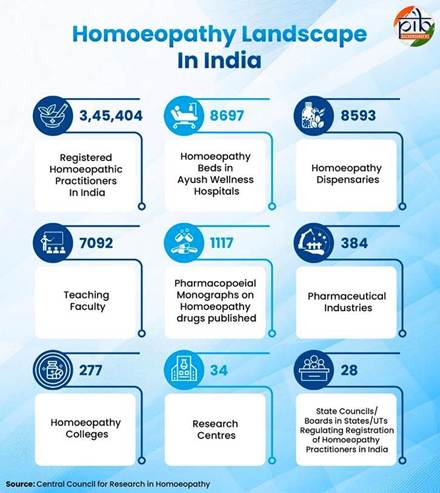
- India has 3.45 lakh registered doctors, 8,593 dispensaries, 277 institutions, and 34 research centres.
- Expansion of educational capacity reflects growing demand and regulatory strengthening in AYUSH sector.
Policy support & government initiatives
Integration into public health
- National AYUSH Mission (NAM) promotes co-location at PHCs and CHCs, improving accessibility and affordability.
- Integration with NPCDCS supports chronic disease management using complementary therapeutic approaches.
Capacity building & research promotion
- AYURSWASTHYA strengthens institutions and research excellence, while AYURGYAN focuses on training and skill enhancement.
- Extra Mural Research Scheme provides up to ₹70 lakh funding, promoting scientific validation in epidemics and chronic diseases.
Drug quality & supply chain
- AOGUSY scheme enhances manufacturing standards, WHO-GMP compliance, and regulatory quality control.
- National Medicinal Plants Board (NMPB) supports 7,000–7,500 medicinal plant species, ensuring sustainable raw material supply.
Public health role & emerging relevance
Preventive & holistic healthcare
- Homoeopathy supports preventive, promotive, and chronic care, offering cost-effective and low-side-effect treatments.
- IEC initiatives promote awareness, behavioural change, and community participation in preventive healthcare.
Epidemic preparedness
- CCRH interventions used in dengue, chikungunya, encephalitis, and COVID-19 as prophylactic and adjunct therapies.
- Example: Arsenicum album (COVID-19) used for ~5 lakh people across 136 centres, indicating large-scale public health application.
Global outreach
- India promotes AYUSH through international cooperation, academic exchange, and research collaboration.
- Strengthens India’s role as global hub for traditional medicine systems.
Challenges & issues
- Scientific validation gap due to lack of large-scale, high-quality clinical trials meeting global biomedical standards.
- Standardisation challenges in drug preparation, dosage, and practitioner-dependent treatment variability.
- Integration gaps with modern medicine due to weak referral systems and coordination issues.
- Global scepticism limits international acceptance and export potential of homoeopathic systems.
- Weak monitoring mechanisms hinder evidence-based policymaking and outcome evaluation.
Way forward
- Promote large-scale clinical trials and interdisciplinary research to strengthen scientific credibility.
- Ensure global-standard regulation and quality assurance in drug manufacturing and safety protocols.
- Develop integrative healthcare models combining AYUSH and allopathy, especially for chronic diseases and primary care.
- Use digital health tools and data analytics for monitoring outcomes and improving policy decisions.
- Expand global collaboration and knowledge exchange, positioning India as leader in traditional medicine systems.
Prelims pointers
- Founder: Samuel Hahnemann; key text: Organon of Medicine.
- National Commission for Homoeopathy Act, 2020 replaced earlier regulatory body.
- CCRH operates through 30+ institutes, focusing on research and epidemic response.
- PCIM&H acts as central drug testing and standardisation body for AYUSH medicines.
- National AYUSH Mission integrates traditional systems into public healthcare infrastructure.


