
Core Facts — What the Supreme Court / Union Government Have Stated ?
- The statement “No new mining leases in Aravalli” is not absolute.
- The restriction currently applies only to general minerals — and only until a Management Plan for Sustainable Mining (MPSM) is finalised.
- Exemption exists for:
- Critical minerals
- Strategic minerals
- Atomic minerals (First Schedule, MMDR Act, 1957)
- Existing mines may continue, and renewals may be allowed under strict regulation.
Bottom line: This is not a permanent ban; it is a temporary pause for general minerals while guidelines are prepared — with exceptions for strategic resources.
Relevance
- GS-III | Environment & Ecology
- Ecologically fragile landscapes, biodiversity corridors
- Desertification barrier, groundwater recharge role
- GS-III | Economy & Mineral Resources
- Critical minerals → energy transition & strategic security
Why Exemptions Exist — Strategic & Economic Rationale ?
- Committee report (Uniform Definition of Aravalli Hills & Ranges) notes:
- Aravallis host deep-seated, site-specific critical minerals.
- India remains import-dependent for many of these resources.
- Minerals flagged as strategically important include:
- Lead, zinc, copper, silver
- Tin, graphite, molybdenum, nickel
- Niobium, lithium, rare earth elements (REEs)
- These are essential for:
- Energy transition technologies
- High-technology manufacturing
- Defence & national security
- Economic growth & supply-chain resilience
Policy logic: Strategic minerals are treated as national-interest resources, hence exempt from blanket restrictions.
Temporary Ban + Future Mining under Guidelines
- The MoEFCC letter (Dec 24, 2025) directs States (Haryana, Rajasthan, Gujarat):
- No new mining leases until MPSM for the entire Aravalli landscape is finalised.
- MPSM preparation agency:
- Indian Council of Forestry Research & Education (ICFRE)
- Final approval by MoEFCC
- MPSM will:
- Map ecologically sensitive, conservation-critical, and restoration-priority zones
- Identify areas where mining could be allowed under strict, science-based conditions
- Approach modeled on Saranda–Chaibasa (Jharkhand) sustainable mining precedent:
- Geo-referenced ecological assessment
- Zones marked as:
- No-mining / conservation priority
- Conditional mining
- Permissible mining
Implication: Mining is expected to resume selectively, not disappear.
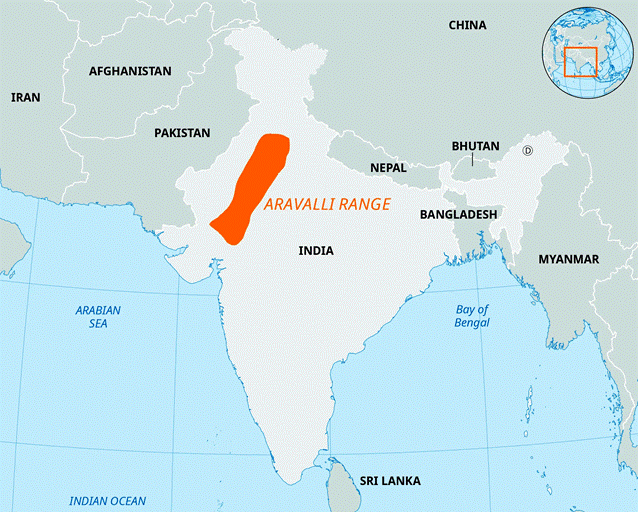
Ecological Significance of Aravallis
- Among the oldest mountain ranges on Earth
- Key environmental functions:
- Barrier against Thar desertification
- Groundwater recharge & aquifer protection
- Biodiversity corridors (Aravali-Delhi Ridge landscape)
- Urban climate-buffering for NCR & Rajasthan
- Landscape already impacted by:
- Illegal quarrying
- Habitat fragmentation
- Dust pollution & slope destabilisation
Trade-off: Critical mineral extraction vs ecological integrity & climate resilience.
Governance Reality — Gaps & Risks
- Public messaging vs policy nuance mismatch
Claim of “no new leases” can mask exemptions → risk of misinterpretation. - Future permissions likely after MPSM, especially for strategic minerals.
- Monitoring challenges:
- Enforcement inconsistencies across States
- Potential for misclassification of leases as ‘strategic’
- Community & environmental concerns:
- Risk of incremental ecological creep
- Possible conflicts in restoration-priority zones
Policy Implications — What Needs Safeguarding ?
- Transparent mineral zoning maps (public domain)
- Clear distinction between:
- General vs critical vs atomic mineral leases
- Independent ecological audits & social impact review
- Cumulative-impact assessments, not mine-wise approvals
- Strict no-go protection for:
- Wildlife corridors
- High-biodiversity & recharge zones
- Restoration-linked mining permissions (progressive reclamation norms)


