Why is this in News?
- Satellite-based studies (ISRO, 2023–25) reveal actual methane emissions from major Indian landfills far exceed official model-based estimates.
- NGT has constituted committees to verify satellite-detected methane hotspots (e.g., Ghazipur, Bhalswa, Pirana, Kanjurmarg).
- Highlights a critical data gap in India’s waste-sector emissions, directly affecting:
- Climate commitments (NDCs)
- Urban safety (landfill fires)
- Public health and air quality
- Renewed policy relevance under Swachh Bharat Mission, GOBARdhan, and revised Municipal Solid Waste (MSW) Rules.
Relevance
GS III – Environment & Climate Change
- Methane as a short-lived climate pollutant (SLCP)
- Waste management and landfill emissions
- India’s NDCs and climate mitigation strategies
GS III – Urban Development
- Solid waste management, landfill fires, urban safety
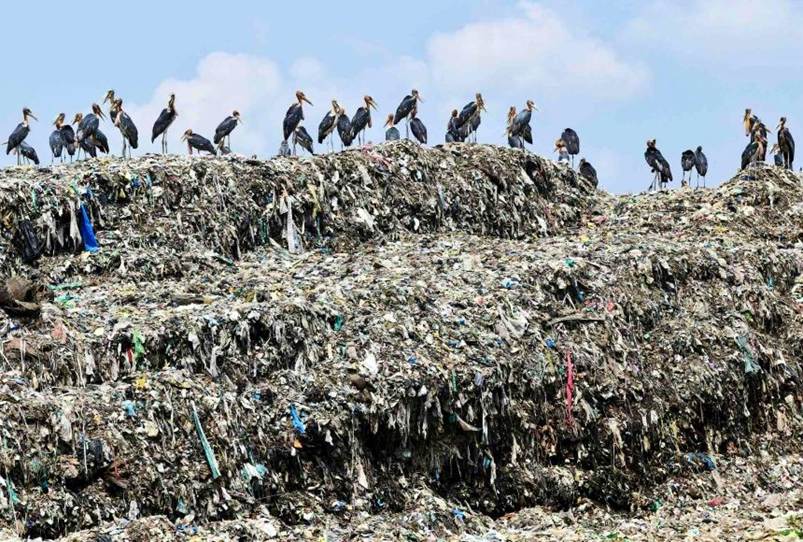
Methane: The Basics
- What is Methane (CH₄)?
- A short-lived climate pollutant (SLCP).
- 84 times more potent than CO₂ over a 20-year period (GWP-20).
- Atmospheric lifetime: ~12 years.
- Why dangerous in landfills?
- Generated via anaerobic decomposition of organic waste.
- Accumulates in open dumps → fires, explosions, toxic smoke.
- Paradox:
- Useful fuel (Bio-CNG, PNG, power generation).
- Severe climate and urban hazard if unmanaged.
Landfills as Methane Factories
- Processes mimic natural gas formation, but at accelerated rates:
- High organic content (wet waste).
- Poor segregation.
- Inadequate capping and gas capture.
- India-specific context:
- Large open dumpsites, not sanitary landfills.
- High moisture + heat = faster methane generation.
India’s Methane Profile (Waste Sector Focus)
- ~15% of India’s methane emissions come from the waste sector.
- Key advantage:
- Unlike agriculture or energy, waste offers quick mitigation wins.
- Technology, policy, and incentives already exist.
The Core Problem: Measuring an Invisible Gas
Model-based Estimation (Traditional)
- Uses:
- Waste inflow volumes.
- Standard decay coefficients.
- Limitations:
- Outdated data (State-level, often 2018).
- Aggregated → cannot locate specific hotspots.
- Heavily assumption-driven.
Ground-based Monitoring
- Challenges:
- Expensive sensors.
- Skilled manpower.
- Continuous maintenance.
- Difficult to scale across India’s urban landscape.
Satellite Monitoring: The Game Changer
Types of Satellite Data
- Regional-scale monitoring
- Covers km-level grids.
- Tracks national/regional trends.
- High-resolution hotspot detection
- Detects emissions at few square metres.
- Crucial for targeted action.
Key Missions & Platforms
- ISRO methane study (2023).
- International missions:
- CarbonMapper (Tanager).
- SRON (Netherlands).
- Data aggregators:
- ClimateTRACE
- WasteMap
What Satellites Are Revealing: The Discrepancy ?
- Global finding: Actual landfill methane ≈ 1.8× higher than model estimates.
Indian City Examples
- Delhi
- Official (2018): 1.07 Mt CO₂e (entire waste sector).
- Satellite: Ghazipur + Bhalswa alone → 0.85–0.96 Mt CO₂e.
- Mumbai
- Model: Kanjurmarg ≈ 11% of city waste emissions.
- Satellite: 1.05 Mt CO₂e (~10× higher; ~50% of Maharashtra’s waste emissions).
- Ahmedabad
- Gujarat total (model): 0.73 Mt CO₂e.
- Pirana landfill alone: 0.60–0.81 Mt CO₂e.
Inference
- Indicates:
- Gas capture failures.
- Accelerated decomposition.
- Engineering flaws.
- Risks were invisible earlier due to data blindness.
Why This Matters Beyond Climate ?
- Urban safety: Methane-driven landfill fires.
- Public health: Toxic emissions, PM spikes.
- Governance: Weak accountability of ULBs.
- Economy: Lost opportunity for Bio-CNG and power.
The Way Forward: A Three-Pillar Strategy
Expand Satellite Coverage
- Mandatory monitoring of all major dumpsites.
- Public, transparent emission dashboards.
Ground Validation Systems
- Rapid-response teams for satellite-flagged hotspots.
- Diagnose:
- Poor capping.
- Gas collection leaks.
- Illegal dumping.
Integrated Data Architecture
- Standardised data-sharing between:
- ULBs.
- SPCBs.
- NGT, CAQM (for NCR).
- Expand proposed centralised waste data portal under MSW Rules to include methane tracking.
Institutional & Policy Linkages
- Swachh Bharat Mission: Integrate methane reduction targets.
- GOBARdhan Scheme: Scale Bio-CNG plants (Indore model).
- CAQM (NCR): Regional oversight for landfill emissions.
- State Action Plans on Climate Change (SAPCCs): Update with satellite-based waste data.
Key Observation
- Methane mitigation from waste is India’s lowest-hanging climate fruit:
- High impact.
- Low cost.
- Immediate gains.
- Core governance lesson:
- “What gets measured gets managed.”
- Data integration can convert urban waste from a liability into a climate asset.
Conclusion
By synchronising satellites, street-level action, and standardised data governance, India can turn landfill methane—from a fire hazard and climate threat—into its smartest, fastest climate solution.