
Content
- Centre’s tobacco tax rejig to take effect from Feb. 1
- Ancient Marathi literature reveals savannas are not degraded forests
- Why does India need climate- resilient agriculture?
- Ikkis: The story of 2nd Lt Arun Khetarpal & the Battle of Basantar
- Amazonian stingless bees first insects to get legal rights in the world
Centre’s tobacco tax rejig to take effect from Feb. 1
Why in News ?
- The Union Finance Ministry has issued notifications to implement a new taxation regime on tobacco products from 1 February 2026 under the Central Excise (Amendment) Act, 2025.
- Key elements include:
- Revival and revision of excise duty on cigarettes (earlier reduced to a nominal level under GST).
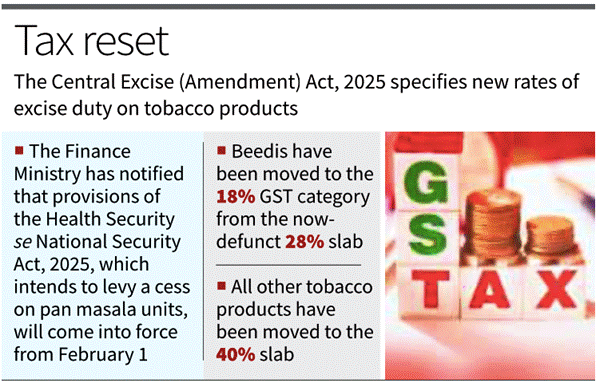
- Enforcement of a cess on pan masala units under the Health Security and National Security Act, 2025.
- End of the GST Compensation Cess from 1 February.
- Revision of GST rates on tobacco products — beedis shifted to 18% (from the earlier 28% slab); other tobacco products moved to a 40% slab.
- The Ministry flagged that cigarette affordability has not declined in the past decade, contrary to global public-health guidance recommending annual real price increases through higher specific excise duties.
Relevance
- GS-3 (Economy)
- Taxation, GST architecture, cess vs tax, fiscal federalism, sin-tax economics, price elasticity.
- GS-2 (Health & Governance)
- Public health policy, NCDs, regulation of harmful products, Centre–State coordination.
Conceptual Foundations
- Indirect Taxes on Tobacco (Pre-GST vs Post-GST)
- Pre-GST: Central excise + State VAT + surcharges.
- Post-GST (2017): GST (12/18/28% slabs), plus GST Compensation Cess; central excise continued only on cigarettes (but reduced to a nominal level).
- Types of Tobacco Taxes
- Specific excise → fixed per unit (effective for health policy; raises price uniformly).
- Ad valorem tax → % of price (can be evaded via down-trading to cheaper brands).
- GST Compensation Cess (2017–2022, later extended)
- Purpose: compensate States for revenue losses due to GST implementation.
- Funded partly by cess on sin/luxury goods (incl. tobacco).
- Economic Rationale for “Sin Taxes”
- Correct negative externalities (health costs, productivity loss).
- Recommended by WHO-FCTC: regular increases in real prices; prefer specific excise.
- Price Elasticity of Demand for Tobacco
- Low but not zero; higher among youth & low-income users → taxation is an effective control tool.
What Has Changed — Policy Moves from 1 Feb 2025
- Excise Duty on Cigarettes Raised/Restored from nominal levels to a meaningful specific levy.
- Cess on Pan Masala Units brought into force under the 2025 Act.
- GST Compensation Cess Ends from 1 February.
- Re-structuring of GST Rates on Tobacco
- Beedis: moved to 18% category (from the now-defunct 28% slab).
- Other tobacco products: shifted to 40% slab.
- Policy Logic Cited by Government
- Cigarettes have become more affordable relative to income growth.
- Aim is to align with global public-health benchmarks mandating periodic excise hikes.
Implications — Economy, Health, Governance
- Public Health
- Likely reduction in initiation and consumption over time, especially among youth.
- Supports NCD control, lowers long-term healthcare burden.
- Revenue & Fiscal Federalism
- Higher excise may boost Union revenues; cessation of compensation cess changes Centre–State fiscal dynamics.
- States may seek alternative revenue sources post-cess.
- Equity & Behavioural Effects
- Taxes are regressive in incidence but progressive in health gains (larger benefits for poorer households).
- Industry & Supply Chain
- Possible down-trading to cheaper/illicit products; need strong track-and-trace enforcement.
- Beedi sector largely informal → compliance and monitoring challenges.
- Trade & Compliance
- Risk of illicit cross-border trade → requires customs vigilance and FCTC-aligned controls.
Analytical Perspectives
- Does tobacco taxation balance revenue and health objectives?
- Compare specific vs ad valorem models; global lessons (WHO-FCTC, Thailand, Philippines).
- Post-GST cess withdrawal and States’ revenue space
- Options: buoyancy via GST expansion vs targeted sin-tax rationalisation.
- Beedi sector paradox
- High consumption, low taxation, informal labour → policy trade-offs (health vs livelihoods).
Prelims-Ready Pointers
- Excise duty on cigarettes continues outside GST (Union power).
- Compensation Cess → designed to offset States’ GST revenue losses; ends from 1 Feb 2025.
- From 1 Feb 2025:
- Beedis → 18% GST category.
- Other tobacco products → 40% GST slab.
- Specific excise is considered more effective for tobacco control than ad valorem taxes.
Way Forward
- Periodic, inflation-indexed specific excise increases.
- Track-and-trace systems to curb illicit trade.
- Differential taxation aligned to harm continuum (discourage smoked forms strongly).
- Health-earmarked revenues for NCD prevention and cessation programmes.
- Support measures for workers/farmers in tobacco & beedi value chains during transition.
Ancient Marathi literature reveals savannas are not degraded forests
Why in News ?
- A new study published in People and Nature (British Ecological Society) shows that the savannas of western Maharashtra are ancient ecosystems, not degraded forests.
- Using medieval Marathi literature, oral traditions, archival records, and ecological evidence, researchers trace open tree–grass landscapes back at least 750 years, predating colonial timber extraction.
- The study challenges the prevailing narrative that savannas are the result of deforestation or anthropogenic degradation, and calls for distinct conservation policies that value both biodiversity and local culture.
Relevance
- GS-1 (Geography / Indian Society)
- Physical geography of biomes, human–environment interactions, cultural landscapes.
- GS-3 (Environment & Ecology)
- Ecosystem classification, biodiversity conservation, grasslands vs forests, policy impacts.
Basics — Concepts & Foundations
- What are Savannas?
- Mixed tree–grass ecosystems with open canopies, seasonal drought, and fire–grazing interactions.
- Characterised by thorny trees, drought-adapted shrubs, perennial grasses, and browsing-resilient species.
- Savannas vs Forests (Conceptual Difference)
- Savannas → Fire- and grazing-maintained, open, low tree density, grass-dominated.
- Closed Forests → Dense canopy, shade-tolerant species, fire-sensitive ecology.
- Indian Ecological Terminology (Historical)
- vana / jāgala → wild, open, drier landscapes (scrub, savanna, grasslands).
- anūpa → wetter marshes and closed forests.
- Modern misinterpretation equates vana with “dense forest”, leading to policy misclassification.
- Two Savanna Types in Maharashtra
- Fine-leaf savannas → drier belts (≤1000 mm rainfall).
- Broadleaf savannas → wetter belts (≥700 mm rainfall).
- Both co-occur across the 700–1000 mm rainfall zone.
Evidence Base — What the Study Found ?
- Textual & Oral Records (13th–20th centuries)
- Sources: ovis, narrative poems, hagiographies, myths across Pune, Satara, Solapur, Sangli, Nashik.
- Recurrent descriptions of:
- thorny trees, grasslands, seasonal drought
- pastoral livelihoods & grazing landscapes
- Sacred landscapes (e.g., Shinganapur / Kothalāgirī) embed tree species as cultural symbols.
- Flora Identified (62 species)
- 27 savanna indicators; 14 forest species → strong signal of historic open-canopy ecologies.
- Key species: Vachellia leucophloea, Senegalia catechu, Capparis divaricata, Butea monosperma, and grasses like Sehima nervosum.
- Functional Traits Indicating Savanna Ecology
- thick bark, spines, clonal resprouting, fire & grazing tolerance.
- Triangulated with 11 Independent Evidence Lines
- Archival photos & paintings → sparsely wooded uplands.
- Colonial revenue records → pasture commons, hay meadows.
- Hunting logs & bird lists → savanna-specialist fauna.
- Hero stones → pastoral conflict & cattle raids.
- Archaeological evidence → blackbuck motifs, grazer remains in Chalcolithic contexts.
Conclusion: Savannas are ancient and persistent ecosystems, not outcomes of recent deforestation.
Why This Matters ?
- Ecological Misclassification Problem
- Policies often treat savannas as “wastelands” or degraded forests → leads to:
- inappropriate afforestation/plantation drives,
- biodiversity loss (grassland fauna decline),
- disruption of pastoral livelihoods.
- Policies often treat savannas as “wastelands” or degraded forests → leads to:
- Cultural-Ecological Linkages
- Savannas host sacred groves, pastoral traditions, ritual landscapes.
- Conservation must integrate local knowledge + biodiversity objectives.
- Conservation Reorientation Needed
- Manage as distinct ecosystems (fire-grazing dynamics, native grasses),
- Avoid blanket tree-plantation policies in open landscapes.
Why does India need climate- resilient agriculture?
Why in News ?
- Climate shocks, soil degradation, water stress, and rising input volatility are weakening India’s agricultural productivity and farmer incomes.
- A policy commentary highlights the need for Climate-Resilient Agriculture (CRA) — integrating biotechnology, bio-inputs, genome-edited seeds, precision & digital tools, and climate advisories — to safeguard food security while reducing ecological stress.
- Despite initiatives such as NICRA (ICAR, 2011) and the National Mission for Sustainable Agriculture (NMSA), adoption gaps, poor bio-input quality, digital divides, and fragmented policy coordination constrain progress.
Relevance
- GS-1 (Geography / Society) → climate variability, livelihoods, rainfed agriculture.
- GS-3 (Economy & Environment) → food security, agricultural productivity, biotechnology, sustainable agriculture, climate change adaptation, bio-inputs, resource efficiency.
Concepts & Foundations
- Climate-Resilient Agriculture (CRA): Core Idea
- Adapt farming systems to climate variability, extreme weather, and resource stress while maintaining productivity and environmental sustainability.
- Key Components
- Biotechnology tools — climate-tolerant & genome-edited crops (heat, drought, salinity, pest tolerance).
- Bio-inputs — biofertilizers, biopesticides, soil-microbiome approaches (reduced chemical dependence).
- Digital & AI tools — precision irrigation, crop-health monitoring, yield prediction, climate advisories.
- Climate-smart practices — zero tillage, residue management, SRI, aerobic/direct-seeded rice, diversified systems.
- Conceptual Distinction (Static)
- CRA ≠ only mitigation → mainly adaptation + risk-proofing agriculture.
- Linked syllabus themes: sustainability, food security, resource efficiency, technology & innovation.
Why India Needs Climate-Resilient Agriculture ?
- High exposure to climate risk
- ~51% of net sown area is rainfed; produces ~40% of food → highly vulnerable to rainfall variability and drought.
- Rising frequency of climate extremes
- Heatwaves, erratic monsoons, floods, pest outbreaks → yield instability and income shocks.
- Degrading natural resources
- Soil nutrient depletion, groundwater stress, stubble burning, chemical-input dependency.
- Food security & demographic pressure
- Large and growing population → need stable, climate-proof productivity.
- Environmental health & sustainability
- CRA reduces chemical load, emissions, and ecosystem damage while preserving productivity.
Where India Stands — Policies, Institutions, Initiatives
- NICRA (ICAR, 2011)
- 448 climate-resilient villages; demonstrated SRI, zero-till wheat, residue incorporation, climate-tolerant varieties, aerobic/direct-seeded rice.
- National Mission for Sustainable Agriculture (NMSA)
- Focus: rainfed areas, integrated farming, soil health, water-use efficiency, resource conservation.
- BioE3 Policy (recent)
- Positions CRA as a biotechnology-led adaptation pathway; promotes genome-edited crops and bio-inputs.
- Market & technology ecosystem
- Growing bio-input industry; expanding agritech & AI advisory platforms, precision irrigation, crop-monitoring tools.
Key Challenges in Scaling CRA
- Low adoption among small & marginal farmers
- Constraints: awareness, affordability, access to technologies & advisory services.
- Quality risks in bio-inputs
- Inconsistent standards for biofertilizers/biopesticides → distrust, poor outcomes.
- Slow rollout of climate-resilient / gene-edited seeds
- Uneven State-level distribution; regulatory caution slows diffusion.
- Digital divide
- Limited access to devices, connectivity, data literacy → weak penetration of AI/precision tools.
- Resource stress outpacing adaptation
- Soil degradation, water scarcity, rising climate volatility.
- Fragmented policy & institutional coordination
- Overlaps across agriculture, biotechnology, environment, and rural development → implementation friction.
Why CRA is Strategic for India ?
- Risk-buffering for farmers → stabilises yields & incomes under climate uncertainty.
- Productivity with sustainability → reduces chemical dependence while improving soil & ecosystem health.
- Tech-led structural transformation → strengthens innovation, agri-value chains, and agri-startup ecosystems.
- Supports national priorities → food security, SDGs, NDC adaptation goals, water & soil conservation.
Way Forward — Policy & Implementation Priorities
- Accelerate climate-tolerant & genome-edited crop deployment with strong regulatory clarity.
- Strengthen standards & certification for biofertilizers and biopesticides; build reliable supply chains.
- Last-mile digital inclusion → climate advisories, AI decision tools, precision farming access for smallholders.
- Financial enablers → climate insurance, concessional credit, transition incentives, outcome-based support.
- Integrated national CRA roadmap (BioE3-aligned) → unify biotechnology, climate adaptation, and agriculture policy for scale & coherence.
- Localised extension & capacity-building → community participation, farmer-producer organisations, region-specific packages.
Prelims-Ready Pointers
- ~51% rainfed area → ~40% food output → high climate vulnerability.
- CRA tools: bio-inputs, genome-edited seeds, soil-microbiome insights, AI-based advisories, precision irrigation.
- Flagship initiatives: NICRA (ICAR), NMSA, BioE3-aligned biotechnology push.
- Key barriers: quality of bio-inputs, digital divide, slow seed rollout, fragmented coordination.
Ikkis: The story of 2nd Lt Arun Khetrapal & the Battle of Basantar
Why in News ?
- A recent feature revisits the Battle of Basantar (Indo-Pakistan War, 1971) through the story of Second Lieutenant Arun Khetrapal, the youngest recipient of the Param Vir Chakra.
- The narrative is linked to the film Ikkis, which portrays his courage during one of the most decisive tank battles on the western front of the 1971 war.
Relevance
- GS-1 (History — Post-Independence India)
- Major wars, national security events, military leadership and heroism.
- GS-3 (Internal Security / Defence)
- Border security, armoured warfare, strategic geography (Shakargarh Bulge, riverine barriers).
Context & Background
- Indo-Pakistan War of 1971: Two Fronts
- Eastern Theatre → Liberation of Bangladesh (offensive operations).
- Western Theatre → Objective was to contain Pakistan and prevent escalation; included key defensive–offensive battles such as Basantar.
- Location
- Shakargarh Bulge (between the Ravi & Chenab rivers, near Jammu–Pathankot axis).
- A strategic wedge—if Pakistan broke through, it could threaten Punjab, Pathankot, and access to Kashmir.
- Battle of Basantar (Dec 1971) — Core Idea
- Indian aim: secure a bridgehead across the Basantar river, block Pakistani armoured thrusts, and hold territory under heavy counter-attacks.

Operational Overview — What Happened ?
- Indian Advance
- Indian armoured & infantry units crossed the heavily mined Basantar river, creating a bridgehead under intense fire.
- Pakistani Counter-attacks
- Multiple Patton tank assaults to dislodge Indian forces.
- Role of 2nd Lt Arun Khetrapal (Poona Horse Regiment)
- Refused to abandon his burning tank, fought on, and destroyed several enemy tanks.
- Continued firing despite being ordered to withdraw; died in action after disabling another advancing tank.
- His actions were pivotal in breaking the Pakistani assault and holding the bridgehead.
Decorated Soldier — Key Facts for Prelims
- 2nd Lt Arun Khetrapal
- Param Vir Chakra (Posthumous) — youngest recipient.
- National Defence Academy parade ground and gates at IMA, Dehradun & NDA, Khadakwasla named in his honour.
Strategic Significance of the Battle
- Military Significance
- Prevented Pakistan from penetrating the western sector.
- Secured the Pathankot–Jammu axis, protecting vital logistics corridors.
- Psychological & Doctrinal Impact
- Demonstrated armoured warfare capabilities and combined-arms coordination.
- Reinforced the role of defensive-offensive operations on active borders.
- War Outcome Context
- Contributed to favourable ceasefire terms on the western front.
Overview
- Shakargarh Bulge as a Vulnerability
- Natural salient projecting into India → high-value defensive priority.
- Armour vs Armour Battles in South Asia
- Basantar illustrates terrain–engineering–minefield integration as decisive in tank warfare.
- Role of Individual Leadership in War Outcomes
- Tactical courage at the platoon level can shape operational success.
Prelims-Ready Pointers
- Battle of Basantar → Western Front, Dec 1971, Shakargarh Bulge.
- Regiment involved → Poona Horse (armoured regiment).
- Award → Param Vir Chakra (youngest awardee).
- Objective → Hold bridgehead across Basantar; repel Pakistani tank counter-attacks.
Way Forward
- Preserve battlefields & regimental histories as military-heritage resources.
- Integrate lessons on combined arms, logistics protection, and armoured tactics in professional military education.
- Use biographies and films to strengthen public awareness of national security history.
Amazonian stingless bees first insects to get legal rights in the world
Why in News ?
- A municipal ordinance in Satipo, Peru (Amazon region) has granted legal rights to native Amazonian stingless bees — the first case in the world where insects have been recognised as rights-bearing entities.
- The Declaration of Rights for Native Stingless Bees grants them the right to exist, thrive, restore habitats, live in pollution-free environments, and be legally represented in cases of harm.
- The initiative was led by Amazon Research Internacional (Rosa Vásquez Espinoza) in collaboration with the Earth Law Center, aligning Indigenous ecological knowledge and Rights-of-Nature jurisprudence.
Relevance
- GS-3 (Environment & Ecology)
- Biodiversity conservation, pollinators, ecosystem services, invasive species, climate impacts.
- Environmental governance, Rights of Nature, community-based conservation.
Concepts & Foundations
- Rights of Nature — Core Idea
- A legal-philosophical approach where ecosystems or species possess inherent legal rights, independent of human use-value.
- Earlier examples:
- Whanganui River (New Zealand, 2017) — granted legal personhood.
- Ganga & Yamuna (India, 2017—judicial recognition, later limited in scope).
- Amazon & Andes jurisdictions — constitutional or municipal nature-rights frameworks (Ecuador, Bolivia).
- What Makes This Case Distinct
- First time a specific insect group has been recognised as a legal rights holder rather than merely a protected species.
- Who Are Stingless Bees? (Ecology Basics)
- Ancient lineage of bees; non-stinging, cavity-nesting, highly social species.
- Keystone rainforest pollinators — pollinate >80% of Amazon flora and crops like coffee, cocoa, avocado, blueberries.
- Culturally important to Indigenous Amazonian communities (medicine, livelihoods, rituals).
What the Ordinance Recognises
- Right to exist and thrive
- Right to maintain healthy populations
- Right to a pollution-free habitat
- Right to ecologically stable climatic conditions
- Right to regenerate natural cycles
- Right to legal representation in cases of threat or harm
Implication: Harm to bees or their habitats can be pursued as a legal injury.
Why Protection Was Needed ?— Risk Drivers
- Climate change → heat stress, rainfall disruption
- Deforestation & habitat loss
- Pesticide exposure
- Competition from introduced European honeybees
- Erosion of Indigenous knowledge systems
Significance — Governance, Law, Environment
- Shift from conservation-as-resource to conservation-as-rights
- Recognises species as moral and legal stakeholders.
- Integration of Indigenous knowledge & modern science
- Supports biocultural heritage preservation.
- Precedent-setting value
- Could influence municipal and national biodiversity laws globally.
- Operational Challenges
- Defining guardianship & representation mechanisms.
- Balancing economic uses (apiculture, agriculture) with species-rights claims.
- Monitoring compliance in remote rainforest landscapes.
Prelims-Ready Pointers
- First insects to receive legal rights → Amazonian stingless bees (Peru, Satipo ordinance).
- Key rationale → ecological keystone role + Indigenous cultural significance.
- Rights granted include existence, healthy populations, habitat protection, climate stability, regeneration, legal representation.
- Led by Rosa Vásquez Espinoza (Amazon Research Internacional) with Earth Law Center.
- Pollinate >80% of Amazonian flora and several global crops.
Way Forward
- Strengthen pollinator protection frameworks (wild bees beyond honeybees).
- Integrate community stewardship and traditional knowledge into conservation.
- Promote pesticide regulation, habitat corridors, diversified agro-ecosystems.
- Explore rights-based or trustee-based models for critical ecosystems/species where appropriate.


